
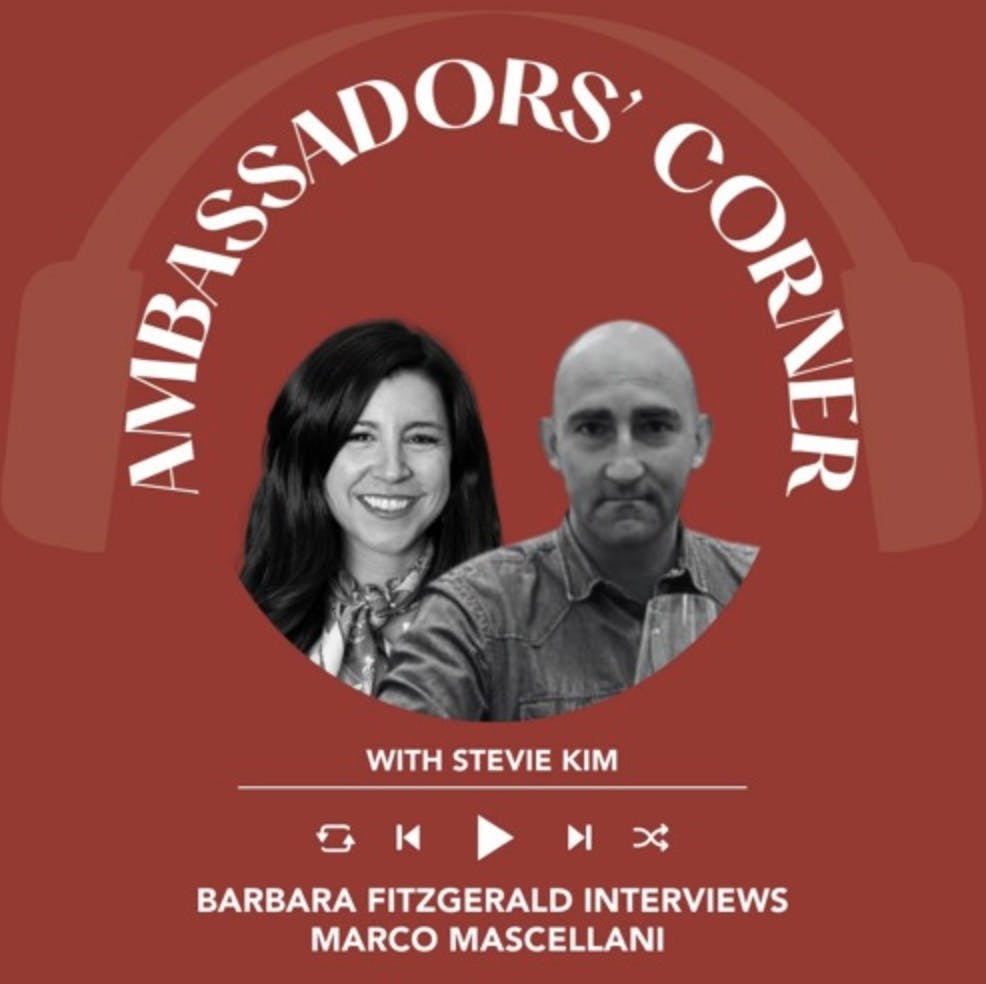
Ep. 1691 Barbara Fitzgerald Interviews Marco Mascellani | Clubhouse Ambassadors’ Corner
Clubhouse Ambassadors’ Corner
Episode Summary
Content Analysis Key Themes and Main Ideas 1. The Diversity and Uniqueness of Puglian Wines: A deep dive into the distinct indigenous grapes (Negramaro, Primitivo, Susumaniello, Verdeca, Minutolo, Nero di Troia) and varied styles produced across Puglia's sub-regions. 2. Marco Massarani's Journey and Role as a Consulting Winemaker: His unconventional path into wine, his mentorship, and the significance and benefits of the consulting winemaker position in Italy. 3. Puglia's Sub-Regions and Terroir: Exploration of how different geographical areas within Puglia (Salento, Valle d'Itria, Gioia del Colle, Alta Murgia, Dalmia) contribute to distinct wine characteristics through varied climate, soil, and elevation. 4. Evolution of Winemaking in Italy (and Puglia): Discussion on the shift towards sustainability, lower alcohol, and more elegant, drinkable wines to meet changing consumer preferences and market trends. 5. Puglia as a Growing Tourism and Wine Destination: Highlighting its appeal beyond wine, including food, sea, and culture, and the challenges of maintaining its charm while growing in popularity. Summary This episode of the Italian Wine Podcast features an interview with Marco Massarani, a renowned consulting winemaker, conducted by Italian Wine Ambassador Barbara. Marco shares his unique journey into winemaking, not hailing from a wine family, and his pivotal apprenticeship with Riccardo Cotarella. The discussion extensively covers the vast diversity of Puglia's wine landscape, detailing its indigenous grape varieties like Negramaro, Primitivo, Susumaniello, Verdeca, Minutolo, and Nero di Troia. Marco explains how Puglia's distinct sub-regions, such as Salento, Valle d'Itria, and Alta Murgia, offer different terroirs that influence grape ripening and wine style. He emphasizes the evolving nature of Puglian winemaking, with a strong focus on sustainability and adapting to market demands for more elegant and drinkable wines. The conversation also touches on the strategic role of a consulting winemaker in Italy and Puglia's increasing popularity as a wine and tourism destination. Takeaways * Puglia possesses a rich biodiversity of indigenous grapes, offering a wide range of wine styles beyond typical full-bodied reds. * Key Puglian grape varieties discussed include Negramaro, Primitivo, Susumaniello (highlighted as a delicate alternative), Verdeca, Minutolo, and Nero di Troia. * Puglia is divided into distinct sub-regions (e.g., Salento, Valle d'Itria, Gioia del Colle) each with unique climatic and soil conditions producing different wine expressions. * Marco Massarani exemplifies a career path in wine that doesn't originate from a multi-generational wine family, showcasing the potential for new entrants. * The role of a consulting winemaker is significant in Italy, providing diverse expertise across multiple wineries and regions. * Puglian winemaking is undergoing a transformation towards sustainability and producing more elegant, drinkable wines to align with global market trends. * The cultural and historical context of a territory is as crucial as scientific knowledge in producing wines that truly express their origin. * Puglia is a rapidly growing tourism destination, attracting visitors for its wine, food, sea, and culture. Notable Quotes * ""Puglia... is a place with quality grapes, great wines, wines with a true sense of place."
About This Episode
During a Clubhouse Speaker 1 on the show, speakers discuss the importance of the Italian wine podcast and encourage viewers to donate money to support the show. Barbara, a successful wine producer, talks about her background and goals for her career, including her desire to share her passion for Italian Y makers and her desire to increase her skills in wine. She also discusses her past experience in wine and her desire to become a consultant winemaker. She emphasizes the importance of learning from people in the wine industry and the diversity of varieties and regions. The speakers also discuss the challenges of creating drinkable wines in a changing climate and the importance of sustainability in the wine industry. They end with a promise to continue their journey in wine and encourage listeners to subscribe to the Italian wine podcast and donate through Pulia's clubhouse.
Transcript
The Italian wine podcast is the community driven platform for Italian winegeeks around the world. Support the show by donating at italian wine podcast dot com. Donate five or more Euros, and we'll send you a copy of our latest book, my Italian Great Geek journal. Absolutely free. To get your free copy of my Italian GreatGeek journal, click support us at italian wine podcast dot com, or wherever you get your pots. Welcome to this special Italian wine podcast broadcast. This episode is a recording off Clubhouse, the popular drop in audio chat. This clubhouse session was taken from the wine business club and Italian wine club. Listen in as wine lovers and experts alike engage in some great conversation on a range of topics in wine. If you enjoy listening, please consider donating through Italian wine podcast dot com. Any amount helps cover equipment, production, and publication costs. And remember to subscribe and rate our show wherever you tune in. Hello, everyone. Good afternoon from Italy. And I guess we're all located in Italy. Right, Barbara? Is it right? Are you still here? I am still here. Yes. Okay. Okay. So so, yeah, good afternoon everyone. So today, this is our one hundred twenty first episode on Clubhouse Ambassador's Corner. So it's been really a while now, and everybody loves this show. It's tell the favorite show on Italian wine podcast. So, basically, we don't have a lot of people now in the audience, but we are recording this, and we will put it up on Italian wine podcast. Spotify SoundCloud, Apple Podcasts, even Himalaya all the way to China. So wherever you get your pods, we are there. For today's Clubhouse, we have Barbara before I I begin asking you Barbara. I will be introducing you to the audience. So she has a career of nearly two decades in the wine industry, and she is specializing in D2C marketing and business development. So recently you've talked about your specialization on wine to wine business forum just this week. So how did that go? Tell us more about it. It went really well. I wanna say thank you again to Stevie and the whole wine to wine team for inviting me to be there because It's such, I think an exciting avenue for Italian wineries right now. There is so much potential. So it felt like, you know, so buzzy to talk about it all. And it was so great to meet so many people who had questions about this and interest in starting it for their own winery. So, yeah, I was very happy to be there. Thanks also for sharing that with, of course, our Italian wine producers who actually wanted to hear more about D2C. Barbara actually is part of the fourth generation of Italian American family among the California wine industry pioneers, and she's a graduate from Syracuse University and returned to California to gain diversional industry perspectives from a range of wineries. So she's our Italian wine ambassador, and she brings her expertise on Italian wine market and coaching wineries in Italy and US strategically about D2C channel in line with their brand values. So together with her husband, they own and operate a boutique wine production company and a small import company specializing in Italian wine to the US. Okay, Barbara. So why did you select for today, Marco Messarani as your favorite producer. Well, I have a real love and soft spot in my heart for winemakers from Puglia and producing indigenous Gudia as a grapes because I feel I spend a lot of time in Pulia, and I feel like the world deserves to know that this is a place with quality grapes, great wines, wines with a true sense of place. And I want the world to know these stories. Yeah. Actually, I I'm sure I I there's really a lot Actually, my first favorite wine is from Pulia. And I look yeah. So I I bet there's there's really a lot Italian Y makers from Pulia to show out there to the world. So what are the learning objectives that we should expect from this interview? As I already touched on, first and foremost, I really want people to understand more fully the quality potential of wines from puglia, as well as the wide range of grapes and styles. So hopefully, you'll leave today knowing that puglia isn't just I think we'll also learn specifically about Marco's path to wine, which is really unique and really of value for anyone interested in pursuing a career that maybe doesn't come from a a wine family background or a multi generational foundation. And Marco's also a consulting winemaker. So that's the last thing we'll be able to learn more about today is what that looks like in Italy, and the kind of potential that that position has, again, for somebody interested in in pursuing it. Okay. So lastly, how did you discover the wife's of Lee Valley? As I said, I'm in Pulia a lot. So I live in Pulia for about three months out of the year. So I first discovered Lee Valley back in twenty fifteen. It was a verdekah that I had from them, and it was so bright and fresh and was the perfect antidote to the, like, forty degree summer day. And then I just kind of started falling in love with them. Every time I found them on a list, I would try them. I love also to just share the wines of Pulea with the world, and Pulea does not pay me to say this. I really it's truly from the heart that I want people to know how wonderful Pulea is. Okay. Okay. So I wanted to also congratulate Marco because it's his first time on Clubhouse. He wouldn't be in Clubhouse without us. So, yeah, so I will mute myself, and then now the floor is yours then. Great. Marco, are you ready? Yes. I'm ready. I'm here. Hi, Barbara. Hi. It's so great to talk to you again. I'm gonna share a little bit of your biography, and then I'll ask you some questions. So You were born in Rome in nineteen eighty one. And after high school, you studied Viticulture and Anology at the University of Peruja graduated in two thousand five with a thesis on, Sanrentino's micro oxygenation, which is so fascinating. Then in two thousand eight, you moved to Pulia. You became the winemaker at Leon de Cascres winery, a very historical winery in Pulia. And in twenty nineteen, you decided to work as a consulting winemaker. So you started collaborating with several wineries and regions all around Central and Southern Italy. In twenty eighteen, you were nominated by Food and Travel as one of the three best winemakers of the year. Congratulations. And in twenty nineteen, you were awarded by Vina Way as the best young Italian winemaker. And in twenty twenty one, municipality of Guanyano appointed you as Negromaro Ambassador. I think it's really great too that you collaborate with the University of Salento on several research projects that aim to enhance native grapes in the area. And you want everyone to know that you love your wife and your two Epulian children and that you hate wines with low acidity. I have to say I'm right there with you. Yes. Yes. It's true. It's true. It's me. It's me. Well, let's let's get right into it because I mentioned a little bit, you know, in the learning objectives that you have a really interesting path to wine. So You're the first person in your family to work in wine. So can you tell us a little bit first, what is your background? And second, why did you decide to become a winemaker? Well, hi, Barbara. Higher one. I very, very glad to be here with you today. And, for me, it's, it's an honor to be here with you, to be like an ambassador of Italian wine, together, URL. Yes, it's true. I'm the first person in my family to work in wine, everything, began when I was, seventeen, when my family and I moved from Rome to umbria we left a big city, to go in, very, very small village, called Montecchio close to Orvieto because, my parents, decided to open a restaurant in the theater. I've never visited a vineyard until, I'm seventeen. I couldn't imagine to to be a winemaker. In the TRC, I I went to to a school, during the weekend. I helped my parents in the restaurant. And I liked it. I loved it because, I still love to meet new people to talk with, with new people who have a possibility to discover several stories I loved it. And, and that's why I decided when I finished the school, to work in the restaurant, but I wanted to increase the quality of services in our restaurant. And, I wanted to to learn more about wine in order to improve our services. And, I started, some of your courses in Peru. And then my life is changed because, I don't remember. Maybe the second, the third lesson, we talked about, the winemaking, practices, and I fairly love because, I couldn't not imagine that, inside a wine glass, there was, so many science, where so many technologies for me, it was a it was like a shock, and I decided to leave everything to start. My study at the university of Peru, and I decided to be, yeah, one maker. That's wonderful. So then as you started learning more about line, were there any specific wines that really inspired you or any specific producers that inspired you? Yes. There was another thing that, pushed me to make this choice because, in the tiers, in Montecchio, in this little village in which my parents had a restaurant, The Caudarela's family, Ricardo Caudarela, and his family were building their new winery. I remember in the village, a lot of people have talked about this, and, they were very, very excited about, this because, Ricardo Caudrella was, already was a very important figure in our world. He was nominated the best white maker in the world. He was considered the revolutionary winemaker for our country. I listened all these things about him, and when I decided to be a way maker, remember, I wanted to try to work with him during the the the the study. At the end of the my study, I decided to try to ask them if I could do an internship with them and, with them. And I started to work, with them. In the first moment, inside is winery. Valescope was the name in the tiers now. It's called, Familla Codrella. From that, I started my collaboration with him that, it lasted, for fifteen years. And, at the moment, I have also some collaboration with him. That is so wonderful. So what grapes was he focusing on? In his winery. They grew today, a lot of varieties of grapes, like, the white popular grapes of the d'etaria of a or vieto. And in particular, they believed in, Rosheto, that is a white grapes of the higher part of, Latium, because it's, it's very, very close at Orvieto. Rosheto is a typical graves of the Terra that they rediscovered, to make a very important white wine. In the Terra, they grow, mainly international grapes, like, Caban, and a low special. Interesting. I've never heard of that. Is that the name of the grape? Rosheto is the name of the grape. Yes. Rosheto. Yes. Yes. Yes. What kind of wine does it make? Is it aromatic? Is it botanic white grape? What is it like? They make it from the grapes, very important. Maybe the the best important white wine of their wine that is called the Ferrentano is wine with the structure and, this agent in barrel, is it the best white wine, you know, the the wiring? He's not automatically grapes. Wonderful. I have a new white wine to try now, so I'll try out for it. Let's talk a little bit about getting an analogy degree in Italy. So is there some advice you might give to somebody who's considering pursuing that path in university? Yeah. I studied almost twenty years ago. Surely something changed from that moment, to get a degree in neurology, you have to study a lot of chemistry and biology and microbiology. I I studied chemistry of soil, chemistry of wine, biology of the soil, microbiology of the wine, biology of the plant because, it's the base of our study, but, something changed between the last ten years. I think a lot of university changed the approach because, it's not only scientific subject that are really important, obviously, because you have to know everything about that. But, also, there is more attention on the cultural story of the territory, because, you know, wine is chemistry, wine is a science, but there is also story of people, story of territory, culture of territories. And I noticed that because, during the meeting of, Italian, analogies associations, that is our association, a lot of collaborations with the universities, all over in the Italy. We do a lot of these kind of, meeting, in which we also talk about, scientific process and, scientific subjects, but, it's not all it is we talk a lot about historical, and also the market because, if you know everything about the story of the this territory, you can, improve your knowledge, and that you can, understand them better. Also, the market trend, it's very important for us. Yes. Absolutely. So you are a consulting winemaker. So my first question is, is this a typical position in Italy? And my second question is, you know, how how do you start to familiar? We we just spoke about how important it is for us to learn the more, you know, the humanities of wine as we try to further our Italian wine presence around the world. So as you consult for different places, how important How do you find out what is important to the territory from that aspect? Yes. I'm consultant Webmaker. It's a typical position in Italy because in Italy, there are a lot of small wires. And, generally, for a small wires, don't need a figure, a steady job, winemaker employee because, the activities that are in the area is not, so intense. For them, it's better to have a winemaker consultant. It's typical also because some other wineries have also big wineries decided to have a consultant winemaker and, winemaker employee and winemaker reseller because, in their opinion, the figure of consultant can give value to the winery because, the consultant is able to have a lot of experiences is able to make a lot of a harvest just one season. All these experiences could be, a value for the winery in which the consultant work you can take something from, another region, from another people. You can take some idea, and you can give this idea in another, in another version, maybe, to another one. It's, it's, it's a wonderful net to collaboration between among the winners in which a consultant can work. And, in my opinion, this is the reason why a lot of winners decides to have this kind of figure. So I was wondering since you do make wine and in different parts of Italy and even within Pulia, like I'll say the different parts of Pulia are so different. So how are you really learning what is important to each area from the humanities standpoint, you know, from the cultural, the social standpoint, as well as just the science and the soil of the wine? I work in several parts in Italy, and I who you are to every wire in which you're working in each territory in which I work for me, it's an opportunity to have this relationship with my partner, with my I like to say my wineries, also if they aren't, it's clear because, there is, a very strong connection with them. When I work in a new territory, first of all, I I have to study in a very deep way that riddory because I have to know the story, of this riddory because in my opinion, when you, when you know the story of the worry and the territory, you have a good chance to achieve an important goal and to achieve your goal that is make a a good wine, that is able to enhance the territory. This is our our goal. This is my way to work because when I go around the wineries and the territories, I always try to enhance, enhancing, in best way possible, the territory, truth, the grapes that the territories are, and the truth, the owners with which I work. And I really love that Italian sentiment that wine is not just meant to be beautiful, but it's really meant to valorize the place that it comes from. And then I hear you guys talk about that so much. It's such a beautiful sentiment. You don't have to have owned, a vineyard for, you know, three generations to work at that. You as a consultant can do that as well. Before we shift to are what other regions in Italy have you made wine? I've started the number. In the first moment in, Orvieto Sierra in, a wonderful era for white wines, but also for red wines. We talked about international grapes like Matlo and Cabernet. And then, I made a wine in Numbria also in the Sacramento Sarah because, after my internship in, my Cortrella family, I moved to Montefalco, and I worked there, for some years, in particular with the Sanarantino, but also with Guerceto, that are, another wonderful white grapes, over Oombium. Since, two thousand and eight, I've been living in, I've been working with, five years ago, I decided to work as a consultant because, I wanted to increase my knowledge, to increase, my professional baggage. I decided to work also in other regions, because, it's, the only way to improve your knowledge. I made wine in Capagna, Alyiano, Grego, farangina, but I made wine in Abruzzo too. Sicily Tuscany. Tuscany is, the north term, region in which I work at the moment. We are working in the counties area. I'm working in in Naprina Pescaresi in Sicily, on the afternoon in several regions, in the central and South Italy. That's so amazing to have such experience in so many places. Let's focus now on my well, I can't say it's my favorite because I love everywhere in Italy, but, you know, my love Pulia. What inspired you to settle in Pulia? And good question. I don't know. I don't know. It was a natural choice because, when I moved here in, fifteen years ago, I I thought that it would have been for some years to do an experience. Then I got married. My wife moved from Rome to Apuria, our children, Napoleon, were born here. I say we because, it was, call it a familiar choice. You know, we didn't say we remain in Apulia. We have to decide. It was a natural natural way, maybe because, the quality of life is good. Fliche, that is the city in which we live, it's a wonderful city. I want to live in city, because I work, in the countryside. I go very often, in the vineyards, in the wineries that, very often they are in the countryside, and I want to live in the city because I I want, I need to live in the city. Lecha is a very, very small city because it's, one hundred thousand people. It's perfect. It's to my size. In my opinion, it's a good city where the quality of life is good. And this is the reason and winter is wonderful. We have to see. So maybe you agree with me that it's very easy to fall in love with Julia? I know because you did the same. I did. Almost almost the same thing almost. Yeah. Some day, it'll be the same, but for now, it's a good chunk of the year. So let's talk a little bit more now about grapes and vineyards and soils. So I don't think people realize maybe how diverse Pulea is from the north of the region to the south of the region. So can you talk a little bit about you know, Dalmea, Alta Morja, bassamurja, Sala, Sala. How are these all different from each other? From a soil perspective, from a climate perspective? This is a very, very hard question. I think there isn't enough time to fully answer. But, I'm going to try. You can stop me when you are bored. Okay. Abuya is very, very big region. It's long and tight. It's like, a little Italy. It's a peninsula, like Italy. And, inside the Pollia, there are, several subregions in which there are different climates and different soils and different conditions to grow different grapes. We can start our topic about, Julia from, Salento. Salento is the, the southern part of the region. Salento included a free province, the, the leche, brindisi that is, leche is the, the South city in the middle, of the the end of the land to north of Leche, to in the west coast. We have talent in the east coast. We have brain disease. And that there is, like, a triangle, be among these free cities. All this area is called the salento. Salento, and the the particularity, you know, of a of a region of a bullion, but of of Italy in general, we can say because when you talk about Italian wines, Italian grapes, you you know, that one of the strong point of, Italian wines, is biodiversity because we have a lot of varieties, in, every regions. Each region has the indigenous grapes and Afulia has a lot of indigenous grapes, and each province of Napoleon has an indigenous grape, at least an indigenous grape. And this is a wonderful opportunity for us that we work with all these diversity The southern part of Salento is the land of Negramar, all the province of Lecha, and, also some part of a province, of Brindice, because there are some villages like, Chilino, Samark, a sandona cheese sanfancrazio that are in the province of GreenDC, but, very, very important for the cultivation of negromaro. But also in Salentos area, in the lower Salento, in the land of Negromaro, we can have a different sides. We have the lower part of the salento that is called the Gurecia, Valentina, because, a lot of influence from Greece. In this area, there are negramaro, like, main grape, but the soils are different from the other part of salento because here we have, the soils are more trained and have more stones, and, less clay. And we have also some, little hills because we can achieve, one hundred meters, above the sea level. It's unusually for the Salentos area. And in this area, we can make red wine or roasted wine from negramaro or fresh and more elegant, maybe, less concentrated with less alcohol compared to the other part of salento, the North salente, which we have the, negramaro, how we know, because it's the, very, very strong negramaro with a lot of tractors with a lot of tannins, with a lot of color. So we, we, we can make from the the North part of Sanrento, the some wines, more, more structured. The particularity is that if we go to north, we arrived in the West Coast in the Primitivos area, province of Canada. We have a Mandulius area. And in the West Coast, we have the province, the East Coast. We have the province of Brindisi in which we can find, there's another graves, Primitivo, you know. Yes. And maybe can you explain because some people might not know what Susan maniello's even like. So I bet I would wager to say most everyone knows what Privetivo is, but can you explain a little bit what Susan maniello's like? Yes. Yes. I'm here for this reason. Okay. Now, primitivo, you know, everyone who knows the primitivo, is a very, very important grapes and wines for William wineries, and, for a full young people in general. Is a minority because there is less a supermanello than primitivo and negramaro, but in the last twenty years, it was rediscovered from, somewhere is, that believed in, these grapes because, fundamentally, means a little donkey. The region of the name was because the the vines are able to maintain a very high quantity of grapes and of bunches. The problem was that, this quantity, when you leave the vineyard of Sushumranello produce, as possible it can. Sushumranello, the grapes, don't achieve their ripeness. If the grapes don't achieve their ripeness, it's a problem for the quality of of the wine. This is the reason because, in the past, Sus Manuel was abandoned, because, it didn't have, value. You know, nobody wanted to buy. But in the last twenty years, we understood that if you manage the vineyard in the right way, is if you are able to maintain, the yield lower than, Susan Manuel de Vineyard, it, cooled. You can have a very, very interesting result. And wine are different from negramaro and Primitivo because, have more color specific, spice, spicy flavors has a good tonnage, and it's very, very interesting why you can do wonderful of in the red version and the in Rosier version too. It's really important though for people to note. So like you said, everyone probably knows negromato and knows and there are some really beautiful expressions of these wine, especially like I told you I had your Neogrel motto from Leverley. And, but they're bigger wines. They're bigger, they're darker, they're richer. And I think Sousa Manuel is a really beautiful example that Pulia, this place that is so hot can produce wines that are really also delicate and not, not, you know, a little bit more, medium medium on the scale, a little bit more dialed back. I agree with you. Yes. So I I agree with you. And thing for everyone to know, there's such a diversity of of styles of grapes and styles of wine in Korea. Yes. Yes. It's true. This is one of our challenges for the future, and in my opinion. Because we have a lot of varieties all over in in the region. We have to enhance our varieties and our territories, making wines, that the market will be appreciated. We have to make more drinkable wines. And in Apollo, we have also a wonderful white grapes. If we continue our journey through the Pollia, we go to north of, Salentocera. We arrive in, Validria. That is another wonderful area. In which we have, Verdehka. We have, we that is, very important to what grapes. We have, Minutolo. Here, the landscape is changed. The climate condition are very different from the salento. If we enter in another region, because the the the climate is, almost, continental, no, because in the winter, very often as nose. In the summer, there is a, a very important thermal excursion between night and day, and it's a perfect territory for white grapes. And the for making white wines. That's why it's a perfect era for white wines. And maybe for anybody who doesn't know, can you give, like, just a brief description of what Verdekas like versus Yes. With pleasure. Verdeca. Verdeca is a typical is maybe the most important white grapes for Apollo. Maybe also the most popular graves, and the most popular wines, also, outside of the pool. The most part of our customers of Verdehka are in a pool. Verdehka is a indigenous grape that come from, Valadetra's area. Valedetra's is a hilly territory, as a cast soil, a very draining soil, about three hundred meters, three hundred and fifty meters above sea level. We have a a perfect condition white grapes. The Verdeca and the Minucal are the main grapes of this area. Verdeca is very, very fresh wines. It's able to arrive to the ripeness with, I believe, a little of a city that this is really important if we, want to make an important white wine. And that that's why the Verdeca found a a perfect condition also in the Salentos area because val Verdeca was born in Validria in which there is a perfect condition for it is able to maintain this, high level of acidity, during the ripeness, it's perfect also for the hop territory like, Salento. Instead, is an an aromatic grapes. In the past, it was called, piano, Minuto. But it was wrong because, in the past, they thought that the Minutulo was included in the big family of Fiano, but, it wasn't true. And when they noticed that they decided to change the name because, a minutal is aromatic, is an aromatic grape. It's an aromatic variety is included in the mosquitoes family. Very, very aromatic, wines. It's very drinkable wine because, has a lot of flowers, but my opinion, we have to, work to, to try to improve the knowledge of a minutro because, in my opinion, it's a wine that can, age for a lot of years because after some years in battle, after some years in the silt tank, he is able to become some another wine, but very, very interesting wine. It has, after some years of age, less flavors, less intensity, but, it's very, very interesting because, it become a more complex. Italian wine podcast brought to you by mama jumbo shrimp. And it still has that fantastic acid that we all love in our minds. Yes. But I think specifically, you do make the wines for Libeli, which is a fantastic producer in Pulia. And what's really exciting is I know in the US, at least. It's pretty easy to find both LIVelli Verbekka and LIVelli Susuman yellow. So if anybody is interested at least in the United States in finding these wines, trying these grapes, I know that they are available, and then hopefully also other parts of Europe and Asia, they're easy to find too. I wanna make sure we have time for a few more questions. But before we go on, can you talk a little bit about the northern side of Pulia because I think that is really what people are not have no idea that it could it is what it is. Like, and Yes. We continue our journey to the Pulia. If we continue to go to Nord, we arrive in a lower merger. And in particular, in Georgia De Coles area, in which, the village, like, Apaviva, Jolla, they call, Castana Morja, that is very important area for primitivo. It's wonderful. This thing, because we have, two incredible different errors for the same grape. If you taste, a primitivo wines that come from, joya del College, you can taste the difference from the Manduria because, the grape achieved the ripeness one month later in Drial Cola. Here, we are about three hundred, and fifty meter above sea level. And, in the Mandurias area, we are in playing It's another another, climate. It's another soil sack, and they are two different wines. Also in the Julia Colocera, you can achieve a a good concentration, in terms of alcohols. But, generally, you can find, in the wines of joya colorless color, more acidity, and more freshness. It's, more vertical, like wine. Them, in which we find the instructor, full body, and the power. They are two different wine it's a very interesting thing. And Can I ask too if the for primitivo specifically, do you know, is is it a specific clone that grows, enjoy the color, and a different clone that grows in Mandela, or is it all the same? In origin, was all the same because, it was a massive selection. It wasn't a clone. Now we are selecting, different clones from, the two areas. The main difference between the the two areas the climate condition and the and the solids. It's considerably cooler also in, you know, up in. Yes. Yes. Yes. Yes. Yes. We if the next stop is is a higher merger, here, we have a lot of varieties of grapes because, in the Castel de Montez area, we begin to meet, near Detroit. That it's, another king of our region, but we find also, bambino Bianco, And also, arianneco, Fiano Greco, that are the other varieties that is not considered typical of, Apuya, but in this area grows in this area, they have been staying for a centuries. Because that area also does border, Campania. Right? Yes. Yes, Campania, and also decided to basilicata. It's a land in which we have a closer to other region. We can have influence from the other regions. Ayani called. So it's very, very, important grape for basilicata for the Bultura. Nero Detroita, we begin to meet a Nero destroyer in this area. The Nero Detroita arrives until the end of Apulia because, in, all the down here, we go to north, and we go down from the hills. We come back in the plane in this area, and that is a very, very big area, the the down area, the taballierde is all the province, of Georgia, and the part of the north of, of the body. And, the neighborhood Detroit in this area is, absolutely the most important grape. I love North Detroit because it's, another very, very particular grapes because, it doesn't have a lot of color. It has, good level of tannins. I don't like to compare the grapes, but to give you an idea, you can compare it with some gallopo for Okay. Yeah. Or or Nebula to mention on a a very popular grape. But it's it's different, obviously. But we can For a point of reference. Something something in common, something in common. Yeah. For a pulling wine is grape with less color, but as a very important canis, and as a very important structure, it's perfect to make wine for aging. And also to make, Rosie wine. Rosie wine, a wonderful Rosie wine, and Napilla, was made also from a Bambino. From Negramaro, obviously, in the Salentos area, but we can make Rosie Weinert from a lot of grapes in Nepal because we we are lucky to have this, biodiversity. All of these grapes are very, very vercettive. This is a really for one region to have so many, you know, a tuck tennis grapes that it's still really producing in large quantities. It's pretty impressive. So I think that is something so special that Clulia does. I want I wanna make sure too we have this. I think a really important thing I wanna talk about is how Viticulture and production has really evolved over the years. So can you tell me, you know, Well, first of all, how is Viticulture production evolving over the time that you've been there? Cause you've been there in a period where it's really been shifting towards, some some really quality winemaking. And also, how is it evolving with changing consumer preferences. So maybe consumers want less alcohol or less less powerful wines. Yes. The video character is changed and is still changing. Because the keyword is sustainability, like, everywhere. We know this, we have to work in order to achieve this goal. It became the first important thing when you work in a Viticulture, you have to consider this, you can't, think the quality of the grapes without consider sustainability. And in my opinion, sustainability doesn't mean organic. You can saying a wonderful and sustainable wine from organic, but you can make also a wonderful and sustainable wine from conventional if you work in this way. And if you have the scientific knowledge because the key in order to arrive to to achieve our goal is this we have to continue to study to increase our knowledge in order to, arrive to make wine in the best way possible in terms of sustainability. This is the key, and everyone, is going in this direction. And I think that your second question was about the customers, you know, the market, the trend of the market, that we are changing our style now We noticed that, in in the past, in Napulia, we made very, very full bodied wine. It is part of our, wine story, you know, because in the beginning, when in Napulia, people started to make wine, the reason of the making wine was the, to sell this wine, like a bulk wine to the northern region, to improve the lighter wines of the other regions. The food and wines were born in this way. It needed to have tractor, eye concentration, eye color. Now we noticed that, we can make, wonder if without, arrive to have this, undrinkable structure. The market goes in this direction, the customers wants this kind of wines now, you know, because also the kitchen is changed. The dishes of today doesn't need anymore to be paired with very structured wines, but it needed to pressure wine, to drinkable wines. And, this is our challenge in my opinion. And, this is our our the, our style is changing in these years. Yes. Well, we have just three minutes left. So I wanna we're gonna have to wrap it up. But I wanna talk really briefly in this three minutes about Pulia is having such a moment. Everybody suddenly is traveling to Pulia, and I think that is so fantastic. I wanna see that continuing to happen continuing to grow. But what do you think is the biggest challenge for Pulia at the moment? And, you know, what is your hope for Pulia in the future? For a Pulia in general, not for a Pulia, for a for a wine Pulia. No. Wine. We'll we'll talk about wine. Okay. Or wine, our our most important challenge maybe is to to continue in this road to have the ability to understand the market trend to show our region, our territories, troupe, our, wines made in a right way in a contemporary way. And, we have to consider this because we have to make a more elegant wine than the past, more drinkable wine. And this is our most important challenge. I I'm sure about this. Corapulian, in general, is a very, very important, region or the Italian tourism, because, during the summer, during the spring, a lot of people can come here because it's it's a wonderful land because, you can find everything here, wonderful for food, a wonderful sea, a wonderful waiter, a wonderful wine. So, obviously, and, And don't forget wonderful people. Wonderful people too. Yes. And we have to maintain, this sharp We have to work to maintain this Sharma because, it's really important to to improve the popularity of the region all over in the world. Yes. I I wanted to conclude by saying that I have been traveling to Italy. Excuse me, Capulia, every year since twenty fifteen, and I have seen your journey in wine, in Pullian wine since twenty fifteen going in the exact direction that you're talking about, and people really starting to pay I think producers starting to pay close attention to this beautiful quality in their wines. And every year, I'm excited to go back and try try the next iteration. So I, yeah, I just couldn't be more excited for for Puglia in general. And I thank you so much for your your time and your knowledge, and your also love and appreciation for this beautiful part of of Italy. Thank you. Thank you very much. It was, it was a privilege for me to be here with you today. Thanks, everyone. Thanks, Barbara, and Marco for taking us to Pulla online. I hope I hope I hope I hope everyone I hope everyone goes and books a trip right now. Exactly. Thank you. Thank you so much. And before I close-up the room, I just wanted to say that next week is our next clubhouse ambassadors corner. It's going to be on Tuesday at three thirty PM. It's actually Eric Schneider's birthday, and he wants to do a clubhouse with federico Cereto. So that's gonna be it. And thanks, everyone. Job, job. Wow. Listen to the Italian wine podcast wherever you get your podcasts. We're on sunk out Apple podcasts, Spotify, email ifm, and more. Don't forget to subscribe and rate the show. If you enjoy listening, please consider donating through Italian wine podcast dot com. Any amount helps cover equipment, production, and publication until next time.
Episode Details
Keywords
Related Episodes

Ep 2325 Anna Obuhovskaya IWA interviews Fabio d'Attimis-Maniago of Attimis-Maniago | Clubhouse Ambassadors’ Corner
Episode 2325

EP 2316 Alberto Martinez-Interiano IWA interviews Emiliano Giorgi of Progetto Sete Winery | Clubhouse Ambassadors’ Corner
Episode 2316

Ep. 2308 Anna Obuhovskaya IWA interviews Sara Repetto of Vigneti Repetto | Clubhouse Ambassadors’ Corner
Episode 2308

Ep. 2299 Beverley Bourdin IWA interviews Grégoire Desforges of Baglio di Pianetto winery | Clubhouse Ambassadors’ Corner
Episode 2299
Ep. 2290 Rebecca Severs IWA interviews Primo Franco of Nino Franco winery | Clubhouse Ambassadors’ Corner
Episode 2290
Ep. 2281 Julianne Farricker IWA interviews Mattia Montanari of Opera 02 Winery | Clubhouse Ambassadors’ Corner
Episode 2281