
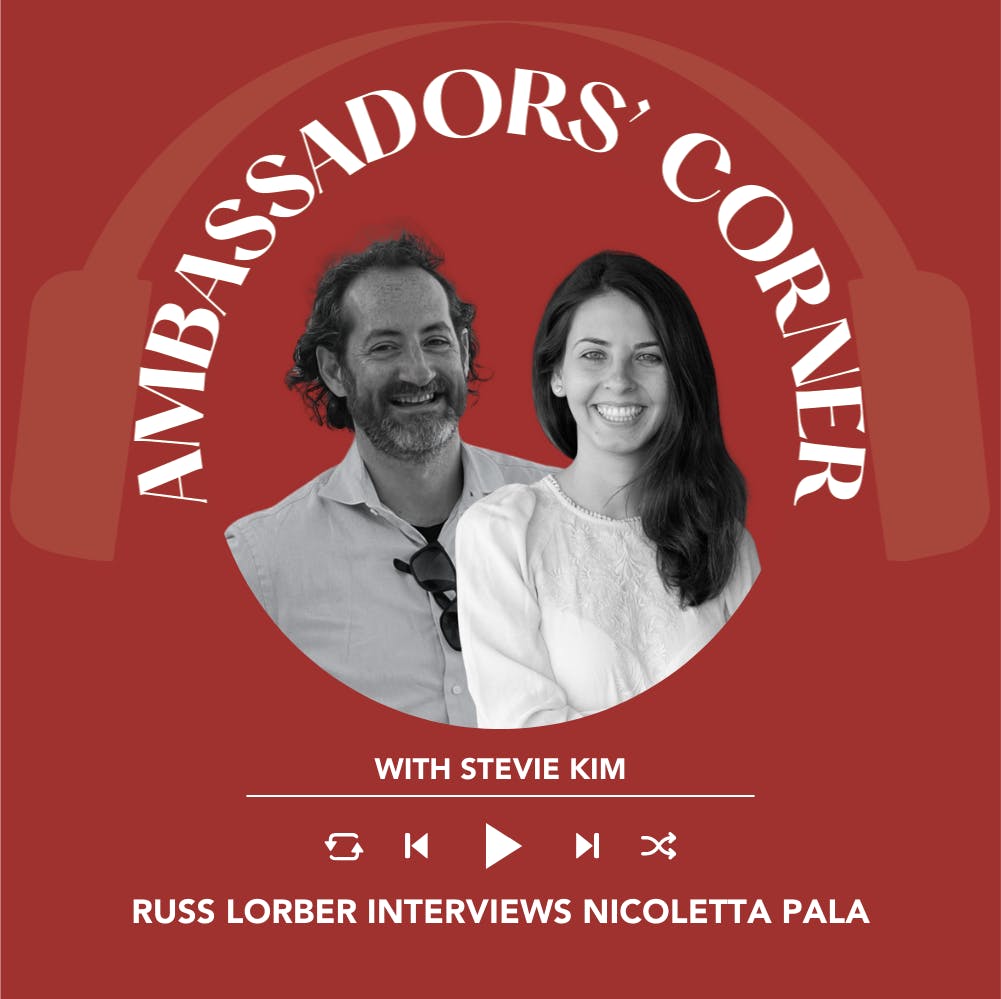
Ep. 1790 Russ Lorber Interviews Nicoletta Pala | Clubhouse Ambassadors’ Corner
Clubhouse Ambassadors’ Corner
Episode Summary
Content Analysis Key Themes and Main Ideas 1. The unique terroir, microclimate, and cultural identity of Sardinia and its influence on winemaking. 2. Aldaria winery's philosophy centered on native Sardinian grapes, sustainable practices, and family tradition. 3. The concept of ""Blue Zones"" and the Sardinian lifestyle promoting longevity and well-being. 4. The balance between tradition and innovation in Italian wine production, exemplified by Aldaria's approach to winemaking and branding. 5. The importance of personal connections, community, and authenticity in the wine industry. Summary In this episode of the Italian Wine Podcast, Russ Lorber, founder of Wide Roots and a certified Vinitaly International Ambassador, interviews Nicoletta Pala from Aldaria winery in Sardinia. Russ shares his personal connection to Sardinia and Aldaria, explaining why Nicoletta and her family's winery are his ""first choice"" for this discussion. Nicoletta eloquently describes Sardinia's unique characteristics, highlighting its mild, windy microclimate and mineral-rich soils that contribute to fresh white wines and powerful reds. She elaborates on Sardinia being one of the world's ""Blue Zones,"" where people live exceptionally long lives, attributing this not just to genetics but also to a healthy Mediterranean diet, strong community ties, and low stress. She then delves into Aldaria's history, explaining how her family has been growing grapes for generations, and how she, along with her brother Salvatore and father Enrico, decided to start bottling their own wines in 2014. Aldaria's core philosophy revolves around producing wines exclusively from native Sardinian grapes—such as Vermentino, Cannonau, Nuragus, Monica, Nasco, Malvasia, and Bovale—using an ""Integrated"" farming method that respects the environment and minimizes chemical use. Nicoletta emphasizes their commitment to expressing the terroir, noting that most of their wines are aged in steel or concrete, with only the Bovale seeing oak. The conversation highlights specific wines like Nuragus, a historically significant but challenging white grape of which Aldaria is one of only seven producers, and Nasco, a lesser-known variety that recently earned Aldaria a prestigious Tre Bicchieri award. Nicoletta also shares the amusing story behind Aldaria's distinctive, modern labels featuring unique photographs, which initially met resistance from her traditional father but have become a recognizable and approachable part of their brand. Looking to the future, Nicoletta expresses optimism for Sardinian wine, foreseeing a trend towards small wineries focusing on authentic native grapes, driven by younger, internationally-minded generations who foster community and respect for the land. Takeaways - Sardinia's unique microclimate, characterized by mild, windy days and mineral-rich soils, is ideal for viticulture. - Sardinia is recognized as one of the world's five ""Blue Zones,"" where inhabitants demonstrate exceptional longevity, linked to lifestyle, community, and diet. - Aldaria winery, a family-run operation, is deeply committed to producing wines from indigenous Sardinian grape varieties. - Their ""Integrated"" farming approach emphasizes environmental respect and minimal chemical intervention. - Aldaria prioritizes expressing the grape's and terroir's natural character, predominantly using steel and concrete aging over oak. - Nuragus and Nasco are notable native white grapes championed by Aldaria, with Nuragus being rare due to cultivation challenges, and Nasco gaining significant critical acclaim. - Aldaria's distinctive, modern wine labels reflect a balance between tradition and innovation, making their wines approachable and memorable. - The future of Sardinian wine production is anticipated to be driven by smaller wineries focusing on authentic native grapes and fostering collaboration. - Strong personal connections and a sense of community are vital aspects of the Italian wine industry, especially for family-owned businesses. Notable Quotes - ""Sardinia enjoys a microclimate completely different from the rest of the mainland, mild and windy days. Make the island a perfect area for the vine, cultivation."
About This Episode
Representatives from Clubhouse discuss their desire to stay in their current industry and their desire to become an Italian wine producer. They talk about their unique and special culture, including their love for their family and their unique and special experience with Italian wines. They also discuss their philosophy on cultivating wine varieties, including their approach to Honestly, respecting the environment, and their approach to cultivating pepper varieties and winemaking. They emphasize the importance of living in a community with strong community and healthy lifestyle, and their desire to create a community with strong community and healthy lifestyle. They also discuss their philosophy on cultivating wine varieties, including their approach to cultivating pepper varieties and winemaking, and their approach to integrating their approach to farming, including using steel wines and their approach to honesty and respect. They also discuss their philosophy on cultivating wines, including their approach to Honestly, respecting the environment, and their approach to cultivating pepper varieties and winemaking.
Transcript
The Italian wine podcast is the community driven platform for Italian winegeeks around the world. Support the show by donating at italian wine podcast dot com. Donate five or more Euros, and we'll send you a copy of our latest book, my Italian Great Geek journal. Absolutely free. To get your free copy of my Italian GreatGeek journal, click support us at italian wine podcast dot com, or wherever you get your pots. Welcome to this special Italian wine podcast broadcast. This episode is a recording off clubhouse, the popular drop in audio chat. This clubhouse session was taken from the wine business and Italian wine club. Listen in as wine lovers and experts alike engage in some great conversation on a range of topics in wine. If you enjoy listening, please consider donating through Italian wine podcast dot com. Any amount helps cover equipment, production, and publication costs. And remember to subscribe and rate our show wherever you tune in. Hello, everyone. Welcome to another episode on Clubhouse Ambassador corner. So for today's Clubhouse, we have Russ Lorber from our Italian wine community. So, hi, Ross. How are you? Hi, Leketh. I'm well. Thanks. How about yourself? I'm fine. I have actually I think I published your episodes on Italian great geek. So I I had fun editing that one. That's right. Hopefully, I didn't give you too much work with the editing. No. No. No. I just had to remove the the ending part. That's right. I forgot I did that. Yeah. Yeah. You did. Anyway, so, so now, our show for today, you are here on Clubhouse Ambassador's Corner, and you have selected Nicoleta Paala as your favorite producer. So before we begin, I would like to introduce you first to the audience. So first, Russ is the founder of wide roots. Wine import and wholesale business based in Baltimore in the US. The philosophy of wide roots is to work with family owned small producers making terroir driven wines growing responsibly and sustainably. The company combines this with education delivered through tastings, events, and social media. He is a certified Vineital International Ambassador and the subject of the documentary Wine Hunter, a story about his entry into the wine business that is streaming on YouTube. So tell us about this documentary because I remember you were here, and it was a pinning here in verona. Right? That's right. So, yeah. So, and and the the crazy thing about that was I had no idea how it was going to go. So if I didn't get pinned, it would have been it would have been on camera for the world to know. But I did get pinned, which was which was great. So, yeah, we we, three years ago work started working on, a project to make a wine documentary. And my inspiration for that truthfully, what, what, I was really inspired to get into the business that I'm in by there's an importer in the US named Kermit Lynch. He's an importer of of French and Italian wines. And back in the eighties, he wrote a book called I think it's called On The Wind Trail in France, and that was one of my inspirations to get into the business. What I really wanted to do was to write that book for Italian wine, but make it in documentary format. And so I started working with Chrisa on that project. And the more Chrisa and I talked about it, the more she wanted to make a documentary about me, which was a bit uncomfortable because I don't really like to be the center of attention, but she thought there was a story there that was worth telling. And so that's how we ended up doing the the Wine Hunter project. And if you if you do go and watch that documentary, you can see, you'll meet Nikoletta there because we spent some time in in the cellar, at Aldaria and going through the the vineyard and interviewed Nikoletta also So it's it's kind of a great opportunity to really see what they do. And I I think in this interview, you obviously get a flavor for the the philosophy there, that they have. But that's that's a little bit about the wine hunter project. So I think we've got something like seven thousand views so far on it. I was a little bit hesitant to do that project, but I think in the end, it, you know, Chrisa really did a good job of of telling my story, and it's it's something I do take pride in. Right. And I'm actually gonna connect that to another question. So why did you select Nicoletta Paula as your favorite producer? So so I have to be clear about something for the world to know, and that's that I don't have any favorite producers. So I I can't have favorite producers. Otherwise, I'll have some some angry people. It's just your first choice. So so that that being said, you have to choose somebody. And there were a few reasons that I wanted to to choose Aldaria and and Nikaleta. One is because of Sardania itself. And so Aldaria is located in Sardania, which is about a thirty min and their location is about a thirty minute drive due north of Kaliati, which is the capital city Sardania, I've been there a number of times now, and it's a really it's a special place for me. It's one of these places that my friends here in Baltimore are probably tired of hearing me talk about. Because I I I just I I love going there so much, and they're probably thinking, you know, I wish you'd stop talking about it and move there so we could come and visit you there. But Sardinia is a very special place. There's a a way of life there that I think you just have to be there and experience it to understand it. There's it's just the relative level of stress is is very low, and the sense of community is just is very special. And there are a lot of hidden gems there that I think are waiting to be discovered culturally, and then also with food and wine. And then the other reason that I I really wanted to talk about Aldaria and interview Nikoletta is that Nikoletta's family really embodies what gets me excited about wine. So they they have a philosophy. They're they're that we're gonna get into, and I don't wanna steal Nicoletta's thunder. So I I won't. I'll let her talk about that, but they stick to that philosophy religiously, and they are uncompromising when it comes to the quality of their product. And so it's it's it's really special, and and I I think it's they've been in the they've had a winemaking operation. I think now for close to ten years, although they've been growing grapes for a much longer time, but they they they really are an up and coming producer, having received the the Trade Picchietti rek designation for now three of their wines, from from Gamparoroso. And so I I think they should really take a lot of pride in what they do. And I'm I'm really excited for for Nicoletta to share that message with with the Via community and the the broader world. Yeah. Exactly. So when did you discover the wise of Audaria. So Nikolletta, it's quite a story. Okay. So so so Nikolletta, I met Nikolletta four years ago, almost exactly four years ago, in fact, in in New York City, and it was the the twenty twenty Gamarolfo Tri Picchietti roadshow. And so Nikoletta was there, pouring a couple of the wines of Aldaria. And for me, it was my very first event as a wine professional. So I had no licenses, no anything, but I was trying to put together this sort of, you know, look for people that I could work with. And so I I had a little bit of imposter syndrome at that event. Like, I was wondering what was I what am I doing here? And everybody else is going to figure out that I don't really belong here. But it was really, by the end of that event, I just felt so energized by by what I experienced. And and Nikoletta was one of the people that I that I met during that show. And it's just it's when you meet Nicolette, it's impossible to forget her. She just she has a very magnetic personality and exudes passion for what her family does and for for for their winemaking operation. So that particular event, Nikolletta was pouring the the Vermentino, the Canal and the Bovale. And so I got to taste those three wines. And little did I know that was really the just the beginning when it comes to what they do. And so over time, the pandemic did its thing and wreaked havoc on the world, but Nikoletta and I managed to keep this connection going. And eventually, we tasted it together, the Naragas and the Monica that that they produce. And then over time, as I got the chance to visit Sardinia and go to the cellar, I got to explore even more of their line. And so we we got to taste the Malbasia de Caliadi and, and also their dry Nasco. And they also do a Nasco, in the in a dessert style as a as a late harvest wine. So over time, I really got to experience all of those wines, and it's just been so amazing to to experience such a great quality product made by, a family that is just so generous. They're so passionate about what they do. And they're so generous about how they how they share that with you. And I and I feel like they've virtually, adopted me into their family and and made me one of their own. So it's really been, I think, quite a journey, and I'm I'm so grateful to to have this connection with with Nicoletta and and a friendship, even more so than a business connection. Yeah. Actually, that's what I also like about the Italian wine community, Italian wine producers. Like, they would take you in as part of the like one of the family, and that's the kind of hospitality I think the wine world needs. And so since we're a little bit geeky here, and we have Italian, are Italian wine ambassadors here listening in. So hello, hi guys. So we wanted to ask you, what are the learning objectives that we should expect from this interview? So I I before I I'm gonna hit the learning objectives, but I just wanna say something. I wanna touch on something that you just said about. And and it was kinda going back to the Wine Hunter documentary. We interviewed Stevie, for the for the documentary, and I I will never forget. There are there are moments in in shooting that I will never forget. And this was one of them. Stevie was asked, what is Italian wine about for her? And her answer sent a shiver down my spine. Her answer was Italian wine is about Italian wine people. And and and that just that rang so true for me because, you know, I I have the the great opportunity to work with so many wonderful people and and it's it's it's all very special. So, getting back to the so the question, the learning objectives, and sorry to kind of derail the question there, but I I really kind of felt passionate about sharing that. So that I have two learning objectives from the interview. And and one is it's they're both centered around why I wanted to interview Nikoletta. One is to build some familiarity with with Sardania and its wines. And so, you know, Vermentino and Canal are the most familiar to people when they have any familiarity about Sardinian wines, but there's really so much more there to explore that is just it's really interesting and exciting and different from what you'll get anywhere else. And then the second that I really want to to get at is Adaria's philosophy as a winemaker. And I think this is going to build on the first objective to to an extent because there's a real passion about working with native grapes, not only of Sardania, but their specific location in Sardania. And so they take great pride in the Vermentino and the Canal, but they're even more excited about what they can do with with locally important varieties, and some of those grapes aren't always easy to work with. And so I think what they do really kind of stands out in the world of of of sardinian wines. And so I I hopefully I think those two things that people should should take away from this interview. Okay. So I'm now going to mute myself, and I give you the floor. Okay. Very good. Nicoletta, are you there? I'm here. Hello. Shah, Nikoletta. How are you? So I'm I'm doing great. Thanks. How are you? I'm good. I'm good. Alrighty. Nikoletta, together with, your brother, Salvatore, and your father, Enerico are the, driving force behind Aldaria, and I'm I'm really excited to have you kinda talk about what you and your family do. But just to to start the conversation, one of the things that we wanted to talk about was, what is, you know, Sardania itself and the wines of Sardania. So you, I think more than anybody have introduced me to this world, but I I wanted to know from your perspective, what is unique and special to you, about the wines of Sardania. Okay. So first of all, I would like to thank you, Ross, and, thank you guys, because I'm so grateful for the connection. I would like to playing you how is, Sardinia because Sardinia enjoys a microclimate completely different from the rest of the mainland, mild and windy days. Make the island a perfect area for the vine, cultivation. Then we are surrounded by the sea. So the current strongly influence the soil that's a low for fresh, every wines with mineral concentration. So I think that the secret about Sabignan wines is, of course, the soil the land. That's because Sardinia for its confirmation can be defined almost as organic area. Usually, while, you know, the Italian regions, many treatments are done in a few months. For example, at the same time, we do one, two treatments. So that's, very important because there is a stronger, connection between the land and Serbian wines. That are reminiscent of the sea and the land. So, the white wines, usually, it's a linear, very fresh and mineral. The red wines, like the famous Canal, are warm, powerful wines. Every state has, unique terawatts that makes, the difference in, Sardvania wines. So that's, our secret at the moment. Yes. So and and and specifically, Eneco, Alexis. You're located near Sirdiana, which is about a thirty minute drive due north of of Caliadi, and and Sirdiana, is is considered a locally important area for, for producing wine. So what are some what are some of the specific things that you would see that are special about Sardiana? Like, certain great varieties or, or certain climates? Sure. Sardiana today is, I think the heart of, serving analytical culture, because when you think about Wines of Sardinia. Suriana is a a little town but is special for wines. And, I think that's, is a special area because, Sambiana is surrounded by little hills, and the altitude is about, one hundred eighty thousand meters above the sea level. And, also, the climate is very windy and, sunny. So that's perfect for the wine, cultivation. We are in a special area because, we are in a valley named the valley of Sibiola where there are more vineyards and wines than, people because, the little town is about two thousand, habitats. So there are many wineries and that's, great, thing for all of Selvina. So we are proud to be part of this area. Also easy to have, supply wise and mineral wise. That's because, Cali, the main city is twenty kilometer is fair. So, of course, also the beach, the Puerto Beach, that's close to our valley. And that's the influence, of course, all the wines and the wine growers. Yeah. And I love how that that contributes that salinity to the wines, and you can, you can particularly get that character with, with, with the white wines. And so it's just, it's, it's one of those things that it's, like, I think about it, like, when you cook and you, you add salt or seasoning to addition, just to the right level. It just kind of helps the flavors pop even a little bit more. So it's it it is really special to to have that location there. There's really a lot to experience in in Sardinia. And I guess that's what what keeps me coming back. What's special to you, Nikaleta? So there's a lot of culture, and there's also, you know, there's some also some unique food traditions in Sardania. So what's special to you about those as well? Yes. Of course. I'm proud to be sardinian, and, I love our culture, food, and lifestyle. I think that our lifestyle maybe is one of the best all over the world because Sabinia is, one of the five blue zone in the world. And, the others are just, a little islands of Japan, California, Costa Rica, and maybe Greece. The blues on our land where people live longer than average. And Sarbanian, in particular, it's a land of centurion as the longevity of Sarbanian, depends about multiple factors. Of course, influencing life prospects are not only genetic factors, but also I think, healthy lifestyle and the food that's very important because we have a Sardinian Mediterranean diet that's rich in vegetables, milk, cheese, and particular goat and and sheep cheese. And, also animal proteins, the strong attachment also to the land and the family of origin, make the sardinia and culture very special. Also, another nice thing is, that we produce just, yes, wines in particular, in Sargana area. But, in Sardinia is a land of shepherds. There are, six millions of ships in Sardinia. And, you know, we are an island of one millions in an in banal habitats. And, also, we love to produce, milk cheese and olive oil. So I think that, olive cheese, and a glass of wine are distigret for a long life in Sabigna. I'm really glad you you brought up the the lifestyle because I have customers that will they'll sell Canal, and they'll say, drink this wine, you live to a hundred and Like, as much as I'd like that to be true. I I just, like, wait, there's more to it than that. And I think when you, you experience a place like Sardania, you you you understand that it's there's so much more to it than the wine that self. And and even the diet, I think there's something to that lifestyle, particularly the sense of of community and and the sense of family and and friends, and the relatively low level of stress. I don't think we understand the toll that stress takes on us. And, my myself having the benefit of of living in a neighborhood where there is a very strong sense of community. I understand how important that is to me. And every time I go to Sardania, I always feel like you know, the island adopts me every time I visit, which is really something special. So there's it's there's so much more to the blue zone I think than than the wine and even the food. I really think those other factors are just so important. And that's probably one of the things that keeps me coming back. So you and your brother, Salvatore decided at one point, you wanted to start a winemaking operation and, and, and your father, Enriqueo, had been in the wine, winemaking business at one point and had gotten out of it. How did you make that decision to start making wine? I think that the decision has been, natural process because I was born into a family of winemakers. So there has always been a great tradition of of Agree business in, Salvina in particular in my family for generation, has always worked doing the vineyards and, produce the mostly bulk wines. And, so in two thousand and fourteen, ten years ago, my god. Just over the age of eighteen, I decide, together with, my brother, Sala Torres, and, the support of our, father, and Rico to start a new project, a project that's, linked to the tradition. Yes. And, the land. But that want to look at the whole world. So we decide to produce the first bottle of Verintino Adaria. Then, we started with thirty seven hectares of vines today, we are working fifty actors. So we are going to grow slowly. I have never been to think, to do something different in my life. You know, when you born, you know, family of winemakers. I think that's the natural process, is to think about the wine and to have your own winery So the grape growing history in your family and and your vineyards go way back, I think, to your your it was your grandfather Salvatorre. Is that correct? Sure. Correct. My brother is, Salvatorre junior, but my grandfather's Alvatorre senior, in, in the fifties, started to plant the first vineyards in, Suriana countryside. And used the, to produce, bulk wine. And, all of the family was working in the vineyards. And then my father started to produce wine, And, yes, in two thousand and fourteen, decided to work, and, together with my brother, we start with the new project. I think that, the one word was is changing. No. So maybe my father is a lunjibrant and, he understands that, okay, the tradition is important, but the young people have a completely different, vision of the world. I do wanna get into that a little bit, but as we as we get into the philosophy that that guides grape growing and winemaking. We work with, quite a few varieties, kinda now, Vermentino, but also some of the other more locally important ones that that I look forward to exploring as we talk more here. Going back to your grandfather, Salva, Tore. Has he always grown the varieties like Noragas, Nasco, Malvasia, or is that something that's relatively new to your family? Of course. Our philosophy is to produce, one is just from, native grapes from Sardinia. So, Murago, and, also Mandazia are important grapes for our production now. But, they are historical grapes. Maybe in the past, for example, Anuragos was, common to send the Noragos all over Europe and to blend the other international grapes because it's like a semi automatic grape. Mhmm. But now our philosophy is to make just, steel wines. So So we produce, for example, the that's still the Malazia, the dry Malazia. And that's very important because I think that's, important to exalt the, importance of the grape. All of the traditional grape, remember the Sardvina Island, no, in flavors, parfums and everything. In the fifty actors, now, we are growing only typical Salvina grape, not international. And, we respect the the environment. We are a special farming method named, Integrator that respect the land, and we work also minimizing the use of chemicals. I think that's, the important thing is, to follow the hurts, the rhythms, the patient, and, also, to, herd the Mediterranean currents and, also to pay attention to the cycles and season, respect the timing, and not practice, massive exploitation. That's very important, and is our philosophy to guide the winemaking process. Coming back to America, Van Italy International Academy, the ultimate Italian wine qualification will be held in New York City from four to six March twenty twenty four. Have you got what it takes to become the next Italian wine ambassador? Find out at the Italy dot com. You've mentioned the I think you said that you call it the Integraat Is that correct? Yes. Is that what you just described? Or is there is there something more to to that methodology for agriculture? Yeah. It's a particular methodology and, it's not organic, but, it's consist just in the to respect the environment. We don't use the chemical because, you know, in Sardinia, we don't need many treatments. The island that I told you is as a microclimate completely different from, the mainland. I think that, the most important thing about the integrated is to work respectful of the land. Remember also, our, company's name, Odaria, because, of that means, nobility of spirit, in particular, we want to represent the value of the land, and we want to represent, also the respect, to grow the vineyards and, also for that environment. So that's so important. We started getting into, you know, your philosophy, your family's philosophy around grape growing and and winemaking. So locally important grape varietals is grape varieties is one part of that responsible agriculture, is another. Can you tell us a little bit more about the philosophy, when it comes to expressing terroir and, like, particularly around how you age your wines. Sure. We are, two different lines of, wines. The first one, that's, the classic line where, we are working with, Vermincino, and Vargos, Monica and Canal grapes, they are very fresh wines ready to drink, beenified in, in steel tanks. Of course, they are aging in the steel, just for seven, ten months. Then, we have another line that's the selection, of, five different wines made from different Sabine and Blake that are NASA, about the whites, Malazilla, Beauvalen. And then, the dessert wine made from UNESCO grape. The Malazilla for example, is aging for one year in, concrete tanks. Bubale is, the only one oaked. So for, one year is, oaked. And then, he's ready after one here in Danalfa. Then NASCO Wine is, aging, in a concrete. And, then we have another Vermentino, Caminera, coming just from, unique state and is a particular wine because, is staying in, the concrete tanks for one year, ten, twelve months. So, of course, it's more powerful and, body and favors compared to the classic vermantino from the classic line. So we have different lines and different wines for different moment. I think, because, wine is like a friend. So he's made to moment of share, and it's important to have the right line in the right moment. Yeah. There's always something for any particular situation. And I think, you know, one of the things I think just to maybe close on philosophy and and and move to the next part, it's only the Bovale that's aged in in Oak. Everything else is aged in a manner that I think best expresses the the character of of that particular grape and that particular one. And I think that's it's you talked about authenticity and and and your mission in your philosophy, and it's it's, you know, to me, It's those locally important, great varieties, but made in a way that you really experience the character of that particular fruit and and the soil and the climate of of where it comes from. And I think you know, when it comes to authenticity, you really can't do it much better than that. So you talked a little bit about the wine line up, and we talked about the special selection line with, the Nasco and the Malvasia, Bovalli, fermentino, and also your dessert style Nasco. Talk a little bit about the classic line, please. So you have the Vermentino and the Canal, but then also the the Naragas and the Monica. Like, what's the right moment to drink a wine like Monica and particularly the the version that you and your family make? Sure. Monica is a very versatile wine, so you can taste it every day in different moments. In my family, for my grandf grandfather was like a daily wine, the Monica. That's because you can try it with fish. Meat pizza, everything. So I think that Monica is a very fruity wine fresh, and you can try to chill it in summertime and is, is amazing. I think that's the red brother of, Noragu's, because Murago's wine, the traditional wine from Caliaria, we are just seven producers of all over the world about Noragu's So I'm proud of it. Nuragos is a white wine, but, is very special because when we talk about Nuragos, we are talking about Sabini history because the name Nuragos remember the Nuraghi that are traditional stone buildings of Sardinia. So that's, very important for our culture. And in the same time, Nuragos, is very mineral wine with a good acidity and semi aromatic, in the past, was ninety percent of my grandfather production. Now, we have just two actors, seven actors. So it's an important wine, but not so much diffuse like in the past. So I think that's important to talk and to explain more about Murago's and Monica that are traditional grapes. So I love them, and, I hope to taste a glass of both to you. I can't wait till the next time we get the chance to do that together. Noragas, in particular, I I know you you take a great deal of pride in that particular wine. I'm I'm not sure that you can choose favorites from among your your lines. Noragas is not an easy great to work with. What makes it difficult to work with and tell me about why you're you're so proud of that particular wine. Norago says, particular grape because as a big bunches, so makes a lot of quantity of grapes. In the past, was good thing because, was common to produce a lot of bulk wine and to sell it all over Europe. But now, we select the quality. So, in regardless, you have to take care of this grape, continuous because, you have to check the bunches and to pass different times. So if, is very hard to work regardless compared than Vermont. I think that it gets lost also for this reason because, in the seventies, the government, give money to remove the vineyards. So many producers without generational transition prefer to remove your the grapes. And in particular, the fermenti, the I'm sorry, the nurag was grape. Because maybe it was more, fashion, the Vermentino, but in the same time, because Vermentino is more easy to work in the vines than, Murago's. So now we are very very proud because we are one of the seven producers of Sabinium, and we are trying to produce a good quality. That's a very hard goal. Yeah. You're one of the few, and it's also a hundred percent stated variety on the label Sure. As well. So, you know, you can't kind of hide anything with by blending something else into it. Just touching on the the Monica really. And I remember the first time you and I tasted the Monica together. As you said, it's easy to drink, more of a medium bodied red wine, very fresh. I remember the first time I tasted that with you, and I just thought this wine over delivers complexity for, you know, being you know, and easy to drink wine. It still can can really over deliver on that. And it's it's really just kind of seeing the the response to that and, you know, we pour it for people and it's just it's so approachable and we tell people how easy it is to pair with with food and including poultry and seafood, and that makes it even more approachable because now you don't have to overthink the food part of it with the Monica. It's probably gonna go with pretty much almost anything you put with it. You know, something that I enjoy myself, pretty frequently, as as much as I can. So you and I met at at the Gamboro roadshow almost four years ago, exactly. And I look forward to seeing you there in February. You just learned that you won or I actually when I was when I saw you in September, you had just learned that you had won Trebicieri for, the Becio Nasco, the Nasco Di Cali. How special is that for you? It's like in Italian wine unplugged two point o, which is the reference text for the Ven Italy International Academy Ambassador Program. There's the the scope is around top one hundred grapes, and then there are the lesser known varieties. And then Nasco is in that lesser known variety. How special is it for you that you can get that kind of recognition for your Nasco? Yeah. I'm very proud of, Nasco's success. It's true. The the Nasco grape is little known outside of Sardinia is a particular grape that's, we can find just, in the south of Sardinia in Cali Area. This award is, very important, not only for, Audaria, but I think for, the entire Salvina because it's an historical grape variety. This, important recommendation invite us, to believe more and more in native grapes and, in the territory, you know, then asco, it's a great variety that in the past, hello, has always been used to make, dessert ones. And the field drive version can be found, also now. It's a great that, I love whose parfums are related to Mewsk and Mediterranean. And, is a very gentle wine. That's a mineral. And, remind also, our police are, CRC. I'm, very proud of Nasco. Also because, the Nasco is, one of the last wine, we show in twenty twenty one at the end of pandemic. So the name of the CEO that is Salvina is, to go out is, like, freedom wine. No? I'm, so excited of this grape and this wine in general. I love Danasco. And also my dog now is named Nasco. So it's a very funny connection. Yeah. I did wanna make sure that we hit with that we hit on the Jack Russell as well because it's clearly a special grape for you to to name your adorable little dog after it. I think I told you about an experience I had once with the the Vasiu Nasco, and I poured it for, Asamalie in a Michelin Star restaurant in in DC. And this is a family friendly podcast. So I can't tell you exactly the words that he used when he when he experienced this wine, but I will never forget it. He held the glass to his nose, and he said, What the blank is in my glass? I didn't know. I didn't know if I upset him or delighted him, and it turned out that I delighted him. So it's, you know, you it was I mean, he just went on and on about how good he probably tasted through your entire lineup and just was effusive in in his praise. You know, you touched on the character of it. It's got that musky sort of character in the aroma that's just I can't describe it any differently than it just like it smells like sardinia. Like that's kind of to me is is what that wine is is like. You should be very proud of of what you've what you've done with that. The classic line, you have a line of labels and we don't talk about packaging much, but one of the things that just really stands out about the the the lineup that I think the the the juice in the bottle is just so good, but the thing that keeps people coming back to it is that it's it's a very recognizable label and there's a series of characters on the labels. Can you tell me about how you came across those characters on the labels and how they ended up on your bottles? Sure. It's a very funny story. Because in two thousand and fourteen, when the first bottle of, Otaria Verintino was born, we were conflict conflicted about, what packaging deals and, what to do. We were looking for a dress that was new modern with a strong impact and identity. We found the these shots in a French magazine leparisiana are unique shots representing wine in a magical world and also with an international outlook. We were a bit confused because, now the Wine word. I think that's, completely changed compared to my father's wine word. So the dress is very important because, the quality of the wines, the technologies, it's the first thing and the first important thing. But when you are in the market, you can find lots of labels. So you have to catch the consumer. When, we found the labels, we said maybe they are something new for us. My father, that's a traditional man, was like, oh my god. What what are you doing? You are crazy. So it was a very difficult moment. But I think that, the wine is, like a friend, you know, so made of moment to share with friends and, these labels, so we'll always make your feel close to a friend. We believe, in the power of communication and social media, I think that, the labels are perfect for that. They are very important for us because cause you recognize the Odaria for the labels. So, also, sometimes, at the restaurant here in Sardinia in particular. So, what, someone asked about the rabbit, why, you know, the giraffe one So it's our identity now. And they do that in the US as well. So, two two things on on on this topic. One, the daughter always wins. Too. The wine that your family produces is is is very serious and it's seriously good, but the the packaging, I think the label I love what your perspective is around that because it's just so approachable and and down to earth. And so it's like it's a it's a fun package that people people recognize. Like they ask for the Zebra wine and the Zebra wine is the Monica and and people love it and they they know they like the wine, but then they can find it because they they know where to look for the label. So I just, like, I love that, you know, you can make a seriously good product that's also approachable. And at the end of the day, it's about people and togetherness and family and friends and and celebration, which is really, I mean, no matter what, I think that's what wine is really the centerpiece of. So I definitely wanted to give you the opportunity to tell that story because I think it really goes a long way to what your worldview is when it comes to to wine and what you do. And so So, we've got a little bit of time left here, and I wanna leave some time for questions. What are some future trends for for wine in Sardinia? I know you do a lot of networking and you attend events and you talk with other winemakers. What are some things that we might see in the future? You said you only produce still wines with Aldaria, and that's very traditionally sardinean, but we do see some sparkling examples every once in a while. So what are some trends that you see? There is a lot to be done because Sardinia is an island of only one million international people. We represent just one per cent, of, national wine production. We have a lot of grapes to be discovered and young people are making, a great contribution in this regard. The important thing of the new generation and also for the future of the wine in Sardinia is to get closer to the nature and the production to her, the nature. The new generation have, important skills and international vision that, is, important also to bring the companies together and to allow the territory to grow because in Sardinia, one of the problem is that we are, a few people, and, everyone think just, for yourself, I believe, that the future will be of, small wineries that, are able to transmit, farming values and to, hello, the territory to grow. Today more than ever, human contact is very important. And so I think that the trend in Sardinia will be about, authentic grapes because there are more grapes undiscovered that are native grapes that are lost in the time, but, that are very interesting. So I see a good future of wine in Sardinia. Yes. There's so much there that's that's worth discovering. So I I I, you know, I really hope that we see more and more of these sort of locally important traditional native, native grapes, and I, you know, you and your family are on the forefront of that. Well, just to close Nikolletta. First of all, who knew four years ago that you and I would be on the Italian wine podcast together. Can you imagine It's amazing. I know. It's so it is amazing. And so and and, you know, the the other thing I think kind of leading into that is just, you know, so proud of you and your family and and grateful to you. And and your family. And every time we pour your wines, you know, I see your face and Salvatore's face and and Rico and and Davice and and Davide and everybody there. So it's just you know, it's there's so much more to this than than wine for me, and that's I'm I'm so grateful for our friendship and connection. So thank you. Thank you. I'm grateful too. Of course, we work with, love and passion and, you too. So that's, our important connection, and I think also the key of our work. I agree a hundred percent. I couldn't sell anything if my life depended on it, but I can I can sell wine for some reasons? Listen to the Italian wine podcast wherever you get your podcasts. We're on SoundCloud, Apple Podcasts, Spotify, email ifm, and more. Don't forget to subscribe and rate the show. If you enjoy listening, please consider donating through Italian wine podcast dot com. Any amount helps cover equipment, production, and publication costs. Until next time, Cheaching.
Episode Details
Keywords
Related Episodes

Ep 2325 Anna Obuhovskaya IWA interviews Fabio d'Attimis-Maniago of Attimis-Maniago | Clubhouse Ambassadors’ Corner
Episode 2325

EP 2316 Alberto Martinez-Interiano IWA interviews Emiliano Giorgi of Progetto Sete Winery | Clubhouse Ambassadors’ Corner
Episode 2316

Ep. 2308 Anna Obuhovskaya IWA interviews Sara Repetto of Vigneti Repetto | Clubhouse Ambassadors’ Corner
Episode 2308

Ep. 2299 Beverley Bourdin IWA interviews Grégoire Desforges of Baglio di Pianetto winery | Clubhouse Ambassadors’ Corner
Episode 2299
Ep. 2290 Rebecca Severs IWA interviews Primo Franco of Nino Franco winery | Clubhouse Ambassadors’ Corner
Episode 2290
Ep. 2281 Julianne Farricker IWA interviews Mattia Montanari of Opera 02 Winery | Clubhouse Ambassadors’ Corner
Episode 2281