
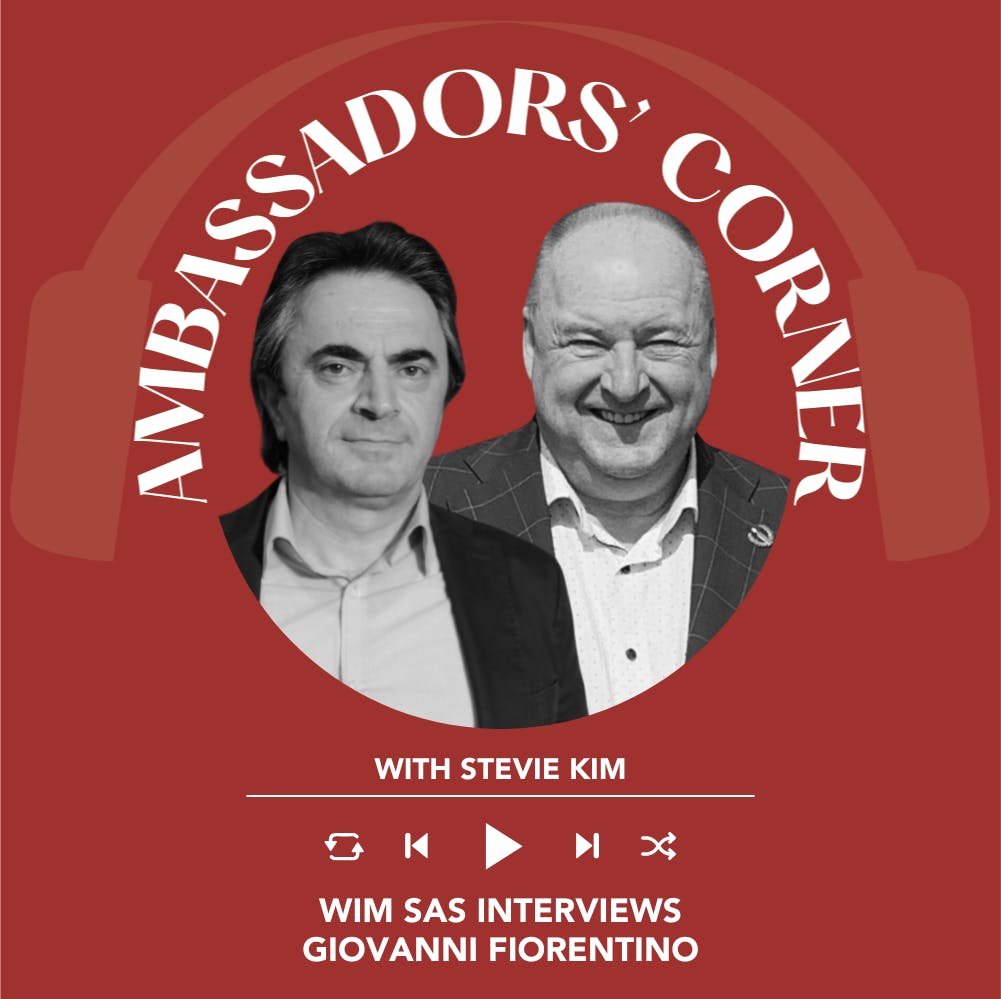
Ep. 2137 Wim Sas interviews Giovanni Fiorentino | Clubhouse Ambassadors’ Corner
Clubhouse Ambassadors’ Corner
Episode Summary
Content Analysis Key Themes and Main Ideas 1. The unique terroir of Irpinia, Campania, and its influence on Taurasi wine. 2. Giovanni Fiorentino's journey as a small Taurasi producer, rooted in family history and passion. 3. The characteristics and versatility of the Alianico grape. 4. The balance between tradition and innovation in winemaking. 5. Challenges facing Italian wine production, particularly climate change and market awareness. 6. Strategies for promoting Irpinian wines globally, including branding and wine tourism. 7. The aging potential and ideal pairings for Taurasi wine. Summary This ""Ambassador's Corner"" episode features an interview with Giovanni Fiorentino, a dedicated small producer of Taurasi wine from Paternopoli in Irpinia, Campania. Giovanni details his family's deep connection to the land and his personal mission to elevate his quality wines, despite starting production relatively late with the 2012 vintage. He elaborates on Irpinia's unique volcanic terroir, high altitude, and specific climate, which contribute to the distinct characteristics of the Alianico grape. A core theme is Giovanni's philosophy of blending tradition (maintaining grape and land identity) with innovation (creating approachable, healthy wines). The discussion also covers the Alianico grape's ancient origins, versatility, and regional variations, as well as the impact of climate change on viticulture, noting the Alianico's resilience. Giovanni addresses the lack of broad market awareness for Irpinian wines and proposes strategies for the consortium and public administration, including branding, wine tourism, and digital engagement. Finally, he shares insights on the optimal aging of Taurasi wines (recommending 10+ years for peak enjoyment) and suggests pairings beyond traditional food, such as cigars, dark chocolate, and aged cheeses. Takeaways * Giovanni Fiorentino is a passionate small-scale Taurasi producer driven by a strong commitment to his family's winemaking heritage and the unique Irpinian terroir. * The volcanic soil, altitude, and specific climate of Irpinia are critical determinants of the quality and complexity of Alianico grapes and Taurasi wines. * Tradition in winemaking, for Giovanni, means preserving the identity of the grape and land, while innovation ensures wines are approachable and safe for modern palates. * The Alianico grape is highly versatile, capable of producing a range of wines from rosés to long-aging reds, with distinct expressions found in Irpinia, Vulture, and Sannio. * Climate change poses significant challenges to wine production in Irpinia, introducing new pests and affecting grape balance, though Alianico shows good resilience. * Despite their quality, Irpinian wines (like Taurasi, Fiano, and Greco) suffer from a lack of international recognition, highlighting a need for improved marketing, branding, and wine tourism initiatives. * Taurasi wines require significant aging—ideally 10 years or more—to reach their optimal drinking window, as tannins soften and complex secondary flavors develop. * Beyond traditional pairings, Taurasi can be exceptionally complemented by dark chocolate, aged cheeses, and roasted nuts, and is a favored pairing with cigars. Notable Quotes * ""Jani's determination and belief in producing the best of our are truly inspiring."
About This Episode
Speaker 0 introduces a club session for Italian wine entrepreneurs to discuss their favorite wines and learns that the wines are from small rural town in Campania region. They discuss their desire to be recognized as a medium high quality wines and emphasize the importance of preserving the winemaking tradition. Speaker 3 talks about their love for winemaking and their desire to be recognized as a medium high quality wines. They also discuss the impact of climate change on wine production and the importance of promoting the wine tourism initiatives. Speaker 3 suggests pairing with a different dish and offers examples of cheese dark chocolate. They also suggest promoting the wine tourism initiatives and online platforms to increase awareness.
Transcript
Now for you personally, Jenny, your first bottles of Kawasaki, they debuted it from two thousand sixteen showcasing the two thousand and twelve vintage. This marked a late start in your journey as a producer. When we initially spoke, your ambition to become one of the top Taurasi producers' reference, could you share more about what led to this decision? And where do you see yourself positioned on the Tabrazy letter today. Welcome to the special club house session of the Italian wine podcast. Listen in as members of the Italian wine community engage in fascinating conversations about contemporary wine topics. If you enjoyed the show, please consider donating through italian wine podcast dot com and remember to subscribe and rate the Italian wine podcast wherever you get your pods. Hello, and welcome to another episode of the Ambassador's Corner. My name is Karlar Vanoro. And today, I'm pleased to welcome back in this case. Vince Sas and his new guest, Giovanni fiorentino. We met Vimsas in a previous episode of the Ambassador's Corner where he interviewed Judith from Campuff, a one relocated in Alto Adi. But today, Vim is taking us to Southern Italy specifically in Campania. Before doing so, I'd love to share a little bit of Vimsa's background. So Vimsa is the founder of Vincennes in Leil Belgium, and he's a renowned wine expert with over thirty years of experience. His company focuses on quality wines, and should you be wondering in his latest interview, we've also discussed his personal definition of quality wines. He recently also learned the title of Italian wine Ambassador from the International International Academy in Verona thirty find his deep knowledge and commitment to Italian wines. So thank you for joining us back, Vim. I'm very much excited to to hear what you have to tell us today. So cutting right to the chase, tell us why you selected Giovanni fiorentino as your favorite producer? Well, it's no problem in, being back. It's a pleasure in doing this. And, for, Johnny, well, I I chose, Giovanni, Johnny, as you say, fiorentino, for the Italian wine podcast because of his unwavering passion and dedication to his small yet remarkable winery, Janice determination and belief in producing the best of our our truly inspiring is commitment to traditional winemaking methods combined with innovative and sustainable practices, showcases his deep connection to the land and his crafts Johnny's story and his exceptional wines will undoubtedly provide valuable insight and inspiration to our listeners. And, second reason is very easy. We are just back from a visit to his winery so it's always interesting in telling something about it. May I ask you, how did you discover the wines of Adxien de gris Cola fiorentino? Well, I discovered the wines from, Johnny, when I was invited to the Vin Italy, I believe this was in two thousand nineteen. Jani was one of the producers at the Erpini tasting held during divinity. And for me, it's rare for a wine to leave me speechless, but that's exactly what happened with this though Razi. Once I got back in Belgium, I immediately reached out to start working together. Very much excited to to try the Taurazi as well now. So last question, and then I'll leave the room up to you. But what are the learning objectives that we should expect from this interview? I hope this interview can set a different view, both Alianico and Taurazi. I'm always surprised. However, Taurazi is very well known in Italy. How unknown these wines are besides the well known producers like mass of Verardino, a site in Italy. And you know, once you have a well aged from these small little producers in your glass, you will know exactly what I'm talking about. Actually, now the show is yours, Tim. So good luck, and have fun. Looking forward to hear what you guys have to say. Okay. Thank you. Hello. Hello, Jannie. One welcome, to you from paterno Polli, I say these words with a purpose because I believe it's important to start by discussing your location as it provides valuable context for listeners who may not be familiar with Espigna or Taurazi, but just share us the unique characteristics of Elanta in Taurazi, and a specific location of your Vignas, please. Hi, everybody. A win. Thank you for your kind invitation. And I'm very happy to share my work and my ideas with you and we'll listen to ours. So I can say to answer to your question that, firstly, my winery is located, but there's no, but it's a small rural town in the province of Babilino. And it's a part of the broader area of Taurasi, the area of Taurasi to several, superlatives or several towns. They are nineteen. And this region, is located at the center in the heart of Campania region. We are eighty kilometers east of, naples, to let you, the listeners understand where your opinion is. This region has a unique taroua, climate they'll make it ideal for progressing the, perennial Taurasi wine. And we can say, the characteristics of the land are the soil, of course, of the altitude, of the climate, at exposure. Of course, the variety of the grapes, and we must talk about a janik of grapes, and, the soil in particular. The soil that is, mainly volcanic soil generation, minerals such as sulfur potassium. And these characteristics, give to the wind complexity. And depth. And we can say that we are not far from, vesuvio and from Vultur, bowel council. So this land is rich in volcanic materials and volcanic issues. The second characteristics is the altitudes. The vaniards are located in an altitude in the area of Taurasi between three hundreds and seven other meters above Cileva. And this favors a good temperature range between the night. You know, this allows to preserve the acidity and, aromas of the Greeks. And then another characteristics, of course, it is the climate. The climate is made it iran and we'll hold, dry summers and cool winters. We have a rainfall in autumn and, in winter. And this it needs to, balance to, to balance the legislative, cycle. Okay. So, there are there is, a bright moment and will There is a period of, rain in autumn, and we harvest very late. And this is something that gives the possibility to the grapes after Anne Summer Barry Hat to gain some water. This contributes to, balance in the, vegetative school. And then this pusher, this pusher or the baniards, the, they are often south and south wells facing. And this means that the vineyards are well exposed to the sun and these, facilitators and uniform ripening of the grapes. Of course. And I think that there's, there's, characteristics, gay to the wine, very peculiar, very good depth and complexity. We experienced that, in in tasting your wines and also experienced it, while it is being you last month. You told me, you weren't yet harvesting, the Ariana code. So, yes, I I completely understand the issue of late harvesting and, the good it does to the Alianico, grapes. Now for you personally, Jani, your first bottles of Kawrazi, they debuted from two thousand sixteen. Showcasing the two thousand and twelve vintage. This marked the late start in your journey as a producer. When we initially spoke your ambition to become one of the top Taurasi producers' parents, could you share more about what led to this decision? And where do you see yourself positioned on the Taurasi letters today? I can save the, in general, Taurasi banks are currently well positioned in the market. Even if they are not well known by the wide public of buying lovers of customers, it's a niche product in some way. You ask me, what led me to this decision? Exactly. Just when you make an investment, it's not only economic. It involves, even values and stores, personal stories. So, I am the son of a named ground. My father lived all live, homes all live in US, in Massachusetts, and Chelsea both on. And my mother, Verizon, for children, and I was among them, working in the countryside and making wine. So I watched when I was a child my mother may wine. And, she made, you know, wines, a janiko, and Cola de wolfe, and Cola de wolfe is a white grape, you know. And so, underlying an investment, there are, my, my goal to change the destiny of my family because all my uncles, all my neighbors, cousins, live in US. They immigrated. And so we lived alone here. And my goal is to, change this way and do something that is related to my family history, to my land. And so I started making wine yearly in the, nineties, in the cellar of my of my house where I was born. And then I decided in two thousand twelve to make a step forward, I put together all the binary of my family, and builded a new, seller, a new seller, in bio architecture. And so I'm trying to do a good job to ask to your question about the positioning of my Taurasi on the, on the letter of binds. So I think that, a small winery has a unique commitment to make an inventory job, a good job, to have a good reputation and to move, on to find, a night market because I make two thousand to twenty five thousand battles each year, you know. And this means there is not a big production. I'm trying to make a good production, and so I hope that my winery and my wines are perceived as medium high quality wines and what I mean. I hope so, but, of course, customers, importers, and wine lovers could say more about this. Yeah. Yeah. Yeah. You you you should be, you should be very proud, of your wines. And, I'm I'm happy to, listen to your story once again. And, that explains a lot while why your wines have, a soul in it. And, while why I I adore the working with your your wines so that's that's also my choice in in choosing, such small producers as you who are, not doing this because it's a job because it's a, but more because it's a passion about it. Now Johnny, would you consider yourself more aligned with traditional winemaking practices or a modern approach? While our previous conversations, suggest a commitment to preserving the traditions of the land the taste of your wines hints at an innovative approach that doesn't strictly adhere to Asian rules. How do you navigate between tradition and innovation in winemaking? Well, we, the relationship between the present and the past, the tradition of the innovation, you know, is a very complex topic every day. We face with news, blog, and social media that, on the differences between a way of making wine rather than another, so natural wines, traditional wines, artisanal wines. I work so complex and so full. Of messages, and we risk to lose the point. I want to be clear. I want to be honest. I I've always told that the best way to present a tradition is to innovate. Respect the tradition is important, but even my mother, even my grandfather, Giovanni, that made wine in the past, they were innovative in their, period respect the, their parents or grandfather. There is always, something that goes forward. And so I try to deny on the identity for me, provision means identity, not the way you make the one but, keep the identity of, a grape, keep identity, of, of land. But at the same time, I tried to share my wines. I want my wines to be approachable, to be nice to be shared. I don't make wine for myself. I will share myself with the others. I have to erase the authors. And I have, at the same time, to be aware, the, the test is changing. Change it. My own test changed over time. So to think that the past is like a paradise where everything was safe, was healthy, was good, was nice. For me, it's wrong. It's wrong because I think that we need to do a step toward making more safe, wine, more healthy wine, of course. But not struggling between different teams, thinking that, each one is doing the, the best one because we lose the point. I want to say just, another thing, and then I close on this point, when my mother or my grandfather, have lunch, the first thing that went on the table they put on the table was a bottle of wine, not dishes, not braids. So, I want to, point on this. We have to put the wine at the center of the drinks because the risks, the risks are, are that the wine become, lazaro aside product, and not the central product that we love, and we are used to see. So some discussion for me are out of time, and I point to be innovative and to make the wine something important in everyday life of the people. Let's be at the same alignment as your mother then because, at home, tower place. Solis, the wine was at first at the table. So I completely agree one thousand percent of what you are saying. I also think you should respect, the traditions, but standing still is like they are saying, going back. And, if there are new methods, why don't you use them? So, yes, Johnny, I completely agree with you. Now and this is obvious as a Tarrausei producer, your focus is on the allianico grape. This ancient variety holds, significance in winemaking. Could you delve into what set these grapes apart and makes it so special? Additionally, are there different types of Alianico that you use considering the variations found in Taurasi, Taburno, or futurre in, basilicata? Well, the Ayianico brief is considered special for several reasons. I can start with a quote of Denise Dubertier, the father of, French andologist. He was all loved. With aniko with a yaniko grape, a yaniko wines, and he considered the a yaniko grape, the, the most unctioned wine and grape in history. As and this is, with endorsement, we could say, on Ayanko by Denise. Why, Ayaniqo is so special? It's ancient origins, it's one of the old street. Doctorua, because grows well in volcanic soils. And I told you about the particular, soil of this area, and the soil influences and, a very positive way. The flavor of this wine, the aromatic profile of identical wines are very complex. There are a lot of dark fluids, spices, earth, something through real. And this may this wang's very complex, very interesting variety But all, I can say that structure and longevity of ionic or wines are the main characteristic. Ayannek is a low yielding but high intense degree, and so produce rhobastanic wines that can age very well. And the longevity all the wines of a Taurasi, allows us to appreciate the development of flavors over time. I can say there's ayanneco is so versatile. You know, when the I produce, a rose wine from ayanneco grapes. Until are reserved, but I would ask from Ayaniko Graves. So it's a very wide range of opportunity to work with this grape. And this grape, so, well considerate because it's a very big grape, to VINify. You asked me about the differences between the Janico from, from son. I could say that Ayal Gujalapodal Vulkry is more robust or complex, wine with strong tendons, barfruiter's spices are there. There's no and so robust one from, from a young, the, the, from, Ethiopia, a young, from European, is, more elegant for elegant ones, with more fresh mails than Volter. And, the iconical of So we say Benavento area is softer and freighter. So there are different version of ayanical inside the same areas in region. So summarize, we can say that a is known for its power for its, body, for its longevity. Ayani codelzani offers elegance and freshness, and Ayani is distinguished by its softness and fruit mails. And these differences make each expression of a yanukkah. So, yanukks of fascinating. And and our difference because of the terroir only, Jani, are are there also the differences in, the clones they are using of Alianico in Vultore and in Sano. Yes. Of course. I can say that every vine and every grape, recalls, the quality of the soil where the vines and grapes grow. So there are, and so, the soil are often very of course, volcanic. We have, different soils between Vultorey, and, and, Sano that makes the difference in the gloves at the end. Okay. That's that's that's a nice bridge, to to my next question, because, would it be correct to say that the triangle in a Paterno poli, Castel Franci, Montemarano, is the best situated area in Taurazi, attributed to the soil, rich in volcanic ashes found there. And, could you elaborate on the main differences, main differences in the soil that contribute to the quality of the Taurazi wines? I can say that, but there are no poly, for example, has begun the last few years, the place where many whiners and big whiners are investing. So this means that it's an attention for this area, but Kastafranchi, where, there is, is producing the main quantities of grapes, and they say there is also the best quality But, of course, I can say that, not only the volcanic ash, some materials, are important. In this area, but the parts of of, different soils. We have a pecanic soils. So rich in minerals, but we have, soils rich in clay. My vineyards are rich in clay. Clay soils, help to retain moisture well. And this is a benefit for, ionical wines, wines, and ionical braids. Because clay contributed to a fuller body and wines and thinning and standing structure. So this lead to wines that age very well. And then we have, I, can make the example of, my vineyards. In the same vineyards, we find different, a composition of the soil. So we have part of the viners with car carriers, soil composed of plants on a mare. And this soil, provide for different minor profile. And the higher soils, enhance the acidity, freshness, so I can say. And so this blends the richness of a yaniko grape the pretzels, banyard, soil, and grapes, and wines from, carcharossoil is wine, lively. Vibrant. And then we have, all the pine, and, a low part of the valley. We have a arupial soils with the sediments. Deposited by the rivers that flows in this area. And so the Aluvio soils, makes the, the growth vary of the vines, very vigorous. But at the same time, we lose something in concentration if the baniards are not properly manate. So in this area, at the same time, we have, microclimate. We harvest very late, very late in end of October. At beginning on November. There are photos of ionic upgrades with the snow, with the snow and the past time before the change. So this means, this combination of different soils, mainly clay with, volcanic ashes and materials. This combination between soils and microclimate makes, make a fuse area so interesting and make this wine so, significant and the word of wine. We experienced these differences, last month when we were, visiting you. And, we took our time driving through the beautiful Irpina, area. We also noticed that, Avellino and especially the surroundings of Avellino are renowned, but not only for the Taurasi Allianry Cobines, but also for two exceptional white wines, Gracody Tufo, Fiano Diabellino, while you currently produce a pota devolpe wine, are there any future plans for venturing into the production of Greco or maybe Fiano? Well, above Jill's, question, I can say that mine was a small winery. And so I tried to emphasize the identity. Of the place of the land of the town, of the family history, as she told you before. So, my mother may Koda developed and Ayanyiko, Paternopoli is a place where Koda developed is, a gray, very common. And it's not a place of, Hannah or Greg. So I'm trying to, work on this, identitory grape. That belongs to the history of my town or my family. Could I work is a fantastic grape, often neglected and not well interpreted, always uses to cut, to blend as reorder wines like Fiano or to I am pointing on, this wine and this grape because I believe that coulda developed can be, very good wine, and I want to say to you, to the listeners that I'm working too on a selection of Calvary Vopecil not only that you're being a BOC could work, but even select, select, to make a wine that can age well and that the people and the, my lovers can appreciate anchovy over. We're certainly looking forward in, in facing this, reserve a type of, Kodativolpe. Meanwhile, you're, normal, let's say, normal, Kodativolpe is already very, very tasteful. In our previous, question, you mentioned the Arianneco, vineyards being under the snow while harvesting, etcetera. And, these things are changing. While let's go a little bit deeper, into this, matter, And when considering the future, how do you perceive the rising temperatures impacting the wine production in your region? And furthermore, do you believe Alianico can sustain its position in the vineyards? Despite these climate changes. Of course, the climate change, the change of temperature, is, a significant concert for Yampers. At the same time, I am understanding my friends working with my colleagues. And that, there are, some positive information that I am understanding about Of course, the increase in temperature can lead to, near the ripening of grapes. It's clear. This might affect the balance between the sugar level and the acidity could result in wines that are higher in alcohol and lower in acidity. And we higher temperature can create, through conditions. And, so put Australia on buckets, particularly, clay, soils. This could lead to reduce yields and affect the quality of the grapes. And I noticed the last year, in particular, past, and this is pressure on the virus. So, you know, twenty twenty three was, very particular for a big pressure, of diseases. On the baniards. So warmer climates, may encourage the spread of pests and disease, that can treat on baniards And so we have in front of us, many ambitions. But at the same time, I can say, I won't personally say that the last year, I noticed on the vineyards, new guests, new insects. New insects that always are live in the north of Africa. They arrived then in Sicily, then I, I read, that they arrived in, calabria in Poullia, now in Campania. This is the, La Chicallina, we call it in Italian. It's the, the Cicada, the Libyan Cicada. So it, it was a it is an insect. Develops in Libya, and now we found it in Italy in the south of Italy. This means a lot. Very, very, strong change. But ayaniko is known for its hardness and has a ability to thrive in challenging condition. So making it a strong candidate for, for new so so for, so, system, sustainability and phase of, kind of change. So I can say that the whole history of Ayanico and the quality of this rape, is something that now can be important to face the climate change. A gate that was interesting. I truly hope this, how do you call it, Las Guialina, the Libyan insect is not going to cause, that much trouble, in the in the vineyards, and, it's not going to do something serious, with it. Now, last in Italy, you invited me, to, in the event the consortium did in, in Verona, for the Espinja area. And, I would like to ask you, to address this lack of awareness about Arazi. And, particularly, among non wine enthusiasts in countries like mine, in Belgium, certainly in in other countries. What strategies do you believe the consortium should implement to raise the region's profile and make it more widely known? I think that your ping is not well known. In Italy, and, and abroad. So I think that there is a, big work to do to make opinion known in the world. Opinion wines, in particular, of course, Paris, Vienna, they are known in a nice public, but they need to be known by the great public. So I think that consortium, but not only the consortium, even the public administration. So the this, province, the region, region, should make an effort to promote our land because we have truly interesting, a wine that deserves to be known as, as well. So, I think that the consortium could work on educational campaigns, organizing events, life in in Belgium or in other countries to introduce Nebraska wines. Through guide of testing. And so emphasizing the unique characteristics of of this wine and the food pairings. At the same time, I think that opinion needs needs to build brand, a brand. We, miss a brand we don't have, a brand so strong, that could help, I think, in the international market. So marketing, branding, and territorial marketing are all strategies, consortium together with the local institution called implement. And I think the consortium could support, impertors and the way makers and wineries to work a a brilliant and trained countries. At the same time, I think that it's very important to support and touristic tourism, the wine tourism initiatives. So to encourage the wine tourism, in Albania is growing and say that is frozen, of course, but we can do much more because of European. It's a fantastic land that, deserves to be visited. And so I think, my intuition is a leverage that we can use to improve the knowledge of this land of cars, I think the digital platforms, and I'm very happy tonight to talk with you and, to share my experience on a digital platform. I feel that digital platforms, influencers and collaboration with these platforms are very, very important because we have to talk to wider public, and not only to apart a slice of deals while, public. So I think that the consortium, of producer can ask the possibility of Taurasi wines, not only in belgians, women, and Palms, beyond, So this combination of education, marketing, collaboration with digital platform, could help to create a stronger for our wines among the Pine lovers, Hamog, non wine enthusiasts. Okay. Believe believe me, Jani, we we really are doing our best in putting, your, Espinja wines, on the Belgium wine tables. And, yeah, getting them to be a little bit more common in Belgium. Instead of, the other more popular wines from Italy. Now, Johnny, I I have a couple of questions for my personal, need. You know, I relish every sip of your Taurasi, and, even your ipinya Alianico Chelsea, I set aside a few bottles of your result by my private seller, and given Taurasi's need for aging, in your opinion, how long should I patiently wait before these flights reach their optimal drinking points? Sabras wines, require some time to reach their optimal ranking point. But, of course, we can enjoy, the life of a wine, light of the life of a person, when his young was when it's sold. So at the same, the same, it's the same for wine for Tabraci. I think that there are different stages of TarAS. The first stage is about five years old. You can pass it, and you my steel, a fan, and there's a porosity, some producer paintings, useful for forever. And so you will find a robust dynamic profile, in five years. Between five and ten years, you find a more approachable Taurasi because the Taurasi begins to show more balance. The tendons start to soften. You find secondary flavors like layers or spice, safety notes. And so all this complexity begins, begins to marriage, better. So it's more approachable between five and ten years. The optimal drinking window, I can say, as pants, eight years. Of course, not easy to say because this means to wait you have to be more urgent. You have to wait a long before you test my Taurasi or Taurasi in general. The entrepreneurs satisfying the You can say that Taurasi reaches, harmony, a balance, a food balance between food, say, DTE, ten, and also the aromas and the flavors, well developed. And so the wine is very enjoyable. After fifteen years, the wine continues. Is development, of course. There are deeper complexity, different amounts. And, however, the wine, my do something in fruitiness, but it remains anyway, very good, very good, I hope I answered your passion. I hope you will have the patience to wait. Well, certainly, we have to ask this this patience. I asked this question because, a couple of years ago, we had a special Taurazi tasting in one of our wine clubs, and we've put ten different Taurazi wines from ten different different producers on the tasting table. We were impressed by the wines, but we all had a feeling the wines were, yeah, drunk too young, and we immediately decided to rebuy the same bottles of Garazi and to do this testing, five year five years later, again. And, last year, we did it. And, we need to say that the wines, the impression of being too young, improved. But, we still felt that it could take some more time in a bottle, to to have the optimal drinking point. So, yes, you have to be patient with the Taurazi, for this matter. Johnny, two ends, you know, I am in addition of being a line enthusiast. I'm a great food lover. But beside being a great food lover, I love pairing foods in line. That's one of my biggest passions. And, I find a great joy in selecting the perfect line to compliment a dish, for a refined Dorazi like yours. I often, recommend enjoying it at the end of the meal with a nice cigar, could you kindly suggest an even better pairing? Yes. We I will, first of all, I, I was staying, very enthusiastic about your passion, figures, is the same here. And so I love to to smoke a cigar with Tuscana with, a good red wine, with a good Taurasi. And so it's okay. It's perfect. And, I appreciate Of course, not only, Sega is a good parent, but, you are in Belgium. You know, Belgium has a very known for is good quality chocolate. And so I think, dark chocolate could be a good pairing with, Taurasi because the bitterness and the richness of dark chocolates, harmonize with the sweet and dirty notes of all the porosity. At the same time, I think, I need a plate, a cheese plate with small pieces of parmigiano regen or Pequarina, could be a good, to enjoy a Taurasi because, of course, the cheese helps, to complement the tendons, and you see the old Marazi, exhaust, enhanced the complexity, one. And the last one, I have think that, are roasted, health nuts, well, nuts, and almonds would be nice to enjoy with a Taurasi because this selfie nose provides for a contrast that is pairing a matching by contrast with the, the structure of the wine. So the cigar is my favorite. We agree on this, I think, but you can try some cheese dark chocolate from Belgium, of course, and some rest of the notes, nuts. Sorry. Okay, Jenny. Thank you. Thank you very much. I I will definitely, try one of your, selected, choices, to pair it with a with a Taurazi. I was thinking you would, you would say, to to pair it with a wild boar because we, we noticed, you have lots of problems it, wild boars and keeping them outside of, your vineyards. But, okay, Jani, thank thank you. Thank you very much. And, it it was a pleasure in, interviewing you. Thank you very much for this opportunity to share, with the listeners my experience and, hope to see you again soon. Okay. Thank you very much for, to Italian wine podcast. Thank you guys. I really appreciate it, your time. First of all, and also the inputs you've shared, because for example, I wasn't very familiar with Alianico in Rosier. So there's definitely a lot of information that I'm gonna deepen in the next days. So thank you again for being here and hope to talk with you again soon. Listen to the Italian wine podcast wherever you get your podcasts. We're on SoundCloud Apple Podcasts, Spotify, Imilayev, them and more. Don't forget to subscribe and rate the show. If you enjoy listening, please consider donating through Italian wine podcast dot com. Any amount helps cover equipment, production, and publication costs. Until next time, Cheaching.
Episode Details
Keywords
Related Episodes

Ep 2325 Anna Obuhovskaya IWA interviews Fabio d'Attimis-Maniago of Attimis-Maniago | Clubhouse Ambassadors’ Corner
Episode 2325

EP 2316 Alberto Martinez-Interiano IWA interviews Emiliano Giorgi of Progetto Sete Winery | Clubhouse Ambassadors’ Corner
Episode 2316
Ep. 2312 McKenna Cassidy interviews Pilar Brito | Next Generation
Episode 2312

Ep. 2308 Anna Obuhovskaya IWA interviews Sara Repetto of Vigneti Repetto | Clubhouse Ambassadors’ Corner
Episode 2308

Ep. 2299 Beverley Bourdin IWA interviews Grégoire Desforges of Baglio di Pianetto winery | Clubhouse Ambassadors’ Corner
Episode 2299
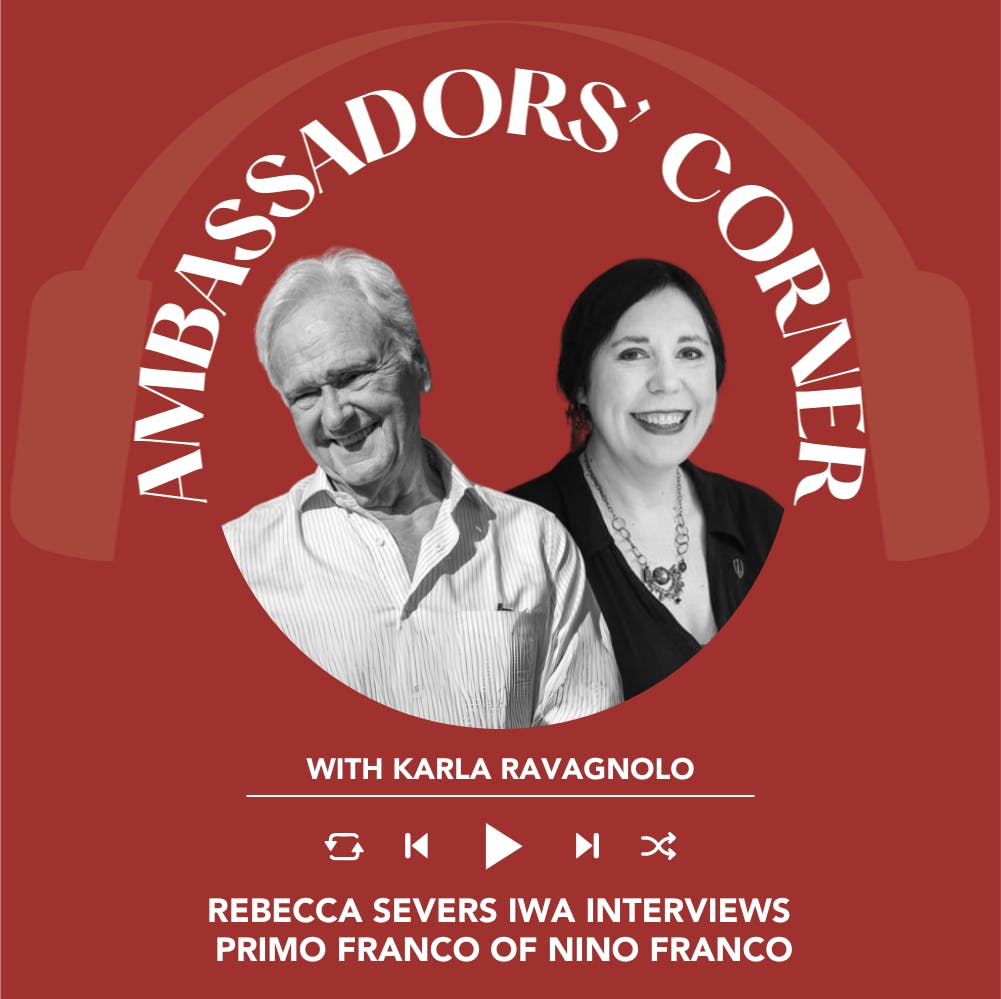
Ep. 2290 Rebecca Severs IWA interviews Primo Franco of Nino Franco winery | Clubhouse Ambassadors’ Corner
Episode 2290