
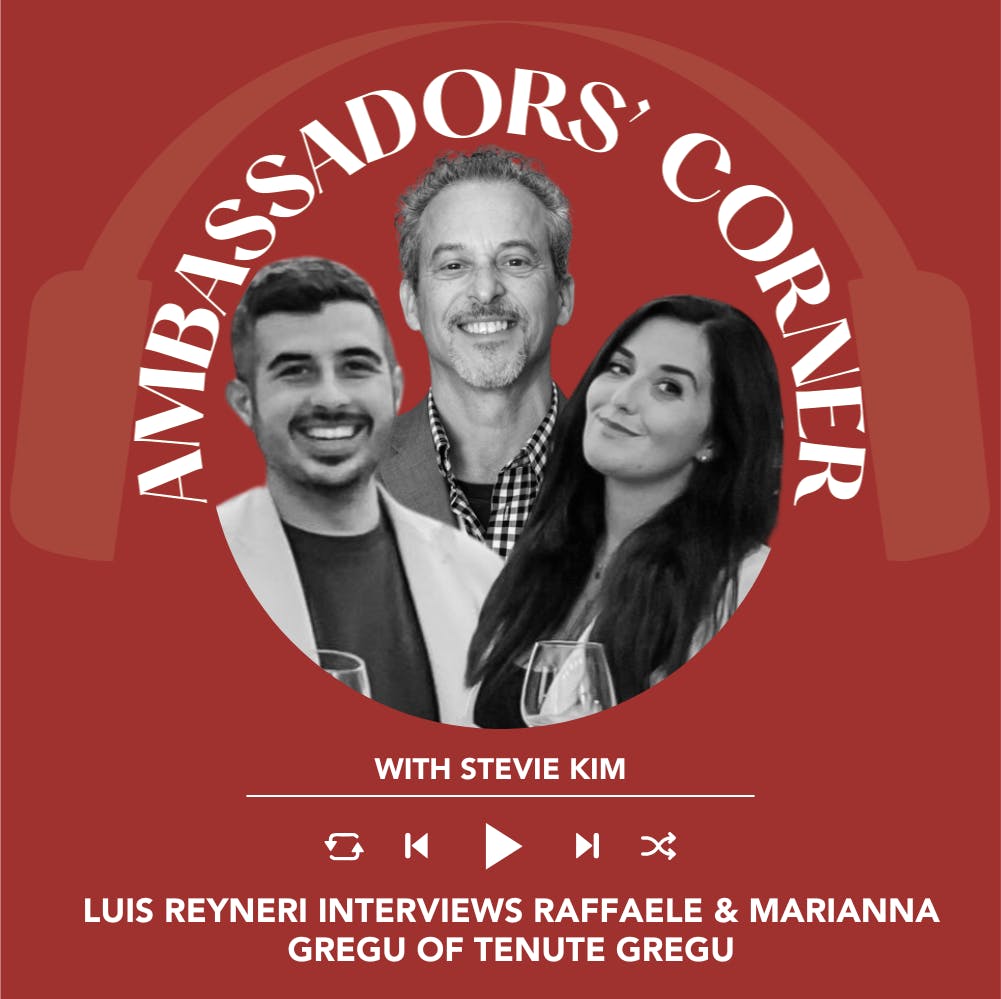
Ep. 2178 Luis Reyneri interviews Raffaele and Marianna Gregu | Clubhouse Ambassadors’ Corner
Clubhouse Ambassadors’ Corner
Episode Summary
Content Analysis Key Themes and Main Ideas 1. Introduction to Tenuta Gregu, a family-run winery in Sardinia's Gallura region. 2. The unique terroir of Gallura, including its high elevation and constant Mistral winds. 3. The family's artisanal and nature-respecting winemaking philosophy. 4. Detailed discussion of Tenuta Gregu's diverse wine portfolio, particularly Vermentino, Cannonau, and Carignano. 5. The integration of local Sardinian gastronomy with their wines. 6. The challenges and distribution strategies for a small, quality-focused winery. Summary In this episode of the Italian Wine Podcast, host Luis Reneri introduces Mariana and Raffaele Grego from Tenuta Gregu winery, located in the Gallura region of Sardinia. The couple shares the heartwarming story of their family's deep roots in winemaking and their decision to revitalize historical vineyards in 2011. They emphasize the unique microclimate of their vineyards, situated 500 meters above sea level with a constant, strong Mistral wind that naturally protects the vines from disease, allowing for minimal intervention. The Grego family details their artisanal winemaking approach, focusing on respecting nature and expressing the terroir. Mariana elaborates on their eight wine labels, including three distinct Vermentino di Gallura DOCG expressions (Rias, Thale, and the unique dry botrytized Petraya), two Cannonau DOCs (Reginas, Animoza), a Carignano IGT (Calagranis), and a blend (Greos). As a chef, Mariana offers insights into food pairings, suggesting their reinterpretation of Sardinian Panada with Vermentino and traditional Culurgiones with Cannonau. The discussion also touches on the family's dedication, their shared roles within the winery, and future plans for international distribution. Takeaways - Tenuta Gregu is a family-owned winery in Gallura, Sardinia, rooted in a long family history of winemaking. - Their vineyards are located 500 meters above sea level, benefiting from a unique microclimate and constant Mistral winds. - The strong winds act as a natural defense against fungi, enabling an artisanal winemaking approach with minimal treatments. - Tenuta Gregu produces eight different wine labels, with a significant focus on Vermentino di Gallura DOCG. - They are unique in Sardinia for producing a dry, botrytized Vermentino called Petraya. - Their winemaking philosophy prioritizes freshness, elegance, and respect for the natural environment. - Mariana, a professional chef, provides traditional Sardinian food pairing recommendations for their wines. - The winery is actively expanding its international distribution. Notable Quotes - ""Our mission... is to make a big difference in a little place, a little town... we produce fresh scratch Italian food that really the town has come to love."" - Luis Reneri - ""The strength of the Nuta Gregul lies not just in its remarkable setting, but in the unity and dedication of the family that runs it."" - Luis Reneri - ""We do a blend between, like, the roots. So tradition, and we do innovation. So we keep the tradition, but we try to create something innovative."" - Raffaele Grego - ""The wind wind, the the grapes stay very healthy. This is one of the best, the one of the best, treatment from the nature."" - Raffaele Grego - ""We look at the weather. We look at every every single condition. And we say, we decided, yeah, it's time to go in the wire. And that's why we we go two times, more or less our three times are two times a year."" - Raffaele Grego - ""When I'm explaining our wines, I'm always saying that the common line is freshness and elegance."" - Mariana Grego Related Topics or Follow-up Questions 1. How do the unique characteristics of Gallura's terroir, particularly the Mistral wind, influence the flavor profile and aging potential of Vermentino di Gallura DOCG? 2. What are the specific challenges and rewards of producing a dry botrytized wine like Petraya, and how does it differentiate from sweet botrytized wines? 3. Beyond the mentioned pairings, what other traditional Sardinian dishes would complement Tenuta Gregu's Cannonau or Carignano? 4. How does Tenuta Gregu plan to navigate international distribution challenges for a small, quality-focused winery, especially in new markets? 5. What impact does the surrounding natural forest and three lakes have on the overall ecosystem of the vineyard and the health of the vines?
About This Episode
The owner, operator, and director at the Grove winery discuss their mission to make a big difference in small town and their involvement in the Italian wine community and auctions. They also discuss their vintage natural wines that reflect a collective passion for nature and share their approach to preserving grapes and avoiding rushing. They discuss their success in growing their grapes, their love for nature, and their favorite food pairings. They also mention their plans to expand their distribution and thank their audience for their support.
Transcript
Being that Mariana's a chef, what are your favorite food pairings at the wine or itchy size gingales? And what do you recommend with Vermentino and Canada? So let's say that for our Vermentino, one of my favorite pairings is our taco Panada. That is a reinterpretation of the traditional, Sardino Panada. Welcome to the special club house session of the Italian wine podcast. Listen in as members of the Italian wine community engage in fascinating conversations about contemporary wine topics. If you enjoyed the show, please consider donating through Italian wine podcast dot com, and remember to subscribe and rate the Italian wine podcast wherever you get your paws. Smith while you're doing, don't forget these testing tips. Okay. So if you are ready, we can start. Okay. We are ready. Great. So, hello, and welcome to club house, the ambassadors corner. My name is Carla Avano. And today, I'm pleased to welcome Luis Reneri, and his guests, Rafael and Mariano Grego from Hello. Hello. Thank you, Karla. So, Luis, I would like to start by introducing a bit of your background. You are born in Cuba, and you are an advanced familiar, Italian wine Ambassador and certified wine educator. With over thirty years of experience in wine and hospitality, today you are also the owner, operator, and one director at the Grove, Cuchina, and wine, where you share a mission with your wife. Would you mind telling us a bit more about it? Sure. Well, well, thank you for having me on, against. I always enjoy being on the podcast. And our mission, we started six and a half years ago, which has gone by rather faster than I thought it would. Is to make a a big difference in a little place, a little town. We have a our town is about fifteen thousand in population, and we produce fresh scratch Italian food that really the town has come to love. And we have the largest find this in our county over three hundred wines. Eighty percent of that is from Italy, and I represent all twenty regions with a different, red and white indigenous are talked in a scrape so that we can educate the consumer. And so we employ a lot of the local, younger folks, students that are in the hospitality trade because in our community here in the southeast part of Florida, the tourism is growing quickly and rapidly. And then we have an auction that we will hopefully kick off next year And the goal there, the objective there is to give back to the community that has allowed us to serve for the last seven years, supporting boys and girls club or any other that that has a has a need and that's the, treasure coast charity one fest That sounds amazing actually. Thank you. Thank you. Thank you. Why did you decide to invite Mariana to the Italian one podcast? Sure. Well, I had the opportunity to meet, this lovely couple Mariana Raffala in Chicago at the, in Italy launched last month And Italy was drawn to their energy and their genuine hospitality. So I imagine the wines would fall and be just as good. If not better, then they'd certainly deliver their beautiful wines. And I thought we have to tell this story. So what are the learning objectives we should expect from this interview? Sure. Sure. The the objective learning objectives is to identify listeners who, like myself, haven't been to Sardinia in particular region, Magalura, home to Vermentino with an emphasis on location and wide production focused on Verintino and Canada. That sounds very interesting. So, enough with my questions, it's for your time to to shine and ask the questions to the producers now, so I'm passing the mic to you. Looking forward to hearing this conversation. Thank you so much, Carla. Let me give the audience an overview of this wonderful winery. Tenitugarebu, again, in the northeast corner of the island, Sardinia, in the region of Galluda. It is nestled five hundred meters above sea level in the lush landscape of Galluda, Sadania. And it took a day to spend thirty acres with twenty five day in the holluda and five to red grapes. The winery grows indigenous varieties such as Canal, Karignano, Mouristelu, along with unknowns like Merlo and Sarat. The mine is surrounded by cork, small rivers, and three serene lakes. The terrain is vibrant and varied, crafting a unique terrace that deeply influences the wines at Tinatogrego. Their approach to winemaking Art is artisanal. Ninety percent of the work happens in the field, nurturing each vine with the remaining ten percent in the cellar, ensuring that each bottle captures the essence of the land and labor. The strength of the Nuta Gregul lies not just in its remarkable setting, but in the unity and dedication of the family that runs it. Together, they craft wines that reflect a collective passion and love for nature, offering drinkers a taste of their rich heritage and soul of Galuta. This is a journey of flavor where tradition meets passion, creating wines of extraordinary as the land they come from. So with that, child, Mariana Rafael, thank you for being with us today. John Reese. We, we made you can just tell the the energy resonates in the call through these lovely folks. And we, as I said earlier, we met in Chicago at the launch of Venintoli last month, and, was a magnificent event. By the way. So I wondered if you would take a moment to share with with the honest story of your winery. How did it begin? So, yeah, you mean, I'll begin between, like, as a new or I'll begin with the the winery. The winery. So everything started, like, I will tell the introduction, and after we give the the word to Raffa. So everything was started, with the family. So with the anchen of the family because the family grows up in a phoney. There is a the I aida's point in the mountain in Sabinia. So, the family was working always with the nature. So we produced wine since the nineteenth century, but in the past, was produced only for family for the neighbors, you know, something like easy. And after that, all the roots are, like, eradicated with the, like, shepherds, creating, like, cheese working properly with the nature, So when Raffa grows up and the family moved to Albia, he he felt like that it needs to work again with that nature. So in that time, he was like calling to himself this opportunity And in two thousand eleven, we bought the new table. And now I give the word to Raffa. Yeah. We bought these, these spices, of land that is are very historical, vineyards here in in Gallura. So we are talking about the the vineyards of Guero mancini as every family when the the main person died, the sons we're the, I can say that. Yeah. Very with the air ready. So it's, it's it's a bit complicated, you know. And, so, one of these songs decided to sell that these, these beautiful wines we decided to have to buy these vineyards. So it was, I can say it's it was a love at first, at the First side. Yeah. At first side. And, we visited this vineyard site. It was unbelievable is, it's, so it's, it's, an amazing, it's an amazing place where the these, these vineyards are. They are very historical vineyards, and, the position is very, very, very nice because they were, so we are vibed. Yeah. We are in Sardinia. Everyone thinks that in Sardinia, we have only the beaches, but it's not, it's not only that. We are in the hills. We are five hundred meters above sea level, and this help us for a lot of a lot of things. So it's, it's amazing. So we are constantly so we have constantly the the wind. So, yeah, the menstrual we will see, during the this interview, a lot of things that the the position of, these vineyards, so that what this position give to us and to the wines So because, it gives us a lot of, a lot of, a lot of things. And also, we do, like, a blend between, like, the roots. So tradition, and we do innovation. So we keep the tradition, but we try to create something innovative. Fantastic. Now, I understand that you both grew up in the nearby area or town, but didn't know each other. So how did you meet? I ended up all night. This was really this was really funny. You're so for for the audience, just to let that nobody on it is a chef, a professional chef, and I'm very, very good. I can't wait to taste for cuisine, but probably that's how you got, Raffa. So tell us about how you two met. So, actually, this was really fun because in the in the past, I used to live in London, and still one of my best friends, she's there. So once she asked me if I could come to because also she's from Selvina. So she's still she in London and she asked me if I could come to to take someone for her and bring him to her parents. And I say yes, but, in that time, I was a personal chef for a Russian family, and I had only the Saturday off. And she was like, no worries. It's not a problem. They are still working. I said, okay. So in that day, I came here and as, like, in the second that I step out from my car, we saw each other and was, like, love at the first time. In that time, straight like this. From that time, we are still together. That's fantastic. Fantastic. That I met your brother in Chicago. Who else in your family is involved with the winery? Because I know it's the hands on everybody's involved. Everyone is involved in, in the winery. So my brother, my father, we divided the, the rules. Okay. So, basically, I end of the administrative and business, the administrative side of the of the business. And also, I mean, the seller working with my brother and with, also, our energies, who are also with, our filmmaker, and, my father, is is the one that, is the man that take care of the one yard with, also my brother. So basically, there are areas where I can say we work together, but, we divided all the all the rules during the all the rules or during the during these years. And, Mariana, actually, the last this year, we we opened, the doors of, of our vineyards, and Mariana is, so, is the chef that to prepare. All all of the things is the manager of the of the experiences here in, in the cellar. Yeah. Everyone have a day's role, but we work together with in in every topic because we think that the the team work in every area, can give better results Let's say that. Yeah. It's a lot of fun. Now let me ask you this regarding the water. For those of us who have not yet visited Sardinia, can you describe your location on the island, the weather, the effect of the mistral and the wines? Elevation and strolls in the vineyards. Yeah. So our winery in the in the shanty landscape of Sardinia. Not far from the majestic lima mountains. So we are between the lima mountains and the coast of Maryland as as, as we said before. This location, is blessed with a panorama of spruelling oak and olive tree, which not only enhance the beauty of surrounding, but also contribute the ecosystem balance that support our wires. So this is graced with the Mediterranean Mediterranean creamade, which means We enjoy yachts, dry and summer and mild wet winters. A perfect combination for grape growing. So that the the the seasons are really dry and hot during the the spring and summer season, but this year was, also dry during the winter season. But, yeah, we have all all the year long, the, the menstrual. So also, for example, the yesterday, we have the menstrual year that was seventy kilometers per hour. And it was very, very, very strong. And also during the spring, as you know, there are some some things that, so the actions say, and every year is more like the same. They call May is the the month of, of the wind. And that's true because every year, during May, we have the strongest wind during the year, about two hundred kilometers per hour. So how do you protect the grapes? I know you had the GEO training system. How do you protect the grapes? Yeah. You know, that the first one is that we are five hundred meters above the level. So the season for us starts later than, some of our, colleagues here in in Sardinia. And, So, you know, we don't have to protect the grapes because we are not in a danger moment for the vineyards. So for us, it's really nice. So, for the this kind of wind because, where you have, dry weather, a dry, yeah, a dry weather where you have, con, constantly this, this kind of wind not a hundred kilometers, but, so for us, when, for us, let's say that, for us, there is no wind when you have a wind of ten kilometers per hour. It doesn't exist that day with a with zero kilometers brow one of wine without the for us, it didn't exist. He tell us to to to grow the the the grapes in a very healthy because where you have the dry weather, You don't have, fungi. Yeah. Foonji, like, the, like, all of the, all of the things. This, all of these, signals. Yeah. So you have these kind of things where you have the the high humidity. And with our, with this kind of weather, you can't have high humidity. The things are different during after the middle of August. After the middle of August, the things switch, literally. So you have a high, high difference of temperature between the day and the night, and so it creates humidity during the night, but in the first hours of the morning as the sun comes up, you have the, still the wind. And, it's this helped you. This help us to grow to have alleys harvest because, the plants absorb this this kind of humidity. But, the wind wind, the the grapes stay very healthy. This is one of the best, the one of the best, treatment from the nature. Yeah. Treatment of the nature, one of the best, one of the highest point. Yeah. Highest point of, of of of Sardinia. So if you think, we close our, seasons with, two treatments with all the season. This year, we closed the the season with, two treatments. The last year that was very difficult, because we had the rain during the summer that is very strange for us. We closed the season with three treatments. Well, I would imagine having that wind constantly blowing is a real blessing is when this does it start in the morning? I mean, I again, I've never been there. So I've I've been in California with the ocean. Pacific Ocean starts in the afternoon. How is it over there in Sardinia? That is probably all pretty long? No. Actually, we we have, like, all the day, as Raffa says, we are constantly the wind every single day, and mostly all the day. We have a lot of deals. So if you go in the field during the morning, you will can come up, like, completely wet. But this is good because, like, the plants are taking, like, as a, a reserve, you know, and they use when they need. But after a week, when the day is coming up, it start the wind. So starting the wind after, starting like the sun, so it's going to be like hot, and it's going to be dry. So it's like, a particular microclimate that we have here. But we have the wind every single day. And mostly, we have wind until, like, six pm during the summertime. It depends. So if you have a mistral, like I mistral, it keep going all the night. All night long. But if you don't have, like, a really strong mistral, around six pm is going to go down and it will be, like, really slow. Therefore, us, as Raffa says, it's no wind. Because here in Sabina, we have a really, really strong wind. Well, I can't wait to go because I I I love flying kites. And Yeah. I'm gonna bring my kite. I hope for my Yeah. And we can all be Now let me ask you this. You said that there's a bond between the land and the winery. Can you explain what you mean, Alpha? Yeah. When we talk about the bond between and the land and the winery, So we just we are describing not only the physical environment, but also the the relationship we have with the nature as teamwork of this incredible place. So, we are our state is embraced by a forest that wraps around us like a protective belt, creating a strand, and harmonious environment. And inside these small rivers, with trot and the landscape, bring the life can contribute to the unique microclimate climate of our vineyards. We can stay here to talk about, our vineyards. I can say to you that is, impressive, to this, fantastic forest around us. As I as I said every time, it's better. So when you come to visit us, you can really understand what I'm what I'm talking about. We were talking about that there there is the wind from the morning, till the six six, seven PM. And it's like there is some someone that is, putting on a fun and switching switching off at six, at six PM. So if you don't see it, it's really difficult to understand or to see it and, but, you know, It's a really nice zone. It's a really nice place where we are. We are surrounded of natural forest. We have three lakes in the in our states. So it's full of wild wild animals, animals like the wild boar. The we have the the deers here. If you don't think so any anyone can think that we have the DRC are in in Galura, but, you know, every if you ask to, to scanny, when Growver, it it will talk to you. It will say that the is the most dangerous animal for human, in the vineyards is the, you know, is the wild boar, for us, it's the deer So it's a so it's a it's a really natural place and we respect it. Our touch is a is a very soft. Our approach is a winter. We go in the wire to to do the treatments when plants meet. Yeah. When the plants meet. It's not a mathematical, formula. No. We look at the weather. We look at every every single condition. And we say, we decided, yeah, it's time to go in the wire. And that's why we we go two times, more or less our three times are two times a year. And that's, that's why because we look, and we we listen to the nature. That's the point. Yeah. And that's a great segue to my next question, but before before I say that, and now I'm very much looking forward to Mariana's cooking of the Chingale, with something. Yeah. Right. I had it in toscana. But I haven't had it in sardinia, so now you got me really hungry. But let's take way into into the wines that you make. Let's get into the meat, potatoes. I believe you make about eight wines. So can you tell us about the Rosato, the one, fermentino, and Canal. So, actually, now we produce eight labels. So, mostly, we produce vermantino. So in thirty hectares that we planted, we do twenty five of vermantino and five of red grapes. But, actually, in those old, eight, labels that we have, we start with a city. Today is our rose, a hundred percent made from Canal grapes, and, is like the sure name of mermaid. So there is a tale that say that in this area of Sardinia, all the small stones in the beaches are mermaid, transform to stones. So we decided to give this name. And this is because having the wind every single day and position it, like five hundred meters after the sea level, this is going to give a really good influence to our wines. So we have a rosy really fresh, completely dry with a note of minerals, and it's a kind of, like, different kind of rosy. So it's not going to be sweet at all. Not even a small point of sweetness. And it's like in some points, could remind you, like, also the beaches. So it's really, really fresh, and it's really, like, nice to drink here in the summertime. And this is our city. After that, I will pass through our rias. Rias is our classic Vermentino. So we produce three different ways of Vermentinos. So rias, it takes the name a kind of Rio is dedicated for the, all the small rivers that we they're passing through our, you know, one yard. And and also, we produce only Vermentino de Gallura docG. It's the only docG that we have in Sardinia. And we are in Gallura, so we are producing that. And Rias is, like, a vibrant and classic Vermentino. Is it reflecting the freshness, the minerality, and the aromatic complexity of our terrace. So classic, it means, for us, not without body or without texture. He has his own, but he's more like kind of easy drinking. He's a he's a really light, versatile. Like, you can drink in any anytime, any part of the day. So you don't need to pair with something. After that, we go through our. So, Selena means you, you because he's, pick it up when we are harvesting in the early morning because it's a superior one. So the grapes are really delicate. So we we do in the early morning, and we give the name. So this is a superior So it's a a refined vermantino with a intense aromatics and structure palates. And also it has a balsamic because where is position at? They're pressing like close small rivers. So you have a lot of spontaneous herbs that are, like, growing up naturally. And this is influencing in a good way our superior one. And for, we we harvest, like, around September, October, I can give you now the the proper date because it's changing every year. And we produce one year later because in this year, we won't seem to to reflect this personality take his time because for having a good product, you don't have to be in a rush. You must respect the times. So with the sale and we also do this, and we do few button as during the year. And after that, we go through our Petraya. Petraya is means like Tom Land and is our top. In this time, we are the only one in Sardinia producing this kind of wine. Is a hundred percent Vermentino de Galura DCG superior one. It is hundred percent made by Botriety's Nobics. And this is really unique. Also, the color is kind of proper gold and it's completely dry. And when you when you are, watching the sunset, lay down in the beaches, and you smell the smell of the sea, And it reminds that because this is because we have the wind every single day. It is really helpful. And we do one year, like, eighteen months of batonash every week. Is a small production also because, you know, one hundred percent motrittities. So it's not, that the liquid is everything like gone with the botritties. So you you don't have a really huge production, but it's a really, like, good one. And, also, we do respect a lot of the nature. So it's right. It's only when the nature gave to us the butt ridges. And after that, we have the Raginas. Reginas is our classic and on now. It's a DOC. And the names means roots, roots because with this one, we will like to recreate the one that our, like, actions we're creating. So a classic panel now made only on a steel tanks, but reflecting his own, like, potential. So we are not using bars at all for his for this one. And it is really like, easy drinking, I mean, about rats So you can also drink when it's really, really warm during the summertime because it has the sun notes of freshness, some notes of herbs, and this is because we try to preserve what the nature gave to us. So this is our most important things that we do. So we really love to work with the nature and we really respect. So we are trying to don't change what the nature gave to us. And after that, we go to animoza, animoza and Sardoza means, like, strength. Someone is really, like, strong and embraced, like, something like this. And this is still a canal, DOC, hundred percent, but he made twelve months of resting on a secondhand burrows. And the burrows is going to give you, like, a micro oxygenation is helping to to be, like, more round and smooth. We don't love when the wines are too high in tendons. So we try to give a balance. When I'm explaining our wines, I'm always saying that the common line is freshness and elegance. And after that, we go up to Calagranis. So Calagranis is a Calagranis, Pitraya, and the Greos are the three ones that create our premium line, our monogram line. So we have a classic line, the monogram line. And Calagranis is one of the the part of the monogram line. So the premium. Calagranis is an IGT. It's a hundred percent Carignano. So normally Carignano and Sardinia, is made in the south. So in the Sujis. So Carignano, the Soljis. We produce, like, carignano from Gallura. So it's completely different. Also, like, the the positioning, the the ride, everything. So also, this one is made on a on a on a steel tent, and it's a really, really, like, new way to to see the carignano. It's really fresh, smoothy, mineral fruity. It's like it's a really good, like, positioning of carignano and Gallura. And the Calagranis is the ancient name of, calangians. Kalangyan is the town where where we are based. We will give a name to give, like, a gift to the to the place where we are based. So we were studying, and we found the Calagranis was the the ancient name of Kalangyan. And after that, we go through our Grails. Grails in, phoneme languages means they're Grails. So we dedicate to the family. Grails is the only blend that we produce. So what we do, all the five grapes that we grow here, Canal, Kariliano, Maristello, there are three indigenous, as you said before, Luis, and after, so we put all together. We do thirty months of resting. So we produce five different wines. When they are ready, we do the same percentage. Twenty twenty, twenty, twenty, twenty, and after that, we put all together at a rest for thirty months. And those are our eight labels. That's amazing. One of the things I love about Tierra Valentino is the salutiniti. And if you're a fan of that style of wines, then, I highly recommend you enjoy all three of the Remantinos. Was gonna say most of your production, then I would imagine it's based on Verma Cortino, and the other wines are small production. Correct? Yes. Right. Being that Mariana's a chef, what are your favorite food pairings at the winery size gingale. And what do you recommend with Vermontino in Canada? So let's say that for our Vermontino, one of my favorite variants is our taco Panada. That is a reinterpretation of a traditional, sardino Panada. Sardino Panada is, like, a Spanishian Panada. Yeah. More or less is, like, a special panada that is stuffed with, pig, pig meat. But we, really interested in, this, this, this, with a cream of cucumber and marinated onions. We give that a fresh, Let's see that. A fresh, a fresh touch of this, a typical, salvinian, dish. And, yeah, for the canal for for sure, there was a delugeans that is, that that is a traditional stuff at pasta from, sardinia that is, stuffed with, potatoes, fresh, sheep cheese, and mint, and this perfect. Perfect pairing with, with a with a can now. Yeah. And they're they are rosetta. So it gives, is is the perfect bearing with a with a classic can now for sure. You're really making me hungry now to drop from me. Yeah. You have to come with me. Am I getting on a plane to lose Hadeen at tomorrow? Yeah. Tell us about the funniest story that happened at the winery. It's it's a since you've been making wine and first vintage was two thousand fourteen. The winery has founded an eleven. It was the funniest, their pages story in those, eleven, twelve years. Yeah. So, it was a one, two years ago. So this guy was working with us. In the winery during the the harvest. It was supposed to to check the the filter. But, you know, for some reason, it was, it was not a proper checking the filter. But at the end, it got late it didn't check on time. When he, he checked the the filter, it was very close to the filter. The, the filter exploded. And so and it left a a print of me in the world. So it was a print of me in the world. And it was completely full of full of wine. So and the stove. We had the imprinting of, until the end of, of the harvesting in the in the wall. Yeah. Yeah. You probably won't feel that now. Yeah. You have to move in the future harvest interns not to do that. Make sure you take your filters right. My final question for both of you is where can our listeners buy your wines? I know that in December fourteenth, we're having our sixth annual wine tasting and sale, and I'm looking forward to, presenting the Vermentino Canal, and see what my local audience responds. And, Hopefully, we tell a lot of you why, but we're for those listening around the world, in Europe and, North America, etcetera, where can where do you have distribution? How can we access your wines? So First of all, from both of us, thank you for supporting live apps and and featuring however, I mean, given Canada to your restaurant, your six hour wine tasting, like, on the on December fourteenth. Thank you so much for this. And That's right. Grabs. Yeah. In Italy, our wines are available in many restaurants and one shops and all around. And for the international customer, we are, actively expanding our distribution nature. So we are trying to to find a way to make our wines, move abroad, you know, like, everywhere. For having me. I wish everybody happy holiday season if we don't top you for the end of the year. Thank you. Thank you, Steveie. Thank you, Louis. Thank you, Carla. Thank you, all of you. Thank you so much. Thank you guys. Just follow-up on what Lisa just said because the connection was a little, shaky in order to contact the, and Mariana, their Instagram and Facebook is and their website is experience dot com. And the email should you be interested in getting, like, direct in reaching out directly to them is experience at denutigragu dot com. So thank you everyone. It's been a very interesting and pleasant talk. I really wish to visit you or see you in person soon. Yes. We really hope to, view and all the people that would like to join us. I think this is a rep. So thank you everyone. No job. Listen to the Italian wine podcast wherever you get your podcasts. We're on SoundCloud, Apple Podcasts, Spotify, email ifm, and more. Don't forget to subscribe and rate the show. If you enjoy listening, please consider donating for Italian wine podcast dot com. Any amount helps cover equipment, production, and publication costs. Until next time. Chitching.
Episode Details
Keywords
Related Episodes

Ep 2325 Anna Obuhovskaya IWA interviews Fabio d'Attimis-Maniago of Attimis-Maniago | Clubhouse Ambassadors’ Corner
Episode 2325

EP 2316 Alberto Martinez-Interiano IWA interviews Emiliano Giorgi of Progetto Sete Winery | Clubhouse Ambassadors’ Corner
Episode 2316

Ep. 2308 Anna Obuhovskaya IWA interviews Sara Repetto of Vigneti Repetto | Clubhouse Ambassadors’ Corner
Episode 2308

Ep. 2299 Beverley Bourdin IWA interviews Grégoire Desforges of Baglio di Pianetto winery | Clubhouse Ambassadors’ Corner
Episode 2299
Ep. 2290 Rebecca Severs IWA interviews Primo Franco of Nino Franco winery | Clubhouse Ambassadors’ Corner
Episode 2290
Ep. 2281 Julianne Farricker IWA interviews Mattia Montanari of Opera 02 Winery | Clubhouse Ambassadors’ Corner
Episode 2281