
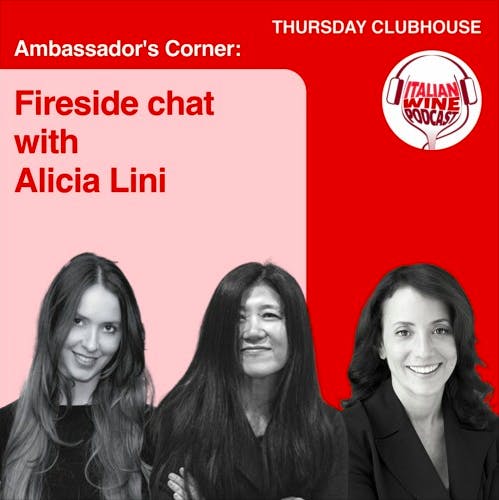
Ep. 677 Susannah Gold Interviews Alicia Lini | Clubhouse Ambassador's Corner
Clubhouse Ambassadors’ Corner
Episode Summary
Content Analysis Key Themes and Main Ideas 1. The re-evaluation and promotion of Lambrusco as a quality sparkling wine, moving beyond its past image as cheap and sweet. 2. Lini 1910's century-long commitment to traditional, dry, and balanced Lambrusco production. 3. The versatility of Lambrusco grapes (e.g., Salamino, Sorbara) and the distinct characteristics achieved through different production methods (Charmat, Metodo Classico, and even a unique Lambrusco Bianco). 4. The importance of food pairing with Lambrusco, emphasizing its adaptability to both traditional Emilian cuisine and modern international dishes. 5. The challenges and triumphs of a niche, quality-focused producer navigating market trends and affirming authenticity. 6. The role of discipline, family legacy, and personal dedication in upholding winemaking standards. Summary This episode of the Italian Wine Podcast, recorded live from Clubhouse, features host ambassador Susanna Gold interviewing Alicia Lini of Lini 1910, a fourth-generation Lambrusco producer from Emilia-Romagna. The discussion aims to uplift Lambrusco's reputation, presenting it as a high-quality, versatile sparkling wine. Alicia shares her family's history, starting in 1910, highlighting their steadfast commitment to producing dry Lambrusco using both extended Charmat and traditional Metodo Classico methods, focusing on native varieties like Salamino and Sorbara. She describes the unique characteristics of their wines, including a white Lambrusco Bianco made from Salamino without skin contact. The conversation emphasizes Lambrusco's exceptional food-pairing capabilities, from local charcuterie to sushi. Alicia also recounts Lini's struggles during periods when Lambrusco was industrialized and cheap, and how their dedication to quality helped them endure. She touches on the meticulous, small-batch nature of their production, their traditional balsamic vinegar, and the discipline she learned as a ballerina that now applies to her winemaking. The interview concludes with an open invitation to visit the authentic Lini winery. Takeaways * Lambrusco, particularly from producers like Lini 1910, is a high-quality, versatile sparkling wine, challenging its former reputation. * Lini 1910 is a fourth-generation family winery committed to traditional, dry, and balanced Lambrusco, often pioneering methods like Metodo Classico for the region. * The winery focuses on Lambrusco Salamino and Lambrusco Sorbara, utilizing extended Charmat and Metodo Classico to achieve unique expressions. * Lambrusco is highly food-friendly, pairing well with diverse cuisines, from Italian staples like tortellini and pizza to international dishes like sushi. * Lini 1910 produces a unique Lambrusco Bianco from 100% Salamino grapes, made without skin contact. * The quality of Lini's wines is attributed to meticulous grape selection, precise fermentation processes, and a philosophy of balance. * The family resisted market pressures to produce cheap, sweet Lambrusco, which tested their business but ultimately preserved their quality focus. * Alicia Lini's background as a ballerina instilled discipline and consistency, which she applies to the winemaking process. * Lini 1910 also produces high-quality traditional balsamic vinegar, aged for at least 12 years. Notable Quotes * ""Lambrusco is a fantastic quality wine, and that's really what I want people to come away from this chat. Thinking about forgetting about the way past of Lambrusco."
About This Episode
The Italian wine club is hosting a wine club session, where they will be interviewing famous Italian wine producers and sharing learnings about their wines and their favorite wines. They will also be touring their booth and sharing learnings about their wines and their family's focus on quality and resistance. Speakers discuss the use of traditional techniques in production and the importance of being authentic in crafting. They also talk about the success of their project, the importance of tasting traditional foods, and the importance of proper quality in the crafting process. They emphasize the importance of proper quality in crafting and encourage listeners to donate.
Transcript
Welcome to this special Italian wine podcast broadcast. This episode is a recording of Clubhouse, the popular drop in audio chat. This clubhouse session was taken from the wine business club and Italian wine club. Listen in as wine lovers and experts alike engage in some great conversation on a range of topics in wine. If you enjoy listening, please consider donating through Italian wine podcast dot com. Any amount helps cover equipment, production, and publication costs. And remember to subscribe and rate our show wherever you tune in. This episode is proudly sponsored by Vivino, the world's largest online wine marketplace. The Vivino app makes it easy to choose wine. Enjoy expert team support door to door delivery and honest wine reviews to help you choose the perfect wine for every occasion. Vivino download the app on Apple or Android and discover an easier way to choose wine. My name's Stevie Kim, everybody, and this is the Italian wine club on the clubhouse. I know this is not our usual Thursday slot, but sometimes we have to make exceptions to accommodate different time zones and schedules. Today is one of those. Today's call is our twelfth installment of the Ambassador Corner series on Club House. As most of you recall, Ambassador Corner is where Italian wine ambassadors, like Susanna and what I like to call the Modsquad, who are others from the Italian wine ambassadors community, to get a chance to nominate and interview their favorite Italian wine producers on Club House. So today, we have, of course, Alicia and Susana Gold as the mod next week. We're back to the Thursday slot, and we have Tanya Morningstar Darling, who will be interviewing Donatella Cinelli Colombina. And then the week after that, it's seventh of October, and we have Slavik Kominski, our number one Italian wine podcast listener and our neo Italian wine ambassadors as well. We'll interview Mikaela Shenza. Mikaela Shenza is the son of, Atilio Shenza. So, and so he talks a lot just like, Atilio. So watch out for that. And then we have the week after that, Mark Miller, who will be interviewing Mario Fontana of Cashena. So look out for those, up in the coming weeks. As you know, this room will be recorded. And probably, replayed on the Italian wine podcast. And as usual, I have a I've got a small ask. If you know what you know, you know what we do here. Right? I mean, it's and nobody gets paid, and Italian wine podcast is absolutely a labor of love. From me, myself, Joy, and Leica, and the entire gang, including the Italian wine Ambassador, Speaking of which, like I just sent me a note, rightly so, because I don't know if you know, I too was, declared the awardee of the the Rivino. So that's like, you know, the man of the year kind of award for, from Fontatune Masi. So we're very, very excited about that. There is a kind of a powwow celebration on the twenty fourth of October. If anyone is interested in attending or I think it it will also be streamed live. So if you if you go to the Italianvine podcast and if you can give a thumbs up to the Italianvine podcast and radar podcast, wherever you get your pause, we'd really, really appreciate that. So I'd like to now go and introduce our host ambassador, Susana Gold today, who will be interviewing Alicia Lini. So Susana, Actually, she's a sister of a friend of mine. I've met Susana years ago, because I went to I did my MBA with her sister Lisa who I've I've not seen it in the longest time. And, Susana started her wine career way, way, way before I did. I think she holds like one thousand certificates in the wine arena, but the most important one and the only important one actually is She is also a Italian wine Ambassador from the Vineetree International Academy, of course. Hence, our host moderator today. She is an educator. She's a woman who is very talented in doing many things, an educator, journalist, communications. She does anything you ask her to do. She's also, I believe the ambassador for, the consortium of Lugana. And recently, also, is that Yeah. It is. It is, Altripo Paveza. Exactly. The lumbered regions at the moment. Yeah. And she has written for many, many magazines and periodicals. So listen, Susanna. The question I always ask are, of course, why did you choose Alicia Lini as your favorite producer to be interviewed today? So I chose Alicia Lini because I'm a huge Lambrisco fan, and Lini Lambrusco is an incredibly iconic and fantastic version of Lambrusco. And I picked Alicia to feature because she's such a big proponent of Lambrusco, and I really admire her spirit and kind of she's been everywhere, you know, as a proponent of Lambrusco. And also, I've been doing a grape series and I'm up to the l varieties, and I happen to be right at Lambrusco. So it kind of everything worked together. That's fantastic. So how when did you discover the wines of Lini? So, actually, I just I went to graduate school in Bologna, and that's when I discovered Lambrusco, but I discovered the wines of of, Lini, actually, when I came back to the United States, through Jeremy Parson. Oh, I know the dude. So Jeremy is a What's his blog called? I can't remember. Dobianci. Right. Right. Dobianci. Yes. And he's a huge fan of Alicia's wines. And so he was always talking about them and writing about them. And I was like, you know, these are Lambrisco wines that I haven't yet tasted. So let me taste them. And then I tasted them and understood immediately why he was so interested in these wines. Okay. Great. So we're really looking forward to, hearing your interview with her, your fireside chat. But, you know, you know, we're kinda geeky here at Via at the Italian wine club. So what are the learning objectives, that we should expect from the both of you today? So, first of all, I think what we should look at is that Lambrusco is a fantastic quality wine, and that's really what I want people to come away from this chat. Thinking about forgetting about the way past of Lambrusco. I know the high level of everyone in this group, and so people think of Lambrusco as a great wine, but I just wanna reinforce that understanding. And then the understanding that there are many varieties in the Lambrusco family, I believe there are sixty. But there are a couple that are people really focus on, and I wanted to get Alicia's take on the different Lambrusco that her family focuses on, the Lambrusco variety. I mean. Okay. Then that sounds fantastic. I have my drink ready, my wine. It's not Lambrusco, but it'll do. For now. So I'll just shut up. This is the the part where I shut up and I get to drink my wine and to you. Okay. I'm gonna introduce Alicia. So, Alicia Lini represents the fourth generation of the family. Producers of some of Italy's most acclaimed and highly rated sparkling wines, they if you see their logo, it says leanie nineteen ten, and that's when they first established their winery in a town called Corrego, which is in the Erego Media province. In, media Romagna, of course. They're not, family that's really into the trends of Lambrusco, so they've always made dry, Lambrusco. That's what they make, that's what they've made, and that's what they're focused on. They do traditional hand riddling, and they focus on having wines that are fresh with bright fruit flavors and that are really fruit friendly. About Alicia personally, she started her career in a totally different industry that has something actually to do with her name. I've learned just today. She was a ballerina in another part of her life. So, let's can I ask my first question to Alicia? Course. I'm here. Can you tell us a little bit about when your family winery was founded? I said it was nineteen ten, but can you tell us a little bit more? Yes. It was my great grandfather. They start to produce wine and balsamic vinegar. The wine was already sparkling because we are in the land of Lambrusco. And we also, the generation of my grandfather, so the generation after, start to experience also the pinot noir. So, basically, the family is focused on sparkling wine, and Lambrusco is the eighty percent of the production plus this twenty percent of pinot noir and the balsamic vinegar. It's a big passion that moved my family, to, to focus on quality and resist also during the years where when Lambrusco was exported in a very cheap and, yeah, low level. So we always focus on that. And we, have been the first start to experience also Lambrusco through, not just the Sharma, but also classic method, middle classico. Can we talk about which Lambrusco variety your family has really focused on? Since at the beginning is the Lambrusco Salamino and Lambrusco sorbara. Because as you said from the beginning, we are under the province of Regemilia, but we are no far away from Karpi, which is already under Modena. So we probably got the influences from Modena, and, we reinforce, our belonging in Rajamilia in, you know, together with the salamino and Chilotta and serveara, the three of them. The three of them. But I think that probably salamino represent that we are not far from Santa Croacher. We are very close. So from from, you know, I think that Salamino represent the most of my family because, for example, the classic method that we produce is one hundred percent of Salamino. So can you tell us a little bit about that class method because that's interesting. Do you consider? Is that a wine or is it a spumante? No. It's a spumante. Okay. It's a it's a spumante, and, it's a v s cool. It's a And, this is an amazing, an amazing experience that really characterizes our family in, the research. And, I think in something that, We start, in between your fifty and sixty, and we never stop to reexperience every every year. Everything is Milizime. We produce a grand couve of Lambrusco. And, something very romantic. If you consider even the past about Lambrusco and my family that, you know, try to challenge themselves, itself in, spending years in order to obtain a bottle of Lambrusco instead, to to invest the hours or just a few days. Yeah. Let's talk about that too, because so, Lambrusco can be made into us. It can also be made into a Frizante. So you do both the classic method and the Sherman method but your Sharma is a long Sherman. Is that right? It's a very long Sherman. You can obtain Lambrusco or even in a week time, our, you know, entry level, our, first, the product is obtained between three or four months, not recommended long term, in a big recipient. And this is a way to obtain, the bubbling is really incorporating to the wine. And, we are able in this way to obtain, something very elegant, even if the Lambrusco is a simple, it's a everyday life, wine. What about, so is Lambrusco or is it blend? I know you said that your classic method is a hundred percent salimino, but as are the other wines blends, or are they all a hundred percent the different varieties? No. For example, our Rosier Now our premium line, the rosette, is a fifty percent salamino, and fifty percent to serveara, or in the Labruzka line, which is very, well distributed in the United States, is, eighty five percent salami nine and fifteen percent of sorbada. That's interesting. So it's kind of a decision of the different producers. So according to the legislation, it can be both. What about your favorite Lambrusco pairings? Do you have favorite pairings? No. I, you know, I always say no because they are very different. Lambusco is a very big family. And even if, our Lambusco is under the Lini family, sometime, I I really enjoy a glass of Lambrusco Roses. Sometimes, I really looking for a Lambrusco Scuro. That is a little bit darker. Sometimes, I cannot stay without a glass of metal to classical. It's like, if I ask you which is your favorite shoes. Yeah. No. No. That's that's true. But do you do you have do you feel like Lambusco matches with different kinds of food? Do you ever drink Lambusco with sushi, for example? Yes. Yes. I love a bit of the classical with the sushi and sashimi. I enjoy so much of the rosette version with, with the fish in general, even, you know, poor fish, sardonini friti, or a risotto with the Frutti dimare, work with the tuna, like this. I love Lambrusco, score with the plates of Capelet embroidered. I like You're making me seriously hungry now. My joy is so much. A glass of Lambrusco with with the pizza. I joined once, with Stevy, a clubhouse on pizza and a match with the wines and, Lambrusco came up. And and I love also, I don't know, some bread with a chug of Cantabrico and a glass of Lambrusco white, obianco, which is Lambrusco salamino one hundred percent, is a very good, friendly glass. How do you how do you make it Bianco? There is no skin contact. Okay. And, my family in the past has started to produce Malvaziran. At some point, they stop and they start to experience Lambrusco Bianco. Because, they have been attracted in the past. And even today, you know, about, France, Champagne Awards, and everything, and at some point, with my family or to consider the idea that's, from, we can obtain, a white, a Lambrusco, a blank memoir of Labrusco. And, and this is works. So it works. Are you the only family that makes, a white Lambrisco? I think I've only had one other one. I think a few, but just because sometimes it's more expensive to produce it because there are some technical operation that you can add to the entire process. And, you have to be well affirming to the market in order to be recognized for a certain quality. So you cannot produce a white Lamroosco and then fight on a bad level. So sometimes it doesn't worth it. And for my family, it makes. That's so interesting. What about, are there aspects of your tear? What's the tear water like where you you have your vineyards that contribute to to the the Lambruscoast that you make? Does the does the soil have a lot of? Yeah. I have to say that, Lambrusco, I think, is really improving now, also in the vineyards, but sometimes the mechanical picked up, just compromise on time, sometimes the, the, the quality. And, I think that the, the quality you can obtain is, about the terroir. It's true that the good wine born in the vineyards. So the selection is the base of everything. My family is really maniac about that. But it's also the time of fermentation and the the all the process that we, have in, in the winer. In the container that makes it expensive. And, and I think that once I tried to ask you to my dad about the prime material, the terroir, and everything else. And, he answered me in this way, say, Alicia, we decided to, focus on quality, and there are many, many factors that contribute to the final quality. And, sometimes, we can focus on grapes in general. But if me and you, we go to Champagne, we pick up the grapes of don Perignon, and we come back and we try to produce don Perignon, doesn't come up don Perignon. And they just, understood the, the, the easy, quicker sample that he want to to share with me just to to make me reconsider all the aspects that contribute to the final quality. So you know that that picture on your website that that looks like a rock band. Are those your brothers or your cousins? Like you and two handsome men? Who are those people? Are they your brothers or their cousins? Yeah. We are very crazy. Yeah. We love this project because, we really, we really fight in order to make it. And, we are a family team, and we are proud to to to be together. But not a rock band. Like, we are not a rock band. No. But you let you because that's photo. It just really makes you guys look like a rock band. So I digress. No. We're not a rock band, but what we are doing is rock. That's that's true. That is true. You just symphony, everything that happens. In your in your winery and your amazing wines. So can we talk about how you see Lambrusco sort of globally and in particular in the US market where I am? I think that we have an amazing perspective in front of us. And, I don't know. You know our story, you know how much we we fight in order to affirm our name, the distribution and everything. But I think, we have a real chance, if we are really focused on quality, and, if we are focused together with other producers. To make Lambrusco more of a household name, you mean, in a in a a different view of Lumber's go? In being real, Susanna, in being authentic, and not building any story behind, and, just, there is this time of storytelling, but the storytelling has to be true. And has to be consistent, and, anything has to be fake, for the next years. And I think that everybody has a nice story to tell if it's true. And let's can we can we talk about if I'm tasting Lambrusco in a glass blind? Let's say, because a lot of people who are listening are professionals or, you know, really serious white people So how do I know that I'm tasting Lambrusco? Quality, lemursco? Are you tasting lemursco? Well, have a let's start with lemni and then have a lembrusco in general. I think, that you, if you approach a red sparkling wine, is not difficult to focus on, Lambrusco immediately. Because Bracchetto is gonna be sweet. But also, you know, in Lambrusco, you can find a sweet or a banana or I think that the low alcohol that is inside the glass of Lambrusco, I think that this is, probably, a characteristic that can put you in the condition to recognize the Lambrusco. Okay. So that's a marker. Yeah. Mhmm. I think and if it's dry and authentic, when you drink Lambrusco, you really want to enjoy food with. I think that the connection is not just about a glass of wine, but a wine that connects your sense to to something to eat. I don't know if I answer you. Yeah. No. Absolutely. So that's if I'm I'm if I'm tasting Lambusco, generally blind. What if I'm tasting a leanie Lambusco blind? What will I be getting in my glass? What will make me say, oh, this is a league. This is a legal drug. One, I think that my dad has, whose technology has a particular focus on the efficacy. So you're approaching something very simple. But, you recognize that behind this, there is, an unbelievable research and studies on, on the balance. He really love relevancy. He really likes simplicity in term of, he doesn't like anything that has to be too much, too sweet to acid, to dry, to sparkling too. So you he always says that the wine that you really enjoy is the one that is like a music, that is, in the room, but then, you forget what you are listening because it's just really comp penetrate, in your, more than mine. That's a great that's a that's that's a great answer. I don't know if I have any more time or if I should open the floor, where Stevie opens the floor to questions. I don't know, Stevie. Going to, bring Paul up because he actually raised his hand from the get go. Let me try to get him up. Paul bologna. Of course he's our, your fellow Italian wine Ambassador. Listen, Alicia, while we bring, Paul up. And, for those of you in the audience, if you'd like to ask a question, this is a good time to raise your hand, and I'll bring we'll bring you up onto the stage. Paul, I'm trying to bring you up I'm I've invited you. Now you just have to accept. Let's try to do that. Listen, Alicia. In the meantime, can you give me, of course, you know, kind of the Give me the load down with regards to how many labels do you have in total? And what is in Three lines, see. Okay. And what is the Three lines, h two are Sharmat. We have labruzka. Which has been considered also from one spectator, the best sparkling one in the world under twenty dollars. So so this value quality price, and red and rosso. And then we have Incora Joline, still Sharma, but he is, more fermented because the Labuschke is obtaining between three and four months, and they encourage July between, six or seven to just double. And then we have, pinot noir, padosse, metodoglacico, and de lambbrusco, metodoglacico. That is something that you probably you tasted in opera wine. Which one did we taste in Alfred? It was, method of classic or also Milizima two thousand six. And and how, like, what is the production, like, in terms of volume of these? It's ten thousand bottles every year. Oh my goodness. That's so, like, tiny. You can drink it basically in your family. We just make them watch manually, Stev, and we make the decoder more manually. We sign every single bottles manually. So it's a hard work, compared to also the the Sharma that's, we just bottle twice maximum three times a year. Oh my goodness. So, like, what that's really a what about the other other wines? How many do you mean, how many bottles? No. It's just three hundred thousand bottles. In total. Three hundred thousand bottles. In total, but we are at tiers, in a in a, I don't know, in a ocean, really. We are very small. Oh, you're good. Terms of Ambusco producers. Yeah. Well, thank you so much for sharing that wine with me. Too bad. I didn't get a chance to drink, you know, have a drop of any of that, but that's fine. You don't the problem is like running out for wine is like time to drink my glass of nah, to Stevie. I want to just text you and say, look, it's impossible. The next time is gonna be possible this, that you drink another, not another wine, but even another typology. So you need to to have our language go just to taste. Yeah. I joined. When you Yeah. The problem is, like, you know, when you're running these events, it's like, you know, it's like you're the bride and, you know, of the, of an wedding. Right? You never get to eat the food, the taste of food. You're just too busy running around. Right? I there's so many great wines. We had hundred and eighty seven wines that that really the best of what Italy represents. But I do do you know I didn't get a chance to drink a glass of anything? You know? It it's not because they don't like me. It's just you know, I didn't have time. Yeah. But so, yeah, that sounds I can't wait to taste some of your wines. So, Paul, you had your hand raised since the get go. It must be really, really important. Hello? Yeah. No. I that was a mistake, but I do have a question. I feel like you and everyone's had a drink already tonight. Okay. Go ahead. Well, my question is, well, I've been to Modena before, but I I haven't gone out into the countryside to to go wine tasting. And what what is that experience like? What would is so if I'm staying the night in Modena and I came out to visit your winery, is it open to the public? Is it, you know, what what would the tasting entail? Do you mean if you visit Lini? Yes. You are always welcome to visit Lini. That's it. It's official. Everybody, Tolini. Yes. It's true. It's true. It's true. It's like that. We are we are not an organization. We are a family. And I remember that the first time that, for example, wine became I was really embarrassed because I said, oh my god, we don't have nothing to, to show in a way. We are as we are. But, we show our our authenticity. So it's Pines, Alami, Lambrusco, and the nice chat. And I I see peoples that are joined as even tonight that they just really already came. And, I saw a fermented boss that was here. Now it's not anymore. And No. He is. He is, but he just changed his, avatar. Look at that. Okay. Okay. Does it look familiar? Now you can see it. Right? No, Paul. You're welcome. Everybody, you're welcome. You can write me an email and we we can accord each other and, you know, on your and my agenda. And it's really a pleasure. You you'll be sorry you've said that now. It's it's going to be like, you know, because it's my pleasure. Nine hundred people in the Italian wine, you know, community of vias. So They are what, Boma. I I mean it. Thank you. I never, you know, when I say that, I want to be authentic as my wine is, I don't say anything if I don't feel and I don't think, what I'm saying, really, from from my heart. Everybody are welcome. Of course, that I if I'm in New York, or I'm inside, I will postpone the the meeting. But, you know, if not, I'm, you know, a pleasure to have you here, Paul. Thank you. Thank you. Vermented boss. Hello. Hello. How's everyone doing? Now I can hear you fine. But, you know, in your recording, when you were you were interviewing Ariana, you're you're recording your sound wasn't so great, but now it's perfect. Yeah. It was probably because I was in California, you know. Yeah. You know, California, they don't have WiFi. Right? They don't have good WiFi. Alright. Listen. I'm not in New Jersey. Mister fermented boss, here, do you have you got a question for Alicia? Two things. First of all, I just wanted to tell Paul and anybody else to definitely, visit Lenny, because she showed me the winery, her Balsamic and, took me out and educated me on the local cuisine and what pairs best with, with the Lambrusco in this fantastic. Can you tell us share some of those pairings? Yeah, I probably don't remember how to pronounce. Yeah. But I know you're you're a man from, you know, New Jersey. I understand. Thanks, Steve. Hey, Steve. I'm from New Jersey too, and I can pronounce it. I know, but you're you're you're you're fluent and entire. You're a woman. Right. Yes. That's Okay. Let's do try your best, mister priest. Yes. Exactly. You knew exactly what I was gonna talk about. Yeah. Wait. Wait. Alicia. You're not let him. Give him a chance. The poor guy from New Jersey. Listen. Alicia is a wonderful, wonderful ambassador, and she helps me out very well. And thank you very much. So, basically, it's it's a fried dough, and, they serve it with the local, charcuterie. And, real simple dish, but it was fantastic with the fat of the dough and the fat of the the meats and the lambrusco, the acidity. It just, it made my afternoon after a long flight from, from New York. So, you know, I I I can tell everybody. A big shout out to also Melissa Leika and Drey, Annie, Curin Jody, Sheila, I saw other people before Kevin was here before. We're going to start a new new series on the Vineetually International Academy. So I think one day, we're going to dedicate it to food and wine pairing. So you guys should send your, you know, favorite food and Italian wine pairing. That's just, you know, by the way. Did you have another question, Hugh? Well, I just wanted to ask Alicia to to talk about her balsamic. I know we're we're talking about Lambrusco today, but she all they also produce a balsamic, which is fantastic. Yeah. That's fine. Yeah. Well, the balsamic has the same, project of quality. You can find, something around that is not authentic, and we just decided to produce, this, must cooked and aged at least, twelve years in order to be called traditional So, yeah, it has to be at least, twelve years old. So we produced the direct lobster, the silver, and the gold, and, It's an amazing, and it's an amazing experience just to try and to, you know, the pairing with, with the parmigiana or with the strawberry, with the ice cream, and based upon the the aged I think that, there there is a lot of to, to say about, balsamic, but in a way, I think that you have to trust the, the producer, and go through because, is, is something that you don't have many opportunity to taste and to record in your, mind and has a taste. So I think, it's gonna be a cool experience if you visit us and we try different balsamic, together, really. So, Alicia, You know, I had no idea you make a Lambrusco bianco. What does that entail in terms of the winemaking process? There is no skin contactor from the beginning because if you cut grapes in the middle, the the grapes is always white. Yes. Tried. Mhmm. So is the skin that gives the colors to, to everything? So there is no skin contact. While, for example, there is just a skin contact for less than twenty four hours. And, and what are the grapes? This, Lambrusco Salomino, one hundred percent. Okay. And it's the same grapes, sir, that my dad works use for the method of classic or also. So when we start when I conduct, a one tasting with our line, I started with Elambrusco Bianco, four months in a big recipient, not to recommend it. Charmark method. So drinkability, fruits, is very fruit. We're very food friendly. Good as an imperative, but very good, with the food. And they finish my, family taste, with a method of classical Roso, Milizeme, two thousand and six. So fifteen years in the bottles, red. And, from the beginning to the end, is, Lambrusco, I open, and I close with the Lambrusco salami no one hundred percent. So it's unbelievable. The ver the versatility of Lambrusco grapes, in order to check considering the pairing, but also consider the final results, in term of wine, there are two completely different words, not two completely different wine. Vermont and Bos can confirm this. So, you know, I am, I'm thinking that you're making such a small quantity. I mean, relatively small quantity of, wine in terms of volume. And so you, your distribution is not exact you know, the supermarkets. Right? Yeah. Yeah. So so how did you, survive? Or how what was the pandemic of the past, you know, eighteen months for you in terms of sales and, The pandemic was a flower comparing to the past years. So because, my family has been the first to start to export to Lambusco in the United States. But then we have to step back, in the years where Lambrusco just became too industrial and too sweet and too cheap. So my family started to to realize that we couldn't even compete, not just with that quality, but also with that kind of project. So we stand back, and we choose, my family choose this, very pure position, you know, and, Macuistan, but this, poorest, decision just cut us out from the market, basically, because in that years, the, the Lambrusco was just cheap and sweet. And we refused to, to produce it. And, and the, and and the other Italian wine or Italian style that represents the made in Italy was, red, steel, complex, would be very alcoholic wine. So we couldn't even play the championship of Lambrusco because we stand back from that level of market. But we couldn't even play the championship of, Italian wine in general because we, we were not even considered, a wine producer years, three years ago, because we were producing, drinkability, food friendly wine and spa thing. So it's been tough. Keep Stephen has been very, very tough. Who's your who's your importer? Who's your importer in, stateside? In America. Wineba. Okay. Wineba. Put my myself in a in a plane. And as Susana said, I tried to to deviate the new face up through me, through my family, through our idea, through our story. I met, friends, not just people, not just, colleagues, but people that really believe in our project. And, I didn't make anything by myself, but together with, and apparently we are do it. Okay. Well, we certainly will do whatever we can to, you know, help you and promote your your wines. I think we can safely say that. Like, who is our clubhouse manager, backstage manager, is on stage. Like, I know you were looking for a house with your husband to be. I just arrived now here in Modena. So No. I mean, I look forward to see. Yeah. I and I I'll definitely go there. Well, oh, okay. So here's my question. Susana mentioned that, you have you have another discipline before you became a winemaker. Is that right? So how the how did that help you in, in in in in doing wine? I mean, like, how did this discipline allowed you? Ah, okay. I'm not I don't know. I think that I studied ballet for twelve years. So I just got my final diploma. In, classic ballerina, but I was really young, and I didn't realize what I was doing every day. I think that the passion just, makes everything very lighter, compare the real sacrifice that me and my family, we made it. And, what I learned, the discipline, you know, how to be focused, how to be constant, consistent, that you can obtain, what you want if you, if you are focused this, you know, this mechanism, but from heart, you know, from, from heart, not in any Italian, say, like, memory. Now, from, yeah, from, I think that this has really helped me in life. And then I went abroad. I started to talk my bachelor in my master's degree in UK. And when I come back, my dad, I want to stay in UK and take my PhD, but my dad asked me to come back to force me to come back, basically. And, say, Alisha, I need you, and, you know, the family need a new generation to have a light, and they say, you have to come. If you like it, you stay. If you don't like it, you you you fly back, and they like it, and I try to stay. This is the little story. That's very inspiring. Thank you for sharing that. Listen, Susanna, do you have any other questions? Otherwise, I think I'm going to close-up the room. That sounds great. Thank you so much for joining and dedicating all this time to us. It's been really great, to share this conversation with you, Alicia, about your wines. And, I know you have three daughters, so I'm sure there are people waiting for you. Alicia, how can we where can we find you? Have you got a separate, like, handle for your Instagram? Or Yes. I'm on Instagram. You can write me there on on Facebook, and my email is Alicia, Kiautula, Lini, that's my family name, nine one zero nineteen ten point e t. Alicia Kia Kia Kia Kia Kia Kia Kia Puntiti. Fantastic. So we'll be looking forward to writing to you and torturing you with many more questions and Can wait. Yes. And and and sharing a glass together. Thank you so much. Super interesting. Thank you, Susanna, and don't forget to come back you guys next week. It's Tanya Morning, Tanya Morningstar Darling. This is really her name. It drives me nuts. She will be interviewing, donatella Chinelli Colombini, back to the Thursday slot eight pm. And that's a wrap. Chara, I got you. Listen to the Italian wine podcast. Wherever you get your podcasts. We're on SoundCloud, Apple podcasts, Spotify, AMLIFM, and more. Don't forget to subscribe and rate the show. If you enjoy listening, please consider donating through enwind podcast dot com. Any amount helps cover equipment, production, and publication costs. Until next time. Hi, everybody. Italian wine podcast on the Breats' fourth anniversary this year, and we all love the great content they put out every day. Chinching with Italian wine people has become big part of our day, and the team in verona needs to feel our love. Producing the show is not easy folks, curting all those hosts, getting the interviews, dropping the clubhouse recordings, not to mention editing all the material. Let's give them a tangible fan hug with contribution to all their costs, head to Italian wine podcast dot com, and click donate to show your love.
Episode Details
Keywords
Related Episodes

Ep 2325 Anna Obuhovskaya IWA interviews Fabio d'Attimis-Maniago of Attimis-Maniago | Clubhouse Ambassadors’ Corner
Episode 2325

EP 2316 Alberto Martinez-Interiano IWA interviews Emiliano Giorgi of Progetto Sete Winery | Clubhouse Ambassadors’ Corner
Episode 2316

Ep. 2308 Anna Obuhovskaya IWA interviews Sara Repetto of Vigneti Repetto | Clubhouse Ambassadors’ Corner
Episode 2308

Ep. 2299 Beverley Bourdin IWA interviews Grégoire Desforges of Baglio di Pianetto winery | Clubhouse Ambassadors’ Corner
Episode 2299
Ep. 2290 Rebecca Severs IWA interviews Primo Franco of Nino Franco winery | Clubhouse Ambassadors’ Corner
Episode 2290
Ep. 2281 Julianne Farricker IWA interviews Mattia Montanari of Opera 02 Winery | Clubhouse Ambassadors’ Corner
Episode 2281