
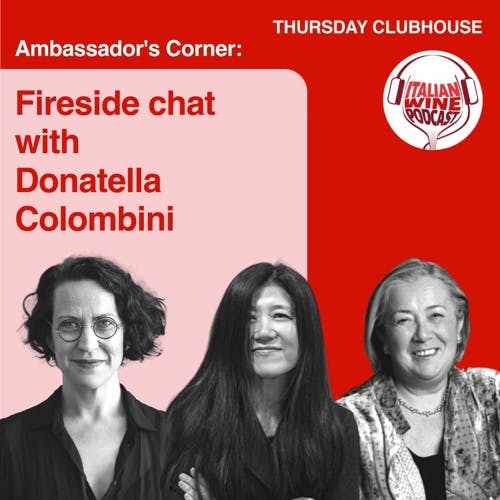
Ep. 682 Tanya Morningstar Darling & Donatella Cinelli Colombini | Clubhouse Ambassador's Corner
Clubhouse Ambassadors’ Corner
Episode Summary
Content Analysis Key Themes and Main Ideas 1. Donatella Cinelli Colombini's Pioneering Role: Her significant contributions to Italian wine tourism, including founding Movimento del Turismo del Vino and Cantine Aperte, and her leadership at Donne del Vino. 2. Evolution and Future of Wine Tourism: The shift from traditional tourism to more experiential, cultural, and localized exploration, exemplified by concepts like ""Tracking Urbano"" and post-COVID trends. 3. Empowerment of Women in Wine: Addressing discrimination, highlighting achievements of women-led wineries (like Casato Prime Donne), and advocating for equal opportunities and professional development for women in the industry. 4. Integration of Culture, Art, and Wine: Emphasizing the deep connections between Italian wine, art history, local culture, and gastronomy to enrich the visitor's experience. 5. Professionalization of Wine Hospitality: The need for wineries to offer more diverse and professional experiences beyond simple tastings, as detailed in Donatella's recent book. Summary This episode of the Italian Wine Podcast's ""Ambassador's Corner"" features an interview with Donatella Cinelli Colombini, a pivotal figure in modern Italian wine. Host Tanya Morningstar Darling explores Donatella's extensive career, starting with her art history background and her groundbreaking work in the 1990s that established Italian wine tourism through initiatives like Movimento del Turismo del Vino and Cantine Aperte. Donatella discusses her philosophy of ""looking"" to understand rather than just ""seeing,"" which informs her approach to tourism, exemplified by her ""Tracking Urbano"" (urban trekking) concept – encouraging visitors to become ""explorers"" of local culture, food, and history. She highlights how post-COVID tourism is evolving, with visitors seeking more authentic, intimate, and repeatable experiences, and a growing interest in less populated destinations. A significant part of the conversation focuses on Donatella's dedication to empowering women in the wine industry. She recounts founding Casato Prime Donne, a winery run entirely by women, to challenge gender discrimination and prove women's capabilities in winemaking. As the national president of Donne del Vino (Italian Association of Women and Wine), she details its efforts to promote wine culture, advocate for sustainability (e.g., lighter glass bottles), and integrate wine education into Italian schools. Donatella emphasizes that women are increasingly managing key sectors like marketing, communication, and hospitality in Italian wineries, demonstrating their growing influence and often superior performance. The interview concludes with Donatella sharing insights on balancing a demanding career (crediting family support) and discussing her new book on wine hospitality, aimed at professionalizing visitor experiences in Italy's numerous wineries. Takeaways * Donatella Cinelli Colombini is recognized as a pioneer in Italian wine tourism, having established key initiatives like Movimento del Turismo del Vino and Cantine Aperte in the 1990s. * Her art history background influences her philosophy of ""looking"" for deeper understanding, which she applies to tourism. * ""Tracking Urbano"" or urban trekking is a concept promoted by Donatella to encourage a new style of tourism focused on exploration, well-being, and cultural immersion in urban settings. * Wine tourism is evolving: visitors are increasingly seeking authentic ""experiences"" over simple sales, with a rise in ""repeaters"" and a demand for professional, varied offerings. * Donatella's Casato Prime Donne winery is run entirely by women, serving as a successful model against gender discrimination in the wine industry. * Donne del Vino, a powerful association led by Donatella, works to promote wine culture, advocate for sustainability (e.g., lighter glass bottles), and integrate wine education into tourism and catering schools in Italy. * Women in Italy are increasingly managing critical roles (communication, marketing, hospitality) in wineries, showing greater productivity per land area than men. * Donatella has authored a book on wine hospitality, providing guidance for Italian wineries to professionalize their visitor experiences. * The personal support system (family, collaborators) is crucial for sustained professional dynamism. Notable Quotes * ""I understood the difference between see and look. That is very, very different. If you see something, maybe you don't understand what are you looking for. But if you look something, you try to understand the meaning of the thing that you are in front of you."
About This Episode
The hosts of the Italian wine club discuss their upcoming installment of pilots' tour, introducing moderator Tanya Morningstar, a full-time wine instructor and writer, wine educator, and former ambassador for other regions. They also discuss the moderator's philosophy on promoting women in wine culture and promoting women working together. The tour guide talks about the importance of exploring the world and being in touch with local people to learn about wine culture and wine tourism. They also discuss the shift from tourists to influencers and the importance of community and communication in promoting wine tourism. The speakers emphasize the importance of working together to build alliances and opportunities for women to explore ideas and ideas without the influence of men. They also discuss the challenges faced by women in the wine industry, including violence andoppression, and the importance of family and entrepreneurship in managing wine tourism and hospitality laws. They also mention a book on wine tourism with a senator and offer a discount rate for those who donate.
Transcript
Welcome to this special Italian wine podcast broadcast. This episode is a recording off Clubhouse, the popular drop in audio chat. This clubhouse session was taken from the wine business club and Italian wine club. Listen in as wine lovers and experts alike engage in some great conversation on a range of topics in wine If you enjoy listening, please consider donating through Italian wine podcast dot com. Any amount helps cover equipment, production, and publication costs. And remember to subscribe and rate our show wherever you tune in. This episode is proudly sponsored by Vivino, the world's largest online marketplace. The Vivino app makes it easy to choose wine. Enjoy expert team support door to door delivery and honest wine reviews to help you choose the perfect wine for every occasion. Vivino. Download the app on Apple or Android and discover an easier way to choose wine. So hello, everybody. Chara Gatsy. My name's Stevie Kiman. This is the Italian wine club on the clubhouse. Today's Thursday, and we are back as you can see to our usual slot at eight PM central European time with the Ambassador's corner. Today's call is our thirteenth installment of the Ambassador Kona series on Clubhouse, and Tanya Morningstar Darling. Yes. That is her real name, or I think at least I think it is, well, I'll have to ask her about that later. We'll be our host moderator from the Mod squad to chat up Donna Dela cinelli Colombini, one of the absolute key players in modern Italian wine history. I mean, I've known Donna Tella. She was one of the first wine peeps that I had met in when I started with Vin Italy, of course. And Tanya, on the other hand, she's a newbie. Like, I've just met her really. So let me just remind everybody that you know the drill by now. This room will be recorded and maybe we played on the Italian wine podcast, fingers crossed that everything goes well. It the recording and all of that stuff, connectivity. And for all the listeners out there from both here on Clubhouse and the Italian wine podcast, as usual, I will ask you to please follow a tie in wine podcast wherever you get your pots. And if you can give a thumbs up to the tie in wine podcast and radar podcast wherever you get your pots, we'd really, really, really appreciate that. So let's go on to the show. I believe this is our thirteenth installment. It's kind of hard to believe, but let me first introduce to you, as the tradition are moderator, Tanya Morning Staw. Darling is a full time wine instructor and writer for nearly three decades. Wow. You look pretty great. You and I both. I think. You know, she is what she's also known as the seller muse all over, social media. She not is only the, program provider for wine scholars certification for French, Italian, and Spanish. She's based in Seattle with also one of our other, Italian wine ambassadors who had hosted the room the other day, in Teriano Martinez. And she is also certified wine educator for, WSet, level one through full. And she's an ambassador of many, many other, wine regions including Burgundy or Vieto, But most importantly, Tada, she has just become also the Via Italian wine Ambassador of Vine International Academy with the flagship edition. So as you know, I always start with the question. Tell us why you have selected donatella Chinelli Colombini as your favorite producer to be interviewed today. Thank you, Stevie. And, yes, this is my real name. I know. I I don't understand. Like, how does that how does that work? My married name is darling, and my name is Morningstar. Oh my goodness. It's pretty amazing. Yeah. You you I thought no one no one will ever forget that one. Yeah. No. No. No. I thought it was kind of a joke like, Mike, you know, the staff just, you know, had written that name and like, oh, we have a new candidate. Her name is Darling Morningstar, and I was like, no. You guys are kidding. Right? No. No jokes. But back to the pressing question at hand, Donatella really represents something very dear for me in terms of values. And that would be the value of promoting women in wine, maybe first and foremost, a sensibility, a a female sensibility in wine making and wine culture. And also as an educator who engages with educational wine tourism, I'm really fascinated, to learn more about her work in wine tourism as a as a pioneer. So she inspires me in lots of ways, and also as a person who loves history and art, which I know she does as well. So that's why. Great. Not that you needed any excuse, but so what are the, yeah, what are the learning objectives for today from What should we what should we expect from after the interview? Well, I really wanna, discover a bit more about Donna Talla's philosophy, in Wayne tourism, and also her ideas about what it means to promote women working together and supporting one another in the wine industry and why that's so important to her. Great. Fantastic. So, actually, like, our, clubhouse backstage manager just pinged me and said, this is actually the fourteenth installment. So she's she gave me a little bit of slack. And the next week is the fifteenth. And by the way, we will have, Slawek, your colleague, Slawek Kominski from Polan interviewing Mikayla Shenza. And then after that, Mark Millen will be interviewing Fontano Diashina Fontana from Barolo. So, okay, I fixed my drink already. So take it away. I'll just shut up now? Well, I first, I would like to introduce Donatella now, actually, and and say that I discovered Donatella's wines actually through teaching. So I was, working at a local college and discovered was working on a lecture about women in wine and discovered her work, and I've been inspired ever since, and have used her wines in many classes. And recently had the great pleasure of visiting her winery in Montalcino just a few weeks ago, which was really inspiring. But Donatella, she comes from a family of Bernelo de Montalcino producers, and really she's been involved with wine her entire life. So she actually interestingly has a degree in the history of medieval, medieval art, a shared passion of mine as well. And her work is really diverse, actually, before founding her own estates, as you mentioned, plural, which we'll get to. She made her mark on wine tourism, actually, before founding her own estates. Actually, before this term was in broad public knowledge, wine tourism, this all the way back into the nineteen nineties. She also founded the Movement Del Torres Delino and Cantina Aperte, which means winery open. Both of these things have had huge impacts, positive impacts on the Italian wine industry over the years. And I I believe through her experience, isn't her family, wine business. She gained the foundation to open her estates. Also, in the in the nineteen nineties, Fratera del Cola in truck Traconda, which is actually a Kianti and an Orchard DOC producer, Orchard DOC is a small appylation that Donatella is currently the president of the consortio for, one of her many things that she has going. Casato Prima de a prima donna in Montalcino, which is the estate that I visited a couple weeks ago. Those are the two estates. Donna Tella works both in winemaking and wine industry innovation, and her work is one many, many awards received lots of well deserved attention all over, the world, really, and specifically by organizations like, the European Sommelier Foundation, AIS, Bibenda, many Win tourism obligations and, of course, Van Italy. And she's involved in a really fascinating project that I look forward to asking her about, called Trecking Orbano or a new kind of tourism sport. She was this is a big one nominated for knighthood by the order of merit of the Italian Republic, and she's the national president of the Italian Association of Women and Wine Dona Delvino. It's totally staggering to me all of the many layers of achievements and contributions that Donatella has made and continues to make in Italian Wayne. So with that, all of that, I do have Lots of questions that I'm excited to ask you, Donatella. And if you could unmute yourself, we can begin. Ciao. Comesta. How are you? Ciao, Tanya. And thank you for this invitation. Thank you to Steve Kim for this big opportunity to to to speak with you about my winery and my story. Wonderful. I'm so excited. We have lots of things to talk about, but I'll go ahead and open with, with a question that takes you, that takes you back, to maybe an earlier part of your career. I know that your background is in in art history, which I'm imagining has informed your, your work in wine tourism as well. Can you tell us specifically what inspired you to think about wine tourism and begin a journey to promote wine tourism in Italy when this was really barely a thing in the world's consciousness. I was very lucky because I I grew up in a family of persons that loved the countryside, and my grandfather teach me how to what is important, how much is important to to be in touch with the final consumer with the wine lover that buy and drink your wine. And the only system we have to to contact the spirits persons, to have a relationship with these people is the wine tourism. And, it was him who teach me the importance of the of open the door of the Huawei for visitors. At the university, I studied Israel Finance. I understood the difference between see and look. That is very, very different. If you see something, maybe you don't understand what are you looking for. But if you look something, you try to understand the meaning of the thing that you are in front of you, and that is a big difference. And, it was a a lesson that I use all over my life to to to do something of different, to to look at the reality with the spirit, with the hope, to change something. Wow. I really love, what you just said, and it the idea of really looking for him and searching to understand things, which actually leads right into my next question about Trucking Urbano, And, I'd love to know more about what this is. It seems like perhaps it is a project, whereby people, can inquire and and look to understand meaning of culture and wine. So can you tell us about it? Tracking or banner is the version, the urban version of the tracking. In the countryside, you you walk and you can visit and you go around only in the good season when the when you have light and, and not in the dark, not in the night, and only in the spring, summer, or maybe in autumn. But, of course, you have to stop when the weather is is bad. The open tracking is is, of course, it is a sport. That you can use has a system to be healthy to use your city or another place to to to be healthy, but it is a different style of of of toys, that convert, that change the visitors in explorer. Explorers that are able to discover something of new Everwhere, the adventure begin out your door. Because each place, also your town, maybe it is a place in which a a a good working become something of healthy, but also a system to discover new friends, new information, artisan, foods, buildings, history. Something that, able to give you emotion and experiences. And so it is a new style to, to become, explorer instead of visitors. Not only in the most famous part of the of of of the place that you are visiting, but also outside to explore, to understand, to to be in touch with the local people. That's so wonderful. As a as a tour guide, we primarily are there with my students to learn about wine, but You can't you can't learn about and understand a time when without exploring Italian culture, art, food, getting to know people, exploring some of the language, the architecture, it's connected. You know, most people know that go that I love Orvieto wines, but if you look at the duomo, actually, the stones are the same stones that form the bedrock of the terroir. And so when you look at architecture, you're actually looking at the stones that the that the vines grow in, and those connections can be made for wine lovers when you're in urban settings too, which is really wonderful. You were gonna say something? I think that the urban tracking is the most, more done and more respect a system to respect the the culture and the local, activities. You you you enter in the life and in the place that you are visiting in the countryside, but also in the in the city. And, this is flowing. It is the right way to become tourists now. It is less, stressed for the, for the local, places that you are visiting and, it is a system to enter in the real, in the natural, in the, original culture of that place in the countryside and in the city. It seems like so much is changing about how we are going to how we explore the world and how we're going to explore the world. And I'm I'm wondering if perhaps in the post COVID world that well, I'm sure tourism is gonna change a lot. I think it's likely that people are gonna take interest in smaller, less populated destinations, and that that really will create opportunities for these things that you're speaking about I'm wondering what what you think is gonna be different about the world of of tourism and wine tourism in this new, you know, post COVID reality that we're living in. The biggest difference, the women. More visitors without a very strong interest in wine. More animals, dogs. Yes. The friends with four legs. And, and, the the the visitors are more interest in experiences and less in the the the the wine selling is maybe less than before in Italy, but we tell more experiences and the visitors ask us more something of new. Of different, a real and original experience of that place and only of from that culture. So you think that tourists are more curious, more able today to really investigate. Sounds like. That's exciting. Of course. Of course. The the wine tourist now is less tourists and more explorer. More is more interested in something of of different different, variety, different denomination, different wineries, something of small, something that respect nature, and something that is able to to give emotion because the story, because the family, because the passion, that the winemaker put in their work? I think people need to be we need to be more connected than ever before, which I I believe is gonna change how people interact. As you say, turning from tourists to explorer, and how how wonderful it is for people to actually have an intimate experience somewhere. It's I I don't mean to sound, you know, kind of out there, but it's it's healing for people, you know, from the isolation that we've been experiencing, to really, approach something and, feel like we've, like, we've connected with it, more than just on a surface level. I think that you've said a lot that will really inform wine tours and professionals about, how to respond to this moment, and in general to, the needs of people who want to travel, but if there was one little nugget, one little thing that you could say, key piece of advice for mentors and professionals, that they could put in their minds moving forward in this new landscape that would help them to better, meet the needs of this new explorer. What would it be? So do I many new tendencies. First, there is a new, the the the the, the number of the people that came back in the same place is increasing. The the the the name of these people is, repeaters, person that can back more than one time in the same place. And of course, it is really difficult to give them a reason to come back. So, also for the most famous places, it's necessary to organize something of new. For example, Monteaccino, there is a a a a a a museum problem that, that is something of new, a new experience. Second, the second tendons that is really increasing a lot is the, never ending. It means that the people that visit the, the wine areas need and hope to remain in touch with the wineries, with the local community. And, so, the wineries as well, the association have to organize a a system to give them information, emotion to keep the visitors to maintain the visitor in touch with the delight that is that is what what happened in in in in the winery and in the region. And sometimes it's not so easy because we are very busy in in the winery and in the in the vineyard, but is very important. This connection is is more important than before. And of course, for the for the professional is really important to book the visit some days before. Now, the main part of our visits, visitors, can book the visit, book the the the the the wine tasting only a few hours before the arrival for the professional is not enough. If, and winery, have to organize something of more important, more, why made is necessary, also a little bit, to have time to for this organization? Well, a couple weeks ago, when I visited your winery Casato prima donna, and had the opportunity to meet your lovely daughter, Violante, I really saw. She's here. Hi, Yolante. Ciao. It hasn't been very long since I saw you. But I wanted to say that your winery really embodies what you're talking about, this offering people something, something intimate that they can understand about what you're doing, but also the greater context, that that your winery lives within most specifically, through the art that, that exist throughout the winery, both the, you know, the replications of medieval paintings that tell stories about about Montalcino and help, visitors understand, something meaningful about the place that they're in, but also the contemporary art in the winery as well that really celebrates, the current moment, and I think all the things that you represent about, women and wine, and joyfulness, and, sharing. So I good job. I it really comes through. In a, in a way that I think, is so intentional, obviously, which doesn't surprise me. But I wanna ask you about this winery, particularly, and the premise of the winery as a winery that's run by women. Can you tell us a little bit, about how that came to be and and what it is and how it's different from your other winery or other wineries? When I won my father, my father and my mother gave me this property in nineteen ninety eight, twenty four years ago. There was a building that was like a ruin with some Vigna or Vigna around, and there was a lot of investment to do. And, so my mother gave me a little quantity of Bernelo just to help me in this in this startup of my activity. And so I I am not a a a technologist, a a white maker. And so I phoned to the school of ethnology in Sienna asking a good student to employee in, in my new winery, the winery that I was going to to build. And, they said no. We have not because the we have a lot of, demand for for this, for this student. And so you have to book this student many years before in advance. And, when I asked the same question, asking women, the answer was completely different. They said, yes, we have a lot because the good wineries don't accept women, has seller master, has manager. And so I discovered a discrimination that was so normal, so old, and so large everywhere. That was, also for me, was impossible to understood. The situation. For me, it was something of, something like a new information, something that I never understood. And, I decided to to do something to change the situation. A winery able to show that the great wine and not doesn't don't need big body, strong body, but we, the women are able to to manage a winery and to produce great wine without a strong body, a very strong energy. And after twenty four years now, we export in forty one, forty one growing nations. We have ten wines, with a judgment, with, a rating over ninety point on the international wine press. And, our business and our, success is increasing. Even if we are women. Of course, the situation is very different now. There are a lot of, women in the university that study and energy. And, from the study that we made, and we are going to show at, wine to wine, on, October nineteen. Nineteen. Yes. At Verona with Steven Kim, we understood that now in Italy, the wineries, managed by women and men, Divina, are managed and cultivated by men, but communication, marketing, and, wine and hospitality are managed by women. And so the most important sectors of the wineries are managed by women in Italy. This is a big news for for us. And for these, we can understand that in the future, women will have a very strong importance in the wine business in Italy. I love it. And I just you said even if we are women, and I would like to pause it the the idea, which I'm sure you probably will share with me that it's in some ways because we are women, which contributes to the success of and I say we, but, you know, and for you, the success of your winery and the success of of the projects that women are involved in specifically because of what women bring to, to their work that's different than men. And so you you already answered the question that I had planned to ask, thoroughly through that wonderful explanation, but I have a different question, which is What do you think is the different sensibility, in wine business that women bring specifically that's different from men that contributes to success, to your success. In the communication, in the marketing, one marketing, usually, the men are more They sell wine. The women create networks and, markets. It is a different style of work. Of course, We prefer wine that are more balanced, more without bitter taste, with a richness, with a very rich, aroma. But, of course, the profession of wine tester and and wine expert are the the same for men and women. There are no difference. It is only because the women usually are more able to create relationship that changed this time. So you are actually also the president of an organization called Donna Delvino. And, which I think is wonderful. Can you tell us a little bit about your work with this group and what the purpose of this group is? We are nine hundred fifty, members, and we are in each Italian regions. We, in in our members, we are one producers, owner of one shop and restaurant journalist, Sumili expert. And, we are also we two years ago, we we reorganized also an international network with ten association like us in different part of the world, but Donna Galvino is the biggest and the strongest, women association in the wine world. And we work in different sectors to promote the culture of wine and also the role of women in the wine board. Of course, now, for example, we work to use the light glass in the fine wine, bottles for the fine wine bottles. You know, that in Italy, it's not so easy to sell in, inexpensive wine in light and, glass, but it's very important to decrease the, the the the use of the heavy glass in wine. At the same time, we work to promote the, wine culture in, the school of catering and, the school of tourism in Italy. You know that in in Italy, the catering schools called, squall Alberghare has have not wine in the, national program of teaching. Yes. And also for the students that study, tourism is they are not, they don't study wine and food of Italy. But but now at this moment, wine and food, the most important attraction of, from for the for the foreign visitors that wish to come in Italy. And so it's very important to treat, teach them not only history of art, but also the barolo, the Barreco, the prosciutto depart. They have to show Italy has a paradise rich of culture and good experiences. So, really, you're saying that women are driving sustainability and also culture in in many, many ways through this through this organization. That's wonderful. Yeah. It is very important that we work all together. Each one of us that wish to do something is able to find a very strong help in our organization. Working together is so important for women, for many reasons. And although progress and opportunities for women in general come through collaborations, of course, between men and women, I feel that and and I think that your organization really exemplifies this. It's important for women to have professional spaces to work in company of one another to, build those alliances. And And actually, maybe even important to have an opportunity to work together in spaces without the influence of input of men for a time, not that women eventually shouldn't collaborate with men, but Throughout history, there's been so few opportunities for women really to, explore ideas, thinking, and scholarship, culture making, together without the influence of men, whereas there's been so many opportunities in history for men to do that without the influence of women. So, it seems important to me. Is that something that you also feel or through this organization, which is really focused on women, is it important to have that space that's just for women? It's very difficult question. I'm sorry. So, best of all, in Italy, we have different problems. The main one is the criminals problems. You you know that each two days, a women are killed. By sometime by the boyfriend, sometime by the husband and, but we suppose we we we don't know exactly, but we suppose that the, the aggression and the oppression and the problems that the women have in the, in the family, but also in the in the company in which they they are working, bigger than we expected. And so this is a real real problem. Second, second problem we we have is to that in Italy, usually, the average, the, culture of the women of of wine is a little bit more stronger than the men, usually the women that decide to work in the winery, in the wineries or work in the wine business come from different experiences. And, they come from, a degree or a master. And, but they own less than men. They have less opportunity than men in the normal situation. And, usually, for for women, it's less easy to act, promotion to ask, to increase the the the salary. And, so it's it's it's really difficult to change this situation. But in Italy, we have also a law that help the, helps the wire is the the the agriculture company with the, with the female with a female owner. So we we we ask to maintain this says hello, but also to give some more, something more to the company that gives the same salary and the same opportunity to women. At at at at women and men. Since it's the the thing that we are asking to the, to the Ministry Ministry now, this is the changing we need now. That's so true. I mean, so many of the things that you said are so meaningful and in the end, it comes down to women's ability to own property and businesses and have self determination through you know, being able to sustain finances, which allows women to put their mark in the world. So yeah, it it's very important work to to create that kind of stability and opportunities for women. Thank you so much. You know, in Italy, in Italy, the the property managed by women are usually smaller than the, state managed by men. So the women manage the twenty one percent of the, agriculture soil in Italy. But this twenty one percent produce the twenty eight percent of the, the culture production. So women are more able more competent, more performing than men. Here here. Well, your sustained years of dynamism are really inspiring to me. I I look at the timeline on your biography, and I think, wow. And looking at the projects that you started in your forties and fifties and beyond, I think it gives me real hope for myself, an inspiration for myself as a, as a woman and a, and a mother of small children that sometimes doesn't have all the time. I really want to do everything I want right now that, that there's opportunity for me throughout my life to really be, to continue to be a dynamic. And, so I wanna ask you this question, maybe selfishly as a as a help to me, which is how do you stay balanced with all these things, that you wanna do and accomplish over a sustained number of years? No. I don't understand. How do you how do you stay balanced with all of the things that you're doing? All of the things that you want to do, how do you how do you hold all There's so much. I can really a question for my daughter. Because I have the own full husband, but he did only because my daughter and my husband how can we that my life's not true. Family. Family is important. Wonderful. Well, I think that that that really kind of, was the main important question that I wanted to ask, you know, to kind of close-up about what keeps you motivated, and, and I think you answered it with the perfect answer, which is the people around you that love you and support you and, having having that, that we aren't actually not just your family, but the women that you have associated within these organizations that, through support of one another culturally in the family system and and in broader organizations, I think that allows women and people the space to continue to, innovate and engage and have, balance in their lives. So, You answered the question. Thank you. It's a good one. We should all strive to have good relationships around us. So Donna, tell her, thank you so much. The that is the end of my formal questions, and it has given me so much to think about. Thank you. I really appreciate it. I think now Stevie wants to open the floor to questions. Is that what we do now, Stevie? Yeah. I mean, we have a few minutes to, open the floor to questions. If anyone would like to raise their hand, I'm happy to, bring up anyone to the stage. As usual, I'll start. By the way, that last question, it's that's such a trauma. I I personally don't think there is a balance. I I mean, everyone talks about balance, but I I don't think there's much of a balance. I think Donatella I'm not sure she agrees, but so donatella, chow chow a gazza. So donatella, I want to ask you, have you seen any changes, first of all, Donna Delvino. How long how long, has it been when you've started it, right, Donna Delvino? Mhmm. And how many years ago was that? I can't remember. Thirty two. Thirty two years. So how has the, you know, the membership, the members, changed and the mission of Donna Delvino? Evolved in the past thirty years or so. Of course, the the mission is always the same. But, for example, the approach is different. When I became president of this association, there was a there was some some pictures on the, social media that show the, Donna Delin of the members of our association with wonderful dress a very, very elegant situation with the toast. And I said, stop with this picture. You have to show what are you doing, not only the social moment of your life. Our life is not made by fashion by on not only by fashion and, light and, and toast. We work. We are protagonist of something that is changing, and we have to show that. And little by little, they became more courageous. And now part of our what project are made by the members of the association. And, they teach in the school. They promote wine with a different way. And, for me, it is important because we are not only women and not only person of social occasion. We are protagonist in our wineries, and we have to show that. And, you know, as Donna Delvino, what what do you do like concretely? To help the younger, you know, generation of the tie in wine industry, the young women, are there any special projects that you do to specifically help them? Yes. We have. The name is Fouture. It means What is it? I'm sorry? The name is of this project is Fouture. Fouture. Future. Creature women of line, and, it was a project, to collect all the, all the activities that the members of our association can do to help the new generation to understand the wine world. After with the COVID, we convert, we converted these activities in educationals and, online activities of tutoring. Of course, in the future, we will continue this project has real activity in presence. It mean, visit, with with explication or, investment in, in, how do you say the, mostly studio? Scholarship. Receive, internship, trip in other countries. The before the the the, the, the project was to go in Chile with a group of, women of wine just to visit a a countryside that is new for the wine production, but also a place that are able to show a different way in the in the wine production. And so it is a project that is changing but was able to to offer opportunities also during a decoded period. Oh, that's interesting. So, you know, I know, Donatella, I'm I I don't want to monopolize, the time, but I know you've recently written a book, about, wine tourism with a senator, very, very famous senator, who's who is the forerunner of wine tourism laws, as well as, promotion of wine tourism in Italy, specifically, What what is the book about and how how can people get a copy of that? It's very easy because in Amazon is is Amazon. What is Amazon? Yes. And it is very It's only in Italian, right? Donatella? It is only in Italian. It is for the Italian managers of wine hospitality because in Italy the about about thirty thousand wineries, tourist wineries, and, it is important they that they work in a professional way. It means that now the main problem of the wine wineries open for visitors is that they offer all the same thing. Visit with explication of the production system and a little wine tasting. It's not enough. It's not enough. The tourism is a big business and needs of professional people that work with with the visitors. So what do what do you, underline in the book? Do you give them like specific instructions or suggestions how to go about improving the wine tourism and hospitality. Yeah. Two parts. The first is about the law in which that is the final senator that is the final explain the this the the the the legal system, the the law about wine tourism, initially. And, me, I teach how to to manage the wine of fatality. The more simple thing, how to show the bottle on the on the, courtesy. The shelf. The shelf? Oh, the showcase. How to, give information the system to offer a big experience to the person that without any wine culture at the same time to give the different experience for the very professional visitors. It is difficult to to to to manage different situation, but it is possible. Okay. Well, I will I'm very much looking forward to grabbing a copy of that. And seeing what's up with the latest news. And the laws of the wine tourism, which is, of course, very important. How many, structures? You said there are thirty thousand wineries who, are, quote, unquote facilitating wine tours immediately. How many of these thirty thousand have, hospitality? Like, did how many of them can actually, host guests, in terms of accommodation Do you know? No. No. No. No. But but the, we think that about ten thousand Okay. What there is, able to offer something of more professional that is not only a wine shop, but also some, some things to eat, some experiences to to do, some, also, some rooms to, to, to sleep. Okay. Then that's it. And I am going to. So that's it. For now, thank you so much, Tanya, for choosing Donatella. And of course, we will see all of you at wine to wine, whether online virtually or in person preferably. We are open for business eighteenth and nineteenth of October in verona. So if you, anyone wants to come, please let us know and we'll give you a friend's discount rate. So please get in touch with us. That's wine to wine dot net. And we will see you soon. Listen to the Italian one podcast wherever you get your podcasts. We're on SoundCloud, Apple Podcasts, Spotify, HimalIFM, and more. Don't forget to subscribe and rate the show. If you enjoy listening, please consider donating through Italianline podcast dot com. Any amount helps cover equipment, production, and publication costs. Until next time. Hi, guys. I'm Joy Livingston, and I am the producer of the Italian wine podcast. Thank you for listening. We are the only wine podcast that has been doing a daily show since the pandemic began. This is a labor of love and we are committed to bringing you free content every day. Of course, this takes time and effort not to mention the cost of equipment production and editing. We would be grateful for your donations, suggestions, requests, and ideas. For more information on how to get in touch, go to Italian wine podcast dot com.
Episode Details
Keywords
Related Episodes

Ep 2325 Anna Obuhovskaya IWA interviews Fabio d'Attimis-Maniago of Attimis-Maniago | Clubhouse Ambassadors’ Corner
Episode 2325

EP 2316 Alberto Martinez-Interiano IWA interviews Emiliano Giorgi of Progetto Sete Winery | Clubhouse Ambassadors’ Corner
Episode 2316

Ep. 2308 Anna Obuhovskaya IWA interviews Sara Repetto of Vigneti Repetto | Clubhouse Ambassadors’ Corner
Episode 2308

Ep. 2299 Beverley Bourdin IWA interviews Grégoire Desforges of Baglio di Pianetto winery | Clubhouse Ambassadors’ Corner
Episode 2299
Ep. 2290 Rebecca Severs IWA interviews Primo Franco of Nino Franco winery | Clubhouse Ambassadors’ Corner
Episode 2290
Ep. 2281 Julianne Farricker IWA interviews Mattia Montanari of Opera 02 Winery | Clubhouse Ambassadors’ Corner
Episode 2281