
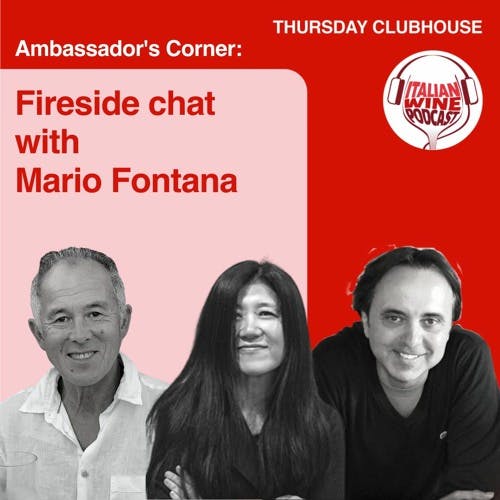
Ep. 692 Marc Millon Interviews Mario Fontana | Clubhouse Ambassador's Corner
Clubhouse Ambassadors’ Corner
Episode Summary
Content Analysis Key Themes and Main Ideas 1. The philosophy and practice of traditional, artisanal winemaking in Barolo. 2. The personal journey and dedication of Italian wine producer Mario Fontana. 3. The distinctive terroir and geological history of the Barolo region, particularly Castiglione Falletto. 4. The challenges and successes of producing natural wines without added sulfur. 5. The enduring value of personal relationships and family legacy in the wine industry. Summary This episode of the Italian Wine Podcast features a Clubhouse session where Mark Millen, host of ""Wine Food and Travel with Mark Millen,"" interviews Mario Fontana of Casina Fontana. Mark, an Italian Wine Ambassador, shares his 30-year friendship with Mario, highlighting Casina Fontana as a small, genuine producer in the heart of Barolo. Mario discusses starting his winery in 1994 and his commitment to traditional winemaking, inherited from six generations of the Fontana family. He emphasizes ethical practices, natural approaches in the vineyard and cellar (e.g., pure manure, natural fermentation, no crushing of grapes), and producing wines that express elegance and finesse rather than just power. Mario provides a detailed geological explanation of different Barolo sub-regions, contrasting the younger, juicier wines of La Morra with the more structured, age-worthy wines from older soils like Castiglione Falletto. He also recounts the unexpected success of his ""Vino Rosso AAA,"" a natural Nebbiolo made without added sulfur, which significantly boosted his domestic sales. The conversation concludes with Mario sharing his typical food pairings for his wines, making listeners hungry. Takeaways * Mario Fontana's Casina Fontana is a small Barolo winery committed to traditional, ethical, and artisanal winemaking. * Mario's winemaking philosophy is deeply rooted in respect for ancestral knowledge and the land, emphasizing purity and natural processes over modern trends or market demands. * Barolo's diverse terroir, specifically the older, limestone-rich soils of Castiglione Falletto, yields wines of elegance, finesse, and structure that age exceptionally well. * The production of natural wines, even as an experiment, can lead to unexpected commercial and critical success. * The strong, long-standing personal relationship between the interviewer and producer adds a unique, intimate dimension to the discussion of wine. Notable Quotes * ""He's a small producer in the heart of the Leilenge, in the heart of the Barolla wine area, a very small producer making wines that are very, very genuine. Mario makes wines from the heart."" - *Mark Millen* * ""Our, person and our thinking is not for sale. Our anima... The spirit, the soul. It's it's not in, for style. Okay. Mainly, it's not for style."" - *Mario Fontana* * ""The vines are like a man. Okay? Depends on how you, how you keep this man. If you keep this man, in, with the good food, and, we do not push so hard, and, you respect this man... you can have incredible, a lot of fun discussion. It's the same for the vines."" - *Mario Fontana (quoting his grandfather)* * ""The boroni is, elegant finesse."" - *Mario Fontana* * ""The DNI in the [wine] is, is for the DNI is format this form. When is form when, the fermentation start, if you change this part of the wine, you change the D and L, the wine."" - *Mario Fontana* Related Topics or Follow-up Questions 1. How do small, traditional wineries like Casina Fontana navigate modern distribution and marketing challenges in a global market? 2. What are the specific technical challenges and rewards of relying solely on natural yeasts and avoiding temperature control in winemaking? 3. A deeper dive into the specific MGA (Menzioni Geografiche Aggiuntive) vineyards of Castiglione Falletto and their unique characteristics. 4. Beyond the ""Vino Rosso AAA,"" what is the broader trend and future of natural wine production in Italy? 5. How do generational shifts within family wineries impact the continuation or evolution of traditional winemaking philosophies?
About This Episode
The Italian wine clubhouse is hosting a wine clubhouse session called Pathale's Corner, where attendees can listen to wine recommendations and speak with experts. Speakers discuss the upcoming tasting panel and showcase a guest, Mario bridge, who is interviewing a famous wine producer. They also talk about their approach to learning about the approach of Mario to winemaking wines, their plans to have a baby, their love for the wine, and their commitment to bringing free content. The speakers emphasize the importance of respect in the wine making process and balancing the concentration of alcohol and finer fruits in the recipe. They also discuss their experience with their own production and how it was difficult to produce a wine without sulfide. They mention their upcoming stay at Tarmina and their commitment to bringing free content.
Transcript
Welcome to this special Italian wine podcast broadcast. This episode is a recording off Clubhouse, the popular drop in audio chat. This clubhouse session was taken from the wine business club and Italian wine club. Listen in as wine lovers and experts alike engage in some great conversation on a range of topics in wine. If you enjoy listening, please consider donating through Italian wine podcast dot com. Any amount helps cover equipment, production, and publication costs. And remember to subscribe and rate our show wherever you tune in. This episode is proudly sponsor by Vivino, the world's largest online wine marketplace. The Vivino app makes it easy to choose wine. Enjoy expert team support door to door delivery and honest wine reviews to help you choose the perfect wine for every occasion. Vivino, download the app on Apple or Android and discover an easier way to choose wine. Hi, guys. Welcome to the To tell you wine club club house. My name is Joy livingston. And tonight, I'm standing in for Stevie Kim. This show is called Ambassador Corner. I'm actually standing in for Stevie tonight because she actually got a couple new dogs today, two rescues, and, they're busy destroying her house. Very, very cute. Yeah. She has her hands full. So I'm taking over for this evening. If you hear any grunting or snoring, that is my dog because this week is all about the dog. So Alright. So anyway, this, show is called Ambassador's Corner, and I am here with Leica, the Clubheart organizer. Hi. Hi, everyone. Yeah. Hi. Amazing. We do these sessions every Thursday at eight PM. They are recorded and then hopefully released on the Italian wine podcast. We do this to reach more listeners, and it's helpful for those who can't participate just because of the time zone that they happen to be in. But, we'll just hope that everything goes, you know, swimmingly tonight, so there's no issues with the reporting. So the idea behind Ambassador's corners to give Italian wine ambassadors all over the world, and wine lovers the opportunity to interview their favorite producer. At the end of this discussion, we will give the audience a chance to participate, and they can ask questions, etcetera. But right now, I we have Mark Millen, who is the, the host of our brand new show wine food and travel with Mark Millen, and it's awesome. And it's on Tuesdays, and you guys should all listen to it because I love it, but let me see. There's some PR marks. Sorry. So, basically, he is going to interview with Mario Fontana of Portana this evening. I think this is the sixteenth installment. Mhmm. What do you think? Is that right? Yes. Of master's corner? Cool. Okay. And I am going to let Mark introduce Mario, but I'm gonna tell everyone about Mark first. Mark became an Italian wine ambassador in twenty twenty one, and he's been traveling, eating, drinking, and learning, and writing about food, wine, and travel for, like, forty years. And he's he's really interesting because he's born in Mexico with, a mother from Hawaii via Korea, and an anthropologist father from New York via Paris, so really international guy, and he was weaned on exotic food, like, really international. So Mark is, and his wife, who is a photographer, are the authors of fourteen books, and including wine, food, and travel books. And, I could mention although there's so many. So I'm just gonna skip over the, all the different titles, but a few lectures and hosts, gastronomic cultural tours in Italy, France, and the British West Country with Martin Randall Travel. And, yeah, he's he's really he's an interesting guy, and I'm so happy to have him on the show tonight. So he's, he lives in the UK. So right now, it is not eight o'clock. It is seven. So, anyway, Mark, how's it going? I'm gonna ask you a couple questions before you start. Are you there? Hi, Joy. Hi, Lake. Yes. I'm here. I'm delighted to be here with you. I'm delighted to be part of ambassadors coroner. It's a series that I've really enjoyed listening to because I, you know, I haven't been able to meet any Italian wine ambassadors yet or indeed you two or Stevie or any of the the via team. So I've been doing all of, you know, the podcasts and everything, without meeting you all, but I've been following all of the different podcasts and it's it's great to be here and to see some of you joining me as well. Awesome. Well, we're we're gonna meet on Monday for wine to wine, which is, starting very soon on Sunday, there's there's a tasting panel, and then, you know, we've got Monday, got the clubhouse marathon because it's gonna be awesome. It's gonna be four hosts including Mark, that that includes Mark, and it's an hour and a half each host, and each host is going to be interviewing various people either in wine to wine or just around the world. And it's just gonna go on all day and you people who listen in are gonna be able to basically get an idea of what's going on, at wine to wine and, you know, some really interesting conversations are gonna happen. So everybody should tune in on Monday starting at twelve noon C ET Central European time. Anyway, sorry, Mark. I forgot to say that earlier, so I took the chance to you reminded me So, Mark, tell us why you selected Mario Fontana as your favorite producer. Oh, gosh. There are so many reasons I could say. I think, you know, listening to Ambassador's Corner, we've met a host of really great wine producers from all around the country, and each ambassador has their reason for picking the producer they want to really showcase. And I think I think all of the ambassadors are really proud of their association with the producer they pick. And I'm really proud to, to be introducing Mario Fontana, who I've known for thirty years. You know, it's you're right, Joy. I have been doing this for a very long time. I started when I was two years old. No, I'm just joking. I, but I, I have known Mario for thirty years. I've been drinking his wines for thirty years. And he's a small producer in the heart of the Leilenge, in the heart of the Barolla wine area, a very small producer making wines that are very, very genuine. Mario makes wines from the heart. And his wines have been a big part of my life. They've been a big part of my life through good times, and we've also gone through some not so good times together. We've shared a lot of things, and no matter what the occasion, there is always wine. There's always Mario's wine. And so they mean a lot to me. And I want to share Mario introduce Mario to the Via community and indeed to listeners of Italian wine podcast because I really believe in his approach to wine and his approach to to life itself. Yeah. So what do you think you're like what are the learning objectives, that we should expect? From from the interview that's about to happen? Well, I think it's really going to be interesting to hear Mario's approach to winemaking. He, will be learning about the grapes he cultivates, about his terroir. In, particularly some of the MGA vineyards that he has. And it really is is his natural approach to making wines is purely as possible. And that's the main thing I want to, I want people to, to, learn from this, of just how, you know, the small producer can make really genuine wines and wines. And although he is small, that are now being recognized, all, all over the world, he's winning awards, he's getting accolades in, in the gambaroro. And, it's great for me. I feel very proud having seen Mario starting, thirty years ago to see what he's built and created along with his wonderful family. Cool. Actually, you touched on my next question already, but, you know, how did you thirty years ago, how did you discover the wines of Casina Fontana? Like, how did you stumble upon them? What was your first, introduction? Well, actually, Joy, that's a really, interesting and rather long answer to that question. But basically Kim and I had been writing a book, The Wine Rhodes of Italy in nineteen ninety. The book came out in nineteen ninety one, and then another edition in ninety two. But we we had been in Italy for over a year. And when we returned to our small town, here on the river X in Devon, Southwest England, an Italian had moved into town and opened a wonderful restaurant, a really genuine Italian restaurant called Nellos Ristorante. And this was Nellogetteso who quickly became my best friend. And I helped him with his wine list and and that that restaurant was was like a second home to to me and really to to our whole community. And one day, we had a telephone call. Nettle called me up and asked me to come around because he had heard that a young wine producer had driven over from his vineyards in Lehlanga, in the Barolo wine hills, with a van full of wine, and he was looking for serious restaurants who would who who might be interested in buying his wine. So I I went around. The restaurant was five minutes from my house. So I went around and, met Mario for the first time, who thirty years ago, he was, he was a very young man, and he was really, you know, there to really, it was quite a brave thing to do to, to, you know, there's no channel, tunnel, and he just put, you know, drove across France and got on a ferryboat with a with a Fergone, a white van full of full of his wine, and he was looking for serious restaurants where he could create some relationships. And that's really where it started, but it became much more than that because Mario used to come out twice a year. We would we would shift about a hundred cases of wine, down into the cellar, and then we would spend a day or two, you know, drinking wine and eating and and getting to know each other, and and this strong friendship developed. In nineteen ninety seven, Nello and I were great cycling chums. Of course, Joel, you met me first when I was riding in talking about the giro d'italia. She's cycling as one of my passions. And Nelo and I cycled from Devon, from Tops from Devon to Venice. My mother had lived in Venice, and, Nelo himself was from the Venetian lagoon. And so we we decided to cycle. My mother had died very young, and, it was a way to raise money for cancer. And along the way, we had various stops, but the most memorable was when we cycled into Alba, and Mario was there to greet us, the sindako as the, of the town was there to greet us in the kamune, and it was just just a great moment. And of course, that night, we we Mario's mother cooked a wonderful man. I can remember it still, the annualotte Al Plin, and Brazato alvaro, and we drank a great deal of wine to fortify us for the rest of the journey to Venice. So this is a friendship to develop over a long period. And as I say, there have been some good times, and there's been some not so good times, but the friendship has really, really continued. We've had some tragedies. We've gone through together. But, through it all. There's friendship and there's wine, and that's what this is really about. Well, it it sounds awesome. And I you know what? I I would say that it my time is has now ended. It's up to you, Mark. I'm gonna give the floor to you and hi there, Mario. Are you there? Yes. I am. Hi, Mario. Okay. So, you guys take it away. I'm gonna mute myself now. Take care. Okay. Thanks, Joy. Well, I'll just introduce to, our group, Mario Fontana, who, together with his wife, Luisa, and sons Eduardo and Vasco, the profineries of Casino Fontana. Which is a tiny estate, five hectares, dedicated exclusively to the cultivation of the classic grape varieties of Leilenge, toceto, Bara, and Nebulaolo. And Mario's vineyards are located in the some of the best zones of production in the Kumune of Castigliano. It it's a holy traditional state that respects and above all follows the culture, traditions, and the history of Velange, and Mario oversees everything himself from tending the vineyards, to making the wines, to taking them around the world to sell them. So, it's very much a small operation, of the highest quality. Chow Mario. How are you tonight? So, Mark, everything is okay. We have, finished harvest, yesterday. So now, we are really in, we start relaxing time. You've got a lot of work still to do in the cellar though. I saw a little video today of the barolo, the the the Nebula for the barolo. It looks like you've been doing the rimontagio, the pumping of the of the must back over the skins, and all of that work in the cellar. You don't get an easy night to sleep just yet. Do you? Yes. Sure. Now we'd like to have a small baby Okay. And, so we needed to to to have the maximum attention. In fact, we understand we needed to, something over, the wine from, for a long time or a few time a days from the early morning until later in the evening. Okay. And is that all done now with the with the barbera? The Dolceto is the Dolceto, you don't have to worry about anymore. That's completely ready now, to leave. Is that right? Yes. The Dorgeto is, we can start to drink. He's, we have, we have, yet, Ricky two times. He's, easy, correct, easy, permanent, ferment, And, also, we have, yeah, the press and the reiki two times. Now it's outside to the starter in a in a tank for to keep, the cold, the temperature of the of the night. Okay. So the Dorceto now is in that tank with the cold stabilization, which we'll talk about later. But I'm I recall he said the Dolceto is ready to drink. I can remember Mario being with you at this time of year, and it's a really exciting moment because you would go down into the cellar and just draw out some jugs of the of the dolceto. Still a little bit sweet. The fermentation isn't really complete, but there's that sweet frothy, we I can recall we would sit around a campfire and and, you know, roast some chestnuts and drink that, that, wine that's not yet wine, and it's, it's very much an autumn ritual. It's something that is of the season of this moment of the year. Yes. The the first perfume that, I need to see in, in a normal, in the autumn is the perfume of the Docceto wine. Is there anything beyond for me? And, when I'm missing this kind of perfume, I understand that, the, the Altun will be stars very early. And, also, I I think, for to change a little bit, the food in house, we started to eat, major pepperoni or, out of vegetables, like, or, or, it changed also the the food in house. Because the season is changing, also, we we we're changing our, lifestyle. Yeah. I guess it's just that that change of the work in the vineyard is finished, then the, then you move into the cellar, the autumn foods, and then, of course, moving into more wintery foods. Mario, you, you were, you created Casino Fontana yourself. Was it nineteen ninety four, nineteen ninety five that you began your own activity? Was in, nineteen ninety four in, December because the last, maintenance with, my family winery was in nineteen, nineteen ninety four. And I decided, during the summer or ninety four, to to start my, my own project in Waimachi. But, I had my family to, to make it, ninety four vintage. And after that, I I live for, and often, Krishna Fontana. Winery. I remember those days, Mario. It was a very, brave thing to do, but also very difficult. And, you know, you, you were, starting, really from scratch to create a new label, a new winery, and you move to Perno, and I can recall those early years of, of, of, of hard work. And, you know, it's, I'm so glad to see the success you have now, but I know that it didn't come easily. And meanwhile, your family has grown up and, you know, it's great to see you in the new house that you and Louisa built with the with the wine cellar underneath. And I can imagine now that the those big Barolo barrels are are full and you know, the the smells in the house of the fermenting line. It's a it's a it's a happy time of year, and it's, you know, it's well deserved for all the hard work that you've Yes. It was, was hard, really hard because, when I restarted in, in my new winery, with my, personal contract in a win, was also a very difficult moment for the classical style wine and traditional white wine. And for me, was, was really, hard to, believe in me. But I not, I not change my own concept in wine, for to follow the market, come chat wine or to follow only the, the money or company as money, but they prefer, I want to continue to produce wine following the uh-uh all the concept in the wine. So classical wine and classical wine traditional style and the wine, where the cellar, where the wine not follow the, demand, but it's a man that follow the wine. I remember you telling me your concepts of wine and and what you learned from your grandfather, Savadio. And, you know, you're the sixth generation of wine growers in the Fontana family. So there are a lot of generations that have, that, that know the land, know your vineyards, that have, and passed on this intimate knowledge to you. And I know that you've been very respectful of the tradition and the traditional way of making wine. What would you say that you learned most from your forefathers from your grandfather, and how has that impacted on your philosophy as a winemaker? Really, I I guess what I want to mean is what I think I'd like us to know is what does it mean to you to be a traditional producer of Barolo? I think that for two, hours of this bastion, we needed to have more of one day, but I can try in the bottle of Barolo. Maybe two. Or or emmanuel is better. But but, sure, in the first, to, produce, wine, is, to follow-up and, to, show a kind of, I don't know in English, the name. Oh, you were talking about being ethical, being ethical in all ways, in, in, I guess you may have a vineyard in the way you treat the vines, but also in the way you deal with life. Yes. Is, because, the wine is for sale. Sure. But, our, person and our thinking is not for sale. Our anima, anima Haines. So The spirit, you're the spirit, the soul. It's it's not in, for style. Okay. Mainly, it's not for style. And, when I, when I decided to restart, to produce wine, or continue, produce wine, in the other generation. So following the the the pure, style, artisanal style, for me, it was also a way for to feel good for me, feel me good. Okay? Mhmm. And, also, he's a way for to, maintain my, And, also, for me, was, was, not, good, to change the white vision Okay? Just, only for because the market asked that. Okay? The business ask that. We're talking about a time when there was this sort of tendency to be the modern style versus traditional. Okay. And, and, in, in the time, I I prefer to, to respect the work and that that my family, other generation, that, from nearly two hundred years, they do in the same way for to arrive to produce this kind of wine and for it to show in the war our wine, our style wine. Okay? And, I think that this is one of the, one of the most important reason that, dry meat do not change, style in the wine making. Okay. And it's also not just the the way of wine making. I know that you're you believe very much that wine begins in the vineyard and the way you treat your vineyard in terms of the pest control, using natural manure, when you're making your wines, the using the natural yeast on the grapes, not putting in a cultured yeast. All of these factors are part of being what you mean being a traditional winemaker is making wines respecting what your, ancestors, what your generations before have done. Can you explain some of those things that you do? Yes. A respect is, is, word that, we follow in a in a different part of the work that we do for us to produce wine, sure, to produce wine, in, artisanal way, you are, for, we are obligated, okay, to follow, organic content in the vineyards, okay, and also to produce, quality grapes a kind of fairy grapes that, give us a possibility to produce this kind of wine, classical style. So elegance and finesse. So, example, we in the vineyards, we are not looking for to not work for to have big concentration, super alcohol, or or super concentration or extracting wine. We prefer to, follow the, the, the work in the vineyards, leave the grapes enough for it to have a balance in the wine. Some, mint as we produce, a lot of grapes for not to have a extreme concentration wine, or example, we we prefer to use, manure, is a thirty percent or for mountain. Because in the mountain, the cow have a, an, international grass and not contaminate, and they are not contaminated, with, a lot of things that is possible that can, that can, have in, in other, concept of uh-uh cow farmer, he's very pure manure. He's a manure that he's a two years age before that we use. So I have a only intredible benefits for the for the vines. And I have a very low, they give a very low way. Here's the elements and the vines. This kind of manure. Because several time, I'm gonna father tell me Mario. The the vines are like a man. Okay? Depends on how you how you, keep this man. If you keep this man, in, with the good food, and, we do not push so hard, and, you respect this man and, you not go in a control against, you can have, incredible, a lot of fun discussion. Okay? It's the same for the vines. We must to follow the vines. And we're not it's not possible for us to decide on the on the desk what kind of vintage will be have next year or what kind of wine we will have, tomorrow. Okay. No. We're not designed enough. We can only follow-up and, following the best way for to have our, contract in a wine with this kind of, in the scandal, all, all, all at work. Yes. I, I, I see what you mean about following each cycle of year, and I know you've spoken to me about this, about how you don't really think that you could say one year is better than the other. Any more than you could say one child is more favorite than another child. They're all different, and your job is to allow the grapes to express that particular terroir, but also the that particular year, that growing season. Let's talk about the casino Fontana Barolo. Berry Brothers and Rod, one of the oldest and most respected importers in London, who you work with say that of all the Barrellos on there are very famous and considerable list. Yours are the most burgundian. I I guess this this is I take this to mean from what you've just said as well that they're the most restrained, perhaps the most elegant. Is is that what you're trying to achieve when you make barolo? The style of barolo that you're trying to to express. There are some people that think in, brown, like a wine, a strong, black, with a big, big concentration. No. The boroni is, elegant finesse. The original boroni is a wine that, you can, and only enjoy without, feel, some in your mouth that, there are, some elements in your mouth that are more than the other, okay, is a very, is a questionable balance of elegance and finesse for us to produce this kind of barolo, is, really important the first, okay, the work in the vineyards, So not concentration in the vineyards. So, I also not, high density of a mines, my vector, but have low density, my mines, my actor, or to have more graves each bite. And also in the trailer is, in the first, it's really important to make the, natural start from the fermentation. Because there is the the the and the arranging, or the DNI is is there. The DNI in the one is, is for the DNI is format this form. When is form when, the fermentation start, if you change this part of the wine, you change the D and L, the wine. If you select the yeast, for to, bring the wine to be, different than the original because you need the market or you need, to wine more, more black, more, juzim, or, Charmsbury, is, you, you lost the raging. Okay? But if you have an natural start, And also, you have, natural, firm, fermentation without using, temperature control is another important point. We don't use, we don't have, tank, limitations, in time, we we temperature control. Also, if, in example, for us, is very important to keep from the skin, the the stroke tour, in a wine, but, in very low way, in fact, the grapes when arriving in the cellar are only, these tanks, not, crash. Okay? So we the skin going, in a tank, when the, when the most, nearly, nearly, nearly not blessed, but, oh, miss Lisa. Okay. Nearly intact. And, in this way, there is a more slow, extraction in the wide. And also, in that time without using selected teeth, we have a possibility to, do we have two, three days before the fermentation start for to make the pumpkin over and for to, have extraction on the the, orange fruit more, far, more, soft fruit, more red fruit, not black, and, for the freshness of the wine. And, and then, we use for to make the long maturation, long maturation that depends from the year can be, two weeks, three weeks, four weeks, long, after the fermentation, for it to have more extraction from the skin, the last extra the last extra extraction on the skin is, what provides, and the wife for two aging from very, very long time. So it is the the the barolo, classical, way, classical style whale for to have, origin, for to have elegance and for for to have finesse. But also this wine will be very balanced. Need a little bit more time for it to arrive from the balance, but it will be really, really fine and, very pleasure for to As you know, I'm a great fan of your Barolo, and, particularly, you know, I know the vineyards you have in Castiglato. You're now making a comune, the Castigliano Ferolo from the crew, Valero, and Mariondini, the valeti, Mariondini wines. What would you say is, you know, with the the Camune, the castiglione Falletto, style compared to, say, La Mora or Barolo, is there a classic castiglione falletto style? Castelilla falletto is, a part of the terwar, on the Barolo area, c twenty in the center of the, Barolo area. In the, in the, north part of Barolo, there is the part of La Mora and, Adula. Also, Barolo is, in the soil, the area is, more rich and more rich on organic things because it's more, more younger than the other part. And so the wine give, the wines work, more hard. There are, in that part, there is, another kind of vegetation for the vines. And, the grapes and the wines are more richness in juicy because they're, part or richness part of, give this wine, a kind of wine, ready for it to drink very young, but also a rich in the in the juicy. Okay? Also, it's possible to age in this kind of bravo, but, not like, the bravo that, is from, other part of the Barolo area. Other part of the Barolo area, is example, are commonly in Montorte. Casting on the fillet. This part of the of the, third war is a more older region, is, original, is, originally, Elbertsian, okay, Elbertsian, period. And they have twelve eleven twelve millions years of origin. And, in in this part of the soil, there's more four than a part of the mora that have only, seven, six, seven millions here, origin, because it's a turtonian origin. Okay? So this part of the soil, more older, present on the soil, different characteristic is, more pure, is more limestone, and also, part of the, sand also said. And, and the wine that, are made on this kind, on this kind of turwar, are wine less rich of juicy, but more rich of minerality of, structure in the wine, but also in the ten year are very, very sick, and very elegant. So our wine, at the moment, there's no way and, a wife for to keep really, very long time. But for drink, for two eighteen, seven years more before the drink. So there are two big area in Barolo, in Barolo. More youngest area and more oldest, older area. And, it's possible to produce very good barolo in the in the in the in the in the both part of the soil. But from Ramora is more richness and for today, more younger, and richness in choosing for an instant and, montfort, there is a soil more older and the saw in the ROI for to keep more long, more long time. Castro is in the set. He's in the center. Have a characteristic of, Edegas, and Finest, and also Strouktor is not not have a part of the Jews of Lamar, but also don't have a part of a big, really big Strouktor over several on the diet, because I love it. So the balance in the customer, Fernando, is nearly perfect. And, I enjoy to excite in winemaking this part, this this characteristic on the soil. And, example, we have M and M and M and M and M and M and are very close. Are about, less than one kilometer of this, of afar. But, Valero is, limestone a little bit Sandy and is, and give a and the wine characteristic of, really, finesse and elegance also in the perfume are very richness in the perfume, but elegance and finesse. The part of Marionino in the and our parcel, Valetti, is the similar, the Tory similar to Viner, but is not sandy. It's more compact. And, from this side, we have a part of minerality and the structure in the wine. So he's a natural, very good blend because we have a energized finesse with Vinero, and also we have a structure and minority from, Okay. That's really fascinating to hear Mario, and especially for Italian wine ambassadors. You know, we've been studying soils and learning about different eras, but to hear about that very, very clearly explained with how the, the soil changes through the different epochs. These simply, you know, matters of millions of years that now have such a profound effect on the soil. And that subtle difference between mariondini and, and Valero. So, that's that's a really, really useful way and very beautiful way to explain, the wines of Castillio Nifalato, in particular, your barolo. Now I just wanna mention one more wine, and then, perhaps we'll talk a little bit about food. When you were fifty, you decided to play around in the cellar and make a wine that I never thought that you would make using barolo nebbiolo grapes that could have been barolo to make a natural wine, a wine without any sulfur at all, a simple vino rosso. And this wine has actually been a huge success. I was in the Banco Delvino in Polenzo, the slow, slow food, repository, this great collection of wines from all over Italy, and your AAA, Vino Rosa, was in the Banco Delvino on the in the permanent display. It's a wine that has had a huge success, and I wonder, was that a surprise to you when you first decided to begin to make it? I'm actually sipping a glass right now of the twenty sixteen, which I think was the first year you made the wine. Sometime when, in the life when, you arrive at fifty, you want to change something I think. But, for me, to produce this kind, the wine without sulfide and, was, simply a a a a try. Simply try that they want to do because, there was, too many people that ask at me about what they think about, in the wild without produce without sulfide. And then I tell then I don't know because I never try. And honestly, I I didn't it wasn't possible to produce exchange, high quality wine without certified because, the other, listen, other, analogist or other winemaker or, other person in the winemaking. Ever, they tell me about, you know, it's not possible to produce wine without certified because the wine that will be growth will be, around will be, def in effect, volatile, high volatil, or reduction, or, breath, or, an auto thing, or o Ocitation. So in two two thousand fifteen, there was a really great, being touched. And, in, from, Gallinot to Vigna, she's a crew of barolo, or the property of my wife that we use for Marolo Classic. For the blend of a lot of classical medical center. The lines of peanuts for to produce, some, a little tank of, wine without add to sulfide. Just only for it to try. What was it for you. And, I do that. I use an, simple, I made a wine, like, I use, to produce other wines. But only I not add the sulfide. And they use it, and fiberglass, tank and the main fermentation. And I, after in the winter, I start to try. And, my big, my, my, my, my, pleasure was when during the winter, a connector of, three player distribution of Italian distribution, wine distribution, especially in sending, natural wines. Tell me the wine for to try the wines because I know is was, is, alberta Financial. I know very well, I we try all the wine at the end, I, I I give this nebbiolo with our fruit fight to try. To to Alberto. But I was, I wasn't so sure to do or or not dream to try or not because honestly, I was a little bit scared of these because, in our Barolo area, every week was, really farmer. But, after the baron will start to sell very well in the world, too many person, having, a little bit aristocratic, a gentleman, attitude, and also some, other waymakers, looking, in me, something worse, when I start, when they know that I start to produce this kind wine just only for it to try. But, okay. I'm here to find us to try. And so we start the collaboration with the distribution on the value in in Italy on this wine. And sure, was, money that was possible that, on the start, I think, that, lost a lot of money because it was better to start a barolo and, red wine, with also fight. Because the price for baroque is three double. But, this wine, give me b mix of the station also for, for, commercial, Business. Business. Business. Because, value, saying that this wine in, a lot of part of Italy, and this wine was, in the hand of, a lot of, restaurant and, wine bar, and, and, in Italy, in that time, I don't sell nearly, I sell nearly nothing. My my cell, my most big part of cell was, outside Italy. And from, this adventure in, and after the wine was in need this kind of wine was in Italy. Know, incredible. A lot of people ask, as also for others wine, Marolo, and, we are right to sell the forty percent of all our production in Italy. And so we, we, drive, right, international. We tour the wine of from export to Italy, for forty percent. So it was incredible searches for this wine. That's incredible. And I remember when you made the wine, you for every box of six, you had a different color label in each bottle. And you said to me, well, I don't know how this wine's going to evolve. Each bottle might be different. I'm drinking the two thousand sixteen right now, and it's still. Well, I think what's most striking about it is the purity of the fruit. It still has the most gorgeous fruit coming through. That's very intense. And, you know, I think that's a credit to the quality of your the grapes that you grow and to how well you make wine because it's a beautiful wine, very different from very different from your longue Nabiolo, but it's a wine I love, and I'm not surprised it's been such a success. Now, finally, Mario, it's now we're approaching the end of our chat. It's been so nice to to catch up with you. Have you eaten dinner yet? I'm just wondering what you're eating. You know, I've had some so many good meals in your house, and it always makes me hungry just thinking about it. So have you eaten? Are you about to eat? What's on the menu for tonight? What are you eating? No, I not have, I not eat, this evening, and honestly, my wife, asked me before or, what I would like it to have for dinner. But I tell I tell, she that, I don't know in that moment because of, I won't make a concentration for, for this live, interview. But, about, Christina Fontana wines, if I, if I needed to, if I needed to make a minimum in the hour wines, I can, start the exam with, dorchetto, and with a glass of dorchetto with, and, like, milleoperative or with antipasti. And after, I like it, to suggest, and, with a really great, with a really, really strong ragu and the barbera, Alabama. And, for the second, I like it, for the second, for the main course, It's possible to have, or Marolo, young, sure, or a lung and a biolo. And, sure, I like it to have a horizontal barolo with the biolo or marola wine, but young, not old. With the with the cheese, I like it, to have, the red wine, but a little bit, called for two separate, for two separate separate, from the, forever, and stop, okay, a break. With the cheese. I like it to have a sweet cheese or also a little bit aged cheese, but, soft with, nipiola, sintas one fifty, cold snare Okay? And, with them, with the dessert, I like it to have, example, the torta de nochola is an ice cake, with a barolo bottle. For me, barolo bottle means to, drink a barolo with the twenty, twenty five, thirty, forty years. Okay. For me that is, barolo. For to drink, just only for a little bit piece of cake, isn't that cake, for a biscuit? Wow. You've made us all hungry, Mario, wherever we are listening. It's been a wonderful chance to talk. And, you know, well, I haven't seen you in a little while through this crazy period we've all lived through, but I'm delighted that you and Louisa will be going to Tarmina. Next week. Is that right? And we perhaps can meet up. I know that some of the other Italian wine ambassadors will be down there with me, and it would be great if those who are listening and others who may listen later. We'll have a chance to meet you. So I'm really looking forward to catching up with you. Yeah. So, Joy, are you here with me? I sure am. So it would no. It was a wonderful I'm getting hungry, I swear. I after listening tomorrow. Yeah. Me too. And Mario didn't Mario didn't even mention that we're now, of course, coming into the exciting season of the tartuffy Bianki Dialba. Oh, wait. Which is also a special moment of the year, and and, wonderful, food specialty that is linked intimately to Alba. Well, I know that, normally, we would actually I have a few questions, but the problem is that we are almost at the hour. And so I, I'm gonna take the opportunity to thank Mario and his son, Eduardo, for for kindly interpreting. We could hear him every so often helping his data. So I think that's really sweet. And, Mark, you know what? I would say if anybody has any questions, for him audio or Mark, you feel free to just ping us on Instagram or, just send us an email at the Italian wine podcast info at italian wine podcast dot com, and we will happily pass them along. I'm going to close it up now. Mario, thank you. Listen to the Italian wine podcast wherever you get your podcasts. We're on SoundCloud, Apple Podcasts, Spotify, EmailIFM, and more. Don't forget to subscribe and break the show. If you enjoy listening, please consider donating through Italian wine podcast dot com. Any amount helps cover equipment, production, and publication costs. Until next time, Cheaching. Hi, guys. I'm Joy Livingston, and I am the producer of the Italian wine podcast. Thank you for listening. We are the only wine podcast that has been doing a daily show since the pandemic began. This is a labor of love and we are committed to bringing you free content every day. Of course, this takes time and effort not to mention the cost of equipment, production, and editing. We would be grateful for your donations, suggestions, requests, and ideas. For more information on how to get in touch, go to Italian wine podcast dot com.
Episode Details
Keywords
Related Episodes

Ep 2325 Anna Obuhovskaya IWA interviews Fabio d'Attimis-Maniago of Attimis-Maniago | Clubhouse Ambassadors’ Corner
Episode 2325

EP 2316 Alberto Martinez-Interiano IWA interviews Emiliano Giorgi of Progetto Sete Winery | Clubhouse Ambassadors’ Corner
Episode 2316

Ep. 2308 Anna Obuhovskaya IWA interviews Sara Repetto of Vigneti Repetto | Clubhouse Ambassadors’ Corner
Episode 2308

Ep. 2299 Beverley Bourdin IWA interviews Grégoire Desforges of Baglio di Pianetto winery | Clubhouse Ambassadors’ Corner
Episode 2299
Ep. 2290 Rebecca Severs IWA interviews Primo Franco of Nino Franco winery | Clubhouse Ambassadors’ Corner
Episode 2290
Ep. 2281 Julianne Farricker IWA interviews Mattia Montanari of Opera 02 Winery | Clubhouse Ambassadors’ Corner
Episode 2281