
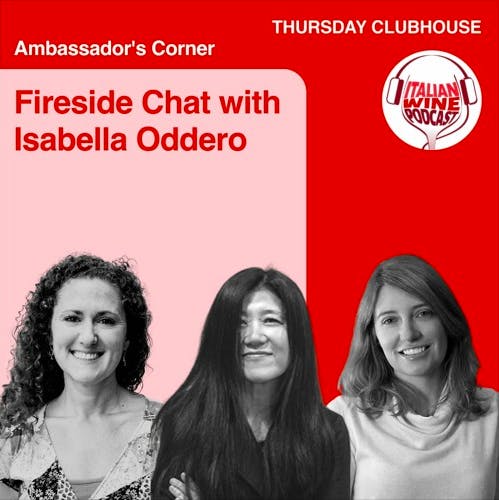
Ep. 756 Amy Ezrin Interviews Isabella Oddero | Clubhouse Ambassador's Corner
Clubhouse Ambassadors’ Corner
Episode Summary
Content Analysis Key Themes and Main Ideas 1. The historical evolution and legacy of the Odero winemaking estate in Piedmont, Italy, tracing back to the late 1700s. 2. The pioneering role of key family figures in Barolo winemaking, including early bottling practices and vineyard acquisition. 3. The significance of specific Barolo crus (Brunate, Vignerionda, Busia) and their geological characteristics (Tortonian vs. Elvezian soils). 4. Odero's commitment to organic farming and traditional, gentle winemaking techniques. 5. The prominent role of women, specifically Christina Odero and Isabella Odero, in shaping the estate's modern identity and future. 6. Expansion into other Italian wine regions, as exemplified by their Barbera d'Asti project. Summary This Italian Wine Podcast episode features an interview with Isabella Odero, representing her family's historic Odero winery in Piedmont. Isabella traces the estate's origins back to the late 1700s, highlighting her great-great-grandfather's pioneering decision to bottle Barolo with the family name in 1878 and his early adoption of sulfur in vineyards. She then discusses her grandfather's strategic acquisition of diverse, high-quality vineyards from the 1950s to the 1980s, which form the basis of their current single-vineyard Barolos. Isabella elaborates on the specific characteristics of their Barolo crus, such as Brunate in La Morra (Tortonian soils) and Vignerionda and Busia in Serralunga (Elvezian soils), explaining how these geological differences influence the resulting wines. She emphasizes the winery's dedication to organic farming, a practice introduced and championed by her aunt Christina, and details their traditional winemaking philosophy which focuses on minimal intervention, whole-berry fermentation, long maceration periods, and aging in large oak barrels. The interview also touches on the increasing presence and influence of women in the Barolo region's wine industry, with Isabella and Christina serving as prime examples of this shift. Finally, she briefly mentions their more recent venture into producing Barbera d'Asti from a vineyard in Nizza DOCG. Takeaways * The Odero winery boasts a rich history dating back to the late 1700s, with a continuous legacy of winemaking. * The family played a significant role in early Barolo development, including pioneering bottled wines with estate names and vineyard management techniques. * Odero owns diverse and historically significant vineyards across various Barolo sub-regions (La Morra, Serralunga, Castiglione Falleto), characterized by distinct soil types (e.g., Tortonian marl vs. Elvezian sandstone). * The winery is committed to organic farming practices, an initiative led by Isabella's aunt, Christina Odero. * Traditional winemaking techniques are prioritized, including gentle handling of grapes, natural fermentation, extended skin maceration, and exclusive use of large format oak barrels. * Women, particularly Christina Odero and Isabella Odero, have been instrumental in the winery's modern improvements and represent a growing trend of female leadership in Piedmontese wine. * Odero has expanded its portfolio to include Barbera d'Asti from the Nizza DOCG, showcasing diversification beyond Nebbiolo. Notable Quotes * ""We found an notarial deed and some parrot shots that take us back to the end of seventeen hundreds."
About This Episode
Representatives from a wine club discuss the importance of learning about language in their estate and the history of their family. They talk about the use of sulfur in vineyards and the importance of farming and bottle production. They also discuss the challenges of organic farming and the value of the winery. They emphasize the importance of care and tailor-made care for the industry and emphasize the value of the winery. They also mention the use of manual and automated methods for cultivation and the importance of the show.
Transcript
Welcome to this special Italian wine podcast broadcast. This episode is a recording off clubhouse, the popular drop in audio chat. This clubhouse session was taken from the wine business club and Italian wine club. Listen in as wine lovers and experts alike engage in some great conversation on a range of topics in wine. If you enjoy listening, please consider donating through Italian wine podcast dot com. Any amount helps cover equipment, production, and publication costs. And remember to subscribe and rate our show wherever you tune in. Good evening. My name is Joy Lod extend. I'm taking over for Stevie tonight. She is presently in Napoli. She is she wanted to be here and she may act oh, there she is, but her internet is very spotty at the moment. So she may she may cut in and and, take over at any time. But, yeah, she's actually discovering the best pizzas in, in the south at the moment. And, making tons of awesome videos that will go up on our mama jumbo stream YouTube channel and on our podcast. I realized I I this is not that, but, you know, that I would give it some PR because, actually, the videos are really awesome. I saw them today. So today's clubhouse, on the, Ambassador's corner is going to be Amy Esrin, who is going to be interviewing Isabella Odero. And this is a a space where wine lovers and ambassadors all around the world, can essentially, you know, pick somebody they really want to interview, and they can they can use this space to talk to them and connect with them and provide you know, a learning space for everybody who's listening. So it's really great. And also these sessions are recorded. And they will, be released on the Italian wine podcast in the coming week. Now I'm sure that there are other, items I am supposed to say at the beginning, but I know that, I've got my my buddy, Lika, here, who is going to definitely help me out later if there's anything important I've missed. And Amy, are you there? Yep. I'm here. Hi, Amy. How's it going? Hi. Great. How are you? Good. Okay. So I'm just gonna give you a real quick, intro here. And then I'm gonna let you introduce Isabella, and then I'll I'll go away. But, just there's a couple questions I have to ask you first because, of course, Stevie loves to talk about learning objectives and things like that. So I know that the end stop me if I've got anything wrong here, but you're one of the three members of the Piedmont guy, a national importer of artisanal wines from the region of Piamonte in Northern Italy. And you're represented across North America by its most qualified passionate distributors. And you're also a a wine consultant for the wine and spirits industry and, you know, you've, you've, gosh, you've done a lot of stuff. I can see that right now. This is very long. You launched your own box wine named Sandy Jovese, and, you that's awesome. You recently worked for the Italian trade agency in New in the New York office, as the manager of the wine desk. Gosh, just so much. And I I'm gonna skip to the end because, you know, Yeah. Your costume of University of Chicago. You're, of course, of an Italy academy ambassador. Wow. And a W Set Advanced certified holder, Yeah. There's just a lot of stuff here. And you are, from Connecticut. Do you do you currently live in Connecticut? I live in, Brooklyn. I live in New York City. Okay. Is it cold there? You know, actually, no. We're having a a nice day today. It's, it's it's killing. It's it's been unseasonably warm. So Oh, okay. Yeah. Well, I'm gonna I'm gonna get to the good part now. Tell me, why did you choose Isabella? To interview tonight. Yeah. I chose Isabella, you know, with full disclosure. Number one, I am honored to represent the Odero family in the US or in North America, with the Piedmont guy. So no. Number one, we we have this, professional relationship, commercial relationship, but, also, you know, Odero is, one of the most historic producers of, barolo their history extends over two hundred years. There is they work in so many different, vineyards and crews and and incredibly important crews. In in the language. And, you know, all of that coupled with the fact that, Isabelle is a great person to talk to. She is a great conversationalist. She really embodies the history of this estate and, her passion for what she does is important. So, you know, there's a lot of elements here that can, you know, really facilitate, a pretty in-depth conversation. Awesome. Okay. And so, you know, with that in-depth conversation, what what kind of things do you think we're gonna learn from from this? Like, what are the learning objectives that we can expect? Sure. I mean, certainly, you know, we can get a really interesting sort of historical perspective on, the language from Isabella because of the history of her family's estate. But I also think that, you know, Isabelle is young. She's a a woman working in a a an industry that's been dominated by men, and I think that she can really speak uniquely to sort of the future of, of the language of a barolo of women working in that area. And I think we also have an opportunity because of the wines that they produce to talk in-depth about some of these specific crews And I know that as the Italy ambassadors, we all love to talk about dirt. And, she is, you know, really well versed in talking about some of the classic soil types of, particularly the barolo and barbresco areas. Awesome. Okay. Well, without further ado, Isabelle, Isabelle, are you are you there? It's how I'm here. Hi. Wanna say that. Okay. So I'm gonna I'm gonna up talking now. And at the end, I will, probably, if there's time because sometimes there really isn't, do a question and answer, period with with the, with the guests. Okay? Great. Go ahead, Jamie. Okay. Hi, Isabelle. Thank you for having me. It's the phone. Or Yeah. So, Isabelle, I think, you know, a lot of people, in the wine world are familiar with your winery, and many people have had the opportunity to meet you. I know, that you've been working in the estate now, most of your career. I know you, you know, went out and lived in Milan for a bit. I know you've studied at the classic, you know, high schools, and, you know, done a few other things outside of the wine world, but that this is where you are today. And, you know, we're really excited to talk about your estate. I will say that, you are an amazing representative for your family. And it's also my pleasure to know you as a person, You are not just, a member of this winery and this family. You are a mom. You're, like, you're you're a busy lady. So, let's get into the conversation about, Odero Like I said, I think a lot of people are familiar with, your estate, but let's just dig in a little bit to the history of Odero and, you know, how how we got to today. Yes. Thank you a lot to hear me for such a wonderful presentation of me. It's a honor to be with you now today and sharing this conversation. As you said, yes. I started to work at my family estate in two thousand and seven. And, I've been working side by side with my aunt, Christina, since then. I have to say that, I am proud to belong to one of the oldest families in our region in the Lang area for the production of, barolo wine. So we do not have, a precise year when, the business was established when we started our production, but we made a quite precise research some years ago and we found an notarial deed and some parrot shots that take us back to the end of seventeen hundreds. So this was the moment when my family, built the house when we still where we still live and where we still have the seller where we age our wines and we benefit our wines. And then a few years later, they, started to cultivate some of, our local grapes, and started the production of the first wines. Which, of course, in the first moment, the wines they were mostly dedicated to the local consumption for our family and for the local families. But then, starting from the mid of eighteen hundreds, things started to change a lot. And the wine production became the focus of all energies of the of the family. And I have to say that if I look back and I think of the history of my family and the territory, I can find the two people, true personality of my family that really are very important and made, some crucial decisions that completely changed. The the years after and the the important consequences on the future, and the its history of, of the company. The first man, is, the grandfather of my grandfather, and, he was the very first one to battle Barolo with our family name on the label. This happened in eighteen seventy eight. So at the moment, there were very few wineries in our region. And, he had a very brilliant idea to battle the wine. So instead of simply selling the wine in bulk, like it was used at the time, it started to battle the wine and, he put our family name on the label in eighteen seventy eight. So he was the one who designed the other logo and the label we are still using today. He was, I have to say, very smart and avant garde entrepreneur, because he understood the quality of the wine, aged in the battle was much better, for offering more complexity with the time. And so it started from that moment to have more requests also from general, so outside of the borders of the region. And thanks to that, year after year, we started to have some requests. We we still have some invoices, a wine sold in back also to Zuri, to London. And, of course, all the energies of the family, started to be more and more concentrated in having more consistency and more quality in the vineyards. He also was one of the first bind growers in in our area to use a surfer in the in the vineyards to treat against the oedema. Oedema is a problem. A big problem still today. Also because temperatures are increasing, and so we still have to deal with the medium. And, he understood that sulfur could be a good way to to limit the damages of this disease that at the time really used to jeopardize the production and destroy the production. And so he took together with the help of the priest of La Ma'am La Mora, who was in contact with the priest of Catania. They were able to, have the sulfur from Sicily all the way to and, have it access and use it in in Lamar for, taking care of the vines. So he really, was a man understood quality. And, thanks to his management, to his decisions, we were one of the first producers to to have our with our family name represented in Europe. That's a fantastic story. So essentially, thanks to the church, sulfur was introduced into the vineyards of Piedmont in order to manage powdery mildew. That's fantastic. Yes. Yes. And with with sicilian sulfur nonetheless. Right? And where did the these the sulfur, I think it came from volcanoes. Is that correct? Yeah. Yeah. Sure. Yes. From a volcan who's in that's pretty cool. But it is funny to know that, how did they know to use sulfur against this, this mildew? Probably it was, that they they wrote, read some, some books, or, some correspondents, letters with, experts in France. So, yeah. And, and that it was very funny to note that the church of course, still today is very important, institution in Italy, but in the past, they really couldn't make things happen. You know, they they could really help a lot and change things. So it was an important help. And also in the past, the church used to be owner of most of the vineyards that then with the time where, gradually released private families. Yeah. And the the second person that's really changed completely the source of my family is my grandfather. They share they have a the common name because both of them are named Jackam. Jacquam is a very important name for my family. Most of the boys of the family are all Jacamos. And, yeah, not big fantasy with the name. Makes it makes it easy. And, Yeah. And, he he he and his brother, they lost their father, for a disease just two years after the second world war. At that moment, the lung area was completely different. To the reality that we know today. Because, this was a really hard moment of, deep poverty. This is not this was not an area with industries and the people they were really starving. So the generation will survive the the war. Most of the young boys that the families, they moved to to a bigger city to find jobs in the industries, but they stayed with the family. They continued to invest in our territory. And, my grandfather understood the potentials of our region. He, started the to buy and little by little of the years starting from the fifties till the eighties. Some of the most important vineyards we are lucky to own today and to to work with. So he really understood in the future, he saw the future, he had a vision of the region many years before other people did. And so he selected with a lot of care, some of the most important and historical vineyard that those vineyards, they were already planted at the time, and they were already planted for specific reasons because they really were the best. Sorry. Sorry is a Pimontee's worm which means, sunny sites. So the best exposure, the best positions of the hills. And, it was lucky to be able to select the some of them and he wanted to look for diversities. So he wanted to, to look for vineyards that, had different characteristics, different attitudes, different exposures, and, different soil compositions. And and Isabelle, was this also because at the time, you know, he was really thinking of, of making wines that were blends of different vineyard sites more so than the single vineyard bottlings? Yeah. Exactly. So he didn't have the single vineyards in his mind. Absolutely. He's a very traditional barolo classical man. He, always wanted to look for differences, but with the purpose of blending the grapes with different characteristics, but complementary characteristics together in and so to have the the the Barolo classical, which is the original barolo, the the the first philosophy, how barolo was born. Right. And, in the original property, it was all located in La Mora Village. This is where we have the wannering disease. The first the the first village where we we used to own the the most historical vineyards. But in the late sixties, he bought Rocky de castiglione. So in castiglito in the center of the Barolo area, And this was a big decision and a big risk because you can imagine at the time, the harvest season was so much different than today. It was much more, riskiest to, to go all the way to Castelioni. If you had to pick the grapes, in a short time. It was harder and more expensive. Because at this time, yeah, at this time, you have you had vineyards only in La Mora. Right? Yeah. Yes. Before the mid of the sixties, all our belongings, all the vineyards were in in La Mora and in the in the barbaresco area where we have some vineyards for the production of barbaresco com. Mhmm. Only later, starting from the mid of the sixties, he, both castillo and Valetor, okay, de castillo, and the very first, the outside of the borders of La Mora. And, from that moment, you acquired the other vineyards in castellona. This is where we have the major part of our vineyards planted with Nebiola to have Barolo. And a later, neighbor for, Galina and Bararesco, and and then also in Vincio for the production of Barbera Dosti. So this is his path, of the acquisitions. And they were all planned by his vision together with his brother, Luigi. That's amazing. And and and just so we're clear, his brother Luigi now has, his own estate. Right? So I I I always I often see a little bit of confusion even on the level of wine lists and such. But there are two, Odero Estates, essentially. And you are Paul duty, Odero, which is the original estate. Luigi Oderro is your, grandfather's brother who who has, another estate. Uncle. Forgive me. Yeah. Yeah. Yeah. Okay. Correct. So what you say, yes. Just wanna make sure everybody's clear that they're they're there's too so we don't have any confusion and that you guys are the, as we say, o g, Odero, the original. Yeah. Yeah. Thank you for this. Yes. And so, yeah, I am very, proud. I mean, I I am very lucky. I, I know that we are lucky because we have the opportunity to work today with, very important vineyards, and the different characteristics in the soil, especially. We are owners today of thirty five hectares of vineyards. And, about nineteen are planted with Nevialo Great giving life to bottle of wine. So, but all of for my family is not only the most prestigious wine, but really the most, important wine in terms of volume. It's really the heart of our work. Right. I know. I I once heard a I heard a, a fun anecdote. I think it was is David de Rosa who told me this story that, that your grandfather was almost happier in the orchards. With with the fruit. Right? With other rather than the vines that that his passion was more more in the orchards than than for the vines. And, obviously, now today, you guys are, you know, really focused on on your vines. Is is a true story? Yeah. Yeah. Because he worked together with, his brother, Luigi, and, Luigi was ring the guy who was in charge of the cultivation of the vines and the production of the wines. My grandfather, I think, was more the the mind, the behind the, all the decisions, but he has this passion for, different we used to have much more fruit trees in the past than we have today. And so he was in charge of it as a passion. That's great. Yeah. But, yeah, they were a good team. Yeah. Working side by side. Yeah. That's great. So, you know, I wanna If if you if you're ready for it, I'd love to dig in a little bit. You know, we can talk about your farming and, vinification a little bit after, but I'd love to talk a little bit about some of these crews because, you know, you really do work in, I mean, I mean, these are are some of the most important vineyards, in all of Barolo by far. And the fact that you cultivate and bottle each one of them individually is, you know, pretty remarkable, for any estate to do. So, and I think the story of how you, you know, you bought them, we talked about Roke, decastiglione, which was one of your first. So maybe, let let's think about, you know, the vineyards as you've bought them, and and talk a little bit about, you know, what what you bring out of these vineyards? What are the characteristics that these vinyards give you, and, you know, which all goes back to the soil that they're planted in. So, you know, let's maybe think about it starting in La Mora, where you guys have your, you know, cellar and which is your you know, home home village? Yeah. Yeah. So in Lamara, we own, of course, many different parcels. So, first of all, I want I would like to explain that our property is extremely fragmented. We own many small tiny parcels, very diversified. So in many different villages. In La Mora, we have several vineyards. I can mention, baker Keys and Capalote, They are, two vineyards. They're important. Some of the most historical for us. But the fruits, the grapes, they are blended together to produce our barolo classico. So the the blend barolo, like in the past. And, we, own also a very tiny parcel, zero point forty five hectares in Brunate. And Brunate is, certainly, he is, the most prestigious and historical venue in La Mora Village. And, we produce, as a single vineyard. We started in two thousand and four, with the production of, as the crew, but the vineyard was bought in the seventies. So before all the fruits, they were blended in the classical. Because my grandfather, he was much more oriented into the philosophy of the classical. And only recently, we started to produce single vineyards. Brunate is a beautiful, vineyard vertical cruise. So starting from, the top of the hill to the bottom. And our parcel is right at the top in the highest the part. So a high elevation. It's the highest vineyard that we own. About three hundred and ninety meters above sea level. So it's a very fresh, microclimate. Probably this one is the one that had the strongest benefit from global warming because in the past, it was a little bit harder to to have the perfect shoes or opening. But, yeah, but we've recent years, this is really, really improving a lot and it's giving the most beautiful and interesting results. Characteristic is part of La Mara. So it's part of the area in Barolo, which is called the tortoni that, is a a kind of soil, which is Of course, the soil we have in in the Langheels is a sedimentary soil, a very old geological formation, which comes derived from, the disappearing of the Maripadano and padano c. So there used to be the c that sixteen millions of years ago in the myosenic era disappeared and what we have now is different substrates of different elements, which are very tightly, stratified. And we have what we call the marl. So the gray blue marl or the white marl, which is a composition of, tilt of sand, clay, and calcareous deposits. But all these elements, they can change a lot depending on the position, on the area, on the geological, age. And, yeah, in Lammar, we have So this is It's a balance to be clear. Sorry to interrupt you. So this Yeah. We're talking now about taurtonian soil, specifically, the Marne de Santaada. Right? I'm I'm looking at the mazda getty. Map right now just so I can, you know, keep keep this clear. So these are, marl soils. Right? So limestone, and you're saying that there's two types that are one is more of a white soil and one's more blue. Yeah. Exactly. So the sand packet are fossil. Marla is what is typical in, starting from the northern part of the the Barolo region. So, Verduo, La Mora. And then going to the south with Barolo and Novello. And, this is the marl, which we can find, and we can see in donato soil. And, has a higher presence of scents compared to the other region of Barolo, which is the elevation soil. It's a little bit complicated to explain. Because there are so many complexities in in the elements. But this is the Tatonian area is a little bit younger than the elvishan area. The elvishan area is the eastern border of barolo region. So, a part of Castillo and, a part of Mount Forteda Alba. Right. And that's also known as also known as for Machione de Laquio. Correct? Is that especially, Sarah Lunga, we can see that these the sedimentary soil and white Mars called the form of Xfinity Lakeio. And, we had a harder kind of, soil, harder rocks with a higher presence of limestone, calcareous deposited. It's a very dry and poor soil. It's a ancient geological formation. There is a quite a important significant difference in terms of the age of, of, of the soil. So from Sarah Luga to La Mora, about five to seven millions of years of difference. And these differences, you can immediately see, when touching the soil and seeing the the the the shape and the color of the soil. The soil in where we have been, has the same mineral residuals that they found in the mountains in the Alps. So probably they really have the same age with of the Alps. From the R. Yeah. Less clay, less sands, higher presence of Calcado's deposits in Ceralounga, a part of Mont Forta, and Castilloito. Compared to the other villages I mentioned before. Mhmm. And so we sorry. So I was just gonna so am am I correct? And, I mean, so of your wines or and really of the zone, it it's almost as if there's, you know, it more commonly you find vines in the marne de santa. Got that right? And it's taurtonian soils. So little rare to the number of vineyards or the amount of vines planted in the older formatortunity Laquiao, or even in the, the Adanati De Diana, which we haven't really talked about much yet. Those are a little bit more rare overall. Yeah. Yeah. Okay. We have the benerio on the are, the which really is a format in Elipio. As I said, the soil is completely white during summertime. It is so white. It almost shines in the sunlight. And, very, very, very poor. Yeah. Very, very dry and poor. And, of course, over their devines, they they are quite stressed for the water shortage because, water is not penetrating in the soil. So, they have more difficulties, and they are more stressed, and they naturally produce a little bit less, but with higher concentration. So the the wine, which comes from this kind of soil, is generally a more austere expression of barolo with more important tanning contains and, more important strap you need it to be a little bit patient and wait for it. Right. Because, yeah, when it's young, it's a little bit tighter, but has a very long life and beautiful elegance and complexity in the aromatic spectrum. Right. And this is why, you bottle Vignor Rionta only as a reserve bag. Yes. Yes. Because this is the one you really need to be, passion with and and wait for it, and When we release the wine, it is always so young. We've got many years in front. I mean, Vineerrianda can really represents the idea we have of Barolo, the king of the wines and the wine for the kings. This is the one that can, age forever. Yes. At what point, when did you, when did you first when did you acquire Vinerianda? And when did it become a reserve? So Vigna was one of the last acquisitions done by my grandfather, the vineyard was bought in nineteen eighty five. Mhmm. And, it was produced as a single vineyard, the that vintage, and then later in nineteen eighty nine. But it was just a regular Barolo when my grandfather and his brother were in charge. So it was my young Christina idea to, age a little bit longer than wine in the, oak barrel. And especially to give extra time in the bottle to the wine before release on the market. So we started to have it as a reserva from two thousand and one vintage. Thanks to Christina. And, it became a ten year reserve from two thousand and six. Okay. Back to today. Today, you're releasing yeah. You're releasing these wines. I think twenty twelve is technically your current release. Is that right? Yes. Yeah. So we because the vintages are so different, of course, they are changing so much. Every year, it's completely different expression from the other. We do not have, one fixed role for the reserva. Vineriana is always a reserva, but, we decide tasting the wine many times and knowing the character of the wine, when to bet when is best to release the wine. So sometimes it's a eight years reserva. Sometimes it's a ten years reserva. It depends really a lot on the vintage characteristics. Right. Okay. I wanna make sure that we talk a little more also about, you know, you and your Christina and and some of the sort of changes in the future of the estate. So, yeah, you know, be I do also wanna point. I would like you to just give us the quick, description of Bousia that you make because and I know the rules have changed around this word. So in terms of how this bottle will be seen labeled over the years, can you give us a a quick little tutorial on that? Yeah. Sure. So with the consortio Barolo barbaresco some years ago in two thousand and ten. The Mentionioni Geography at Juniva were approved, by law, with, disciplinary and legislation. So there are one hundred and sixty six differentiments in San Diego and the rules for the single vineyard were defined in two thousand and ten. So they delimited the vineyard and they established the rules for the labeling and naming of the of the crews of the single vineyards. And so, Bosea, it's a very large vineyard today. Our parcel is located in, in the Busia Suprana. So on on the label in the past, it was Britain Busia Suprana, Vigna Mondoca. Today is just the Busia. So the only name allowed is Busia. Binya Mondoka is our own parcel and this is a monopole because it's like a vineyard inside vineyard and it's only owned by my family and we are in Piam polvera so in in Piam polvera and on top of dark laterals and just to give you an indication because Bosia is quite large. Yeah. Yeah. This is a beautiful, a histocratic barolo, a beautiful vineyard, the full south exposure, quite a warm vineyard, but good elevation. And the soil is quite similar to the Vigna Yona one, because, it's very dry and rich with, Calcado's deposits. Probably this is the the driest soil that we have. Interesting. Fascinating. Okay. I also wanna point out that Of course, you are in Barbara. You make, a Barbara Galina, you know, which is one of the top crews of Barbara. Certainly, one of the top of Navy, the village. Yeah. Then you also, started making not too long ago, you had ventured up to ASTy, and you're making a NIPTA of Arbera Dasty that has become now NIPSA DOCG. Can you give us a quick little description of that? Cause that's a fun little evolution at the estate. Yeah. Yeah. And this was the very last, acquisition realized by my grandfather in the beginning of nineteen nineties. And, he always had a true passion for for Barbera. Or this is why we have in some of the most important positions in Barrolo. So very important tools, like Belero, Okere Castillo, and we have some rows planted with Barbera. So when everybody, of course, produce vision, we produce also barbera from Roque, because, this really was, is a true love and passion So when, he was offered to buy a small vineyard in, Vinky Odasti, in, the Valvera Dasty area, which is now new, it's at the SUVG. He didn't think twice immediately bought the vineyard. And it's, quite strange because generally it's producers from us to go all the way to Barolo to cultivate and then you're gonna produce Barolo. And in this case, it's, we we live from Lamora, and we go all the way to being here to grow Barbera there. This is a beautiful vineyard, the very old vines, steep vineyard narrow rows, and a special terrace, the new project of the Nitza, We immediately, took part, in it, and we agreed. It's, I have a good expectation. I think, this is an area with huge potential. So there is a great relation price and quality, and they are working very well to establish new, laws and limits to improve the quality of the area. So we will see for sure in the future beautiful results. Uh-uh. We we support a lot of the project. Yeah. And we are It's a great. And I know it's an old vineyard, very tight spacing. It's a difficult vineyard to work in. So it's obviously a a labor of love. I recently tasted this. I was tasting this with Richard Hanauer who's, you know, directs the RPM restaurants in Chicago. And we had all these amazing wines on the table, and he tastes this one laugh. And he's like, you know, this was not supposed to be the best wine in the lineup. He's like, I love this wine. Like, he just You know, there was nebbiolo on the table and everything and he loved this wine. It's so complex and so powerful, really, which is impressive. Yeah. Yeah. It's a beautiful gastronomic wine. To beautiful, boy, food, and beautiful evolution. Yeah. Yeah. It's it's the one line that I can take around and show people that, you know, get people to understand your estate because we always have so little of the Neiola to say, you know, it's always filled out. So, let's talk a little bit about, both how you work in your in your vineyards because this is important because, you've now been, certified organic for quite a long time. Yeah. And and I recently listened to, I listened I went back and listened to your interview with Levy Dalton from twenty thirteen, and I I I couldn't believe that it was actually that long ago because I remember the interview, and I went, oh my god. That was so long ago. So Really? So much more history with, farming organically and everything. So let's dig in a little bit to how you work in the vineyards, and then we can talk a little bit about Finification. Yeah. I have to say that, we realized a lot of improvements in our agronomic practices, and they are all thanks to, the view of my aunt, Christina. So she's responsible of our production. She's started her first vintage was nineteen ninety six. She was working with my grandfather and with Luigi. And then starting with two thousand and four vintage, she was, in charge. And, she Finally, after some difficulties with around family, which is quite normal in the generational, shift, she was finally in charge and able to make her error choices. She introduced the organic cultivation, and we did it gradually. So starting with some vineyards in La Mora, the ones that are the closest ones, to our winery because we want it to be serious. So we want it to be certi certificated, so to obey to, disciplinary and to, to be, of course, able to, have the good quality. And, it is not so easy to be organic in PMonten. It's a different, microclimate than other regions in, in Italy and Europe, but we all need to respect the same limits. So, there are difficulties in the organic cultivation for sure. We learned through experience. We are very happy, with, our results. Now it's been, many years because she started the conversion in two thousand and seven. So the whole property is now organic, farmed. We also, have a lot of interest in the biodynamic philosophy. So we cannot declare ourselves as biodynamic producers. We are not but, we share common points with the biodynamic philosophy, especially concerning the care of the soils. So, every year, alternating rows in some vineyards when where there is need of we do the solution. So we plant the the seeds, legumes and plants. Yeah. Exactly. A terrible essence, to improve the biodiversity of the soil to enrich the soil. Green manure, of course, only if it is needed. And today, you know, every single operation needs to be tailor made. Not just the vineyard per vineyard, but sometimes row per row. I mean, first part of the vineyard can be completely different than the the the lowest part of the vineyard. So all the operations are so much personalized. And, I think that, she introduced the many, many details of care. And today with the new challenges that, we have to face because of the general changes in the climatic conditions. The use of synthetic products, they absolutely are negative for, for the biodiversity of the soil and for the resilience of the vines. So this the future is, of course, for everybody, I think, irresponsible and sustainable, farming method. Yeah. I mean, they're definitely a huge it's a huge undertaking taking to farm, organically in Piedmont. And with thirty five hectares, that's a a remarkable undertaking. Yeah. Tell us a little bit about difficulties. Yeah. Your vinification. How do you work in the in the winery and the I mean, I guess we can focus a little bit on on the nebbiolo because I think that's, you know, gonna be the most complex. Yeah. So I was raised by my family. What I learned from my grandfather and from my aunt is that, of course, quality comes from the grapes. So quality is made in the vineyards. So for us, ninety five percent of our investments, of our cost, it all happens in the vineyards. In the cellar, you can ruin what you do in the vineyards. So we we try not to. Just this is, of course, a strong sentence to say. I just mean that we try to be very, very careful and very delicate. So our hand is to be not aggressive at all. So to be so much respectful of the raw material of the natural characteristics of our indigenous grapes and of course, a specialty of Nebula, which is such an extraordinary grape able to express all the differences we have in our in our vineyards, and we want to exalt the differences. So we don't want our hands to be, aggressive or important in in in the in the verification. We use a new machine that we acquired in two thousand eighteen, which is a distending machine, but it is not a crashing machine. So we remove very carefully, the green part, the stems, we, we very carefully avoid the stems to break inside. Mhmm. And, we have whole berries. So a lot of control and respect of the integrity of the berries. The berries are not crushed. They are moved transported, into the tanks or into the teeny. Most all the single vineyards, but all we have all different good and teeny for the single vineyards. And we have, the alcoholic fermentation with whole berries. So we do not crush them. Okay. And the alcoholic fermentation, luckily, generally starts, naturally. So with no need to add any select the yeast. So with natural yeast. We just, have temperature control, but this means that we just avoid the temperature to go over thirty, thirty two Celsius degrees. So if it's too high, we lower it. Otherwise, we don't control it. It's natural. And we do, just one, two pumping overs, depending on the vineyards, depending on our decisions, in to have stability of temperature and to oxygenate a little bit. So our, maceration contact with the skin is generally very long like it was in the past. We didn't change at all of the philosophy. So it can be from twenty five days to twenty eight to thirty days. Some vineyards like Vileron. We do the all the technique, the super merged cap technique maceration. So, and we can have sixty, sixty five days because we just, rock is ice racking. We just had the racking, like, ten days ago. Yeah. Good to know. Good to know. Yeah. So you so are you using submerged cap on all of the, Barali? No. Just for Vileo, and, with Rico Keysza because of the vineyards are a little bit, larger vineyards. And so they allow us the to to do a correct submerged cap. Yeah. And all the other parts of the Right. And so I think this is actually really this one point, I just want to clarify the whole berry. So you're destemming with this machine. That's a very gentle destemming And then your whole barriers are going into a fermentation tank, and you're never actually crushing the berries. Right? You're you're allowing them to really crush themselves in a way. Exactly. This is very important for us because we think that the complexity really comes from the integrity of the skin. So of course, you need to have a very ripe and healthy grape to do so. And, we want to preserve the the whole berries and have a very slow and gradual natural caceration and crashing naturally without the machine. So we do not crash them. Yeah. Okay. And and Isabelle, I wanna make sure we talk about you, specifically a little bit. So just to, for the to end the VINification, topic, you then, all the all the wines age exclusively in large barrels. Right? You lose twenty five hectolitre or barrels. You have a lot of beautiful stockinger barrels in the winery. Yeah. But, yeah, it's important. Yeah. We use, only big bars. Of course, we have different sizes, different capacities because we have so many different vineyards with with different production. We use mostly all string oak, so we use stocking, Mariana. She was one of the first producers in the area to stop using, stocking it in two thousand and one. So we are Yeah. They're they're, like, for, like, the theory of of barrels. Yeah. They are quite expensive. Yeah. Yeah. And, of course, very high quality. And we have the big bars for the Barolo classic. So when I'm at the accelerator, ten thousand liter barrels, and, sixty hectoliter, forty hectoliter for the smallest vineyards twenty five hectoliter. Yes. Okay. We also use a little bit of French oak, We started in two thousand and four, but it with France. What's the number of grants? Yeah. Just a little bit, but, never new oak, of course. Or the nameobolo, we never used the nameobolo with a new barrel. Fantastic. Alright, Isabelle. I just wanna because this is a a very little amount of time to talk about what is I think one of the most important things about your winery, which is, you and your aunt Christina you know, Christina, it has really brought this winery into the new era. I think that, you know, without her intervention, you know, the wines just continue to receive greater accolades and greater attention. And I think that's recognized by everybody How do you see yourself as, the future of the estate? How are you gonna carry on basically this amazing legacy that Christina has really handed off to you as, you know, the female heir to this estate? Yeah. I have to say she really was one of the first pioneers, in our area, the first one of the first women in the region, to be finally responsible for the production. So when she started, in the nineties, it was not easy at all at all for her. She has the some difficulties with around family and with our older employees. Today, the scenario is completely different. And luckily, there are so many, girls and women, extremely talented. I I have to say that most of the new wineries in, all the wineries in Barolo and Barbarasco, they are they are managed by women. So this is now more than men. But yeah. I am learning a lot from her like I did from my grandfather, and thanks also to the pandemic I, I am learning more and more because I have more time. I am traveling a little bit less and focusing more. Yeah. So this is a positive thing because I am re really learning in the vineyards and, in the seller. And, I think, I feel a lot of the responsibility of the, what I received as a heritage. And, of course, I try to have my voice in my everyday work. I acquired the awareness of the importance of our region, and I think this is very important to have the awareness of the value of what we are lucky to do And and and so I I want to respect the the vineyards and I want to respect the the history, I have. That's an incredible story. Yeah. It's so great that, you know, you have the incredible history and the great, you know, this perspective, but it's also amazing, how you guys are really a representative of the future of Barolo, especially with this element of, you know, this this girl power behind it, which is, which is which is fantastic. And you know, like we said, when we started this, Isabelle, we could have filled hours talking about all of this. I, you know, we could probably do another hour, but even our time is up. I think Roy is Joy's gonna figure we left no time really for questions, but I'm gonna I mean, I thank you so much for what was a really interesting conversation. There's so much more we could say. And, you know, hope maybe we'll have that that chance again soon. I know I'll see you in person. So now I have more questions. But I'm gonna turn it over to Joy, and and, you know, thank you so much for your time today. That was a great chat. Thank you, Amy. And thank you, Isabelle. That was a that was a great to Interview, actually. That I was I really enjoyed that, and I didn't even notice the time. There is indeed no time for questions, but I should, I should probably just mention, because of the holiday season, we're not gonna have any live club houses in the next few weeks, but we we will obviously have these on the podcast. So tune into the Italian wine podcast, for those. But on January twelfth, we have, an interview, Alara Donah Doni, who will be interviewing Eliza Delavanso. And on the thirteenth of January, we have Catherine Stratton interviewing Julia Montilio. So, of course, I hope you guys tune in for that. And, you know, what? Happy holidays. It's, you know, it's been a crazy year, and, I wish you guys all the best. I'm gonna I'm gonna close-up the room now, guys. And also, oh, I forgot, Stevie. I know you can't actually talk to us because you're in Napoli, but, Yeah. I hope that, it's it's going well down there and you're eating lots of pizzas. She's actually trying out a million different pizzas, and she's she's documenting the whole thing. So all the best to her down there. Like our I I don't know if you can chime in. Are you there? Yes. I'm still here. I'm still here. So thank you so much, Priscilla. Thanks, Amy, and thanks Joy for a wonderful interview. Thank you so much for having me. Thank you guys. Bye bye. Thanks, guys. Listen to the Italian wine podcast wherever you get your podcasts. We're on SoundCloud, Apple Podcasts, Spotify, EmLIFM, and more. Don't forget to subscribe and rate the show. If you enjoy listening, please consider donating through Italian wine podcast dot com. Any amount helps cover equipment, production, and publication costs. Until next time, Chichi. Hi, everybody. Italian wine podcast celebrates its fourth anniversary this year. And we all love the great content they put out every day. Chinching with Italian wine people has become a big part of our day, and the team in Verona needs to feel our love. Producing the show is not easy folks, hurting all those hosts, getting the interviews, dropping the up house recordings, not to mention editing all the material. Let's give them a tangible fan hug with a contribution to all their costs. Head to Italian wine podcast dot com and click donate to show your love.
Episode Details
Keywords
Related Episodes
Ep. 2532 The Wines of Beaujolais with Natasha Hughes MW | Book Club with Richard Hough
Episode 2532

Ep 2325 Anna Obuhovskaya IWA interviews Fabio d'Attimis-Maniago of Attimis-Maniago | Clubhouse Ambassadors’ Corner
Episode 2325

EP 2316 Alberto Martinez-Interiano IWA interviews Emiliano Giorgi of Progetto Sete Winery | Clubhouse Ambassadors’ Corner
Episode 2316

Ep. 2308 Anna Obuhovskaya IWA interviews Sara Repetto of Vigneti Repetto | Clubhouse Ambassadors’ Corner
Episode 2308

Ep. 2299 Beverley Bourdin IWA interviews Grégoire Desforges of Baglio di Pianetto winery | Clubhouse Ambassadors’ Corner
Episode 2299
Ep. 2290 Rebecca Severs IWA interviews Primo Franco of Nino Franco winery | Clubhouse Ambassadors’ Corner
Episode 2290