
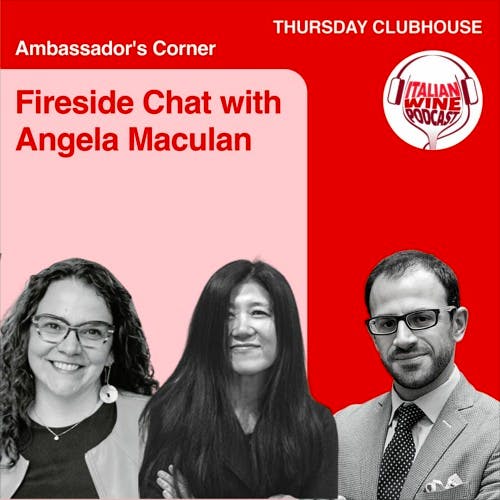
Ep. 781 Giuseppe LoCascio Interviews Angela Maculan | Clubhouse Ambassador's Corner
Clubhouse Ambassadors’ Corner
Episode Summary
Content Analysis Key Themes and Main Ideas 1. Generational Transition in Family Wineries: The discussion centers on the succession planning and leadership transfer from Fausto Maculan to his daughters, Angela (sales) and Maria Victoria (winemaking). 2. The Maculan Winemaking Philosophy: Core principles of elegance, purity, consistency, and a strong connection to the territory and heritage, balanced with subtle adaptation. 3. Influence of Mentors and International Styles: Exploring how Fausto Maculan's vision was shaped by figures like Luigi Veronelli and Émile Peynaud, and the impact of Bordeaux winemaking on Maculan's approach. 4. Adapting to Industry Changes: Addressing the challenges and responses to climate change, evolving consumer preferences (e.g., alcohol levels), and the debate around low/no-alcohol wines. 5. Market Dynamics and Global Presence: Angela Maculan's role in managing international sales, understanding diverse market demands, and the impact of global events on travel and business. 6. Innovation within Tradition: The exploration and development of wines from indigenous grapes like Vespayola, demonstrating a willingness to challenge while staying true to identity. Summary In this episode, Giuseppe La Caso interviews Angela Maculan about the enduring legacy and evolving practices of her family's Maculan winery in Breganze, Veneto. Angela recounts the winery's transformation by her father, Fausto, who, starting in 1973, pioneered a focus on quality, varietal clarity, and vineyard expression, influenced by figures like Luigi Veronelli and winemaking practices from Bordeaux. She articulates the core Maculan philosophy built on elegance, purity, and authenticity to their territory. The conversation highlights the seamless generational transition, with Angela managing sales and her sister Maria Victoria overseeing winemaking, both empowered by their father's strategic guidance. They discuss how Maculan subtly adapts to contemporary challenges like climate change (leading to higher alcohol content and earlier harvests) and shifting consumer tastes, while firmly resisting trends they believe compromise wine's essence, such as non-alcoholic alternatives. Angela also shares insights into their diverse market appeal and the development of new wines like Valvolpara from the indigenous Vespayola grape, showcasing their ability to innovate without diluting their established identity. Takeaways * The Maculan winery has a rich history, with Fausto Maculan significantly elevating its quality standards and branding in the 1970s. * Fausto Maculan drew inspiration from Italian wine critic Luigi Veronelli and French enologist Émile Peynaud, influencing his focus on terroir and winemaking techniques. * The Maculan wine style is consistently characterized by elegance, purity, and clarity of flavor, reflecting the family's meticulous approach. * The generational transfer of leadership has been carefully managed, with Fausto stepping back to empower Angela and Maria Victoria in sales and winemaking, respectively. * Maculan adapts to market changes (e.g., adjusting oak use, earlier harvests due to climate change) without compromising its core identity or values. * Angela Maculan firmly believes that ""a wine without alcohol is not wine,"" reflecting a strong cultural and philosophical stance against non-alcoholic wine trends. * The winery maintains a significant local market presence in Veneto, alongside successful international exports, adapting its portfolio to diverse global preferences. * Maculan's Valvolpara wine, made from the indigenous Vespayola grape with skin contact, exemplifies their commitment to subtle innovation within their traditional framework. Notable Quotes * ""My dad... wanted to be different from before. So he started using seven fifty bottles, using natural core labels, with... the name of the of the variety in the in the front label, using the name of the vineyard."
About This Episode
The Italian wine club is hosting a clubhouse session where members of the Italian wine community will discuss their favorite Italian wines and their experiences with the pandemic. The clubhouse is a hub for Italian wine entrepreneurs and wine lovers, where wine lovers can find the best crafts and share their knowledge and experiences. The speakers discuss the importance of direct-to-consumer and the success of their family business, emphasizing the importance of empowering family members to carry on legacy even through generations. They also discuss the importance of organic wines and the importance of their heritage. The speakers emphasize the importance of consistency in their values and the importance of being true to their own style. They also mention their success in various markets and their plans to travel to other countries.
Transcript
This episode is brought to you by the Italy International Academy, the toughest Italian wine program. One thousand candidates have produced two hundred and sixty two Italian wine ambassadors to date. Next courses in Hong Kong Russia, New York, and verona. Thank you, make the cut. Apply now at viniti international dot com. Welcome to this special Italian wine podcast broadcast. This episode is a recording off clubhouse, the popular drop in audio chat. This clubhouse session was taken from the wine business club and Italian wine club. Listen in as wine lovers and experts alike engage in some great conversation on a range of topics in wine. If you enjoy listening, please consider donating through Italian wine podcast dot com. Any amount helps cover equipment, production and publication costs. And remember to subscribe and rate our show wherever you tune in. House. Missente Divena. Okay. Because last week, we had a little bit of, technical issue here. So I want to welcome everybody to Italian wine club. And, of course, as you know, we've been doing this for some time now. We have, like, who, who is our backstage manager for Clubhouse. Chao Laika. So do you wanna tell us about what episode is this? How long? Tell us a little bit. We'll do a little bit something different today. Tell us a little bit about the clubhouse, what we've been doing here so that everyone's on the same page. Okay. So this is the twenty six installment of our clubhouse ambassadors corner. So the concept is when we we connect, it's our Italian White Ambassador from our Italian wine community to their favorite producer. So in this in this segment, we have Giuseppe and Giuseppe La Caso has chosen Angela Macron as his favorite Italian wine producer. Micah, why don't you introduce Giuseppe today? Okay. So so Giuseppe is, from New York City, native, and he has spent all his live traveling between Italy and USA working as a wine importer and and also in the wine distribution company industry. So having recently relocated to California, Giuseppe has founded Lucidity wine merchants, a boutique fine wine imports or wholesale company and with nurse, a direct to consumer platform where wine lovers can find the best artisanal wines made by the wine growers. So, yeah, Excellent. Thank you for for having me. Listen, where where are you now? So you moved to California? I have. We moved in the middle of the pandemic in June two thousand twenty, literally, you know, putting all our stuff. What did you do that? What's it? Are you going through, like, your midlife crisis? How can you move from New York to California? Those are, like, two different worlds? Yeah. But, you know, after twenty years in the city, with my wife, we were kind of, done with the craziness and and trust me, New York during the pandemic was, wasn't easy. And so, my direct family is all in California. So we decided to come come closer to the, to my brother and my, my, and my, and my dad basically Well, congratulations. I only realized that because I saw, like, I think one of the social media feeds that you were hosting the cavalier de tartufo because I know you're one of the masters. Right? Yes. Yeah, together with my wife. Yep. Yes, that's it. That's fantastic. I've known Giuseppe for some time now because he's actually participated at our first edition of Vineetree International Academy. He was kind of like our guinea pig. Do you remember that? Yeah. That was fun. That was another fun actually. Actually, per the program has completely changed since, by the way, if any one of the listeners out there, they are either interested in the virus program for Venitley or Vineitley International Academy. We will probably doing we are trying to I I don't know if Yacopo's here. I think Yacopo's around. He's our new coordinator for Vineitley International Academy. We are going to Nadine, you should do it. We're going to do I see Nadine. You should do Vineiteale International Academy. I think we will be doing a session sometime in March in New York. Hopefully, by next week, I'll have more information about that. So we are crazy enough to think about doing something for Vineical International Academy in New York in March. So I'll have more information about that. Giuseppe, of course, you've worked for Weinberg for one hundred years with your uncle. And you know all the produce in the world. Like so many Italian producers. Why did you choose Angela? Angela Macron as your favorite wine producer to be interviewed today? Well, it it's actually kind of simple because Angela and I are basically the same age. We're just a few months apart. And we literally grew kind of grew up together in the industry, we known each other for twenty years. And what I've always admired, yeah, what I've always admired of the Macron styles that they kind of transcend the appalachian, you know, they they they don't really can't rely on on a on a famous appalachian. So, almost forty years ago, maybe a little longer than that. Fausto had to kind of come up with, a way, a method to really make his wines meaningful. And it was one of the very first to actually put the name of the variety on the label, which if you think about it, Italy, nineteen seventy six, nineteen seventy eight, they were only drinking rather white. No one really cared about. And so, you know, this kind of purity, this, this this concentration gives focus on the variety of character. For me, it's something that I've always admired. And then, you know, Angela, we we bonded right away, and, and our relationship kind of, is is beyond work. And we we became friends, and, we kind of rely on each other, and then that's basically it. So, Chuseppe, let me get this right. First of all, you are now you have several companies. Right? Cause I see I'm a little confused. Tell me about your companies, the importing companies? Yeah. You know, when I left wine though, I wanted to stay in the industry, but, things in the US are, you know, very well, very, very, very challenging. So I figured, okay, let me just try to put my all my knowledge and expertise to work at the service of producers that really want to, to build their brands. And, at that time, you know, I I knew the sys the system that the entire three tier system and all of that, and I said to many producers, this, and I think you'll probably be better off just focusing on few selected markets. Let me manage those markets for you. And, basically, I'll set up, GLC wine. So that's when anybody tally is a consulting slash brokerage. And then Okay. So that's the bar group, the GLC. Mhmm. Correct. And then, COVID arrived and and at that time with Barabara, we were actually thinking about, like, opening a wine bar, wine, wine store in California, which you know, it's one of the states where you can combine those two things. Mhmm. And then we COVID, we kind of change change our minds. And at the same time, I was talking to my dear friend, yacupoito Dorodoro, the owner of our kids and our sellers in New York, and I say, yacupo, you know what? Let's go back to what we know, best and what we know, and what we do best and let's, set up a new company. And in California, you can have three licenses bundled all together. So import wholesale and retail, online retail. And so in the middle of COVID, we'd say, let's forget important wholesale. Let's, let's try our end at, direct to consumers. And so we started Vintners. And then with the intention eventually to actually do important also as well as soon as COVID permitted. And so in May, two thousand and twenty one, we start the lucidity. And, you know, I I spent all my life in why important wholesale. But for me, direct to consumer was a whole different thing to learn. Even if I have an MBA and all over all of that, it's it was, there was a pretty steep learning curve, but, it it has been a greatest greatest experience, I have to say. And so, basically, yeah, it's it's three companies. They're connected in a way by me, obviously, but each of them has a separate end user, if you want, and, and where we're talking to three different people with those three companies. Okay. So I am looking forward to all of your new adventures to learn more about that when I see you next. You're such a smart dude. I'm sure you will be successful in whatever you do. But tonight is dedicated to Angela Markulan. So, you know, we are Kinda crazy about learning objectives. Tonight, what are we to expect from your call with Angela tonight? Again, from a wine marketing standpoint, I've always admired the fact that Angela's father Faust was able to distill in the Machulam family name and brand, a few very important values that are really transcending the trends. And so what I hope, is gonna come across from this interview is number one, the importance of that strategic long term vision and how to really empower the family to carry on that legacy even through the generations. So those are the things that are really, really relevant in Italy because as you know very well, I think that vast majority of wineries in Italy or family businesses. And so I think there are a lot of people in in Angela's shoes that are either receiving the legacy and our cost cost to carry over, over time all those values and, and, and, and, and the success over their family business. So that's basically what we hope is gonna come across. Okay. Great. So up to you. I'm going to give the mic back to you now, and I'm just going to grab a drink, and my favorite pod is just listening. And then I'll come back for, in the end, if there's some, if there's some extra time for a q and a. Okay? Chow it out soon. Angela, we speak, two or three times a week, more or less. It's it's it's great to have you here. If if you like, I'll start again right away with the with the questions. And I think it's important for everyone to have a little bit of a history about the mapulan winery. When did your father start making one? Can you give us a little bit of clarification? Sure. First of all, thanks for having me here. It's always nice, and it's always a big pleasure to talk a little bit and to explain our philosophy and our the history of our winery since we are, known, but not from a very well known and renowned DOC area. So as you said, we we did. My dad at the beginning did something very, very important for the area. So the history of our winery goes back, some decades because, actually, the winery was founded by my grandfather in nineteen forty seven. My great grandfather used to have a little Osteria, a little restaurant, and he was making a little bit of wine for the Osteria. But at that time, it wasn't the main business of the family. Right after World War two, my grandfather Giovanni decided to build the winery and start making wine in bigger quantities. Even if he didn't have any vineyards. So he was just purchasing the grapes and making the wine, very cheap and low, very low quality and big bottles. One liter bottle with the crown cap and in the big jars of the big damage on them. My father, Fausto, was the only son. So it was literally sent to Coneliano to study winemaking, whereas in Coneliano, where the Prosecco, original Prosecciarra is, there's one of the oldest, winemaking high school of Italy. And after he graduated, he arrived at the winery back. He came back to the winery, and he decided he wanted to be different from before. So his official first harvest as a winemaker was nineteen seventy three. And since then, he hasn't stopped yet making wine. Of course, the first years were have been pretty challenging. It was a completely different market. It was a completely different world. It was a completely different wine world. But for my dad, Fausto has always been very, very clear that he wanted to be different from before. So he started using seven fifty bottles, using natural core labels, with, as you said, with the name of the of the variety in the in the front label, using the name of the vineyard. He started traveling going around and see what the other wineries were doing at the time. So, Frioli, Piamonte, to Escana, France, of course, so both Burgundy and and Bernaux, and bringing back to Braganza any technology, wine making techniques, but the very, very big change, right, when you realize that if you want to make a top quality wine, you should start from a top quality grape. And the best way to have a great, a beautiful grape is to grow your own vineyards. So he rented vineyards and then with a little more money. He bought land and planted more modern vineyards. Today, we have about fifty actors, all in the DOCR of Braganza, that we directly manage. And we still purchase about ten, fifteen percent of the grapes from farmers of the island that have been working with us for the last twenty, twenty five years, so they know exactly what kind of grapes we want. I don't know if everybody knows where Braganza is. I don't know if that's gonna be included into your question, but Braganza is a small deal scenario right in the heart of Veneto. We are about one hour from Venice, one hour from Verona. On the heels at the footstep of the mount of the Altopiano Diaziago. So the name of the province is Vicienza. And, Braganza is, again, it's about six hundred actors DOC area with only seventeen producers. Some are very small. Some don't even have distribution outside the area. So this is the situation where we operate every day. Thank you, Angela. It's think it's important also to mention that in the middle of the seventies, in Italy, one consumption was basically connected to the wine for the table. So everyone was really drinking red or white, and they didn't really care about what exactly was in the bottle. This is when some of the, classic wines, today, they are considered plastics like Tignanello or or SASkaya, they were starting to be noticed. So it's important that, to underline the fact that, falls to add that kind of vision already early on. Did, Angela did falls to have any mentors? I I believe he had a really good relationship with, which he got on Emily. We're kind of influenced even, which he got on Emily on him. So Luigi Veronelli is was probably, probably changed the life of many wine producer, that were starting their career, in the seventies and eighties. Because he was so, basically, Veranelli was just supporting and, and cheering for the legal producers very connected to the soil and to the vineyard. He understood that he was probably one of the first that was pushing and then this and then he understood that the great wine comes from the soil from the land from the vineyard. Which it this is something that today I mean, we we all know that if you want to make a good wine, you have to work hard, a very good managing of the vineyards, reduce the production, and all this kind of stuff But we have to think as you said in that we we were in the seventies, early eighties with a completely different wine word and wine consumption and style of the wine. So definitely Veronelli was probably one of the very important people that changed my dad's life, but old, not only my dad's life, also from many other wine producers that were emerging in that, the time in the seventies and early eighties. Other than him, my dad is always a big good friend and have good relationship with many other producers. He was also really impressed by Emil Peno. He, my dad, went to the first edition of the VINexpo in Bordeaux. In nineteen eighty one, and he met Amy Peno at one of his, lectures. And, he was really impressed by meeting him and having been testing the wines and, getting suggestions from, from him on the on the production of wine. So if I could say these two, maybe not mentors, but definitely very, very important people and change the the way my dad was viewing the wine and making the wine? We we have mentioned Bordeaux many times. What kind of influence did Bordeaux have on on on Fausto. And I know that the influence is still present today because you have carried on with your style keeping it consistent through the years until still today. So what kind of influence did for the lab? On on the way he wanted to make wine. So first of all, we have to say that in the area traditionally, all over the northeast of Italy, if you are not in their owner where they have where you will find the traditional grape for the the use for Balicella. All over the northeast of Italy, the main grapes, red grapes are cabernet sauvignon Merlo, a little bit of cabernet franc, and there's also some pinotaro. So having cabernet sauvignon and Merlo in the vineyards, and these grapes have been grown here for over a hundred fifty years. So this is really what it's traditional for us. Of course, when you start learning how to make wine and you want to make to you aim to produce a top quality wine, where else can you go? Of course, Bordeaux, it is the place. So my dad went there. He visited the vineyards, met the producers, met the winemakers, have him done tasting our wines and tasting their wines. And of course, if you If you want to compete, with them or at least being in that, you know, being one of their competitors, you have to learn from, from, from the producers that make that kind of, soft quality wine. So Bordeaux, France, in Gerald, because there's, of course, burgundy, but Bordeaux mainly has always big had a big, big inspiration for us always been. And still is So the vineyards, we have about twelve actors of high density vineyards planted with ten thousand vines per excerpt, because my dad sold them in Bordeaux. So in nineteen eighty five, he started planted high density vineyards. See, we started doing the punching down in the early nineties because they saw that they were doing Pajage using Baricks. But the first Barrick my dad bought was in nineteen seventy eight, So all these, all these things, you know, are definitely come definitely comes from an influence, a French influence, for sure. Which makes sense as you said because of the, the the traditional, type of of of of of of grapes that we have as we have in regards to. So it really makes sense. If you could pick three words that you think have defined, macro lands when making since the early days, and that they are still, valid today. What would you think? What would you say? It it it defines your style, forty five years ago as well as today. Wow. Definitely, I can say that our wines are elegant. So elegance, because, they they are all a good mix between the strength and the fruit, but the elegance and the acidity. The our wines are true to the territory because, I mean, again, Kevin and Melo have been here for so many years, but always with an eye to the world because we sell our wines all over the world. And then the I don't know if that makes sense in English, but our wines are straight. You know, they are true to their, characteristic. So if you taste the cabinet, you you can tell it's a cab. If you taste them a little, you can tell it's a merlot. They're all very, very clean, and straight? I will, always remember the very first time I had a maculan wine. It wasn't one of your recipes. It was actually Ashley Nobili, which is the we'll try this expected the spayola that you you make every now and then. It's a dessert wine, obviously. Mhmm. But even then, and it was I didn't know much about wine back then, and and I was offered a glass from Valonardo, and he was meeting with your dad in his housing in nineteen seven, I believe it was, with and and and I was there, you know, visiting. And, I remember the purity of the flavor. And I think that purity of the flavors is what is one of the many things that really defines Maculam as a as a producer as a style. Clean, pure, very transparent, very, crystal clear, flavor profiles. And, and that and and that's something I really admire. And the fact that, I like to say that I think the way, your father, Fausto cooks speaks a lot about the way he makes wine. I will never forget, we made a spaghetti without a gold star, spaghetti with lobster, and it's a Giuseppe. In life, you only need two or three very simple ingredients and make sure they are combined well. And then everything you do is we're gonna shine. And that was, that was a great teaching that I got from your that, and I think that applies to your winemaking as well. So listen, let's talk about you because one of the things we want to talk about is, you and your sister Maria Victoria, are the second, actually, the fourth generation now. And so you you will have to carry on this legacy going forward. So when did you start officially working at the at the winery? So, Wow. My official first business trip because I'm in charge of sales, and I'm the traveling smile of the winery. My first business trip was to New York the portfolio testing organized by Wango back in nineteen ninety seven, and I was underage. So I it was illegal for me being behind the table at that time. But I still remember everything of that trip. I spent two days in New York, two days in Washington, DC, and then, back to New York for one more day. So I was I was nineteen. Not not even twenty yet, but since then, I have never stopped. So I've been traveling again for twenty wow. Getting old. Almost twenty five years now. We're getting there. Yes. So That's my that's my role main role. I've always traveled about a hundred, a hundred fifty days a year. I'm in charge of the whole sale. So Italy, Europe, and, also the rest of the world. So I'm the only one that travels for the winery. And I've been doing, since ninety seven. Then I became, officials, I mean, one of the partner one of the owners of the winery in two thousand seven. And since then I'm much more involved, also in other decisions, here at the winery, when I'm home, I I taste the wise with my dad and my sister. And, And I hope I can go back, on the road again soon. My sister, Maria Victoria, she's younger than me. She graduated as a winemaker. She has always wanted to be a winemaker since she was a kid, and she graduated in two thousand seven. Since then she's working side by side with our dad in the winemaking and vineyard Managing area of, of the winery. So it's the two of us and my dad, who supervised both of them, both of us. So you you kind of split the responsibilities, but when when it comes to big decisions, how does it work? How do you guys kind of come together all, you know, in a room and, tell us a little bit about the process because I'm sure there are a lot of people that will listen that are in your position. And we you and I know that family business, it's great, and then it's also benefiting. Very very difficult at one point because, it's all about balance and and finding the right, asking the effect between all the members. So how how did you guys manage this old relational passage? So, there are two things that I have to say. First of all, it's not, as you said, it's not always easy to balance the personal relationship. So with my sister and with my dad and the business relationship with my business it's not always easy. When when it comes to big decisions, we all get together in a room and we discuss. Of course, if it's a It's from a it's from a sales perspective. I will have the last word. If it's a more technical, quest subject, my sister will have, the last word, the last decision. But, of course, we all discuss together that, of course, if it's an everyday decision, we don't need to do big meetings. That's, that's for sure. The other thing the other thing I have to say, I really have to thank my dad because at one point, in two thousand four. He decided to stop traveling. Because, from my first trip in ninety seven all the way through two thousand four, we were both traveling, not together, but separate. But, you know, if you go to, I don't know, let's say, to New York and you have a meeting with this this buyer, and then the next night, my dad will go. You the buyer doesn't have, just one person to, as a reference from, from the winery. So it is said, okay. I'm not traveling. You will do everything. So I took over, of the of the traveling part. And he didn't come to Vin Italy for three years in a row because he wanted all the buyers, all my importers, all our customers that he wanted that they were talking to me, and not just him. Because if we are together, If we are together, everybody wants to talk to him. He's the big guy. Yeah. Yeah. So, I mean, of course, everybody wants to talk to Fausto and all these things, you know. So for three years, he didn't show up at Vin Italy. He, of course, because, I mean, you know him. He called us, like, ten minutes after we left from, from Breganza. So where are you? How is it going? Do you this third traffic So these kind of things, you know, always present, but not physically at the booth at Vinitally. So, of course, people just started talking to me about discounts, about new vintages, and all these kind of, you know, kind of business agreement that you have, that you do at at Vinitally. And then when he came back, because, of course, he can't stay home. So the following year, the fourth year of Vin Italy, he was back at the booth the full time for full time. And, the importers were saying, no, I want to talk to Angela. So that was that was very nice, and I really have to thank my dad for for doing this for me and for my career. So that really made a big big change for me. And and I think, it's not easy to do that as a, you know, founder in a way. To really empower and then, you know, let people do their own thing? No. It's definitely not easy, also because my dad has a big personality. But, He said, you know, sooner or later, this generation change will happen naturally because that's that's life. And he said, you know, it would be easier. If you go with me be being behind you just to kind of protect, and guide you, you know, from the distance. So this was the idea, but that thing was not easy. That's I think it's, like, it's an important thing. And, you know, I hope, this would, would inspire more more founders to, to, to, to move the same way. Going back to the style, to the winemaking style, what do you think, is not the secret, but what what what are you doing to make sure your style keeps current? Because, you know, very well, we are going through a lot of changes in the industry. But I always know that if I if I pick a Maculan bottle, I know what I'm going to taste and what I know what I'm going to find. So how have you built this style? And how are you going to keep this style consistent? Is it your values as a family? It's definitely our valued as as a family as a winery as a group as a working together group. As I said, our wines are are clean or pure. They are true to the variety to the territory. Of course, the market is changing. The taste of the consume consumer is changing. So we try to adapt our wines to the taste, but, I mean, not following the trend because that would be too much. But always maintaining our characteristic and our purity, as you said, because I think purity is the perfect way. To describe our wines and also ourselves as as people as persons. What do I mean by, adapting or following the the the market? For example, for Frata, Frata is our top red wine. It's a blend of cabernet sauvignon and Merlo. We have always used the hundred percent new oak, new French oak. Now in the last few vintages, we've reduced the new oak using also second second usage Oak because the market is going that way, trying to harvest a little bit earlier to maintain the acidity and the elegance. So we're kind of, Yes. Follow in a little bit of the market. This is what we do for living. So this is this is what, I mean, the wine is wine is our is our life. So we we still want to express ourselves, our territory, but at the same time, so be true to ourselves, but also at the same time try to, a little bit, follow the market because at the end of the day, you have to sell the wine. Right? Yeah. Yeah. I mean, it's it's it's small adjustment, without diluting without diluting your style without diluting your identity. Oh, absolutely. I did a vertical tasting, like, last week. Going back to the eighties with Frata and both Frata and the and the dessert wines, and you can still recognize the style is always the same. The style is the same. Of course, there are a little bit of adjustment because Like, if we take Frata, I I pulled the bottle of Frata eighty seven, the alcohol just the alcohol was twelve point five. The current percentage is fourteen point five, you know. So there's much more extraction and much more body and and and and bigger and, so but the style, again, the elegance, the acidity, the purity is are there. So you can definitely find these things throughout all the production. They either in the red wines or in the dessert wines, as you mentioned before. And and, Angela, I I'm sure you've heard this question many times, but going from twelve percent, to fourteen, which by the way, we are seeing everywhere. I mean, even here in California, Napa, I remember I came across, some classic Napa wines from the eighties, and they were twelve point five. So do you think this is really because of climate change? Or have you seen, especially in the last part of the harvest? A huge, a bigger influence of the climate over the the the, the beam. So there's, of course, this the the the climate changing, it's one of the reason. I remember when I was a kid, the harvest here in the area will never start before school at any in Italy, school starts around September ten. So before start it's the the the the it was before the school and then the harvest. Now harvest starts the the the last the week of August for the early days of September. So this really changed a lot. But if we are talking about the wine, it's the combination between the climate changing and the taste of the consumer, the style. Because if you produce a wine now with twelve percent alcohol, I'm not sure the people will like it because we of course, we say alcohol because it's something that it's written on the label, so something you can, read, but fourteen percent of alcohol is made of so many things, you know, color, fruit extractions, aromas, structure, complexity. It's not just alcohol. It has to be I mean, everything is has to be around and very little balanced. Yeah. And and, you know, we we share the same taste and and we kind of grew up together in this interest. So we we totally are on the same page. That being said, one of the trends I wanted to, talk to you about is at least during the US, there is a growing segment of the younger population that is looking for low alcohol to no alcohol ones. And for me, obviously, it's unthinkable because I do not see alcohol as a drug. I do not see a bottle of wine as a drug. Okay? For me, alcohol, as you mentioned, is part of the product, and, obviously, it needs to be within a range, but it's part of the product. I do not, let's say, I I don't have a a health problem, obviously, but here in the US, people are trying to to eat healthier, drink healthier. So we in the trade are a little concerned about this, there's there's no alcohol wines because frankly, I do not see I think it's lacking something. It's lacking. As you said, roundness, it's lacking, balance. But but the younger consumers they don't have the same training or they don't have the same product that we have, they are actually looking for this kind of product. So, one of the questions I have for you is, how our you as as a company as a winery going to, adapt to things like that because we will just, you know what, that's not a segment of the consumer that will are that will will pursue. They would we're not gonna we're not gonna try to target the those consumers. But how is Macron talking about all these changes, the natural wines, the no alcohol wines, and things like that? Wow. Are you guys thinking about it? Are you are you discussing? Not Not really. Not really. I mean, we're talking about organic. That's for sure. Sometimes we discuss about natural wines, but it's not in our style. It's, I have to say. A wine without alcohol for me is not wine. I agree. So I'm sorry. I mean, it's it's going to be, I mean, I don't know, grape juice. It's, I don't I don't see I don't know if that's because I'm Italian and being Italian. I grew up with wine. I mean, not only being born in a winery family. Mhmm. But as Italians You perfectly know. And I'm I'm I guess so many of the listeners have been to Italy. I mean, it's part of our culture. It's, how do I know how to explain? I mean, it's, it's it's part of us of our heritage Yeah. I I'm totally with you. It's just that here in the US, you know, the thing things can be a little different. No. Not good. Of course, I know. Of course, I know. You know, it's it's gluten free pasta, gluten free pizza. To me, they're they shouldn't be called pizza or pasta, they should be called something else. But if you take away a key component, okay, of a product, then you should call it something else. So I I I can agree on the gluten free if you have a gluten problem. I mean, like, if you're Chiliaco. I don't know how to you say in English, but, I mean, if you cannot if you cannot eat gluten, that's Yeah. That that that's not the reason, Angela. Most most people are thinking gluten free at, like, pot free or light or healthier or things like that. So I don't know. I don't consider wine, alcohol free wine wine. I don't see that. I have to say. But again, we'll see. I mean, I don't think we will get to produce a wine without our call. I but you never know. I mean, it's the market has changed so much, but I don't think I will go that direction. Sooner. And it's also it's also true that, fortunately you are very, very well rooted, locally in benefit, especially. How much of your production is actually, stays in benefit. It's about one third. We're very, very strong in the local market. I usually say that out of the six hundred thousand bottles that we produce, one third is exported, one third is sold in Italy and one third is sold in Vanital. Well, it's something pretty unusual. I have to say when I say this to my colleagues, they always stare at me, but you're very, very strong in the local market. Well, one one last question, and then I think we should, open it to questions. You before COVID, you have traveled a lot. Have you seen, major, differences in in the way markets react to your wines, or is Macron always received pretty much the same way from New York to Tokyo to Canada to, Brazil and things. Wow. That's a very difficult question. So I can definitely say that we have a pretty big portfolio. We've mentioned, like, I've talked a lot about the red wines, but we're very, very well known, renowned for, the dessert wines. And we produce four different dessert wines, about twenty percent of our production are are sweet wines. So and we also of course have whites. So we have a pretty big big portfolio with twenty one different wines. It's really different. Every single market is a different market. It really depends on the importer and the trend. I don't know. In the US, we've always sold a lot of pinot and toy, which is a pinot grillo, pinot bianco, and Tocai Frulano blend, a lot of Brentino, which is the Cameron Emerlo, can be considered the entry level. I don't know. Let's say UK. UK, they're crazy for our dessert wines. They they they buy tons of, dinderella and Torcorato, very few of the other wines. So it really depends on the market. One thing that I can say that's worldwide in Italy too, of course, is that they recognize the passion that the of the family of, all of us that we put in our, in what we do every day, that we, in our wines, because I I think that you can taste and feel the passion and the love for what we do when you drink our wines. And again, what we said before, clean, be true to themselves. So they really I can say that the the wines are the perfect mirrors of of us as as as a family, you know. So that's something that, that that people, the people recognize and they, they admire in our wines. So can we say that the success of a brand like Macron over time is is the ability to incorporate in the brand name, your own style, making small changes if it's needed, but always trying to be true to your own identity, and so that are there is the there is the personal side of the Macron family into the wines. It's those are wines that are made by people that believe in those products that believe in in doing things in a certain way. Absolutely. I mean, when you do something like that you love, you are ready to, you know, to make big small changes, small adjustment, but you still want that your product is still true to yourself and to to what we you are. And this is, this is our these are our wines. So so definitely, yes. Unfortunately, you know, many producers, every now and then they try to intercept trends. And so every Every three months, they come up with something new. And, the result is that, they dilute their identity, they dilute their their their values. And, at the end of the day, after a few years, no one really knows what this, that producer is really all about. When it comes to you, I think it's way more clear. It's way more defined. Mhmm. And I believe that's that's the secret of, of being, successful over time. Yes. I agree. I can definitely I can see myself and my family and my winery in, in your words. So, yes, definitely. Yes. I want to also to ask, how are you going to so hopefully, we will be out of COVID eventually. Are you starting to already plan trips around? I know you're coming to the US in a month, but, what about the other countries? So I haven't booked my flight yet because I'm still thinking, but, yes, that will definitely come. Not really. The situation is still very, very unstable, unfortunately. I just had the news this morning that they canceled a big tasanian Rome for mid February. There are rumors that they are postponed in Provine. So it's, I don't know. The world is still too much and stable for making plans, long term plans. By this time of the year, I would usually already had, you know, like, a program, the, February, May, September, October, November, everything, you know, but, not it it's not that time yet. I also have to say that I had to, kind of reprogram my life, you know. Yeah. Traveling traveling a hundred fifty days a year, from going from there to zero, not even moving outside my my town was not easy at the beginning. I've always tried to since the very first day, I decided, okay, I wanna see also the positive sides of this. And, I found a lot I have to say. I the the the most beautiful thing for me was following day by day, I live in the I I'm lucky enough to live in the vineyards. So following day by day, the developing and the growing season, it was just amazing because, you know, being away for two or three weeks, you you leave home that the buds are already still closed, and then you come home and then you have, like, the fifteen centimeters shoot. But the following day by day was just amazing. And then other other you know, I definitely have more time for myself, which sometimes, in my previous break COVID life, I didn't have much. So I'm really enjoying it. But I'm I'm totally sure then as soon as I will be at the airport or on a plane, I will be back to my my life, and I will definitely schedule and, and and also really happy to be back on the road again. So, Angela, one last question. This is what I do. One other question about the generational passage. So you told us that, at one point, Fausto, kind of, gave you the keys of the sales department and say, well, now you're in charge, I will step back. And, call me if there is an issue. Did it do the same with Maria Vitora for the for the production, for the winemaking, or was he a little closer to Maria Vitora trying to guide her? Because I haven't seen, obviously, as we said, major changes in style. So I guess, Maria Victoria is really following on his steps. But how did that change happen in the production side? So it was not as drastic as it was for myself. You know, if I'm in New York, my dad is not is not with me. So I have to decide, okay, I'm going to present the wine like this and, and do this and, and and say that, you know, where the wine making is different because it's, It's I don't know. The process takes a little longer. Of course, the vineyard managing and everything, the times, of the the different actions are are longer than a thirty minute appointment with a buyer. And, of course, my dad is is here at the winery every day and he follows step by step. Of course, it's not like, okay, I want to do this and you have to do this because, of course, my sister It's the same for me. If it's a big decision, it's the two of them that they take the big decision. It's the same. I I take with my dad the decision. But, and in the everyday small little things, we are both, on ourselves. So, I mean, I can take my own decision. My sister can take their own decisions. But, of course, the school let's say, let's call it the school. It's our dad's school, you know. We have our own the path and the roles it's, the they come from the same. So we are just following. Yeah. Yeah. Yeah. Yeah. I wanted to so there is one you really don't release many new products very often, Angela. And that's kind of part of the philosophy behind Macoran in being consistent but you did release a new, product some time ago, I think, a couple of years ago, from made from the Vespayola grape, which is one of the very few native varieties of the area. And I think I think it's called Balvok Parra. And there is a little bit of skin contacting that wine. How did you come up with that idea and what was the soft process about making that wine? So Vespayola, as you mentioned, is the the only, really indigenous grape that we have, and that is really unique to Brghanssen. And it's a traditional use to make turkolatto as a dessert one. So we dry the grapes to make the turkolatto. We also make a ginobili, which is the one you mentioned that changed your life. The You really did actually. The one with the botaris, but of course, we also verify the gray the fresh grape to make the vespayolo. So just to explain a little bit about this grape variety, it's a white grape with a very bright acidity. A few years ago, we purchased this property when we fi we found some old vines of Vespayola, So we had the our genetic material. I don't know how to explain that. I mean, reproduced in the greenhouse. So we planted our own clone of vespayola. Vespayola is a is a white grape It's a beautiful bouquet. Reach a lot of white flowers, white fruits. And in the mouth, the acidity is what it's, it's the the main thing. You know, it really exploded in the mouth. But it's not it doesn't have a big, big structure. It's not a full body weight. So we decided to try to do something different with this, our own clone of vespayolo. So we picked the grape. We dry a little bit for just a couple of weeks to have a little more concentration. And then we do five days of skin contact. We do this in order to have a bigger body and more structure and to extract all the beautiful aromas that the Vespayola has. Because we really believe in this grape, and we would like to not focus, but, I mean, to, we to have a bigger wine with more longevity and more structure. Because this paolo here is a very easy drinking, refreshing, which is amazing, but we also wanted to challenge ourselves in a more, in a more complex, vespayolo. And that's the Valvolpara. Valvolpara is the name of the vineyard as many of the name of our wines is the many of the name of our wines comes from the original vineyard where the grape is from. It's a small production. It's only not even a thousand bottles, but it's something that we and we believe this way of making the Vespayola can really age for longer, long, many, many years. I think it's a great example of what we just said about, you know, making small adjustment, small new things without really losing your identity and keeping, consistency in your values. That's great. Absolutely. See, I'm I'm pretty much done with the with the questions. I mean, I'm Andrew and I can talk for hours. So we can Okay then. That then hold on one second. There you go. That was Thank you. You know, because I'm sure they'll be clapping, you know, the audience, but, you know, you can't hear them. So we do a little cheering for for our speakers. That that was wonderful. Thank you very much. I know the traveling that I can completely relate with you, Angela. It's I don't know how much, Josepe, have you been traveling a lot? No. I haven't at all. I was supposed to be, very, very little. Very, very little. I was supposed to be in Las Vegas last week, and I canceled. I did it over Zoom, but next week, we will have the, slow one in San Francisco, and I will have, five producer. I mean, I have five tables. No one is coming from Italy, obviously. And then I will fly to Seattle on Tuesday. Yeah. But it's very Yeah. This I'm not gonna not gonna do long flights, until, April. So I'll be I'll be But you'll be coming to Vinitly, I hope. Yes. Absolutely. Yes. Yeah. Alright. So thank you very much for that. I just want to remind we are out of time right now. But before closing, I want to remind everyone that next week. We will be back with Rob Miller and Diego Karadi. Again, Veneta next week. The week after that, we have Marsha ham from Canada with Lorenzo Marotti Campi. And tenth of February, we have Stefan Metzna with Clemens Lagerda. And then on the seventeenth, we have Julian Faraker with Amanda Courtney. And the twenty fourth of February, actually, it's my birthday. Ashley Howell with Pier Luca Prietti of Abia Naloha. So we are and it goes on and on, the entire schedule, like us doing a great job scheduling all of you here. And remember, please remember that all of our conversation will be replayed on the Italian wine podcast. Last week, I was saying, like, you know, it was it's very exciting because we had more than million listings last year, which is very, very significant, obviously mostly from the anglophiles. But we are getting some traction with the Italian, audience as well. So we're very excited about that, and we will be doubling down with our podcasts. In two thousand and twenty two. So hoping to see some of you at VINitally, if you can. If any of you would like to participate in the buyer's program, please reach out to our team. And then we'll see you next week. Thank you so much. Listen to the Italian wine podcast wherever you get your podcasts. We're on SoundCloud, Apple Podcasts, Spotify, email ifm, and more. Don't forget to subscribe and rate the show. If you enjoy listening, please consider donating through Italian wine podcast dot com. Any amount helps cover equipment, production, and publication costs. Until next time, Jinching. Hi, guys. I'm Joy LIVings Denon. I am the producer of the Italian wine podcast. Thank you for listening. We are the only wine podcast that has been doing a daily show since the pandemic began. This is a labor of love and we are committed to bringing you free content every day. Of course, this takes time and effort not to mention the cost of equipment, production, and editing. We will be grateful for your donations, suggestions, requests, and ideas. For more information on how to get in touch, go to Italian wine podcast dot com.
Episode Details
Keywords
Related Episodes

Ep 2325 Anna Obuhovskaya IWA interviews Fabio d'Attimis-Maniago of Attimis-Maniago | Clubhouse Ambassadors’ Corner
Episode 2325

EP 2316 Alberto Martinez-Interiano IWA interviews Emiliano Giorgi of Progetto Sete Winery | Clubhouse Ambassadors’ Corner
Episode 2316

Ep. 2308 Anna Obuhovskaya IWA interviews Sara Repetto of Vigneti Repetto | Clubhouse Ambassadors’ Corner
Episode 2308

Ep. 2299 Beverley Bourdin IWA interviews Grégoire Desforges of Baglio di Pianetto winery | Clubhouse Ambassadors’ Corner
Episode 2299
Ep. 2290 Rebecca Severs IWA interviews Primo Franco of Nino Franco winery | Clubhouse Ambassadors’ Corner
Episode 2290
Ep. 2281 Julianne Farricker IWA interviews Mattia Montanari of Opera 02 Winery | Clubhouse Ambassadors’ Corner
Episode 2281