
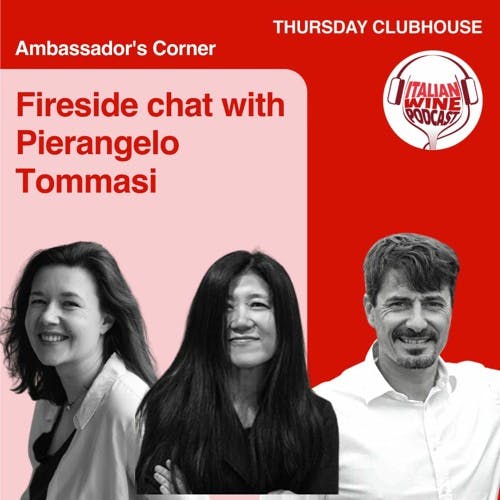
Ep. 952 Anna Obuhovskaya Interviews Pierangelo Tommasi | Clubhouse Ambassador's Corner
Clubhouse Ambassadors’ Corner
Episode Summary
Content Analysis Key Themes and Main Ideas 1. The history and enduring legacy of the Tomasi Family States winery, founded in 1902. 2. Pierangelo Tomasi's personal journey and leadership, embodying the fourth generation of the family business. 3. The Tomasi family's business philosophy, emphasizing mutual respect, teamwork, and a shared vision across generations. 4. The winemaking philosophy focused on respecting regional terroir, producing elegant and enjoyable wines with finesse. 5. Strategic expansion of the Tomasi Group into diverse Italian wine regions, including Tuscany, Puglia, Basilicata, Lombardy, and Sicily (Etna). 6. The integration of hospitality and wine tourism into Tomasi's long-term business strategy. Summary In this Italian Wine Podcast episode, Joy Livingston hosts a Clubhouse recording where Anna Obuhofskaya interviews Pierangelo Tomasi, CEO of Tomasi Family States. Pierangelo, representing the fourth generation of the winery founded in 1902, shares insights into the family's enduring success. He discusses his personal career progression from warehouse work to executive director, highlighting the importance of family unity, mutual respect, and a shared vision in managing a large multi-generational business. The conversation delves into Tomasi's winemaking philosophy, which prioritizes respecting the unique characteristics of each region's soil and grapes to produce elegant and enjoyable wines. Pierangelo elaborates on the company's strategic expansion beyond Veneto, detailing projects in Tuscany (Maremma and Montalcino), Puglia, Basilicata, Lombardy (Oltrepò Pavese), and their newest venture in Etna, Sicily. He also touches on the significance of integrating hospitality and wine tourism into their business model, particularly for projects like Lugana. The interview concludes with Pierangelo's vision for the company's future and his deep personal connection to Amarone della Valpolicella. Takeaways - Tomasi Family States is a successful multi-generational Italian wine company with a legacy dating back to 1902. - The company's success is attributed to strong family dynamics, including mutual respect, shared vision, and effective delegation based on individual strengths. - Tomasi's winemaking philosophy aims for elegant, enjoyable, and accessible wines that respect the unique terroir of each region. - They have strategically expanded their vineyards and projects across Italy, now encompassing regions from North to South, including a new venture in Etna, Sicily. - Hospitality and wine tourism are integral parts of their long-term strategy for new projects. - Amarone della Valpolicella Classico, particularly Tomasi's single-vineyard Amarone del Bùdies, remains a flagship wine and holds significant personal importance for Pierangelo. - The company's approach to human resources emphasizes empathy and team compatibility alongside professional skills. Notable Quotes - ""The most important thing is to get along. When you, when you respect each other, you respect each other's strengths and weakness, you support each other."
About This Episode
The Italian wine podcast is hosting an Italian wine buggery clubhouse session and discussing the success of the clubhouse and rebuilding their brand. They talk about the importance of family companies and the success of a winning company. The speakers emphasize respect and communication between members and the importance of maintaining the original DNA and characteristic of each region for a good working team. They also discuss their investment in a wine podcast and their plans to create new wines and be a family, state, and tour company. They express their love for organic wines and their desire to be a family, state, and tour company. They also discuss their plans to create a signature style of Thomas Yards and their interest in organic wines.
Transcript
Welcome to the Italian wine podcast. This episode is brought to you by Vinitally International Academy, announcing the twenty fourth of our Italian wine Ambassador courses to be held in London, Austria, and Hong Kong, from the twenty seventh to the twenty ninth of July. Are you up for the challenge of this demanding course? Do you wanna be the next Italian wine Ambassador? Learn more and apply now at viniti international dot com. Welcome to this special Italian wine podcast broadcast. This episode is a recording off clubhouse, the popular drop in audio chat. This clubhouse session was take from the wine business club and Italian wine club. Listen in as wine lovers and experts alike engage in some great conversation on a range of topics in wine. If you enjoy listening, please consider donating through italian wine podcast dot com. Any amount helps cover equipment, production, and publication costs. And remember to subscribe and rate our show wherever you tune in. Hi there, everyone. Let me just talk a little bit about clubhouse. It is six PM at the moment in Verona Italy. We actually do these every week, and they get replayed on the Italian wine podcast. So this will be on the podcast in the next couple weeks. And tonight, we have Anna Obuhofskaya, who is interviewing Pierangelo Tomazi. Now I will introduce Ana in just a moment, but I just wanted to say that, yeah, Clubhouse has been super successful, and we are basically, replaying it on the podcast so that people all over the world can listen to it in their own time zones. So, yeah, Anna, are you are you there? Yes, sir. I'm here. Hi, everyone. Hi. Did I pronounce your name correctly? Right. Not exactly right. Oh, god. Okay. I was sure I didn't, but okay. That's great. So, Yeah. There are, you are based in Saint Petersburg, and you have thirteen years of, experience in wine, marketing and sales. And you've had many different roles but, yeah, no, best cavist of two thousand and eleven. I could I could just go through a very long list, but I want to ask you why you chose, your producer today, Well, it was actually easy to pick Thomasy because, they produce one of the most impressive wines I have ever tried Amarona de Buddhist, a flagship wine, if they stayed from a single wine yard. And that's pretty amazing. It's, Amarron of Great Finance in elegance where power isn't straightforward, but hidden between countless layers of aromas and taste nuances, you know. And besides that, I also have respect for the business approach and the new project that Thomas develops. They make wines at the most perspective, escalations of Italy, Maraima, and Matulcino, and Tuscany, Vulture, in Brazil. So that's why. Okay. Well, you're a fan. I can see that. I'm well, it if, you know, what what are the the the the learning objectives? That's normally what Stev. Stevy asks these questions much better than I do. But What what learning objectives, can we get from from your interview today? Do you think? Well, you know, Joy, today, I'd really like us to learn more about not not really about the area or grape variety, but, about the approach and business vision of a winemaking company. The point that interests me the most with Tamasi is, what are the key factors for a family company to be successful today. You know? There are many, many family, companies on the market. And not that all of them are as as a successful, Estamazi, So I hope we talk about it with Tarantula today and he shares some secrets with us. Oh, okay. Well, that actually that sounds very interesting, because that's that's true. There are so many family wineries and, each one so unique. So I'm I'm looking forward to your conversation with him. Is is Pierangelo in the room now? Yes. I am. I've been listening every single word. I, everyone. It's It's lovely to meet you, Pierangelo. I am going to let you and Anna have your your interview now. I'm going to to mute myself. Thank you, Joy. Thank you very much for introducing this. And, well, from my end, I would like to say thank you all for attending this podcast. I'm very glad to to share with you as many information as possible about not only myself, but more importantly to Massey Family States. You see, I'm not gonna promise to share really cigarettes, but at least some insights of Domazi. That's for sure. Wonderful. Okay. We will we will talk. We will talk really. Joy, let me also, say, how I discovered wines of Thomas, how when it happened and, in which sequences. Okay. Okay. Go ahead, you guys. And at the end, I will intervene. And if there's time for questions or If there is time, then we'll we'll have some questions if there are any. Otherwise, yeah, I'll see you guys at the end. Alright. Thank you. So, well, I've met, we had Thomasy Wines the portfolio of the importer that I used to work with at the time looting. And I was selling the, Thomas wines for my customers, but later in verona last summer, during the ambassador's program, there was a seminar on historical families of Amaroni, which appear Angel optimizely attended, and we, finally met in person. And it was really a unique chance to taste different Amaroni wines from legendary producers like Alegrene, Mazzie, Betty, Taadeshi, Zennaro, Ricardo, thirteen in total. And comparing this wise, I noticed how elegant and sophisticated Thomasy Amarona was. And I appreciated. I appreciated it even more. So I shared my impression with, Pierangelo, and he was very kind to invite me to visit the winery. And I did. I did it a few months later in November. I had a chance finally to drive to the Davouris Viyard, of my favorite, Amaron, and to work to walk on its coqueries soil and better understand where the style of the flagship Amaroni comes from. So this white yard is on the top of the hill with fantastic view. I could even see Lake Garda from there. So I also visited, state and gorgeous seller, and I should mention that Armani, the fashion brand, organized a show, a runway show, in the seller some years ago. So I'm not the only one who thinks that tomasi's seller is beautiful. You know? And I visited a very modern wine shop and museum of the wine and perceived how much work is behind Thomas brand and each glass of wine they produce. So seeing back, black and white photos of the state, that was that were made decades ago and comparing it with today, I felt really strong impression. And the fact that it's a family owned company impresses me even more, you know, you compare it with the decades ago and you compare it now. And it's you can see really huge progress that this, company made within years. So, I'm really happy to to be talking to Pieranzo today, and, I have a few questions to ask. Okay? I am ready on any time. Let me, Pieranzo, let me, introduce you your current, as a CEO of the you were born in nineteen seventy five in one of the greatest Italian white families, Tamizer Family State, founded in nineteen o two. And you were, one of the nine members of her current, fourth generation who run the family business. Is that right? Yeah. This is correct. Okay. And as soon as you finished your studies, you went to work full time in the company and started, training as a warehouse worker then, wine shop responsible for wine new tours and tasting, then export director and work in, your way in the company and see your current position, the executive director. So that's quite an impressive career. I must say so, then, you inherited your passion for wife, from your father and uncles, with whom you went through with the Vier's driving tractors and use, using harvest, the grapes. So you inherited the rigor and reality as well. Such qualities have allowed you to make, the range of foreign markets, and to be often one of the over seventy countries where commercial family state wives are distributed. So you are married. Have two kids and a dog, and indulges in your passion, soccer, both as a player and as a fan. Well, is everything correct? Yeah. I mean, everything is correct. I would say that I I I used to be a player of soccer, but now being forty six year old, I have to be very careful. So I still consider myself a good player, but although I'm not, that young anymore to really be active as I used to be, but this is actually correct. Thank you. Yeah. My, my first question was actually about, your your personal story, how Yeah. How, your how your career started, really. I just, said a few words, or about it, but but could you could you say it from your point of view? I mean, I mean, which do you think what was the standing point in your career? When when do you realize you really want to be in this business? Well, you see, I mean, I, I kind of introduced quickly the company itself before getting to talk a little more about myself in a sense that to answer your last question, I mean, that came easily being part of a family. With DNA as always been in wine production since, nineteen o two. Actually, one hundred and twenty years ago, when, my great grandfather who was a farmer working a vineyard here in the Valpolicella Classic region, but the this vineyard was actually owned by another, very noble rich family. He had the chance to buy this vineyard from his boss because his, desire is long term project, engaging, was to to do something on his own. And it started the the the tomasi business though. So growing in a family, there has always been part of the one industry the passion and a desire to be involved is almost natural, I would say. So, going back to myself and to your question, although my studies in, in, particularly in high school were not specifically linked to Viticulture, nor analogy, but I actually started and graduated in, in a school that was actually focused in foreign languages and tourism. And that helped me once I, decided to finally start working in the company, in the family company to be able to look after the export markets, which, as you mentioned, was not my very beginning in the, say, business career because as I started as a as a warehouse worker, got a passion about, you know, logistics as well, which, several years later, I can say it's been extremely important for my for my business life because once you learn about logistics and how to actually handle things in warehouse, your your your mind is mentally prepared to, in a way, organize things, handle with people, and also in a way, try to have a sort of a long term vision. And, and after this, year and half of really training and working in a warehouse, I could finally start, introduce myself to be a little more into the the the export business of our company, which back then was already pretty well in a way, organized, but I had the chance in so many years to definitely, take you to the next level. So then when you are in the family business like we are, at some point, you kind of have to have somebody to take the further step up to the role of, of Theo, and and that is actually me, and I'm very proud of that. Well, did your did your parents, insist on you being a part of a family business? Not at all. Not at all. You see, this is actually quite fascinating, I would say, about our family, but I can tell you, more in general, I think it is very much part of the of the Venator in a way DNA and attitude. There are several, industries here in the verona and more in general, Venator region. Wine, you know, agricultural, more in general, We actually have the very famous marble production here in verona province, tourists, for instance, linked to the amazing historic city center verona, but also Lake Garda, and and and several others, actually. And, I can tell you there are so many family companies in all this industry is because it is quite, you know, enormous as part of it, local culture and DNA. So so it it's been the same in our family though. I mean, you know, opening the the windows, the bedroom windows every morning, and seeing vineyards, you you're getting you're getting involved with with wine even though you you don't want it. I mean, you really feel it's part of your life. And that actually happened to me. And luckily it happened also to all my, sisters and cousins, that were all involved in the family business. So this is the best way to prove that, even though parents did not necessarily insist, but we felt as natural to be involved in in in such a lovely, business because, I mean, I mean, I mean, what else would you like to do then be involved in running your own wine company? Well, that's a really good way you put it. It's really, yeah, I I know there are a lot of, family companies in Verona, especially, and it's very long tradition. So it's really a good way. You it's a good point. You're you bring up with a with a statute. If you if you talk about, to my advice in general, How would you describe the signature style of Thomasy wines? What is it to your point? Well, you see when you or what I mentioned actually, something about Thomasy wines as you briefly introduced, earlier, mentioning the different regions in Italy where we're actually involved right now, but starting from our homeland valicella classico and Amarrone wines for instance, etcetera. We have always believed in, respecting the the real nature and DNA of the soil and the local grapes. And the same, say, philosophy has been then in a way developed and maintained in every other regions where we decided to invest, in the most recent years. So based on that, based on that mission, to reach us back so the local characteristics. Our wines, have to be in a way, you know, okay, of course, complex in their way. Some of them are more by nature. Others are more kind of fresh and easy to drink, if you will, but they all have to be elegant, enjoyable, with great finesse. And, anyway, they have to be no brainer. I mean, no one around the world has to have any hard time to drink a tomato wine and no hard time to match with food. So rather than really trying to make our wines different or just appealing to the trends or to what the potentially the worldwide consumers like. We prefer to maintain the real original DNA and characteristic of each region. And do our best to to produce quality wines that people are really have a good time and enjoy to drink. Yes. I'm one of those people. Yeah. I actually remember the conversation we had, though. So I know that I'm I'm kind of knocking an open door with you about that. Right. So, and what do you think, coming back to this topic of a family business What do you think is the most important thing when doing business with family members? You know, you're all cousins and brothers and sisters and uncles and others. Yeah. How do you stay, I mean, I would say in a in a a good working team. I'm sure you're a great family. I could see that, but but how you stay, a great, what is the key to stay a good team, good working team? Nine of us, large, you know, generation nine members, between brothers and cousins. We actually run two different activities in the family group because besides producing wines, we also own hotels and restaurants. And and therefore, to finally answer your question, the most important thing is to get along. When you, when you respect each other, you respect each other's strengths and weakness, you support each other. You also, understand that working as a group. You can really achieve great results whereas becoming individual players, you can easily and quickly be a loser. That is actually very much part of our family again DNA and and in any way it's been our mission, since a long long time. And then, you recognize in everyone, the ability, to be more involved in something for instance, either making wines or selling wines or looking after administration and so on and so forth. So when everyone has the chance to really do give its best according to the attitude then you can tell that the team, is actually a winner. And, and that that has been, so far, for Thomasi Family States since, we all part of the fourth generation started in nineteen ninety seven, so twenty five years ago. But more importantly, you really have to respect each other every single day. Obviously, you argue sometimes. I am not here saying that everything is actually perfect. You argue, you discuss, you don't agree, or, not necessarily agree all the time, but in the end of the day, when you really understand that that the team is what really wins, then you are a winner. And I and I'm very proud that all of us had been very, very close-up to now. That said, we have to thank our fathers and mothers that really grew us up understanding the importance of being and staying close as a family. And this is now the same thing that all the nine members are doing with our own children. I actually have two, as you mentioned, But if I also include all the other, you know, nephews and niece that I have come from our from my cousins and sisters, the fifth generation is made by sixteen children. And different ages, of course. So our, mission today is to grow them up, teaching them how important is to stay close as a family, respect each other, love each other besides whether or not they will be working together because that's still a bit far away from now. But at least they have to love each other, respect each other and be still close as as cousins. And, and I'm very positive. Looking at the way they behave and they stay together, I'm very positive that the fifth generation will continue, with the same trend as we have been able to do in this past, so many years. Well, the way the way you described by this remind me of a soccer game, you know, where all the players are important. And if, everyone is good, then the team wins. So it's so much, so much in common with the sport. Yeah. You see the fact that I'm actually a fan of, soccer in particular, make me think many times, in my mind, it's comparing as you as you just said. I mean, comparing a team that is actually family, but also people that work together with a team of, you know, teammates, actually, that, that have to share the same vision. Otherwise, you will never be a winner, but you will most likely be a loser. Right. That's that's you're very right. And could you could you please tell about the roles of your family members, like who do does what? Yeah. I mean, I kind of quickly briefly mentioned earlier in a sense that luckily, being so many, we had a chance to be involved in a certain sector, according to our attitudes. And for instance, I'm happy to mention, my cousin, Jean Carlos, who, a way a long time ago in high school, and then even more in the university decided to become the technologist. So we are happy and proud to have, the real white man as I column technologists part of the family. And then the other relatives are actually involved in sales, for looking after the Italian market, administration, human resources, So we really control all the main sectors of a of a company. And then, two, cousins of mine, actually, two members of the fourth generation have been running since a long time, the hospitality business, which is the other brands of the family group. Okay. I see. And speaking of the well, that's very interesting. I've met, Jacarlo, also at the at the States and it's is really positive and it it you can really see his lively character that that he expresses in the wine somehow. I don't know. But but I just take a glass and I really feel this positive And it is it is it is really very nice what you say. Very nice to hear. I mean, yeah, when you when you when you enjoy glass of tamazi wines and you kind of visualize and feel this very much than Carlos style. I mean, when you get to know him personally, like it happened with you, then you can really see a lot about himself and use any personality and his way of being in our wine. So enjoyable, pleasant, and as I said earlier, no brainer. And that really very much respects my my cousin's, character. So I really like what you say. Thank you. You're welcome. And speaking of your human resource, I was really impressed, when I met some of your, members of the team, especially export managers. I noticed how much qualified they are. Even, to my impression, even overqualified to the positions they have, you know, they're pretty educated. They speak languages. They travel. They know market very well. They know much more than that market in Italy. They're working in. So it's such a huge background they have. And it's really, I I was I was, very happy that that to see, what what a brilliant what brilliant people do you have in the team? And could you tell me how, what's your approach of, choosing professionals that work for you? What do you seek, which criteria in their resumes or in their personality is the key for you. Italian wine podcast brought to you by mama jumbo shrimp. Well, I mean, you see, when you, look for when you have an open position in a certain sector of the company, you, of course, have to stop looking for somebody who has most likely, the experience that can be more or less depending on on on the timing. But, I mean, when I interview candidates, the first, And the most important thing I wanna feel is the if this person is empathic. I mean, I wanna have my, kind of, my heart and soul telling me whether this is the right person or it is not. Meanwhile, of course, I try to get the feeling whether this is really skilled at at the level that I'm looking for. But more importantly, I mean, the question that I have to myself is, do I like him or not? And when I think of that question, I also think, would this person get along with the rest of the family and the rest of the team? Those are the two main questions that I I do I I do to myself when I listen people is introducing myself at least in the first, in the first interview. And then everything else come, almost by itself. So I'm really happy and proud of the way you described the some of my, you know, team members that you actually met. I'm very proud of them. Sometimes you are lucky that you really find the right person. Sometimes you are really not, and you just realize it you know, over the time. But, but again, besides the how skilled they are in in their in their, you know, in their business, in in in their role, actually, I really try to find people. They can really be well received by the rest of the team at first step and be, ideally good partner in the same team. So you see very much the way we have been able in the family to create a certain atmosphere. I wish to be able to create the same atmosphere with, with team members. And and then in the end, it's also up to them to get along because you cannot really control their minds or their behavior. But at least start with a good sense, I believe this is the right person, and then time would tell. Well, it's, it's it's a great way you put it. You you said at the beginning that you're not gonna tell any secrets, really. But I think you're you already spiel the the main secret that's very rare when I hear from see of the company that they look for some, atmosphere. You know, it's so rare in business, in selling business, in, importer's business, in, in a business where big money involved. That's quite rare, I should say. Well, it's nice that that you you have this approach. Okay. Let's switch let's switch to the projects you have in other outside of Veneta because it's very, very interesting. Please tell about them, like, what where you chosen, which which ones outside of, Vena to Humake and why you've chosen those, affiliations, those regions? So, I mean, I have to say that these all, project, or journey as a like colony journey started in, family holding today called Thomasi Family States. Once we all agreed on that, the company was actually able financially to invest. And our desire, from the very beginning was to buy more vineyards. We have always been Vintoners. I mean, we've always produced wines with our own grapes. And the the amount of vectors that we own back then were not enough for a long term project. So we decided to invest more in land, And in one way, we did it immediately in the in from the very beginning in the Valpolicella area. But at the same time, we realized that we could be a long term successful one company, if we would actually also possibly expand the with one project outside of our home area, Veneto. And, we when we finally agreed to do that, we thought that Tuscany should actually be the region to be. For for for many reasons, I mean, the the, in a way the importance and authority of Tuscany wine regions all over the world, based on all their, most historic, operations such as Brunelo, Canticlassico, Supertuscans, and, and then later on, Bulgaria and all the others. So, that was actually the region where we first wanted to possibly invest. And, I actually mentioned Montalcino, not as a coincidence, but because that was our dream in ninety seven, but we were not able to really, in a way, afford an important project and expensive project, back then. And at the same time, I think we were not brave enough. We were still young and we needed to do an experience somewhere else, probably to do our mistakes, in a less risky wine region before really, possibly hopefully getting into Montecino area. And that's why without giving up with the idea that Tuscany should be the region to be at, we decided to start a nice project in Marema toscana in southern Tuscany. As I said, in a way, last risky, so to speak, not as expensive as Montatino was back then. And, that was actually a great, great solution. A great decision. I can tell you several years later. Because we learn how to work with different grapes than the local ones from verona. We learn how to manage a company a few hours away from home. We learn how to handle with local employees, again, a bit far away from home. I mean, we learned so many things, which were really critical for for for the following projects, that we made several years later. And, as I explained why Tuscany, some years later, we decided to expand in Southern Italy in a Pulitzer region in particular because we were then ready again to take another step. And then the strategy back then became very clear, with the ambition to invest more. We wanted to invest in those regions which could make the Thomas family state's portfolio more complete. And quite strong to be able to offer to all our national international partners. I mean, customers basically the chance to buy from from us wines from three basically, regions, in, from Italy, north, central, and south. I mean, and the rest has been, a continuous, journey of, of, I mean, they're quite exciting, driven by clear strategy behind, supported, luckily, by, a very, in a way, say, healthy financial situation of our company, And the fact, and I go back to the very beginning that we are a very solid family with many members that are really giving a hundred hundred and ten percent of themselves every single day we, ourselves, spend a lot of time working, and that is actually quite, quite important, very strong roots to be able to expand as much as we have done so far. I would like to go back quickly to Montalcino because, I mean, as I mentioned, it was almost a dream back in nineteen ninety seven. And then we were finally able to make the dream become true in two thousand fifteen. When we finally purchased the Casizano estate. So you see, it took eighteen years, before we got it. And, in my mind, I think it is like when you give birth to a child. And then once he gets eighteen, he's now an adult and he's free to go. So, apparently, we started in ninety seven. This Thomas family state journey. We were kind of just born, in in in that sense, in eighteen, in eighteen years later, we were able to make the dream become true. And then the rest is history. And, I mean, I'm happy to announce that, after having added the basilicata area also to the group, lombardy for Spartan wines, we actually, which is a a a sort of a work in progress project. But recently during in Italy, we signed the last contract and acquired a very exciting project in one of the most exciting Italian wine regions, which is Aetna and Sicily. Wow. That's that's that's a great news. You'll be you'll have Aetna wines. I I can't wait, to see what what the style will be. I'm sure. I I can I I can really imagine this, signature style of Thomasy and Aetna Wines, you know? Yeah. This should be really interesting. One other percent, and I can tell you probably at least one year before we will actually release the wines from there. That, that is another region where we will definitely respect the characteristic of the area we where we are at. I I had the chance to visit the region a few times, understand the region a little more. And, speak with local producers. Many of them are actually good friends of mine. And understand how different the soil can be according to the sub region where you're at Netna. How much you are exposed to east, to towards the seaside, whereas if you are more north of northwest and so on and so forth. So I don't wanna make a lesson about ethanol wines now, but I mean respecting the really the the the kind of the crew, or, you know, which are very, very much part of the area, will be our mission. And so, this will give definitely continuity to what we have done in every other wineries up to now. Well, I wanna I wanna ask, which, we how what is your choice based on when you when you look for a direction for new for a new project? Is it, other numbers or some studies, some recent studies, or maybe other successful producers that you look after, what really makes you choose a new project in certain region? I mean, you you are actually always inspired by somebody, of course. Sometimes can be just a good connection of people you know, colleagues, you know, But at the same time, it can also be when you feel and you understand that that region is going to grow. It's going to really develop because you understand the potentials. You know, I can make different examples because they're not all alike. I kind of mentioned earlier why Marema, why Marema in Tuscany, the importance of the region and the fact that, when we were younger, Montecini was not affordable, But then Montecino came later, and you can tell. I mean, the importance of Bruno as much as Amarona is. So we are proud to be producers of, two of the most, I would say, prestigious and unique wines from Italy. But then I also mentioned why Pulia, we wanted to complete the portfolio with strategic wines, good value, good quality, good value wines from southern from southern Italy so that our customers would be able to buy wines from our from us, from north, from Century for South. Then Lumberdi, project in Ultra Popa Vista was driven by the, desire to be able to produce classical method of sparkling wines, and that is the land of pinonero, grape in Italy, the land of an historic method of classical, which unfortunately as a wine region is not as known as it should be. Due to the importance of the area, the the the history of the area, Ultrapopa, is, for for Spartan New mines, actually. Then, basilicata, because we, we had the a great chance to do something together with a family, Potter Noster, who we had known for a very long time. That was a few years ago in a position, to have the previous generation step out and the new generation, which is basically represented by by Fabio, but they're not a technologist to really take over. And it was it was willing to possibly be in partnership with a family that has a long term project. And luckily, that the Thomasi family actually asked, was the family was happy to do business with. And I know we're talking about a very small wine region, basilicata, but where patternoster is actually, the star. And, with a wine, so complex, which is Alianico del Vultore, that as far as I can see up to now as, is quite well received in Italy, in particular, central and southern Italy, it's kind of growing. It's, you know, redistribution in Northern Italy, but it's still, not as known as it should be in all around the world. So with this project, we have, a long way to go, which is which is very exciting because it is going to inspire us every day. And then to finish with Aetna, if I may say something about that, That was actually, quite obvious. I would say these days that if we would ever be able to do another investment, like we just did, we should look at the region which has been probably the fastest growing Italian wine region in the last, say, ten years, with, great, great location, great, really territory. With big history, fascinating. You see, you know, the Aetna volcano, a mountain behind you, and then you see, the sea, just in front of you. So an amazing place. And with very interesting wines, they can be quite enjoyable when they're young and with the long aging potential. So, Ethna was actually inspired by not just the beauty of the region and the quality of the wines, but also understanding that if Aetna is very good today, it will actually be great in just a few years to come. Yes. I agree with you. I love, Aetna wines, and I'm I'm really impressed with the potential this wines have. And, considering those regions you mentioned, Korvietta and and, Lombardia. I I think those are underestimated, like Altopa pavese in Lombardia. Those are underestimated. Definitely. Those great they make, great wines that are, not very known on the market, but I hope they will be growing big in the in the next years. I totally agree with you. I would, If I if I would play your game, I would I would do the same moves, actually. You see, from, from our end, Anna, we have, the ambition to contribute to possibly contribute to take those little, still unknown regions to possibly become a bit more known in the future. So that is our our mission and, and one of the reasons why we are we are happy to be involved there as as much as we are in more known wine regions such as verona, say Balpolicella, Garda, Montecino, etcetera. Great. Well, we have a question from our listener. It's Lucio Brito, and he wants to ask whether Thomas Ywein is being exported to Brazil? Yes. They are. Actually, we have, three, say, regional distributors in Brazil. All three, in a way, at the moment, include primarily the the core wines from the Veneto Portfolio. So, Marrone, of course, Balpolicello in particular, you know, I mean, I'm sure the your name is Lucha. Right? You can, certainly easily reach out to me by email, and I can give you more information, where you can possibly, find our wines there in the market. Thank you so much. And I would, like to ask you about the Ligana. It's a project. It's my favorite white wine you make. I've tasted absolutely all white wines you produce. I everyone has character. Everyone is great, but but Logana is very special. It's so deep. It has great structure. It's very promising. You know, and I I feel how it develops with an age. It's truly a great wine. And I know it's quite a new project for you. Lefernacha, Logana, Could you say, please, a few words about it, how you came up with it, and what's your, ideas about this, about this project, about this lines? Yeah. I mean, I'm very happy to talk about organic, because that is actually a wine that I so love from the white to white side, and and the way you described, I would have used actually the same, exactly the same words, from, say, from the from the technical and stylistic standpoint. Lugana is not really such a recent project from us. In a sense that we have owned a fairly small vineyard in the lugana area, at least since thirty years. But it's only be o only been since two thousand fourteen. Well, we decided to really make it way more important than what it used to be. And therefore, we, in just a couple of years, we bought several more vineyards, to the point that we actually own forty five hectares under Vine today, which is quite largest state in in the lugana area. And, in a way, I mean, many reasons why. One in particular, which I, you know, we haven't mentioned so far, but this is also good for other wine projects in other regions where we are involved outside of Veneto. The fact that since, part of our family DNA and activity has been in the hospitality business with hotels and restaurants. The project we choose are not only necessarily linked to the production of that wine period. But that actually, I mean, making wine or making that wine is only something about a larger project and and a much longer term project, which definitely includes the, this, the, as you say, the the importance of, talking, about the region where the wonder is based and where the one is produced. In particular, where, incoming annual tourism potentials are actually huge. Where we can develop an hospitality project to welcome visitors to come, visit us, and enjoy the wines locally. So Uganda is a perfect area for that. You know, beautiful area, beautiful cities in in the in the area, in the region, very, busy from the touristic standpoint. So in one end, we have the chance to produce, a lovely one, which is technically, and enjoyable and with aging potential as you mentioned. While on the other end, we have the chance to do it in a region which is full of annual tourists, and that is quite, part of, our, you know, family, path, which will hopefully continue for a very long time. Thank you. Thank you, Carangelo. We have just, nine minutes left until the end of the club house. So I have two more questions to ask you. And, could you please tell me, what do you hope, what do you wish Thomasi, company, Thomasi Group would be, like, in ten years? Well, I mean, sir, first of all, to still be a very solid, family based company, and I'm one one hundred and ten percent sure this will actually happen. No question about it because in ten years, I will still be here. And I will make sure that the company will continue to be, as solid as this today in terms of family involved. And then, of course, we have ten years to go to work hard every day to make our, brand recognition grow, develop even further, improve, and in, you know, in basically, a a sort of a long story short, be known as a family, states, be known and reconsider as one of the most, respectful representative of quality Italian wines throughout the world. Okay. That sounds very promising. I hope, I hope to see how you grow in, ten years, Elliot. What's, what is your favorite, Thomas Ywein, by the way? I mean, and I hear it's quite easy to answer. I mean, Thomas, the booty, Samarone, what else? That's right. It's so breathtaking that, nothing else would, even close. But maybe maybe your Edna wine would be as, as great. We'll see based on some of the new projects. I mean, we'll see, I mean, the tech, to just quickly quickly explain the reason why sorry about a moroni. I mean, you can tell this is a wine that I've been in a way admiring, since I was a child, seeing how my father and uncles were carefully selecting grapes drying them on on the on the in the in the dry and loft areas, and and so on and so forth all the way through the long aging, etcetera. Then I I became to an age where I started appreciating the wine, and then that wine has actually represented us throughout the world, and it has helped me also in a way to succeed in my business. So in one hand, I I love it as a wine, but on the other hand, it represents my my story. So the answer is definitely easy. Then the Buddhist, project and single vineyard came years later, and that is actually a certain return of the cake. That said, I have to say that if I had to pick a region where as a, private wine consumer usually buys to enjoy, that is definitely touscany. For some reasons, I have a I'm particularly fan of. Etna, I can tell you I am so excited. I did I'll really look forward to releasing the first, to multi family wines from there. And and what's the, what's the biggest market for Amarona, the Buddhist? Well, actually, the Buddhist itself, in a way, respects also, what is the other to Manza Marona classical in terms of, recognition distribution, there are there are three main regions, actually, where we are at, say, United States and Canada for sure, and then, Scandinavian a lot. But also, I mean, the historic ones in Europe, such as Switzerland, Germany, but technically, I would say, all five continents. You see the beauty of a marone? And the gudamaroni, and we are very lucky to be one of the producers of this amazing wine is that the style, the characteristic, are in a way enjoyed, everywhere or around the world. I mean, the wine match the international palette and international cuisine. And then and that is quite important for the success of the wine. So we are proud, but also lucky. To be one of the historic producers of this amazing one. That's, that's a great way you put it. It's a taste that unites, all five continents. It's it's quite challenging to may to produce wine, which, so many people would appreciate, and and cherish. You know, that's really a hard, hard thing. And I I remember This is in the state. I had a chance to taste, berries that were drying. You know, the berries from the Buddhist wine yard. Yeah. And I can still feel the taste of those grapes. You cannot they're so fresh and it was a good consistency. It was really a nice fruitness. And I could really feel it in, in the wine as well. You know, this very sophisticated taste. It's, pretty amazing. You see? Yeah. I'm happy I tasted, the actual grape, you know, that will see that the market will see in five years. Yeah. Yeah. You see, I mean, we just, you and I kind of described the the maroney wine kind of more from the technical standpoint, but I, I mean, as I remember your visit, and how much you enjoyed. You see, you can be really, you you are. No. You can be you are a great ambassador of it because, even more than tasting berries, as you said, and enjoying wine, etcetera, you you visited the vineyard. So you really had the chance to experience the importance of a vineyard dedicated to such an important wine. So, I mean, our family philosophy is, you you if you wanna make a good wine, you you start by far from the vineyard. And then just after, you do actually do your best in the cellar. But if you don't really have the proper vineyards for premium projects, everything else you try to do would most likely fail. So Len is the key of a success. Alright, everybody. That was a lovely conversation. It sounds very heartfelt, actually. So I really enjoyed that. I, unfortunately, because it's so close to seven, I'm going to have to close the room But I just wanted to thank you both for for that conversation. That was really lovely. Well, I mean, thank you, Joy. Thank you so much, Anna, for, your questions and conversation. I would like to say thank you also to Lika. Who actually, worked and helped us to get this, together. And, thank you all for attending. I hope to see you visiting tomasi one day. If it's, if this will be the first time, first time. Otherwise, again, and not just in the Vanental bottles from the other regions. Keep promoting and join Italian wines, guys, because you are really are the ambassadors. Thank you so much. Thank you guys for for listening. Thank you, Karia Pianjo, for this very nice job. Thank you. Thank you both. And and just in case there are any people who would like to ask questions, but because we are out of time, you can always ping Laika on Instagram at Italian Wine podcast. Or you can also just send us an email at info at italian wine podcast dot com. And I would be happy to forward those questions. So, have a good night, everybody. And, See you next time. Ciao. Ciao. Thanks for listening to this episode of Italian wine podcast brought to you by Vineetli Academy. Home of the gold standard of Italian wine education. Do you want to be the next ambassador? Apply online at benetri international dot com for courses in London, Austria, and Hong Kong, the twenty seventh to the twenty ninth of July. Remember to subscribe and like Italian wine podcast and catch us on SoundCloud, Spotify, and wherever you get your pods. You can also find our entire back catalog of episodes at Italian wine podcast dot com. Hi, guys. I'm Joy Livingston, and I am the producer of the Italian wine podcast. Thank you for listening. We are the only wine podcast that has been doing a daily show since the pandemic began. This is a labor of love and we are committed to bringing you free content every day. Of course, this takes time and effort not to mention the cost of equipment, production, and editing. We would be grateful for your donations, suggestions quests and ideas. For more information on how to get in touch, go to Italian wine podcast dot com.
Episode Details
Keywords
Related Episodes

Ep 2325 Anna Obuhovskaya IWA interviews Fabio d'Attimis-Maniago of Attimis-Maniago | Clubhouse Ambassadors’ Corner
Episode 2325

EP 2316 Alberto Martinez-Interiano IWA interviews Emiliano Giorgi of Progetto Sete Winery | Clubhouse Ambassadors’ Corner
Episode 2316

Ep. 2308 Anna Obuhovskaya IWA interviews Sara Repetto of Vigneti Repetto | Clubhouse Ambassadors’ Corner
Episode 2308

Ep. 2299 Beverley Bourdin IWA interviews Grégoire Desforges of Baglio di Pianetto winery | Clubhouse Ambassadors’ Corner
Episode 2299
Ep. 2290 Rebecca Severs IWA interviews Primo Franco of Nino Franco winery | Clubhouse Ambassadors’ Corner
Episode 2290
Ep. 2281 Julianne Farricker IWA interviews Mattia Montanari of Opera 02 Winery | Clubhouse Ambassadors’ Corner
Episode 2281