
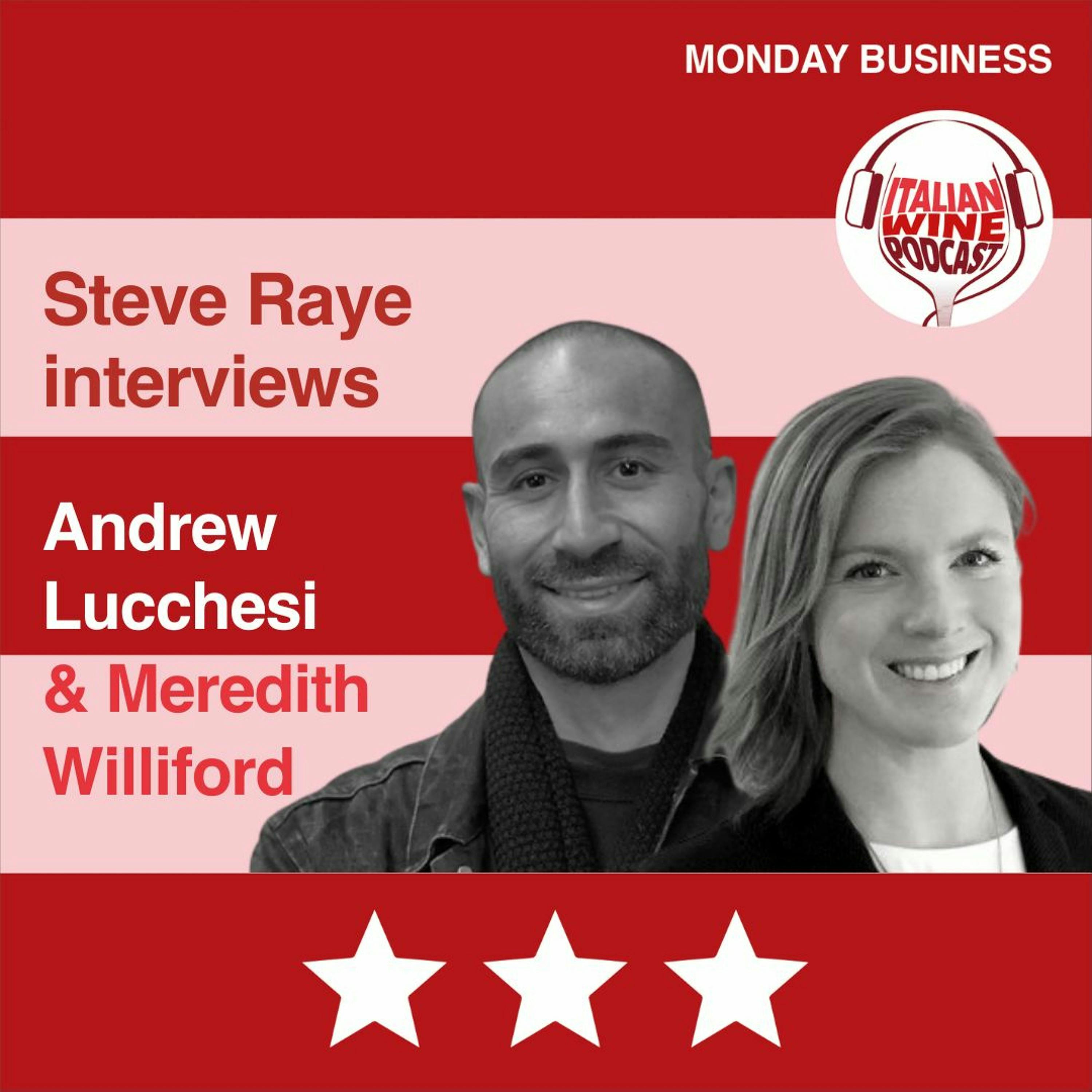
Ep. 1168 Andrew Lucchesi & Meredith Williford | Get Us Market Ready With Italian Wine People
Get Us Market Ready With Italian Wine People
Episode Summary
Content Analysis Key Themes and Main Ideas 1. The evolving nature of business education, specifically MBAs, adapting to online formats and its impact on accessibility. 2. Millennials' perspectives on the Italian wine and export community, encompassing consumer behavior, workplace expectations, and generational differences. 3. The paramount importance of sustainability, environmental awareness, and authentic corporate social responsibility (e.g., B Corp certification) for millennial engagement. 4. Changing workplace dynamics, including the challenges and benefits of remote/hybrid work, and millennial expectations regarding meritocracy and career progression. 5. The critical role of genuine storytelling and transparent communication in marketing to digitally-native generations, contrasting with inauthentic or ""greenwashing"" practices. 6. The necessity for traditional industries, like wine, to regenerate their supply chain, integrate diversity, equity, and inclusion (DEI), and adapt internal structures to align with contemporary values. Summary Host Steve Ray interviews Bologna Business School MBA students Andrew Lucazi and Meredith Grace Willeford about millennials' perspectives on the Italian wine industry and modern business practices. The conversation begins by exploring the shift in business education post-COVID, highlighting increased accessibility through online and hybrid models. The guests then delve into millennial consumer and employee expectations, emphasizing their strong preference for sustainability, authenticity, and ethical corporate responsibility, as exemplified by B Corp certification. They discuss the implications of remote work on professional development and communication, alongside millennials' desire for meritocracy and accelerated career growth. The episode also critically examines marketing strategies, underscoring the need for genuine storytelling and warning against inauthentic attempts to connect with diverse audiences. Ultimately, the discussion stresses the urgent need for the Italian wine industry to introspect, regenerate its supply chain, and embrace diversity to effectively engage with and attract younger generations. Takeaways - Business graduate programs are increasingly adopting online and hybrid formats, enhancing accessibility for students. - Millennials prioritize corporate social responsibility, sustainability, and authenticity when making purchasing and employment decisions. - The rise of remote and hybrid work models presents new challenges and opportunities for workplace communication and professional development. - Younger generations expect a merit-based system for career progression and are often impatient for promotions and increased responsibility. - Effective marketing to millennials requires genuine storytelling and transparent practices, as inauthentic efforts are easily detected. - The traditional wine industry needs to adapt internally and externally to align with modern values, including DEI and supply chain regeneration, to attract and retain new talent and consumers. Notable Quotes - ""The value of the business degree is something obviously that's changing. You're seeing declining rates of of people actually enrolling a business school in the United States."
About This Episode
The hosts of the Italian wine podcast, Y M F on, invite listeners to donate to the show and discuss the impact of COVID-19 on graduate school and business school. They also address the importance of being authentic in the Italian wine industry and the benefits of a business degree. Speakers discuss the challenges of working from home during Zoom calls, the importance of differentiation in marketing, and the need for a systemic approach to finding the right skills. They emphasize the need for value and access to skills and the importance of engaging with people across the value chain.
Transcript
The Italian Wine podcast is introducing a new donation drive this month. It's called y m I f on. We are encouraging anyone who tunes in on a regular basis to send us your ten second video on why you are a fan of our podcast network or a specific show. We will then share your thoughts with the world with the goal of garnering support for our donation drives. Italian wine podcast is a publicly funded sponsored driven enterprise that needs you in order to continue to receive awesome free wine edutainment. Seven days a week, we are asking our listeners to donate to the Italian wine podcast. By clicking either the go fund me link or the Patreon link found on Italianwinepodcast dot com. Remember, if you sign up as a monthly donor on our Patreon, we will send you a free IWP t shirt and a copy of the wine democracy book, the newest mama jumbo shrimp publication. Thanks for tuning in to Get US Market Ready with Italian wine people on the Italian wine podcast. I'm Steve Ray, your host, and this podcast features interviews with the people actually making a difference in the Italian wine market in America. Their experiences, challenges, and personal stories. And I'll be adding a practical focus to the conversation based on my thirty years in the business. So if you're interested in not just learning how, but also how else, then this pod is for you. Hello. This is Steve Ray, and welcome to this week's edition of Get US Market Ready with Italian wine people. This week, I'm pleased to have as guest two students, from a class that I taught at Bologna Business School that, was held virtually. Usually, I would have done it in person at, Villa Guastad de Velani, but we we did this one, by Zoom. And I think the interesting thing about that was simply that we've maintained contact thereafter. And perhaps a part of that is because Zoom is the way we're talking right now. In any case, my guests this week are Andrew Lucazi and Meredith Grace Willeford. Welcome to the show. Thank you. Thanks, Steve. I got a full name with the announcement. Yeah. I think I didn't have the middle name. No. You didn't. Oh, you can probably hear it in matter to this voice, but, she's from the south and, they tend to use It's true. Middle names. The first question I'd ask you guys is why DBS and why business school in in a world that's changing so rapidly, and this is gonna be the theme to everything that we're talking about here today. How the impact of COVID, what the impact of COVID has been on a whole bunch of things. But let's start with the whole concept of graduate school and business school. Great. Yeah. I don't I don't mind starting. So MBA, doing an MBA or business school was something I've been thinking about for a while. I've definitely had the question before of why would you go to Italy to do business school, which is a fair question. At the time, I was living in London and the US and the UK both have a lot of really good business schools. But what was unique about the business school in Bologna, what they had to offer was they had kind of an accelerated one year program that also had an industry focus So, as you could probably tell by the the topic of this podcast, what Meredith and I both did ours in was food in line. So you, do the typical MBA courses that you do, like marketing, finance, accounting, strategy, with the end part, you have some focus areas in that industry of choice. And that was something that was really unique that I didn't see at many other business schools. And it was an opportunity to explore the world of food and wine in a country that has such an incredible food and wine culture. And staying in Europe was something I was interested in doing, not to mention a nice silver lining was that it's much less expensive. And did did yeah. Well, there's that. Did you speak Italian before you, started on this project, and do you speak it now? No. I I so I spoke some very basic Italian. I did do some studies when I was in undergraduate, when I was younger, and my parents are Italian Italian Americans. So I had some smattering of phrases here and there, but really, I didn't I didn't get to learn it until I'm here. And now I would say I'm conversational. He's more than conversational. His his Italian is pretty excellent. So I think the point I was trying to make there those most certainly the class that I talk is in English because that's the only language I know. Most of the people that I deal with certainly from the north and everyone connected with BBS and also with Stevikins operations. Everybody speaks English, and in fact, they speak English better than most Americans because it's the second language and they pay attention to grammar. Let's move on from that. So I I was saying earlier about the focus of the, conversation. What I wanted to do was to focus on the perception of call it the entire Italian wine export community. So not just Italian producers and Italian exporters, but also American importers, distributors, salespeople, writers, all the all the rest. Everybody who touches, wine or or some some stage on the path of selling wine, from the perspective of millennials. You too, are you millennials? Are you like authentic millennial? I mean, it depends on what you mean by authentic. I don't think I mean, I'm definitely am authentically. I am born within the the time period that is required to be classified as a millennial. However, perhaps I don't meet the stereotypical, particularly from a consumer profiling perspective of what a millennial might Yeah. And I wonder if there's anything in stereo the real question I was asking, and maybe I'll I'll ask that. And, again, you guys are unusual in terms of pursuing a, a business degree, and b, a business degree in a foreign country. But by the same token, you're also members of the millennial community. Whatever the dates are. It really doesn't matter, but that's what you are. So what I wanted to focus on today was from the millennial perspective. So you may not be speaking from your own personal perspective, but you are I would like you to be at least speaking from the per perspective of that age cohort, much like who or I to be talking about baby boomers. Certainly doesn't apply to everybody, but it certainly also would be indicative. So when we originally met, I guess it was in the beginnings rather than the middle of COVID, because I'm I'm guessing it was probably two thousand twenty and probably April or May or somewhere around there. And we didn't know what was gonna happen. Now we have. So now look back two years, two and a half years. And And just talk a little bit about the impact that COVID had on whole concept of a business degree and a business degree from an Italian business school. You know, I think that, you know, Andrew said this and in his intro, and I think that The value of the business degree is something obviously that's changing. You're seeing declining rates of of people actually enrolling a business school in the United States. And as a result, you know, I think that we're seeing some shifting dynamics, regarding the education piece as it is. So when we look at millennial participation in those in those environments, I'm not sure that we know exactly what's driving that behavior, but we do know that like Andrew was saying that coming to Europe to actually get your business degree is a much more affordable option. I think that with COVID, bringing COVID into the into the conversation and some much larger kind of some some other dynamics that are at play, we are seeing a lot of people move away from business school. We're moving we're seeing a lot of people move on into online formats. You know, we were in an online format, which changed the way that we experienced our educational process. The way that we that we collaborated with our colleagues, right, business school and any educational experience. Historically, it has been based on your ability to be in person and interact. That's how we've known education since education was introduced. And now that's changing. That was only accelerated by COVID, which obviously was part of our part of our experience. Now we see that more and more and understandably so. One of the great things is is that it's increasing access. For for folks to education. People who, you know, originally couldn't couldn't access, couldn't actually attend classes in person, whether it's because of a, you know, motor disability or because they're located three hours away from their school of choice. You know, it's an option for them. And one one thing I'll add is that I think, that that was something that was exciting for the community was at University of Bellonia. Unibal was one of the first and largest European universities to make the switch online with COVID, and they did it in a pretty seamless way. And I think it actually, as Meredith was saying, but with COVID, it allowed us to continue to pursue education, not put that on pause, which sadly some communities weren't able to do. And it also mimics the way that jobs are are happening right now or a lot of times in a hybrid or even remote way. So I think it gave us skills in how to manage new situations and interact with our colleagues students that we are able to take to the workforce where a lot of our meetings are then again online. Yeah. It definitely prepares us for a hybrid workforce. We examine these trends in hybrid work forces while also essentially mimicking that in our day to day activity, which in itself is a very interesting thought experiment. One point, I wanna make Andrew you talked about, the age of of the institution, University of bologna, I believe, is the oldest European college university center of education going back to ten eighty eight, which I think is something that really impressed me when I was there. It has an American art history only goes back couple, three hundred years. Alright. But back to millennials. One of the things that we hear about millennials, when I say we, I mean, old white men in the business. And that's certainly a category that that I belong in, and that you know, how relevant are the authorities, if you will, or the decision makers as opposed to the opinion makers in the industry, or how relevant are they to the needs wants and interests of this changing and evolving we could call it a target audience. I don't like that phrase, but millennials as an age cohort. So talk to me about what millennials are, and you can talk a little bit about how you think you're different from typical millennials, but the idea is to is to put in a perspective with how things have change versus how they used to be or how you understand they used to be based on what people have told you from the industry in the past. I don't think that we're as different from previous generations as we perhaps are described to be. I think that we do have different expectations of the workforce, but also that, you know, work in itself is changing in its very nature. So I I don't think that we're actually so so different fundamentally from, say, Genex. Right? We actually have a lot of overlap, especially on our end of the millennial spectrum. Like, we have a lot of overlap with Genex. I am technically pre digital. I think Andrew, are you pre digital? Versus digitally native, which I think is the the the corresponding term. Right? But we, you know, we weren't born with with digital technology in our fingertips. Right? We we weren't born touching the device. I think that we were talking about it earlier, and I think that the first time that both of us had cell phones was probably in high school. Maybe you middle school. High school. Yeah. Yeah. And the first time that I accessed social media was in late high school. So I think that, you know, it's really the digital divide that that fundamentally differentiates some generations from others as an example of Gen Z versus Gen X, very different. The digital divide, you know, gen Z is entirely digital. Right, whereas, you know, Genex, you are entirely pre digital. So there's not as much cultural overlap. It's just not there. So that's very clear, and I I think it's a very accurate way of doing it. But let's dig a little bit deeper into that some of the things I'm gonna shout out a couple of words to you, which have, commonly been ascribed to millennials and the the way they behave. And and just comment on them, if you will. And one of them is interest and sustainability. No. I think it's a super important aspect and something that people, millennials in general, seem to feel a greater sense of urgency and put more importance towards that in their Not obviously not across the board, but from what I've seen in not only how they live their lives on a day to day basis, but in what they expect from their employers and their workplace. And we'll get into the the workplace in a moment. I'm I'm thinking more generally now, but So kind of a a corollary to that and I where I'd like you to go is how can brands communicate with this new target audience in a way that that where they appear relevant and real rather than just taking a box or saying things because somebody wants to hear it. And we've all seen examples of both. I'm sure. Yeah. So there's a big difference between action and greenwashing. That's a big phrase that's coming out that that you see a lot right now. And and like you said, it's not just taking the box. I think millennials, and also I can probably say, agents, you want to see, real substance behind those actions and not not just ticking the box. So they want to see authentic and traceable types of activities that can be done either whether it's in a certification like a B corp. That's something that's gained a lot of momentum the past five to ten years locally in the US, Europe, and across across the world. And it's a system that has a number of different components, including sustainability. And it's also one of the many certifications that the wine world has started to look into also. So kind of like organic and kind of like biodynamic with Demetor and some of those kinds of things. My understanding though is that B corp, speaks to how the, entity conducts itself both in and to in communications with the the larger world that they're integrating with. So it's not like a marketing tool. It's not a social media platform. It's an it's an ethos or an ethic in, how they run a company. I see a lot of reference to that. But getting B corp certification evidently is is quite a process. It doesn't mean that much today. I don't think in the US, because most Americans don't. So we've kind of talked about B corp defined it Sort of. Can you explain to me what a B corp is? I can I can start? Yeah. I can start. So a B corporation, while it sounds like it is actually, a type of incorporation in the United States, like an Scorp or or a sequence, etcetera, etcetera. It is a it's a certification that a business obtains after going through a pretty rigorous process where you are essentially do a desk analysis and a strategic analysis and a fiscal analysis of your entire these operation. And what it ultimately and what they look at is they look at your environmental, right, your environmental policies, how it is that you interact with the government, with with the environment, how you interact with your employees, right, so how you socially sustain yourself, And then what your governance mechanisms are that you have in place in order to ensure that you adhere to those standards, right, to whatever policies that you have in place. And so these are things that one has to apply for. They get measured by some entity And if they pass, then they get bestowed this certification, which they can put on their label. Okay. It's just like ISO, like an ISO certification. Right? Which matters in industry, where industrial stuff, but, you know, doesn't matter to somebody else that there, we used to have this thing called six sigma. You know, what's in it for me? I don't know what I get out of that. But the flip side of that of things like organic biodynamic, my original question was about sustainability. And really, there's three thoughts inherent in that, or that kind of combine with sustainability to work together. One is environmental, or the second is environmental awareness. And the third part is, call it global warming, but that's really part of environmental awareness. But it's you know, the significant change in weather in vineyards around the world, earlier ripening, earlier harvesting, changing of varieties that are ideal in in countries where the type of wine they make in the style and call it terroir or whatever you wanna call it has defined things. That's under assault, if you will, from, global warming. So all of this together is, I think, I see it as a recognition that there's something fundamentally broken. Some recognition on the part of the millennial cohort that there's something fundamentally broken that needs to be fixed and that they expect companies to address that directly and proactive. I think that that's correct. I think I think that that's largely correct. I I think that there that there are deviations from that, but I think that the majority opinion probably goes in that direction. As an example, I was talking to a a family member of mine who's also in the alcohol industry, and I asked her about a specific concern. I'm we were talking about specific concerns that we had. We had climate anxiety. It's one of the things that you'll hear from genseers and young millennials, particularly, is this whole idea of climate anxiety. Right? It's something that they carry with them constantly because they are genuinely concerned about about the future of the environment. And all of the collateral effects that a deteriorating climate has. But I was talking to this individual, and she said to me, she said, no. I'm not concerned. You know, this is the way that you know, so and so intended it. Right? This is the way that that that that our history has been laid for us. And I found that to be and this was when I was in the United States a couple weeks ago. I found that to be a really shocking comment, very in a deviated from from what I typically hear from millennials and gen zers. So, you know, I think that oftentimes when we talk about millennials and their perspectives on on climate change, we tend to follow this narrative that everybody's on the same page. But I think that that might need to be dug into a little bit deeper. I think that all in all, it's probably correct. But I think that there are some pretty significant deviations from it that we might not be captured sharing. Yeah. I'm almost hearing, in your response there that it might be the equivalent of, evolution versus, intelligent design. We're not gonna go down that road. Probably not a good one to go down now. Right. Yeah. So, let's move on to kind of a related subject here about talked earlier about the experience of working remotely. And what I see as the lack of an experience of working with others on a part of millennials or people who are working remotely and an inability to read cues that is, I think, a very critical thing that you learn when you actually work in an office and interact directly with people because it's not obvious on Zoom. Yes, even when you can see one another, that's fine. But you can't see body movements and those kinds of things. It it's a lot harder. I see that with people. And it and it goes from something as some as innocuous as somebody making a statement or an observation on something I might have said that was, dismissive or so forth when it wasn't meant as dismissive but was taken as such, all the way up to something that makes me wanna respond. Who the hell are you? And why do you think you know so much about my subject? You know, you've only been in the business for a year. And neither most of those things have happened. Neither of those were my responses. But but that's what's happening. Can you comment on that? So Yes. In in general, I think it's definitely a challenge, especially for millennials, people that are just coming into the workforce when they don't have that experience in the office, the human connection. You miss out as you're rightly saying some of the the queues, the social queues, the it's just not the same no matter how close you try and make it being on a Zoom call versus an in person office meeting. And I think part of that was forced because of COVID. Right? There wasn't another option and people tried to make the best of it. I think where it becomes tricky is now, that people have somewhat gotten used to it and they don't want to revert to ever going back to meeting in person or they want to stay online maybe because they've become comfortable with it. I think Maybe that's not not the right way to go either. So it kind of went from one extreme where some places always mandated everyone in the office nine to five every day. I think that time's come and gone. But On the other side of the spectrum, we have people that are now remote one hundred percent of the time. And and sometimes that makes sense, but sometimes for some specific positions, but I think a lot of the times a hybrid option is maybe where you can get kind of the best of both of those where you can rectify some of those communication issues that could happen if you're always online, and still have the opportunity to have more flexible personal life that you wouldn't be able to have if you were always in the office. Yeah. Italian wine podcast, part of the mama jumbo shrimp family. Okay. Let's take that down into a little bit more detail. One of the things, I've been talking with Meredith about is deI, diversity, equity, and inclusion. We did an interview with Deborah Brenner of women of the Vine and spirits and explored that in-depth. It's also one of the key kind of, planks, if you will, on the platform, that define millennials. How does the university teach things like corporate management, and dealing with the problems of today versus the problems of yesterday. And as an example, I'll use one that I never heard of, but just found out about called quiet quitting. So was that kind of stuff addressed as normal management you know, here here's how you manage an entity in an organization. Here's how you organize it. Here's how you motivate it. All that kind of stuff. Yeah. I'll take this one. So I think that one of the unique things about, BBS is that and and what probably differentiates it from a lot of, programs in the United States is that it wasn't founded on the traditional, you know, financial praxis that most US business schools were founded upon. Right? The the actual approach to the dead active material is very different. It's much more humanistic in its education, and they really emphasize civic responsibility within the leadership curriculum. How it is that they try to form you as a leader is very much rooted in this sense of civic responsibility. And and also in another important and adjacent and an associated component is that there's more of a focus on a triple bottom line as opposed to a profit just a strictly profitability model of doing business. And so I think that BBS in its you asked about specifically, you know, organizational management and so on and so forth. All of that comes through in almost every single class that you have, whether they, you know, accounting or financial management and at the risk of continuing to sound like a a BBS commercial. It it really actually is a fundamental piece of of how they approach academics. So you couple that with the food and wine experience. You can imagine Alright? That there is a much stronger focus on sustainability, whether that be social sustainability or environmental sustainability, right, than you might find in institutions in the United States. Okay, Andrew. Here's one for you kind of related to what we were just talking about. I see this written about a lot that there's been this, change. Also call it a dramatic growth. In the expectation of how much millennials, are to be paid for the work that they do and the speed in which they expect to see promotions and go from being an an intern to owning the business. And as a manager, former manager, I don't have any people reporting to me anymore. Thank god. But, that that was something that that we had had to manage. And the tools that you used and the currency that you used was course, money, but also responsibility. It was title. Those things don't carry as much weight. I don't think. But am I wrong? Tell me. No. I I think overall you're right. I think It's a tricky question in the sense that I think there's an aspect of that that everyone when they're young is a little bit more impatient and wants to move faster than maybe the world will let them. I think when you're first in the workforce, especially with millennials, You have a, like, I've seen and I felt a strong sense of meritocracy in the sense that if I work really hard and I do a good job and I'm able to manage all those responsibilities, as you mentioned. If you don't, that's another question. But if you're able to manage all those responsibilities and do the work that's expected and or exceed them, then why not be able to be promoted? Why not why have to wait in line just because there's someone older than you or someone who's been around longer? So I think there is an aspect of impatience. It's maybe natural, but there's something that millennials see that think they should if they if they are doing the work, they should be given the responsibility and have the opportunity to grow, not just not just because they feel like they have to wait because you need to have ten years experience. If you're doing the work, why not have the title or the money or the opportunity? I think that you you said the word, use the word meritocracy. And I think that that is it's extremely important because I think that a lot of millennials, probably not us. But a lot of other, we don't we aren't indicative of the millennial experience in all in all of its ways. You know, we're both white white people who are from the United States who have economic needs. And so we experience, you know, we we experience the business environment in a different way. Right? Whereas a lot of a majority of people don't actually have the benefit or have not historically had the benefit of meritocracy. Right? Miratocracy is not you know, fully formed unless it actually is applied to everyone. And so I think that, you know, when we see the things that we're seeing, the trends that we're seeing with, you know, with with job salary expectations with hours of work expectations, right, with roles and responsibilities expectations. You know, I think that it all ties into this genuine desire for a deeper and more authentic meritocracy. And if it's that way, if it is in fact a meritocracy, then I think it will root out some of some some of what we see to be the trends in asking for higher compensation. Also, I think that the markets need to adjust. Well, I think that's a huge thing. It's almost like there's the wine market, which is this old stuck in the mud thing for a thousand reasons. And then there's technology or technology influence things, and there are two different salary rates, ranges, and and growth rates that happened with there. But I'm not gonna go down that road. Let let's jump to because we're running low on time, but I did wanna get to this, you know, the fundamental thing that we're talking about I'd like to be talking about is is marketing. We were talking about some of the words that define millennials. I'm gonna throw three more out and and pause it that they don't necessarily apply only to millennials. They apply to everybody as a as a consumer, the things that are more interesting these days are not just is a product better than another. It was product differences that, kind of define the point. The, the old ways of positioning statements and by by using somebody else as a point of reference to say I am better because of this. It's no longer a function solely product quality, but things like history, legacy, and authenticity, which think of them as the legs on a stool. That support it, but are themselves not the primary reason for doing it. And that that applies to everyone. And the fundamental reason in my perspective is because the information is now available to everyone through smartphones and online and dedicated sites and all the rest of that. And that's the fundamental change. It used to be that the people who controlled the printing presses controlled the access to information and education. That's no longer the case. It's pretty much everybody can get anything anytime. Anywhere off their smartphone. Can you guys comment on that? Yeah. Sure. I I think that you're definitely correct in the sense that now with so much information available all the time, people are able to really analyze and ask for more from the different products that they have available to them. And so marketing really needs to find a way to differentiate to millennials that have a lot of different options. And that means like you said, just right rightly said, having legacy, a story, a history on top of just the basics that you need to enter, like, having a good product. That's also where things like some of these certifications we were talking about come in. You you really need to be able to provide a lot of different things, check a lot of boxes to stand out when you can get this information from almost any product anywhere and order something anytime. Yeah. I think that fundamentally that is I think that that is the that's the key is to be able to deliver something and no matter how deep the research goes, that the product and the way that it's delivered, it still stands. I was drinking I was having a I was drinking about a wine from Veneto. I won't name the producer. But it's a it's a long time producer. Right? They've been around since the early nineteen hundreds. They have a long and story tradition, and they decided that they were going to spin off, and they were going to create a new product that was produced for the US market, also sold here in Italy, interestingly enough. And they decided that they were going to feature on every single label, a black man, Okay? Interesting. Very interesting because this is a this is a producer in Veneto. And typically, one, you don't see people, right, who are animated on a bottle. That's a new that's new. And it's a fresh direction. Right? And then they gave him a different ethnicity. Right? And as a result, what they were trying to do is they were trying to communicate, right, and be more inclusive in their marketing effort. But if you pull back the layers on that, right, How is that represented internally within their corporation? Right? Where is that where is that coming from? Is it just a marketing is it just a marketing exercise? Right? If you pull back the layers, what that looks like is is a marketing exercise. It's very unauthentic. It doesn't seem to actually reflect the reality of the corporation itself and its values. It seems to be a money graph. So that's a real disconnect. And my my sense is where you're getting to is that Gary Vaynerchuk had this great. Remember when we had that oil spill in the gulf? He said they they can smell an oil spill across an entire gulf of Mexico. It's very clear to millennials when something is inauthentic, not that something is is authentic, but a little bit of an exaggeration or trying to claim too much, undermines exactly what it is that you're trying to do. So you've got, another issue of, okay, what about copywriters and ad agencies? Assuming those things still exist. You know, are they aging out as well? And do you need new people writing new copy for new audiences in new media? I think that that is part of the regeneration of the supply chain that absolutely essential. Say that again. I love that. The regeneration of the supply chain. Explain that to me. I like it. Alright. The regeneration of the supply chain that's so essential, we can we can do all of the work that we want to to, you know, we've had, as an example, we've had multicultural marketing folks for as long as we've had marketing. Forever. You know, like fifteen, twenty years. Yeah. Forever. Right. But but it's taken us a long time to turn that same lens inward. Right? And to look at not only us as a company, but to look further down downstream in the value chain. And finally, we're doing that. But a lot of that's happening in the United States. Right? It's happening at the important distribution levels. It's happening at storytelling over there. But when you look at production, right, you look at production in Italy, where you have a relatively homogeneous ownership tier. Alright. You you don't see that introspection because if they do that introspection, it's going to be very difficult to align it with the US reality. So if if consumers want a product where they in which they feel reflected, not only in the marketing, but also in the story behind it, then producers And everybody, including copywriters, and, I mean, it's it's everyone. Everyone in the production on the production side has to find a way to become more engaged in the conversation in a meaningful way and actually prepared to take some action. But not just more engaged, which is a a big stretch for a lot of company leadership, but also the empowerment or the permission to be able to speak. Used to be, you know, everything had to go through the PR guy and senior management would approve everything and it was all sanitized and long sentences and, you know, using big words with more than three syllables. And and I don't see that happening. I I use one example, a client that I was at where they basically literally opened the doors to the the factory and the production facility and how it was all made and and we could see, the buy in, if you will, or the living breathing thing that was their vision and philosophy. Question and the challenge to me is, okay, how do I communicate that to American consumers who did not have the the benefit of going over there and actually seeing it and feeling it and hearing it and all that kind of stuff. And right, it's I I don't have the answer to that. That's challenge. Just saying it. No. No. No. No. No. Really. This is serious. This is what I mean. That we have to find different ways of communicating that. And I think one of the solutions has to do with the word that we use, which was engagement that It isn't just having other people say your product's name, but call it evangelizing on behalf of the product on your behalf telling their friends about this product in their words, which you don't get to edit. And you may not even get to see because you're not part of that conversation if you're not even following some of the the entities. And yet those are the conversations that dominate more so than those that you paid for through advertising or paid ads online. Was gonna ask a question, but I I think I just answered it. So, you guys are resident, Italy now. What what's your next steps? How are you gonna? I'll be like dad. Yep. Are you gonna get a job? I think that we're actually both still kind of getting similar questions from our own families. Now now for me, I think that we're both I'll let I'll let you speak for yourself. But but I am I'm planning to stay in Italy, but I'm splitting my time between the US and Italy. As To be clear, in your case, your mom is setting up a distillery called micro or mini distillery. What what's the name of that company? Well, it's actually it's it's a series of three distilleries. The business plan has grown and changed and evolved. The business plan was initially contrived and or conceived of in, March of twenty twenty. Great timing, excellent timing. And initially, it was one distillery, and now it's three distilleries. And the name is Liberty and plenty. So a series of distilleries in North Carolina specifically. So here you are with experience in the food and wine industry and now a freshly pressed NBA from the oldest university in Europe. How come you're not at home working from home? Well, it's an excellent question, Steve. My other passion and kind of the other shade of my soul is, is is really committed to DEAI. In fact, when I when I came to a blown new business school, one of the reasons why I came here was because My objective was to try to operate in a consulting space, working on inclusive production. So looking at industrial and agricultural environments, and seeing how it is that we could work in, principles adjacent to DEA and social sustainability, throughout the production chain. So that's that's really why I ended up there. And that's Yeah. Not just in the corporate offices, but through the rest of the company, where stuff actually gets done instead of got talked about. Okay. I'm gonna turn the eye of Sauron over here to you, Andrew. And what are your plans? Okay. So my plan for for the time being also staying in Italy. So, right, right now, I'm working with a creative agency, digital agency called the Army Bar. That has, was founded in the New York, but also expanded note in their European office here in Milan. Where we do a lot of brand launch and relaunch, largely in food and beverage space internationally in, in Italy and outside Italy. So, it's been a way, coming from a background of technology and technology consulting It's been an opportunity to get more involved in the food and beverage world from your game perspective, but also to see, how how I can work more on the marketing side and bring together some of the passions of of my previous experience with technology, but also new Italian kind of products, excellence that's there, and also bringing aspects of sustainability. So that must be a huge area for growth and development because it's what everybody needs or wants even if they aren't able to articulate that, which it is. It's more than just you're the new copywriter telling those stories, but that it's it's this, confluence or completion of, both technology itself and the and and this marketing strategies of how you communicate, engage with, and, motivate people to become evangelists to a brand, which, as we all know, is a much more powerful way of doing it. One of the things I've heard is about the hundred true followers or whatever you wanna call it, but the idea is a very small set of very motivated, influencers is gonna be more significant than having a hundred thousand who are just tuning up clicks and likes and whatever. Because today, it may be Instagram and LinkedIn. And last year, it was Twitter and TikTok, and maybe some of those things are gonna last. I don't know, but I think you can safely say that all those things are going to change and they're going to evolve and where they are today, they won't be there tomorrow. So it seems to me that that kind of stuff in that capability carries a lot more weight and value long term to prospective employers than, I can manage the Facebook page or something like that. Yeah. Exactly. It's like what you were just saying about those people that are going to really advocate for your product and engage organically without it being a paid advertisement, just like what you're saying with the hundred people. Oh, without it looking like it's a paid advertisement. That's that's the biggest challenge. Yeah. Yeah. Yeah. That it's it's it's gotta be believable. Okay. So we definitely are over time here, but I wanna draw it around. What what's the big takeaway? You know, my listenership is mostly trade, mostly in the US, some in UK and also fewer in Italy surprisingly. Probably because this is in English. But in any case, it was a trade audience. You know, there's different messaging that you wanna send to the trade about brands and so forth than you would consumers, especially in a three tier system like ours. So of all the things that we talked about is there something that you heard or said or the other one had said that you think is the big takeaway that someone could put to use practically after they stopped listening to this podcast. So I can I can speak more generally? We we talked around it, maybe not directly at it, but I think one of the things that is important is that as you said, there's a lot of, I think, millennials and younger people that are interested in this industry And it seems like there's also a lot of people in industry that are looking to engage with millennials and younger generations. I think that there can be there can be actions on both sides taken to better have that match. So there's a lot of people like myself who come from a background that's not wine and spirits, but I'm interested in being involved and having a part of that conversation. I think there's a lot of different roles that someone like myself or someone who's listening to this podcast and maybe isn't involved in the industry now but would like to be can bring to the table. A lot of value, whether that's in the back office, whether that's in finance, marketing, HR, I think there's a lot of ways you can get involved. Even if it's not directly with a winery, there's adjacent companies that do work in that space, and that It's not necessarily a linear path and to just be not to be afraid to reach out and ask for help and talk to those people that you see that are doing interesting things that you would could see yourself doing in the industry, like how you know, we've we've been stayed in touch and been able to stay connected to you. Okay. Meredith, do you wanna comment on that? And you couldn't make it broader than trade. That was, you know, restate the question. No. I think I think that it's relevant. I think that it's transversal. Alright. I think that the idea and and the central point that you're making is really about access, which is something that we've talked about a lot of Steve together. And and and at the end of the day, what it's about is looking beyond your immediate field of vision or the traditional places in which we look for conversations, about the industry and the way that the industry is going. You know, one of the common refrains that we hear is, well, we can't find the right skills. Goes back to the same thing with quiet quitting. You know, people people aren't just, you know, limiting their work to a certain scope because they don't care about their livelihoods. It's because they're tapped out. And oftentimes that actually takes root in companies not knowing what skills they're looking for or where love for those skills. I I think that's fundamental. I mean, if you need someone to manage the website, fine. You can say I need someone to manage the side, but the larger issue here is how can I improve communications both within and among my different communities with and without my entity? I just don't see and and maybe there's an evolution going on that I don't see at my level, but I don't see a great arm wrap around that. But I definitely see it as a need. And I think that it's a it's a systemic problem and systemic problems are really scary. But because systemic problems need systemic solutions. And you can't, as one producer in Italy, even if you are a big one, you know, you can't solve that problem of not being able to find skills or more even more going deeper, you can't solve the problem of not knowing what skills you need to get you through the next five years all on your own. That is that is not a question that you answer in a silo. And so you can't engage with the right people if you really don't know what skills you're going to need. And it's, again, that's a question that has to be answered at a systemic level. That engages everyone across the value chain. You guys said something earlier before we started recording thing. I I thought that was one wonderful. And you talked about being here, meaning h e r e. And my plan is think about here as h e a r. That people do a lot more talking than they do listening and in the world that we live in, I think listening is a lot more important than talking because generally speaking, you don't have a clue as to what you're talking about, maybe the first in that line. So it's hard to do, but I think it's abs absolutely critical to do that because digitally native people are able to articulate things in a digitally native way rather than having to translate it to something that is intelligible to not only the new audience, but your new, employees. So okay. Long interview, but I hope you stayed with us. So this is Steve Ray signing off this week for Get US Market Ready with the Italian wine podcast. And, come join us again next week for another interesting interview on, Italian wine podcast channel. Thanks again for listening. This is Steve Ray with Get US Market Ready with Italian wine people on the Italian wine podcast.
Episode Details
Keywords
Related Episodes

Ep. 2513 ITA Masterclass "Startup Italy: Young Producers and the Future of Italian Wine in the U.S." | wine2wine Vinitaly Business Forum
Episode 2513
Ep. 1159 Chris Scott | Get Us Market Ready With Italian Wine People
Episode 1159
Ep. 1150 Kayla Winter | Get Us Market Ready With Italian Wine People
Episode 1150
Ep. 925 Tara Empson | Get Us Market Ready With Italian Wine People
Episode 925
Ep. 814 Lia Tolaini | Get US Market Ready With Italian Wine People
Episode 814

Ep. 770 Andy Morton | Get US Market Ready With Italian Wine People
Episode 770