

Ep. 211 Monty Waldin interviews Martin Foradori Hofstatter (Hofstatter Winery)
Storytelling
Episode Summary
Content Analysis Key Themes and Main Ideas 1. The history and multi-generational legacy of J. Hofstätter winery in Alto Adige. 2. The unique and complex ""four-dimensional"" terroir of Alto Adige. 3. Key grape varieties of Alto Adige, including Gewürztraminer, Pinot Noir, Pinot Bianco, Lagrein, and Schiava. 4. The dynamics of the Italian domestic and international wine markets for Alto Adige wines. 5. Challenges and opportunities in Alto Adige viticulture, such as land prices, labor, and tourism. Summary In this episode of the Italian Wine Podcast, host Mark Millen interviews Martin Foradori Hofstätter, the fourth-generation owner of J. Hofstätter winery in Alto Adige. Martin shares the 110-year history of his family estate, highlighting its fifty hectares of owned vineyards and additional grape sourcing from local farmers. He emphasizes the unique ""four-dimensional"" terroir of Alto Adige, shaped by east/west facing vineyards, varying altitudes (200-1000m), diverse soils, and distinct microclimates, particularly the significant difference in sun exposure between the eastern and western sides of the valley. Martin discusses the shift in Alto Adige winemaking from red to white varieties over the last 50 years. He details the winery's flagship wines: Gewürztraminer (from its hometown Tramin), Pinot Noir (with a 160-year tradition in the region), Pinot Bianco (a re-emerging mineral-driven white), Lagrein (an indigenous red hero), and Schiava (a traditional, lighter-bodied red). Martin explains that nearly 80% of their wines are sold in Italy, with key international markets including the US, Japan, Russia, and the UK. He also touches upon the high cost of land in Alto Adige, the challenges of finding vineyard labor (often sourced from Eastern Europe), and the significant role of tourism in local wine consumption. The episode concludes with Martin introducing his children, Nicholas and Emma, as the potential fifth generation to lead the winery. Takeaways * J. Hofstätter is a century-old, fourth-generation family winery located in Tramin, Alto Adige. * Alto Adige's terroir is exceptionally complex, defined by unique east/west sun exposure, varied altitudes, diverse soils, and distinct microclimates. * The region has seen a significant shift from red to white grape varieties in the last five decades. * Gewürztraminer, Pinot Noir, Pinot Bianco, Lagrein, and Schiava are prominent and historically significant grape varieties cultivated in Alto Adige. * Food pairings for Gewürztraminer include spicy Asian cuisine, while Pinot Noir pairs well with white meat, salumi, and game. * Land prices in Alto Adige are exceptionally high due to limited availability and high demand. * Wineries in Alto Adige rely heavily on migrant workers, particularly from Eastern Europe, for vineyard labor. * Tourism plays a crucial role in Alto Adige, with 50% of the region's wine production consumed locally by visitors. * The Hofstätter family has a long and unique tradition of cultivating Pinot Noir, predating its widespread adoption in other regions. Notable Quotes * ""We are a four dimensional wine growing area."" (describing Alto Adige terroir) * ""To use my words, we are a four dimensional wine growing area."
About This Episode
The speakers discuss their wine winery and their experience with traditional Italian wines, including PinotOE and pinotOE. They also discuss their favorite varieties and their long history with PinotOE. They talk about their experience with their winery and their favorite varieties, including Pinobiancom, which is a more transparent and tasty. They also discuss the importance of growing Scava and the high prices of the region, as well as the difficulty of finding vines and the need for sun and heat to rip out. They also talk about the pressure on wines and the labor intensive work involved in wineries, the potential profitability of wineries, and the openings of the vineyard land in Altuado.
Transcript
Italian wine podcast. Chinching with Italian wine people. This podcast is brought to you by Native Grape Odyssey. Native Grape Odyssey is an educational project financed by the European Union to promote European wine in Canada, Japan, and Russia. And joy. It's from Europe. Hello. This is the Italian wine podcast with me. I'm not too old. My guest today is Martin Forodori Hochteta from the j Hochteta winery in Alto Adidje in Northern Italy. Welcome. Hello. Good afternoon. Looking forward to hear you describe the history of your estate. You can go back as far as far back as you want. My winery is located in the beautiful village amin in Italian Terremena, the hometown of the great variety of I'm the fourth generation of this winery. The winery itself is approximately one hundred and ten years old. And we are also one of the biggest wineries in Altwadagib, but when I say big, it doesn't mean bottles that we do, but, vineyard land that we own. So in the family, we have a fifty hectares of owned vines on seven different estates. And then we buy also grapes from farmers, from village, and the surrounding villages. So what are your main markets? If we work back from now, your main markets for these for these grapes, shall we say over these wines? Approximately nearly eighty percent of the wines remain in Italy. So we have a very strong, Salesforce from the north up down to to the south. And, yeah, we are happy, very happy about this because, it's the market in front of our seller or so we can keep or we have everything under under control. But of course, we also sell. Outside of Italy, the main markets are the United States, Japan, historically, Russia, UK, is, waking up for us, fortunately, again. And, yeah, we look forward to a great UK market in future again. We just look forward to a UK. I think, which caught in the background of Brexit. Okay. Let's go into the Trentino Artuadoje, terroir, and particularly where you are. Obviously, it's northern Italy, but it's very dry, isn't it? Whoa. To talk about terroir in Altoadays, in my region, this is very difficult. It's difficult because, to use my words, we are a four dimensional wine growing area. So the first dimension is east and west facing vineyards, huge difference. Then the second one is the different altitudes, what we what we have. We start to grow grapes at approximately two hundred meters over the sea level, and we go up a thousand meters over the sea level. Then to talk about the soils, they are different from one side to develop to the other side of the valley, but even on the same side of the valley. We have big changes and the fourth dimension to make everything much more complicated is even on the same side of the valley, depending where the lope is phasing. We have a different microclimate. So when we talk about the value, we talk about the value of the river AdiJ. Is that right? Exactly. This is the southern part, of Alto Adija close to the border to the Tarantino south of the main city, Bolzano. So Bolzano is the main city in the in that valley. Exactly. Not not only in the valley. It's the main city of the whole artoisier region. Okay. So it's called Bolzano in Italian, Italian, and it's called Bosen in Exactly. In in German, generally, or Austrian. Yeah. Just, okay. So in terms of trends, you know, we often well, we do associate outdoor energy often with varietal wines. What are the popular varietal wines or the most popular varietal wines for the Hofstetter winery? First of all, there is to say that in the last fifty years, there was a major change from red varieties to white varieties. So from eighty percent red and twenty percent white fifty years ago, now it's sixty percent at wide and forty percent red. To come to my winery, my leading white variety, how could it be different than Gewirtzraminer. Yeah. That's a great pleasure for us to, yeah, to grow Gewirtzraminer in the village Strramine. And the other major variety, the red variety is Pinot noir. In my family and in my estate, we have a hundred and sixty year old tradition with Pinot noir because the first owner of the bar to now a state, which is part of my property or part of my vineyard. He introduced one hundred and sixty years ago the Pino variety there. So it has a long history. So it's not like you just walked up to Burgundy and brought a few vines and stuff them in the ground. It's a long tradition in your area to grow Piena noir. Yeah. That's right goes back to the brother of the Kaiser Franziosev, which was the Emperor, the Austrian Emperor, Altoireje was a part of Austria before World War one. And this gentleman was very close to agriculture in general. He lived in the city Mirano, which is north of Bolzano. And thanks to him, you know, since, yeah, thanks to him, we grow the French varieties in Altuarice. And because Ludwig Bart von Bartonau, this was the first owner of the Barton estate. He was a chemistry professor at the University of Vienna. Probably he had good connection to the royal house, and probably somebody of the Royal House introduced him into this fabulous variety, Pin of Newark. So you would class that as a it's obviously not a native variety, but it's a variety that's traditional that we can say it's traditional out to your region. Absolutely. Absolutely. Because, compared to the rest of Italy we have a long tradition with Pinot noir. Us, we have a long tradition with Merlu, with Kavanaugh, with Chardonnay, with Chardonnay, with Chardonnay too. But especially the Pinot noir, thanks to the fresher climber that we have up in the north, Elalto Adija, the, the results that we get with pinot noir are excellent. So is that are we talking for red wine or also for sparkling wine? No. Mostly, mostly red. In Altois de jacques compared to our neighbor's Trentino, we don't have that tradition with sparkling wine. So most of the pinot that this grown in alto adige is for red wine production. Okay. And what's a good food match for an alto adige pinot noir? Pooh. Depending which pinot. My winery, we produced four different selection. It's the parts from the easygoing Pino, the lighter version who was in stainless steel, who goes well with white meat, with salumi salumi in general, with the easy antipasti. And then higher we go with the selection, let me say, mostly with red meat. I love it. We'd do it red meat, but also with game. And what about Gewyot's Chamin, good food matches for that? It starts to get a little bit more difficult because Giverson Miner is a very strong, a very heavy white, variety with a lot of, with a lot of flavor and, aroma. I prefer to drink it when I'm at home as an imperative, but especially, for example, in, when I'm in Asia, I love the the match with Thai cuisine. Convertsom in on Thai cuisine is one of the best matches. So that is a spicy food? Exactly. But not too spicy. Yeah. Just a little bit of that. Exactly. Okay. And so that's those two varieties. What is what is another variety that's particularly or particularly strong in you feel? Pinobian Com is definitely a variety who is back on track. I say that because starting with the seventies with the eighties, the sharpener wave started, then the pinot grío wave started. And and, yeah, we forgot a little bit about our lovely great variety, Pinobianco. This was like, to have in, in front, to be in front of, a wall made out of stones, and there was this little flower somewhere and nobody recognized this little flower. But now Pinobianco is definitely, yeah, as I said, back on track and the variety, which to consume reslaf. Pinobanca, is that a little bit spicy in your region or not? No. Absolutely not. This is the the little I think I can say this is the little brother of the chardonnay and the little brother of the the pinot grillo. It is the more mineral is the more fragile variety. It's more trans it's more transparent, isn't it? It is. Very fragile. And, yeah, but the deepness, the minerality of the Nobianco, is unique. A chardonnay and the pinot grigio, they are more like big opera singers, but the pinot bianco is a little bit the shy broader. Okay. And a food match for pinot bianco? Pinot bianco has aperative, of course, and I will match it with, with seafood. Should we move on? What's the next one we can move on to next great variety? It must be the Lagrange. Lagraine is our indigenous, hero. Let me use these words of our who is has his origin in Altoadija. It's a very deep red colored wine with a lot of tannin, a wine who matches great wit with dark red meat, which game. Beautiful. We do enough to add a free stylistic of Lagrange. The first one are the Rosets. Then the second one are the entry level easing going Lagrange, and then to finish the big selection, which we age in, in Oak Bell, which are the aging wines. So would the entry level one also like rain also be like an appetitivo wine or not? No. It's it's a little bit it's a little bit all rounder. For antipasti, for Primi, for pasta. Also for, let me say, an easy schnitzel, and a classic Lagayan is a perfect match. Next, Scada. Scada is another indigenous grape variety was the leading variety in Altoadija. Many, many decades ago eighty percent of the surface in Altoadija, the vineyard surface in Altoadija was covered, by the Mariettiscava, which is an easy going wine. Many consumers say that it is an a rosette, but for us, it's, it's a red wine. Unfortunately, this guava in the last thirty years went out of fashion because the consumers, they were looking for, for dog darker red colored one, the ones with Mortanin, and Scava is definitely is definitely the opposite. But I love Scava. I think you need to have a certain age to appreciate Skava because when you are forty plus and over. Sometimes you prefer to drink one and more glass of wine than just nip on a one glass of wine, and this gal is the perfect wine where you really can have fun with few glasses of wine. Is it, in terms of our potential alcohol level, is it a little bit lower than other reds, so, like, if you grew a merlot, for example? Absolutely. The Skyaba is around twelve point five maximum of thirteen of alcohol. And in the past, it was even low but I think the best alcohol content for the Skaba is twelve point five. Is it easy to grow? Yes. And no. The Skaba grows up at best at an altitude of two fifty up to a maximum of four hundred meters over the sea level, but it needs, it needs a lot of sun, and it needs a lot of heat to rip, completely, completely out. I don't wanna say that it's complicated, but it is not easy too. So it just needs the right site there, doesn't it? Yeah. We grow the Scava mostly on the western part of the valley, which is the the warmer part. It's the morning sun and the hot evening sun. Yeah. In the afternoon sun, we grow the pinos. Okay. Because the afternoon sun is the I know sounds a little bit strange, but the afternoon sun and the evening sun is the cooler sun. That's interesting. These are are are quite obviously right. I said, Little nerds, if it's great to hear you say that because that's, a little subtlety that, I'm sure many listeners will find very interesting in terms of, you know, sight mean, the region you're in is very mountainous, Hilly, and you started right off at the beginning of the interview talking about the the sights on on either side of the valley. Let's dig into that a little bit deeper. If I'm coming to your region and I say I want to I really want to buy some vines in, in your region. What advice would you give me? Invest the money somewhere else because the land prices in Alto Adige are incredibly high. I'm a millionaire. I'm not kidding. It's very difficult to find land in in Alto Adige. Not only not only for locals or for somebody who comes out of auto hydrogen, even if you are a millionaire, it's very difficult to find to find Why is this so expensive? It's expensive because we are in a mountain area. The land, the quantity of land, is that what it is? But not very much then. Not very much. So the five thousand four hundred hectares of vineyards that we have, that's almost it. But you have a strong local demand, though, don't you? Because I mean, like, things are slightly easier in the sense that Not a not a not at all. There is not a a big turnover of vineyard land. Maybe especially the old farmers, when nobody from the family wants to go on with that with with that business, maybe they maybe they sell l, but those are very small pieces of land. You have to know that the average property of a farmer in Vineyardland in Altuado is eight thousand square meters less than a hectare. Yes. Point eight of a hectare. Less. Yeah. Point eight. Yeah. Because of the the extreme terrain. Exactly. So when you I mean, obviously, when you were a boy, I imagine you worked in the vineyards, what was your favorite job? My favorite job, favorite job, because you're a you're a strong lad. You're a big you're a big lad, okay? So strong, strong chaps, you know, I'm sure they give you the hard jobs. There is no favor every job in your vineyard, you have to do what is to do. But, I had a lot of fun to to take off the green shoots from the stock. So this was when I was a kid to my job. So water shoots. So the non fruit shading and getting in that way. Yeah. It's cool. They lift them in early. Exactly. Right. Yeah. Okay. So that's it's also slightly backbreaking, isn't it? Because you've really gotta get down low ish to make sure you pick pluck the right bit off because if you put the wrong bit off, you could get sunburn, wouldn't you? This too, but this is more when, let me say on the higher level of the vine, this is when you and especially in June, when you clean up the shoots, when they take off the leaves, this is the the more that this is the delicate word. Because also in June, the shoots that remain on the vine are the one that you select for the next winter pruning. So the the work in June is very important. Yeah. You can mark a mistake because you'll affect two years how does it ring you? Exactly. And in the house we haven't talked about, you don't talk I think we should focus or, remind a little bit more the microclimatic situation a lot to Adija, because if somebody comes to visit Alto Adija, and he's on the west side of the valley. And when I explain him that the eastern part of the valley is the cooler part. He makes big eyes, meaning they wanna fool me. It's very close. How could there be that much difference? In terms of numbers, the eastern part compared to the western part in a year has tile thousands, a thousand hours of sun less. This explains a lot. That's a huge quantity of no sun. Exactly. Yeah. So and this is the reason because on the eastern part, we grow, Pino, and on the western part, the warmer part, we grow, Givrts. How about tourism in the region? Oh, a lot too much. Could be more, but especially in my part of Alto Adige, there is a lot of German Austrian and Swiss tourism who starts in April until end of October. So there is not a lot of going on in the wind time. So, actually, there is nothing going on in the wintertime because the tourists are moving in the dolomites where where they can, where they can ski. But from April to October, the villages are quite packed and, yeah, we are very happy about this. There is also to say, thanks to the tourism, fifty percent of the alto adige production is consumed in alto adige. Does that help? And so I imagine where you are, it's very labor intensive. There are, as you said earlier on, so you you have to physically, you have to pay people to do jobs, that are very time consuming. Does that cash flow help you fund that sort of hand grown aspect of wine growing where you are? We try to mechanize as much of as possible. The problem is less the people that you have to pay, but the main problem is from year to year, much more difficult to get people who want to work in the vineyard. More you mechanize, better it is, and for the moment, most of the hand work is done by people who come from Poland, for example, from Romania and from Czechoslovakia, for example. Well, they're happy, I mean, I suppose they're happy to to have the work. Absolutely. And, we have now for years, the same, the same group of people who work in the vineyard. And, this is positive, for divine and for the quality of the wine too because those people know their job and they know exactly what they have to do. Are they, I mean, are they welcomed when they come? And we have, I don't wanna go on about politics at all, but Europe at the moment is in quite a funny place. Are we saying in my country, the nation, Great Britain, voted for Brexit? So they are ease of ease of movement of of, she would say, non EU workers could be compromised. And obviously, no fortunately, those are EU European community workers. So all the all the paperwork is easy is, it's quite easy. It's, it's the same, let's say, it's the same paperwork as, if you hire Italian Italian people. And, of course, they are welcome, and we're very happy that they come to work to Alto Arjan. Who is the next generation in your family to take over the family estate. Probably my son is studying analogy. It looks like that my little daughter is interested too. I think that both together they will be a good team, a good fifth generation of the winery. And their names? Yeah. It's Nicholas and Emma. Great. I wanna say thanks to my guest today, Martin Forodori Hochtata, from the Jay Hochtata win in Alto Adi. Particularly for explaining those key differences in the, in the way of looking Alto Adije, West Side or East side. For me, for you, that's absolutely fundamental. You're welcome. And, yeah, come to visit me in the winery, and, everybody's welcome. Of course. Thank you very much. You've been great to meet you. This podcast has been brought to you by Native Grape Odyssey, discovering the true essence of high quality wine from Europe. Find out more on native grape Odyssey dot e u. Enjoy. It's from Europe. Follow Italian White Podcast on Facebook and Instagram.
Episode Details
Keywords
Related Episodes
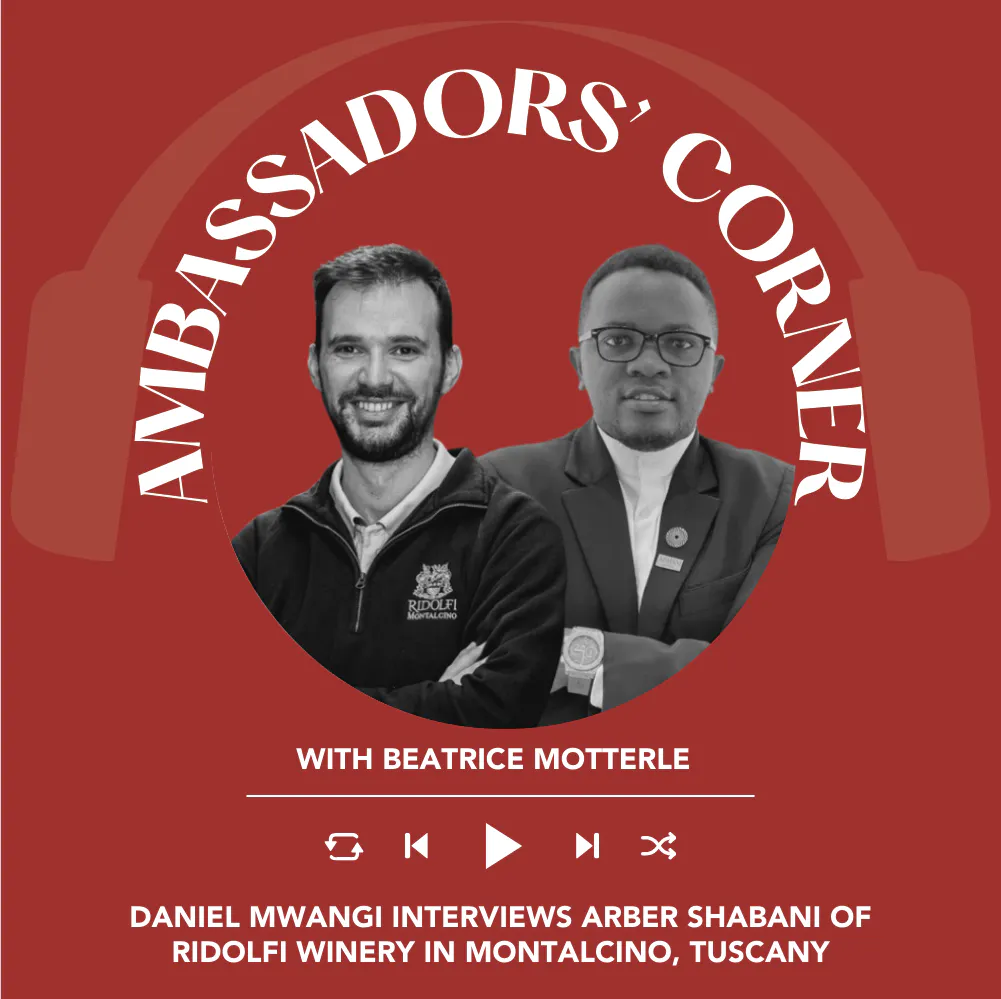
Ep. 2644 Daniel Mwangi interviews Arber Shabani of Ridolfi winery in Montalcino, Tuscany | Clubhouse Ambassadors' Corner
Episode 2644

Ep. 2614 Mauricio de Chiaro IWA interviews Christian Carlevero of Marchesi Alfieri winery in Piedmont | Clubhouse Ambassadors' Corner
Episode 2614

Ep. 2607 Stephanie Johnson IWE interviews Matej Skerlj of Skerlj winery in Carso, FVG | Clubhouse Ambassadors' Corner
Episode 2607

Ep. 2479 Francesco and Santiago Marone Cinzano of Col d'Orcia winery in Montalcino | On The Road Edition with Stevie Kim
Episode 2479

EP 2316 Alberto Martinez-Interiano IWA interviews Emiliano Giorgi of Progetto Sete Winery | Clubhouse Ambassadors’ Corner
Episode 2316

Ep. 2299 Beverley Bourdin IWA interviews Grégoire Desforges of Baglio di Pianetto winery | Clubhouse Ambassadors’ Corner
Episode 2299