
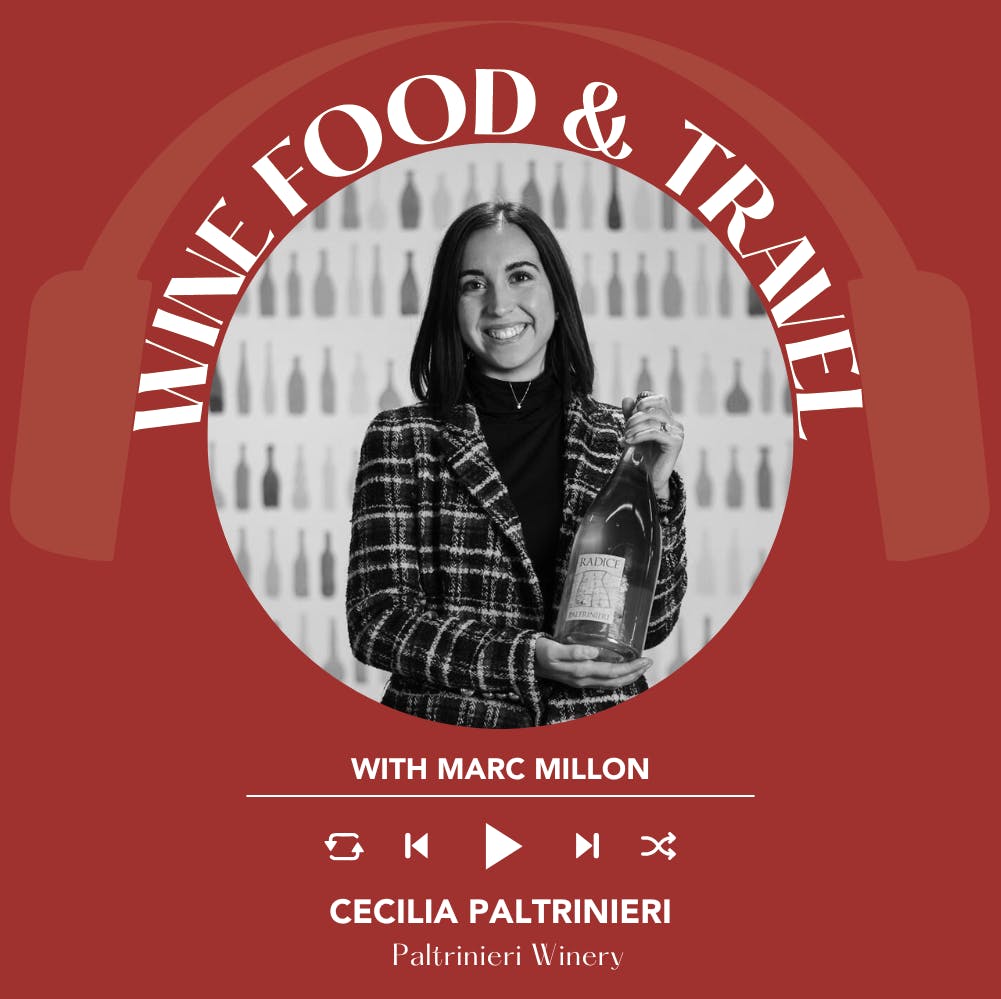
Ep. 2288 Cecilia Paltrinieri of Paltrinieri winery | Wine, Food & Travel with Marc Millon
Wine, Food & Travel with Marc Millon
Episode Summary
Content Analysis Key Themes and Main Ideas 1. The unique characteristics and historical significance of Lambrusco di Sorbara wine. 2. The multi-generational history and specialized production of Cantina Paltrinieri. 3. Different secondary fermentation methods (Metodo Classico, Pet-Nat, Charmat) applied to Lambrusco di Sorbara. 4. The deep connection between Lambrusco di Sorbara and the rich, fatty cuisine of Emilia-Romagna. 5. The traditional production of Aceto Balsamico Tradizionale in Modena and its unique characteristics. Summary In this episode of the Italian Wine Podcast, host Mark Millen travels to Sorbara, near Modena in Emilia-Romagna, to interview Cecilia Paltrinieri of Cantina Paltrinieri. Cecilia, a fourth-generation winemaker, shares her family's history, which began in the 1920s with her chemist great-grandfather. The Paltrinieri winery specializes in Lambrusco di Sorbara, a unique grape variety known for its pale color, high acidity, and specific pollination needs (often assisted by Lambrusco Salamino). Cecilia explains that Lambrusco is a broad family of grapes, with Sorbara being ""the weird kid"" due to its distinct characteristics. She details the winery's diverse range of Sorbara wines, produced using different secondary fermentation methods: Grosso (Metodo Classico), Radice (traditional Pet-Nat style, which the family ""never really stopped"" making), and Leclis (longer Charmat method). The conversation highlights the ideal food pairings for Sorbara, emphasizing its ability to cut through the richness of local Emilia-Romagna foods like cold meats and gnocco fritto, and even its surprising versatility with fatty fish. The episode also delves into the Paltrinieri family's production of highly aged, traditional balsamic vinegar (Aceto Balsamico Tradizionale), explaining its unique ""Solera"" method and serving suggestions. Cecilia concludes by inviting listeners to visit the Cantina Paltrinieri for comprehensive tours and tastings. Takeaways * Lambrusco is a broad family of grape varieties, and Lambrusco di Sorbara is a distinct, pale, high-acidity type. * Cantina Paltrinieri has a rich four-generation history, specializing exclusively in 100% Lambrusco di Sorbara wines. * The winery utilizes multiple secondary fermentation methods (Metodo Classico, Pet-Nat, Charmat) to create diverse expressions of Lambrusco di Sorbara. * Lambrusco di Sorbara's high acidity makes it an excellent pairing for the fatty and rich traditional foods of Emilia-Romagna. * The Paltrinieri family also produces traditional, aged balsamic vinegar using methods passed down through generations. * Acidity in wine plays a crucial role in cleansing the palate when paired with rich or fatty foods. * The winery welcomes visitors for tours and tastings, combining wine and balsamic experiences with local food pairings. Notable Quotes * ""Sorbara is kind of like the, you know, the weird kid, like red headed, blue highs, and everyone else is like dark hair and brown eyes."
About This Episode
The speakers discuss the history and characteristics of traditional wines in Sur Guinea. They explain the use of the term " handy" to describe the fruit and how it is different from other varieties. They also discuss the use of various techniques for organic creation of traditional lambvinios and the history and taste of traditional wines. They recommend checking the taste on different fruit types and visit winery for a taste of the drink.
Transcript
We are in Surbada. Surbada is this very little town near Modena, about twenty kilometers far from Modena, which our focus is on Lambousca Sarbara. At some point, late nineties, we decided to try this one hundred percent Savara grape. And actually, we were the first ones to try to quantify Savara separately. Of course, we still have some Namusco Salamino because we need this paper ID to pollinate Cervada. So of course, we work with both, but let's say our main focus is on are alone. Fascinating people with stories to share, fabulous wines, and the best local foods to accompany them, and beautiful places to discover and visit. All of this and more on wine, food, and travel with me, Mark Millen, on the Italian wine podcast. Join me for a new episode every Tuesday. Welcome to wine, food, and travel with me, Mark Minen, on Italian wine podcast. Today, we traveled to Amelia Romania to the wine hills of Sorbarra, not far from Modena to meet my guest, Chichilia, Paltry Nierry, of the Cantina Paltry Nierry winery, which specializes in the production of a Very special wine that I love Lambrusco di sorbada. Pongiorno Cecilia. How are you today? Is it a beautiful day in sorbada? Hi, everyone. Yesterday is such a nice day, very sunny, and warmer. Yeah. So so spring has arrived? It is arrived. Yeah. Okay. That's great. It's not yet arrived here in England. A little bit chilly here, but I think we're getting there. You're an Emilia Romania, one of the great food regions known and loved around the world. People may not know Surbada so well, a small town, and a wine that isn't as widely known as it deserves to be. So before we talk about your family and about the wine. Can you describe where you are, what the country is like and what the countryside looks like? So our listeners who are located all around the world can get a good visual impression of of where you are. Yeah. Again, we are in Surbara. Surbara is this very little town near Modena, about twenty kilometers far from Modena. We live in a very wide plain, you know, this is called Pianura Padana. So everything is pretty much very, very flat. We see the mountains, but they're very far from where we are. Actually, Sara is basically the narrowest point of land between the two rivers that flow in Modena. So, you know, the territory that we have is, of course, very humid. And, well, we are lucky because our our soil is very rich in water and minerals, of course, too. But, yeah, so we are in, let's say, very, like, wide countryside Yeah. That's where we are. Okay. Well, that's great. And your family have been producing wine for four generations. Is that right? Can you share your family story? Yeah. So I am the fourth generation. Everything started with my great grandpa in the twenties. He actually was a chemist, the first person in my family to ever go to university. You know, we're talking about late eighteen hundreds, so going to university was like a huge deal. That probably meant that his family had quite a little bit of of money. So having some money, they invested it in in the land. So they started to buy some land, to plant vineyards, of course, and they started to make wine really has a family tradition. So he would make wine with his kids. He had five kids. My grandpa was the youngest. And by the time that my grandpa grew up, let's say he realized that he wanted to make wine. Of course, times had really changed to compare to what my great grandpa was was facing. So, basically, in the sixties, he decided to marry my my grandma. They stayed in Sabara to live, and basically he inherited the, small winery that his dad had built, and, of course, some of the land. So in the sixties, this, let's say, it becomes a full time job. And then, my parents then took over in, late nineties. My dad graduated from university, I think, in nineteen ninety six. So that was the first, let's say, official harvest that he did in the winery. And then my mom joined a couple of years later. And then I started to work here about a couple of years ago. Yeah. Okay. So it's four generations now. In this small town, of Sabara and cultivating a quite unique great variety. Now many people around the world will be familiar perhaps with Lambrusco. With various styles of lambbrusco and various colors of lambbrusco wine, but they may not have come across a lambbrusco di sorbara, which is quite a unique grape variety Can you tell us first before we talk about the wines? Let's just talk about this grape variety. Yeah. Everyone is pretty familiar with numbers in general, like you said. What people not very often. Maybe you realize is that Namroscope is such a wide family of different grape varieties, you know. So I think it's definitely more interesting and better in general to then go deeper and, like, specify a particular grape variety that we're that we're talking about, you know. So what we like to to say here is actually using this metaphor by which numbers code would kind of be, you know, the the family name, the last name for a family. Okay? A family with, like, many, many kids. So if you just go by Lambrusco, of course, you're not saying much. Okay? You're not identifying someone in particular. Okay? So, this is our way of saying that it's definitely more interesting to go deeper in this type of conversation. Okay? And more specifically because, again, what people are usually familiar with is a type of Nebraska that is usually very dark and maybe even a little bit sweet. What we do is actually quite the opposite. So Savara is instead very, very light and very acidic, very dry. So going back to this metaphor of of the family, you know, what we like to say is that Sorvara is kind of like the, you know, the weird kid, like red headed, blue highs, and everyone else is like dark hair and brown eyes. This is because Sarvara is really in this family, it really sends out for his a unique color and very high acidity. These are the two main characteristics for this grape. You know, the the color for this for this wine is really given by, of course, the color of of the grape. Okay? So we're talking about a grape for which the berry has a very thin skin and very light per se. So, of course, when we press the grapes to get the juice, we don't really get much color. Okay? And then the second characteristics is very strong acidity actually comes from a pollination problem that this grape has. So, but we're basically talking about grape variety that is not able to self pollinate So, basically, the result is that not all of the varies in the single bunch mature all of the way up. Okay? So you will have some berries that will mature because they will have the seed inside But then you will have so many more theories that will be little because they will not ripe. They will not mature. Okay? So, of course, when we harvest, it's not like you can really separate you know, the mature varies from the not so mature ones. So, of course, we collect everything together and the result is a is a very strong acidity in the juice and then in the wine too, of course. Okay. That's really, really interesting. And I think it's very important for our listeners to understand exactly what you said, but Lambrusco is a family of grape varieties. There are many types of Maestro. Many, many different and as you say, many different colors from the deepest reds that are almost a a black to the very pale, Lambrusco di sorbada. Very interesting what you were saying about the self pollination. Cecilia. Lambrisco de Sorbara is almost like a wild grape vine, isn't it? And it needs to have some assistance with that pollination. Aren't other vines sometimes planted nearby to help assist with the pollination? Yeah. So traditionally, what people have found that helps a little bit with this situation for for Sabara being so aesthetic because of the pollination problem is to also plant another great variety which is still part of the whole Lamrozco family, which just by the fact that it would be planted right next to Sabara, it wouldn't help with the pollination. So this other great variety is called Salamino. The full name would be Lambrusco Salamino, and it's really a DOC in terms of the area for Modena. It's a DOC very close to the area where, Savara DOC is also produced. Salamino is basically basically functions as the pollinator for Sabara. Of course, Salamino is actually quite the opposite compared to the sorbara grape. So we're talking about a grape variety that is naturally much darker and much, like, fruiter and not as acidic as sorbara. This because the the skin is much thicker, so and just darker per se. So if the natural color is darker. And as far as the acidity is concerned, basically, this other grape variety is not really affected by the exfoliation problem that instead serveara faces, So into the wine, it does not really translate into such high sixties. Okay. That's really interesting as well. So we're really getting an idea as is the case throughout Italy, but how local these different varieties of Lambruscoa. And so Bara already grown in a very small area within modena, vineyards, and and Salomino similarly as are the other varieties. So I think people can begin to get an idea of distinguishing between the various Lambrusco. So I think it's very interesting that your family specialize just in one variety of Lambrusco, Lambrusco de sobora, but yet are still able to make a full range of wines. Can we just dive into some of of the wines that you produce? And I'd like to begin with your Yeah. So as you as you said, of course, our focus is on Lambusco Surbara and actually her family as a winery, we were we were the first ones to try to quantify Surbara separately. And that is because as I told you, Lamino works as a pollinator for Sabara. Right? So of course, it is planted right next to Sabara and actually up to twenty, twenty five years ago, the standard was to plant these two grape varieties even in the same rows. So Of course, the easiest way to then collect during harvest was to just collect everything. So the standard product around this area was a natural blend of these two grains. So at some point, late nineties, we decided to try this one hundred percent Savara grape path. Of course, we still have some lumbruscovines because we we need to to have this grape variety to pollinate Savara So of course, we work with both, but let's say our main focus is on Solvara alone. You mentioned Groso. Groso is our first method of classical. So Chankinwei's style. Grasso is one hundred percent of bar grape. And as a method of classical, basically, we usually wait from thirty to thirty six months before taking away the yeast So in the bottle. And then, so for example, we are selling now. We are selling gross of vintage twenty twenty one. Decort last summer, so in July twenty twenty four. Okay. So almost, three years on the lease in the in the bottle. Grasso is our first spumante wines, my daughter, Glasgow. And I think it was one of our ways of try to explain to people that this very strong acidity that, really characterizes so far. This is really what allows us to, I'd say, to experiment in time, you know, to do such long confirmations, long aging into the bottle, and I think this is really what we like about lambrozco di Sabarra. There's very strong aesthetic. Okay. And what does making a method or classical lambrozco di sorbarra? What does that process give to the finished wine? Because I know you also make a multi note in. We'll talk about that in a bit. Yeah. I think it just gives so much complexity. You know, the wine sets on the lease for three years. So you have all of that complexity given by the yeast. And this very long aging process, but then the yeast is taken away, so you still have a very smooth type of wine and very elegant to, I'd say. Of course, then the bubbles are very fine as being a monty wine. And, yeah, fine and elegant of, of course. Okay. So a completely different wine then would be your radice, which is fermented in the bottle as well. Yep. But not by the method or classical. Exactly. Radice is a bottle fermented wine. So, basically, the first fermentation happens in the stainless steel tanks. And then we usually have we try to have a unique bottle in session around March each year to bottle Radice before the second fermentation happens. So that the second fermentation entirely happens inside the bottle. Of course, once the wine is bottled, you know, we don't really have any way of controlling the the temperature there. And so any way of controlling the whole fermentation process, actually. So the second fermentation, so the one that gives the bubbles eventually, that will just happen in a very spontaneous and natural way inside the bottle as the temperatures outside rise basically. Okay. So it's more of a pet nap style, would we say? Exactly. Yeah. So then the yeast remains inside the bottle. Once the fermentation is done, and we just sell it like this. So it's a cloud, the non filtered type of wine. Okay. So very different for that to the elegant, the metodo classical, but also your name is Radice. So this goes back to the family roots to how wine was made by your great grandfather and perhaps your grandfather? Yeah. Definitely. Actually, Radisha, for two reasons. I don't know if you if you remember the the label for this wine, but it's an old map of where we are. Mhmm. It it was our way of saying, you know, our roots are here. Okay? In in the label, you can actually recognize where the winery is. A way of saying we've been here for for quite some time. And then the second reason is what you were saying. So really the tradition for this method. So, of course, when my great grandpa and when my grandpa too, when they were making wine, stainless steel was not much of a big thing as it is today, right? So they would use concrete, actually, but just for the first fermentation. So they would let the wine ferment for the first fermentation. So for the alcoholic fermentation in cement, and then they would bottle everything right away. Just letting the second fermentation happen spontaneously during summer and and spring. So, you know, it's it's fun because sometimes I have people coming to new winery and asking me, you know, there is much, like, of a trend for, like, this natural wise nowadays, but not style. So when is it that you started making your own natural wine, right? And what we what we like to say is that we actually never really stopped because this method was really it's really the most traditional, method to get the bubbles in our area in not just in our area, everywhere you make bubbly wines, actually. Okay. That's really important. I think that's, very good explanation of the history of Lambrusco in your area and also of the family root another wine I'd like to, hear about and I'd even more like to taste it is. Yeah. Leclis is one hundred percent survival. Just like grocery and just like radice actually. Leclisa is a long Sharma method. So I told you, you know, nowadays, again, stainless steel is what has been used most of the time. So, of course, we use Charma methods for some of our wines, Martinati style. Leclis is one of those. Instead of doing actually a standard, Martynati method, Leclis is actually a bit longer. Does a little bit of a longer fermentation because it's staves in the tank in the in the autoclave for about four to five months. So it's a bit of a longer fermentation, and this, of course, means that the bubbles get, you know, finer, more elegant, more persistent, generally speaking, So this I think has a little bit more of a, structure to this wine, a more of a complex type of structure of of body for for this wine. And also, like, let's say he's a crew, so we only use one specific parcel, for this wine. Okay. So there's a more concentrated character of the Lambrusco disorbata coming from the crew, the single vineyard, but also from this lengthy period of secondary fermentation in the tank, Charmat or Martinotti method. Yep. I was interested to see on your website that we're talking about one great variety, Lambrusco di sorbada. This pale variety of Lambrusco, making wines generally so much paler in color than the dense and deeper colors of some Lambruschi. But even within that, you have quite a range of colors yourself between your wine. There's quite a palette of colors. Is that through a greater extract when you're vinnifying, or does it vary from year to year? It does vary from year to year. Then, of course, then I think what what will you place significantly control here is specifically the second fermentation. So talking about the wines that we explored earlier, you know, we summarize all of our, let's say, the methods that we use for the second fermentation. So the Martinati style, butter fermented, and method of classical, right? So I think this second fermentation really is the one that plays a significant role you know, just to give you an idea, the sharma method lines that we make, we make six of them, but, four of them undergo a standard Martinalty method, fermentation. So a couple of months. In the tank, then I told I told you about, like, Lisa, that does instead from four to five months, and then we also have Latis Airva, which is twelve months. So, of course, with a longer fermentation, the color actually even decreases a little bit a little bit more. And of course, the the bubbles are affected too. Okay. Okay. Well, that's actually that's a very good point. These three very distinctive ways of doing the secondary fermentation. Now I know you produce more wines, quite a range, but I'd like to turn now to food because you are in one of the great food areas of Italy, so or bad, of course, is just outside of Modena, which is a city of fast cars and slow food. We're in an area with some of the greatest and most outstanding food products that are known around the world. The food of your area is really made to be enjoyed with wines like Lambrusco di sorbara, isn't it? Can you tell us about some of the foods that are really typical that every visitor that comes to modena and to Surbata should definitely try to taste and how they pair with your wines. Yeah. Well, this area is food wise. Okay. It's very known for usually very greasy type of food, very fatty. Yeah. Anything related to cold meats, but then also if you if you know that. Yeah. So, of course, this type of food pair is very, very well to, Lambrusco and especially, Lambrusco de Servara. I say, especially, Lambrusco de Cervara because given the super strong acidity that this wine has, that this grapevine ID has, You know, this is really something that helps the mouth to be cleaned up when you eat something so fatty and so greasy again. So anything that has a little bit of greasiness would be super good with our wines. And actually going a little bit farther from our region. I think these wines are very versatile, really because of this strong acidity that they have. We were quite surprised when we started to export. We were quite surprised to see that one of our biggest market, is Canada where, you know, fish consumption is pretty high. And that is really because, you know, well, the color of our wines definitely helps. Here. Okay? They're very light. So, you know, generally speaking, fish is paired with white wines and our wines are very pale. But again, a very fatty fish just like it Tuna or salmon, they pair very well with our wines too, with Lungrozco de cerbata in general. Okay. That's that's really interesting. And it is important to appreciate acidity and how it helps to really, really helps, to pair. I'm I'm thinking about that. Yeah. It's a pasta dough that's deep fried. Is that right? Yeah. Exactly. Yeah. And then you would maybe have a slice of with that or some. Yeah. So something to eat with your hands and then and then have a have a glass of lambbrusco disor butter with. You also produce a very special product that is again very linked to modena, also from grapes. Can you tell us about your achaetaya? Yeah. We do have a small production for balsamic. For us, this really is kind of a niche production and product in general. So we only make the very aged one. The production for our balsamics started sixty years ago or so with my grandpa. And we never stopped ever since. So what we make is basically a almost a sixty years aged Palzami vinegar. So the full, you know, name would be, Cheto Balzamiko because it has aged more than twenty five years. And yeah, it's basically, it's my grandma taking care of this, actually. I wish I could someday be as good as her in taking care of our balsamic Of course, you know, balsamic is is a product starting from must, so from juice, so not really from wine. What great varieties would you use for your Cheeto balsamico, The tradition would be to use white grapes. And in our region, the most common one would be Trebiano, Cribbiano modenese, which is again a white grape variety. And the reason why you would use this grape variety what white grape varieties in general is that our region is known for wine, but mostly for red wine. Right? So when people had some white grapes, they wouldn't use it for for wine because they thought of it as kind of a second secondhand sort of gray variety. So instead, they would use that for balsamic, which been so aged, you know, you cannot really tell, especially if you go very long with the aging of that product, you cannot really tell the the starting point, okay, because every year, it just concentrates so much. It becomes so thick. So doesn't really matter that much which grape variety you are starting with. Okay. So this is the grape must which you then cook. Exactly. Yeah. You boil it. It's kind of like a Soleira method for wine, meaning that balsamic is basically non vintage type of product. So every year, fill again those little wooden barrels within which you still have some balsamic, but it evaporates during summer. So the portion that is missing, you use the previous vintage to top that off. Okay. Starting with bigger barrels for the Yeah. And then moving through different woods of smaller sizes. Yep. Okay. And I just want our listeners to be absolutely clear that this, this very old Alcheto Balsamico has nothing to do with the industrially produced Alcheto Balsamico de modena, which is found around the world, and which is very confusing because this is made simply and only from cooked grape must. Is that right? Yeah. It is right. Yeah. So, it's something very, very special, something very rare, and something that must be tasted. What is the best way to taste your So one of the best ways would be on parmesan, on parmesan, actually, and especially the one that is a bit aged. So I would go with a thirty six months of Asian or even more if if possible. One other way that I that I like to suggest is on ice cream, and that is because ice cream is so cold, you know, that it doesn't really modify anything for balsamic. In terms of the consistency, the texture, the flavors. So if you really wanna taste wasamic, the best would be on something that is cold. And that is actually yeah. It's actually the reason as to why If you go to, like, a, you know, a balsamic tasting, most often they would serve it on ceramic spoons because ceramic says it maintains the cold. Okay. Okay. So this is something we're talking about. You sample. It's very, very precious. It's very expensive. You sample it drop by drop, and it is really exquisite in the real treat to be able to experience it. And Cecilia, our listeners who will be very anxious now and and keen to taste, Lambrusco di sorbara, and also a Cheeto bassamiko Tradizzio Nale. Can they visit you and what do you offer for hospitality? Yeah. Of course, they can visit us. We'd be super happy to have them. We offer tours every day from Monday to Saturday in the morning and in the afternoon. We offer wine tours. So, basically, you have the possibility of touring the whole winery. So every process, of course, also the, vineyard if the weather allows it. But yeah, inside every every aspect of the unification, the packaging, really everything. And then, of course, if people want to see it, we also let them see our Ajadaya. So where we make our awesomeic, and then we have the taste in our wines, and, of course, the balsamic too. Okay. That sounds great. That sounds like a comprehensive end. Is it possible able to have some of those fatty foods, those salumi or or foods like that with the tasting? Oh, yeah. Definitely. Yeah. That's a must, isn't it? Yeah. Well, it sounds fabulous. Chichilia, it's been a real pleasure meeting you this morning. Talking about Lambrusco disor butter learning about it because as I say, it's a Lambrusco that many listeners won't have sampled. This pale, delightful, quite gastronomic, Lambrusco, very dry with this backbone of acidity that makes it such a great food wand. And you've really, really explained that story well. And also these different ways of secondary fermentation of the mettler classico, the secondary fermentation in the bottle, the pet nut style, and then, of course, the Martinotti method. So three very different ways to get different results, but all from the same grape variety. So thank you very much for sharing your story, your family story with us and from being my guest. Thank you so much for inviting me. Good. Well, I hope to meet tonight, I look forward to tasting your wines with you. Thank you. Thank you so much. Bye. Thank you. Bye. We hope today's episode of Hawaiian Food and Travel with me, Mark Milin, on the Italian Hawaiian podcast has transported you to somewhere special. Please remember to like share and subscribe, wherever you get your pods. Likewise, you can visit us at Italian wine podcast dot com. Until next time, Chincin.
Episode Details
Keywords
Related Episodes

Ep. 2791 Italian Wine in a Changing Climate: PIWI, Terroir & Tradition with Nicola Biasi | Wine, Food & Travel with Marc Millon
Episode 2791

Ep. 2784 The Other Side of Valpolicella: Volcanic Soils & Sparkling Wines with Francesca Marcato of Talestri Winery | Wine, Food & Travel with Marc Millon
Episode 2784

Ep. 2778 Bread of the Sea: The Story of the Anchovy with Sudi Pigott | Wine, Food & Travel with Marc Millon
Episode 2778

Ep. 2773 Trento DOC: one of Italy’s finest sparkling wines with Alessandra Caroni of Maso Martis | Wine, Food & Travel with Marc Millon
Episode 2773
Ep. 2755 The Longest Table: Honoring Nello Ghezzo’s legacy | Wine, Food & Travel with Marc Millon
Episode 2755

Ep. 2749 The Many Faces of Etna: Climate, Contrade and the Art of Volcano Winemaking with Federico Graziani | Wine, Food & Travel with Marc Millon
Episode 2749