
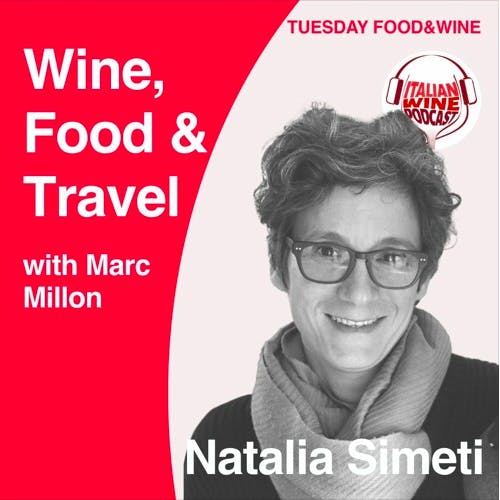
Ep. 724 Natalia Simeti | Wine, Food & Travel With Marc Millon
Wine, Food & Travel with Marc Millon
Episode Summary
Content Analysis Key Themes and Main Ideas 1. Family Legacy and Farm History: The multi-generational story of Bosco Falconeria, a family farm in Western Sicily, from its acquisition in the 1930s to the present day. 2. Sustainable and Organic Agriculture: The commitment to organic and regenerative farming practices at Bosco Falconeria, emphasizing soil health, biodiversity, and future generations. 3. Winemaking Philosophy: The traditional, minimal-intervention approach to winemaking, focusing on expressing the unique characteristics of native Sicilian grape varieties like Cataratto and Nero d'Avola. 4. Diverse Farm Products: Beyond wine, the production of other artisanal goods such as olive oil, wine vinegar, and various fruits and vegetables. 5. Interconnection of Food, Wine, and Culture: The deep ties between the farm's produce, Sicilian culinary traditions, and the family's international influences. 6. Challenges of Climate Change: The direct impacts of changing weather patterns on agricultural production, particularly olive cultivation. Summary In this episode of ""Wine, Food, and Travel,"" host Mark Millen interviews Natalia Simetti, who runs Bosco Falconeria, her family's farm in Western Sicily. Natalia shares the farm's rich history, spanning generations since her great-grandfather acquired it in the 1930s. She discusses her parents' role in revitalizing the farm in the 1970s and her own journey to take over its management, emphasizing a deep connection to the land. The core of their philosophy is a commitment to organic and regenerative agriculture, prioritizing soil health and biodiversity. Natalia details their winemaking process, which focuses on minimal intervention to allow the native Cataratto and Nero d'Avola grapes to express their true character, including their unique orange wine, Falco Peregrino. Beyond wine, Bosco Falconeria produces olive oil, a special artisanal wine vinegar made in a purpose-built structure, and various fruits and vegetables. The conversation highlights the integral role of the farm's produce in Sicilian cuisine and how family traditions intertwine with broader cultural influences. Natalia also touches upon the growing challenges posed by climate change, especially concerning olive production. Takeaways * Bosco Falconeria is a multi-generational family farm located in Western Sicily, with history dating back to the 1930s. * Natalia Simetti took over the management of the farm, continuing a legacy of viticulture and agriculture. * The farm is deeply committed to organic and regenerative farming practices. * Their winemaking emphasizes natural processes, minimal intervention, and expressing the terroir of native Sicilian grapes like Cataratto and Nero d'Avola. * They produce a range of wines, including a unique orange wine called Falco Peregrino. * In addition to wine, Bosco Falconeria produces extra virgin olive oil, artisanal wine vinegar, and various fruits and vegetables. * The farm's produce is intrinsically linked to traditional Sicilian cuisine, often incorporating sweet and sour flavors. * Climate change significantly impacts agricultural production, particularly olive cultivation, requiring adaptation strategies. Notable Quotes * ""Well, Bosco, Falconaria, it is actually, an area between Partinigo and Alcamo. So Western Sicily, the border between the province of Palermo and Trapani."
About This Episode
Speaker 0 and Speaker 0 discuss their experiences with wine and family farm in the US, including their decision to take over a farm and their love for organic and sustainability in their farming practices. They also talk about their approach to creating a purpose-built wine farm and their love for fruit and vegetable production. They mention their plans to create a vinesawrushy place in Spain and their favorite foods and dishes. They encourage viewers to donate to show their love for the show and subscribe.
Transcript
Welcome to wine food and travel with me, Mark Millen, on Italian wine podcast. Listen in as we journey to some of Italy's most beautiful places in the company of those who know them best. The families who grow grapes and make fabulous wines. Through their stories, we all learn not just about their wines, but also about their ways of life, the local and regional foods and specialities that pair naturally with their wines. And the most beautiful places to visit. We have a wonderful journey of discovery ahead of us, and I hope you will join me. Welcome to wine, food, and travel with me, Mark Millen, on Italian wine podcast. Today, we travel to Western Sicily to meet Natalia Simetti on her farm at Partinico, Bosco falconeria. Good morning, Natalia. How are you today? Hi, Mark. I'm fine. Thank you. How are you? I'm very well. Thanks. I'm sorry. I wasn't able to visit you this year, but I hope all is well with your family and with everybody. Yes. Luckily enough, everything is fine over here. Tough times, but everything is okay. Yeah. That's good to hear. You and the group as well, but hopefully soon we'll be able to arrange it again. Yes. That would be really, really nice. Now both Falgonidier is your family home. Tell us a little bit about your family story. Tell us where Bosco Falcononia is located. What is like so that our listeners can gain an understanding and a picture of of where you are. Well, BOSco, Falconaria, it is actually, an area between Partinigo and Alcamo. So Western Sicily, the border between the province of Palermo and Trapani. It's an area of hills overlooking the gulf of the Castel Amares, so the sea. We are not very close to the sea, but close enough to see and enjoy the view. And it's a farm, but it in my family since the thirties of last century. It was my great grandfather who bought it and started making wine, here. Then it was at the beginning of the seventies that my parents decided to restore the first of all, the buildings, and then the farm itself and start producing the wine and oil and other products. So I grew up in Palermo. Actually, I was born in Palermo, but I spent all my all the weekends. And, Christmas holidays, Eastern's holiday summer here in the farm and around thirteen years ago, I had a decided to move and live here and work with my father to take care of this place. Yes. It's a very special place. Your your father, Tonino, is an agronomist. Is that right? Who was teaching at the University of Palermo? Yeah. He was teaching there. And, my mother is instead coming from the United States, and she moved to she actually came for what should have been one year of break in the beginning of the sixties to work in Partinigo at the Danilo Dolce Center, and they met. And they actually had different plans. They were thinking of working in cooperation and travel, but then then they ended up taking care of the family farm, but, you know, very ended up being very happy with this. They're still in any way. That's interesting. I had a similar destiny. I, I came to England for one year and ended up staying here when I met my wife. So I know this, how, how things can happen. Your mother, Mary Taylor Semetti, is a well known American food writer specializing in the foods and food history of Sicily. So I guess from your earliest days, you were coming to Bosco Falcon any of those weekends, the summers, and just absorbing all this knowledge of the land and of all the abundance of good things that it that could yield must have been like a paradise for a child. Yeah. I have I have very good memories about my time spent here. I still remember the trees that were, my brother and my favorite ones to play with and, the involvement in the picking the grapes. Of course, there were moments in which we did hate it quite a lot. And as soon as we were teenagers, we just stayed in Palermo instead of coming here every weekend, but I have the memories. And I also have still the memories of how all this process influenced also my mother that actually discovered food and food history while she was here. So I do still remember I mean, I I I can remember how even our food experience in the family has been changing since I was a small child. Oh, that's really interesting up to now because when she came to CCD, of course, her relation with food was totally different. And actually, even in my father's family, there were some health issues. So my grandmother was not so. I still remember some of her special dishes, but in a everyday cooking, she was not so, elaborated and but slowly my mother started learning and being fascinated and studying. And so even we're eating kind of started changing. And So coming from that American background and adapting to all the abundance of food that was literally coming from the farm. Yeah. We started making this. I still remember, and we still this year was the first time we didn't actually make the sauce in the summer because, for many reason, we really didn't have time. And but since I was such a child in the recent murder, there was the making of the sauce for tomatoes. It was for the estimated sauce for the winter, and then the marmalade, and and drying the tomatoes to make the paste. That is something we've been drying tomatoes, but the paste we've never done it actually, the that's something we've never So having absorbed all this your whole life It was still a big decision. Did you, when did you know that you would want to take over running of the farm that you and Rami would make this your, your family life? Well, for me, it is funny somehow because, for me, has been a pretty pretty long process, and I don't really remember the moment. My father says that there was a moment I went to him and said, like, okay, I decided. That's what I want to do, but it I was already thirty thirty five, thirty four, or something. I don't remember at all that meant for me. I remember it as a little bit longer process in which I slowly because I've been I've been away from Sicily for almost ten years while I was studying at the universe CD in a little bit after, and then I came back, and I started working in Palermo, and in the cultural heritage field, and I was coming for the weekends here, and then the weekends started to become longer Friday to Monday. And then slowly, I decided that actually what I wanted to do was if there wasn't reason to be in CC and to stay here, it was to be in the farm and take care of it. And, actually, when I met Rami, I had just started the process and he, right away, even if he's from Finland decided to, okay, then I I'll be the one. Wow. Gosh. So who can who moves and so he came here. I think in the beginning, he had an idea that he could travel a little bit more and that we could leave a little bit of the year here and a little bit of the year in Finland, but then he realized that taking care of a farm, you don't go anywhere. Told you, we are. There's always something to do every day and every moment. In our climate, that it's never, like, there's always some there's always something you can do. Yeah. Sure. Now in your mother's book, on Persephone's Island. She's got she has a beautiful description of wine making at Bosco Falconelia. That's pretty, pretty rudimentary and basic. Wine is it's always been made. I'll just read a a tiny section here. This is towards the end of the book. I work in fits and starts. One ear attending the sound of the tractor that signals that it is time for me to pull on a windbreaker, then go outside to throw the switch on the grape press and start the big brass screw turning. Ours is an old press. It's red paint, chipped and rusting, and it does a very inefficient job, but what we lose in quantity we gain in quality. The same delicate squeeze without bruise, we cost us extra in a more modern machine. So each year, we decide affectionately to cope with the eccentricities of this one for one more season. I'm just wondering since you've taken over, looking after the farm and looking after the wine making, have things changed very much? Yes, sir. Not at the same time. I think the way we make wine has not changed, but this the press my mother was writing about is still in front where you you you you you probably saw it. It's still Yeah. Front of the house, but we are not using it anymore. We are making the wine in, at some friends winery at the moment, and the process is the same. That means that we try not to control too much or affect too much all the process of making wine. The press is much more modern, right, which is softer press that makes for sure a better, a better job. And I do remember that when I was a kid to control the temperature during the fermentation, my mother had made these kind of big skirts for the tanks, and we would just make them wet with water. Now the system to control the temperature is, it's controlled with a, with a free Jira system, but but feel I would say the the other aspects are the same that we still don't add the selected yeast and we'd still try to make the grape express as much as possible the territory and the and the harvest and the vintage without interfering too much. In, in fact, that natural approach, in fact, organic and sustainability lies at the heart of what you're doing, not just with the wines, but with everything you're doing. Yeah. I have to say that, I I was very lucky that I already my father started moving toward the organic agriculture in the eighties. And, since then, the farm has been run this way, and we take I think it's very important. Mainly when you do agriculture is you're not only producing, but you are also taking care. You're not only producing food, but you have to take care both of the landscape, but also the soil and the possibility of for the future generations to keep using the soil. So organic agriculture, but even beyond, regenerative agriculture are very important for us. It would not really make sense to produce in other ways. So we try to do our best to, take care of the biodiversity we already have in the farm and, but to also improve it and be very improve also our way as much as possible of taking care of this of the soil. Mhmm. Well, let's discuss, three wines you make your growing, And you also make us a very special wine that I particularly love the falco, Peregrino. Let's just talk about your wines. We hope there is all, actually, a surprise. We have a fourth wine since twenty nineteen with the you've started making a rosato a rossell. Oh, I look forward to trying that. So, yeah, we grow Katarato Nero davela, which are the most common local varieties. And we make two white wines from the Colorado, one, which is a classical white, and a Falco Vergreno, which is so called orange wine, that wine, white wine that ferments on the skin. And then the, and now since we had some younger binds of, you know, we've started experimenting with, as I was saying, with, Rosato. And they're all wines that try to be as much as possible expression of this area and the kind of soil we have and also of the vintage. So what has been going through the year in terms of climate before we peak our grapes. And, yes, I I think that your wines to me taste very, very pure. They're really pure expressions of of these important data great varieties. Yeah. And I think that both both varieties, the are very interesting varieties that if you don't try to make them correspond to an idea that you already have over taste or how they should taste to kind of make surprise you and be very interesting. And, our wine are actually according to me, pretty straightforward, pretty simple into brackets wines. But if you let the variety express itself, then at the same time, they can be complex, and they can be very interesting especially the Cartarato. It's a variety with this that has this kind of a little bit bitter aftertaste that makes it very particular. And that can express change a lot from areas to areas. So I would say maybe one of the best according to me, of course, I'm a cataract producer. One of the best sicilian varieties. And very interesting too, when you ferment it on the skins to make this intriguing FALCO Peregrino, which I think is such a wonderful wine with food, richness. Yeah, it is actually a wine that at the beginning, when you taste it, you may think it's difficult to, to drink while eating, but instead it has pretty, it's pretty good with everything, I would say. It's we like to consider it our winter wine white wine because it's, of course, being on this having been on the skin is a white that you don't wanna chill too much. You the best it's to drink it. Yes. Just at the room temperature. Yeah. And it is very, very good to be drank in the, in the winter, as well as of wine, because your white wine goes very good with, well, with cheese, and also meat. Mhmm. Yes. There's wonderful pecorino cheeses from your area. Yeah. You you also cultivate a number of other products produce at at Bosco, Falconania, just explain what else you're doing on the farm? Well, we produce olive oil. We transform some of our wine into vinegar, but we also have fruit trees. So we have also production of fruits and a little bit of vegetables as well that we sell on the local market. We used to produce more, month, a few years ago. Now we mainly produce the vegetables for ourselves because We don't have lots of water, so we had to make some decisions on how to use the water we had. So we grow mainly in the summer pumpkins and watermelons. We have three varieties of olives, the bianco lila, which are all of these area. And with that, we produced, extra virgin olive oil. Yes. It's a wonderful oil. I've really enjoyed tasting that, often seasoning your own vegetables. The olive oil, the olive cultivation has been difficult in recent years. You've had some problems with this fly that's come in. Is that, is that better now? Modest was a it was, we were still harvesting a little bit because this has been a very, very wet fall here, which has been raining so much. Too much. It has been, so so. The quality is very good, but not many olives. But, yeah, in the last years, it has been quite I think that maybe olive trees at the moment are the ones that one way or the other are suffering the ma most the climate changing for some reason. So it's, it's a little bit difficult. They have a car. The it is a tree that for its nature, produce every two years more. But in the past, it was much easier through the way you prune it. To kind of make it more even nowadays. It's really, like, the last five or six years have been really, every year different than the other. There has been, I think, it was twenty eighteen. We for the first time in my father's history, we didn't pick any olives where there weren't olives, but we will have to find a way, like, in with everything else to, to adapt to what the future is gonna be. Well, I was also really interested to see on my last visits, the Atataya that you've built, this purpose built building to create some really exquisite wine vinegar. Tell us a little bit about this project. Yeah. That when when I took over the farm and I could make a project to get some funding from the European community, I decided to to do that because we had always well, in Sicily, it's it was pretty common for every family to make their own wine in the countryside and then to have a barrel for vinegar. And my father, I remember when I was a child, found a barrel, some, you know, another area, storage that my great grandfather had and move it here, and then we started making vinegar. And we I always played with him in tasting the vinegar and, deciding which one was better. And we would every year when we were harvest add some wine. So I decided, but we were not doing it officially. So I decided that I was going to to build a proper place that we decided to do with, according to, more sustainable architecture. So it's building wood and straw. And then we started making there the vinegar, the way has always been made here. So in the most slow and static way, just putting together, some alive vinegar and wine and just let it have time and oxygen enough to produce, in wooden barrels. In wooden barrels. Yes. We it's funny, but we make the wine in In in in in stainless steel. Yeah. Famous stainless steel exactly in vinegar in in wood, but wood is the best because for making vinegar because it becomes perfect home for the bacteria. Still, even if you would have, get out all the vinegar from the bottle, still, there would be lots of life in the bottle. And you can always restart with making vinegar. And so we do make vinegar both from our cataracto and from our Nero Dawala. And it's a very traditional CC and strong vinegar, but at the same time keeps all the different flavors of the original wine. Yes. It's a wonderful vinegar and quite important to, to the cuisine of sicily, this sort of balance of Yeah. The combination of vinegar and and sugar, the sweetened sour is quite traditional in many dishes, like the carbonata or the sweet and sour, Zuca squash in many different dishes. It's a combination that's very important and enjoyable. You're personal family cuisine goes beyond just flavors of Sicily to America, to Finland through Rami. Are there particular favorite foods that you enjoy with your own produce that have reflecting these these influences? Yeah. I would say, well, we eat a lot of, for example, in the summer, a lot of sicilian cuisine made out of directly from our, products. So the pasta conite nerumi, which is a vegetable that we grow She's that the big, big, tall, long, courgette type thing, a big squash. Very, very big. Yeah. You eat also the young leaves in the summer, and you make a pasta. We, we did in which the oil is a very important ingredient. So that's a way to eat lots of oil. We'd also make some carbonata. We with the vinegar and some of our other products, we are and that comes a lot from my mother's side, we make a lot of, pickles. So we make figs, and we use also the watermelon to make pickles. So we have From fill in, it's more than bread and the and sweets because Rami, you know, Rami, it's was a has actually a past as a baker, so he does make bread and sweets. But with the local, we don't grow wheat. But we use, like, Pertosaki or majorca or, anyway, local ancient varieties of wheat that are grown by local producers, friends who work in, would be it instead. So, yeah, it's a kind of nice combination. I'm actually thinking that maybe I will some of these pickles I may start making to, you know, small quantities to sell because it's a nice mixture of CCily and other cooking conditions? Well, I've already enjoyed sitting around that abundant table at Bosco, Falconeria, with almost everything coming from the farm, and it's a real pleasure. And I hope our visitors have gained, something of an idea of, of this special corner of the world where you're living and working with your family. It's been a real pleasure talking to you this morning, Natalia, it was nice to hear you and talk to you also. And catch up. And I, then, please send my warmest wishes to, to Rami and to your mother and father as well. And I look forward to coming back again sometime in the future. I will. Yeah. I hope so. I'm really looking forward to have you taste the our Roshardo and see what you think about it. Yes. I'm looking forward to that. Okay. Thank you very much, Natalia, and we'll see you soon. Okay. Bye. Okay. Bye bye. We hope you enjoyed today's episode of wine, food, and travel with me, Mark Millen, on Italian wine podcast. Please remember to like, share, and subscribe right here, or wherever you get your pods. Likewise, you can visit us at Italianwine podcast dot com. Until next time. Hi, everybody. Italian wine podcast on the Breights its fourth anniversary this year, and we all love the great content they put out every day. Chinching with Italian wine people has become a big part of our day, and the team in verona needs to feel our love. Producing the show is not easy folks, hurting all those hosts, getting the interviews, dropping the clubhouse recordings, not to mention editing all the material. Let's give them a tangible fan hug with a contribution to all their costs. Head to Italian wine podcast dot com and click donate to show your love.
Episode Details
Keywords
Related Episodes

Ep. 2791 Italian Wine in a Changing Climate: PIWI, Terroir & Tradition with Nicola Biasi | Wine, Food & Travel with Marc Millon
Episode 2791

Ep. 2784 The Other Side of Valpolicella: Volcanic Soils & Sparkling Wines with Francesca Marcato of Talestri Winery | Wine, Food & Travel with Marc Millon
Episode 2784

Ep. 2778 Bread of the Sea: The Story of the Anchovy with Sudi Pigott | Wine, Food & Travel with Marc Millon
Episode 2778

Ep. 2773 Trento DOC: one of Italy’s finest sparkling wines with Alessandra Caroni of Maso Martis | Wine, Food & Travel with Marc Millon
Episode 2773
Ep. 2755 The Longest Table: Honoring Nello Ghezzo’s legacy | Wine, Food & Travel with Marc Millon
Episode 2755

Ep. 2749 The Many Faces of Etna: Climate, Contrade and the Art of Volcano Winemaking with Federico Graziani | Wine, Food & Travel with Marc Millon
Episode 2749