

Ep. 1160 Francesco Mazzei | Wine, Food & Travel With Marc Millon
Wine, Food & Travel
Episode Summary
Content Analysis Key Themes and Main Ideas 1. The enduring legacy and generational continuity of Castello di Fonterutoli and the Mazzei family in Chianti Classico since 1435. 2. The historical development and precise definitions of the Chianti and Chianti Classico appellations, including the introduction of quality tiers and geographical subregions (UGAs). 3. The expression of distinct terroir through specific Gran Selezione wines produced by Fonterutoli in different parts of their extensive estate. 4. Fonterutoli's pioneering role in the Supertuscan movement with their ""Concerto"" wine and their innovative approach to winemaking. 5. The integral connection between wine, hospitality, and traditional Tuscan gastronomy at the estate, rooted in its historical location on a pilgrim's route. Summary This episode of the Italian Wine Podcast's ""Wine, Food, and Travel"" series features host Mark Millen interviewing Francesco Mazzei, the 24th-generation owner of Castello di Fonterutoli, a historic wine estate in Chianti Classico that dates back to 1435. Francesco shares insights into his family's long history, highlighting the significant contributions of his ancestor, Ser Lapo Mazzei, who first linked ""Chianti"" to wine in 1398, effectively becoming the ""father of the appellation."" The discussion delves into the intricacies of Chianti Classico, differentiating it from broader Chianti, explaining its quality pyramid (Riserva, Gran Selezione), and detailing the upcoming UGA system for defining subregions. Mazzei proudly describes how Fonterutoli's three distinct Gran Selezione wines—Castello Fonterutoli, Badiola, and Biccheriego 36—each express unique terroirs. He also recounts the estate's role in the birth of the Supertuscan movement with their ""Concerto"" wine. Finally, Francesco emphasizes the Mazzei family's enduring tradition of hospitality, offering a unique bed and breakfast experience and a restaurant (Osteria) that champions local game and produce, creating a holistic Tuscan cultural experience. Takeaways - Castello di Fonterutoli has been managed by the Mazzei family for 24 generations since 1435. - Ser Lapo Mazzei, a 14th-century ancestor, is credited with historically defining Chianti as a wine region. - Chianti Classico is distinct from other Chianti wines and is recognized by its black rooster symbol and specific quality tiers: Regular, Riserva, and Gran Selezione. - The new UGA (Unità Geografiche Aggiuntive) system will further delineate Chianti Classico into 11 subregions to highlight diverse terroirs. - Fonterutoli produces three top-tier Gran Selezione wines, each showcasing the unique characteristics of different vineyard plots on their estate. - The estate's ""Concerto"" wine (1981) was a significant early Supertuscan, blending Sangiovese with Cabernet Sauvignon. - Fonterutoli maintains a strong tradition of hospitality, offering accommodation and a restaurant that emphasizes local Tuscan cuisine, particularly game, paired with their wines. Notable Quotes - ""Castel de fundamentally belongs to my family, to the Matze family since fourteen thirty five, and I represent, generation number twenty four."
About This Episode
The Italian wine podcast introduces YMI fan, a sponsored fund-led enterprise that needs individuals to donate to fund the podcast. Frank F deny explains the history of the Matze family at Castello, including their involvement in the harvesting of wine and the creation of the first European classico in the Italian wine industry. Speakers discuss the importance of verticality in wine, hospitality in the Italian wine industry, and the use of Supertiscan in the language of Kiantis. They also talk about the traditional hospitality culture of the city and their love for games and naturality, including truffles and game dishes.
Transcript
The Italian wine podcast is introducing a new donation drive this month. It's called YMI fan. We are encouraging anyone who tunes on a regular basis to send us your ten second video on why you are a fan of our podcast network or a specific show. We will then share your thoughts with the world, with the goal of garnering support for our donation drive. Italian wine podcast is a publicly funded sponsored driven enterprise that needs you in order to continue to receive awesome pre wine edutainment. Seven days a week, we are asking our listeners to donate to the Italian wine podcast. By clicking either the go fund me link or the Patreon link found on Italian wine podcast dot com. Remember, if you sign up as a monthly donor on our Patreon, we will send you a free IWP t shirt. And a copy of the wine democracy book, the newest mama jumbo shrimp publication. Welcome to wine food and travel. With me, Mark Billen, on Italian wine podcast. Listen in as we journey to some of Italy's most beautiful places in the company of those who know them best. The families who grow grapes and make fabulous wines. Through their stories, we'll learn not just about their wines, but also about their ways of life, the local and regional foods and specialties that pair naturally with their wines, and the most beautiful places to visit. We have a wonderful journey of discovery ahead of us. And I hope you will join me. Welcome to wine food and travel with me, Mark Millen. On Italian wine podcast. Today, we traveled to Tuscany, to the heart of the Chianti classico, to visit a historic and prestigious wine estate, Castello di fonte Roto Lee. And to meet my guest, Franchesco Matse. Whose family have been here for many, many generations since fourteen thirty five, in fact. It's a real pleasure to have you here with me, Franchesca. Thanks for being my guest. How are you today, and and how is it today in the Kianti Wine Hills? Well, first of all, good morning, Mark. I'm doing well, and I'm in, fun territory next to Castelina with a sunny day, hot to be end of October. But beautiful. Wonderful. I'm just imagining the colors of the vines beginning to change now. The the harvest is complete and, it it's, I guess, for winemakers, this is a moment of satisfaction. I know there's a lot of work going on still. But you know that you have the wine in the cellar. Yes. This is the time of transition from, the vineyard to the to the cellar. And, yeah, we had a we had a pretty interesting and challenging, harvest this year. It was a bit dry and hot, but, finally, there's a there's a great quality. In the cellar. Oh, that's good to know. Now Francesca, I know our listeners will be very interested to learn something about the lengthy history of the Matze family at Fontte Ruttely, story that extends literally centuries. Can you give us, I know it's a long story. Can you give us, something of, of the history of your family in this, amazing wine estate? Sure. Well, first of all, as you said, in the introduction, Castel de fundamentally belongs to my family, to the Matze family since fourteen thirty five, and I represent, generation number twenty four. And we have on board the twenty fifth generation with two of my nephews working with us. And, simply, we who narrated the property in fourteen thirty five as, one of our ancestor, madonas Meralda Matse got married to the landlord of Ontario. And then as they didn't have kids, children, and, and he had no relatives. The property went, to my family and, from to the Matze family, from, that time to us directly generation by generation. Okay. And you had an illustrious ancestor, sir La Ponce, who played a role in in actually defining Kiente as an entity. Exactly. And he was actually he was the grandfather of that lady, the married, and, Salab was a quite interesting person, and there's a lot of, There are a lot of documents about him. He was a nursery, and he was, very, very expert and, and physicist of wine. And, it was also the sort of a consultant of the most important, merchant of the period, Francesco Ratini. And, they invented the it seems they invented the letter of credit. So they were the first to buy goods without paying them, straight in in other goods or with money. But just with a letter saying we will pay for that, this amount of money blah blah blah. And in one of these letters, for the first time, the word, chianti is associated to wine. And this, December sixteen thirteen ninety eight. And designed by then also I'd say. So he's considered the father of the appalachian because he's the first one that mentioned Chianti as a wine region. Okay. And that's that's really interesting. So This was at a time when, Tuscany was quite advanced in as far as the merchants, developing methods of trade and and taking products, textiles, line, all over Europe. So this was, a vital economic period. Yes, it was. Tuscany was very advanced. Was, that, well, banks were born, I'm not sure if the first bank was born in, in, in, in, in Tuscany, but certainly, one of the first banks was born in in in, Tuscany, and, it was, very open and liberal country, a trading with all over, with all the the world, the known world at that time. K. So and Kianti was also the name of the geographical area as well as the wine. We think of it as a wine, but the Kianti was the was the place. Yeah. We we we we can try to clarify a little bit of confusion about that. Chianti is definitely a geographic area between, south of Florence and north of of Sienna. So the yields between, between Florence and Sierra. And which is the region where nowadays the Canti classico is produced. So it's the original candy. Then for some reasons, there was, a decision by the government in, early and nineteen hundreds to let beef will produce, a chianti wine outside of the chianti as a typology. That's why there's a little bit of confusion, but the chianti is the original area, and that it's where the chianti class was produced. Nothing to do with the normal cap. Yes. That is important for our listeners to understand because it can be confusing, the eight subregions, and, the county quality pyramid. Can we perhaps talk a little bit about that before we move on to your wines, the chianti, chianti classico, etcetera. Sure. First of all, generally, the chianti class can be recognized by the fact that he carries, a black rooster, as a as a symbol of the of the candy classic. And as I said, it's Canty classical is the one that is produced in the regional area, the county, which has nothing to do with, with the normal county, not classical. There are different rules, by law, and, and by by the whole word that Catacás has recognized to be, of a higher level. Talking of the Canticlassical. We have mailed three tiers, the regular Canticlassico. That can be released a year after the the harvest, then the reserve that can be released, two years and half of the, after the harvest. And finally, the latest introduction, it's the grandsona, which is the top tier, and that that can be released, later, about three years after, and a little less than that. And, can be produced only by the people that own the the the vineyards. So there's no trading of of, bulk wine or or grapes to make the grandson. So this is to guarantee that the whole process is controlled by the same producer. Okay. That's very important. And we'll and I'd like to talk about your Grand Salcione wines. One other question I have, Franchesco, is the UGA, the, this way of defining subregions within the Kympti class echo. Sure. This is, something that is still in in in in its itinerary. It has to be it has been approved. It's just we need The final, it's not really an approval. The final determination of it by the the ministry of agriculture, publishing in, it in the, as a law because it's a, it's a, it's a it becomes a rule, the new rule, and, the county council is, will be divided in eleven UGA, which is subbasically subregions. That will be marked on the labels only for the Grand Zalecion at the beginning. And most of them are municipalities, such as Castelian Canti, where we have our headquarter. And some of them are, part of, municipalities or, an, an, an aggregation of, of, municipalities. Okay. So from, a consumer's point of view, it's allowing one to taste terroir in a more defined way, noting the difference between a chianti from Casa Nueva Bara denga, for example, or Castelina in chianti. Exactly. It's it's it's done to address the consumers who make their choices in terms of, you know, different styles, different soils, different micro climates. Okay. And the top of the top we've already mentioned is and, you actually produced three grand, I guess, we're doing the same here then, Franchesca. You're really defining the terroir from each of these three lines. Can you tell us a little bit about these three lines and and perhaps how they express themselves, express their terroir? Sure. Yes, we we we have the we're lucky because, our, our property sits on mostly on the Castelian County municipality, municipality, but also has a, a leg fit in the Radancanti municipality, as well as in Casanova, dengue, with the sub, region of, Valy. And for that reason, we, decided to make a step ahead. And, along with the castello Funta Rutto, which our main grandson and comes from the vineyards around the village of Funta Rutto, the Hamlet of Funta Rutto. And this is our core wine, in terms of Grand Salizione. And it's, it's a synthesis of, of, structure and, elegance, given the soil that is very her caries and and the stony with albereza stones. So that's the the the the cork wine. And, aside of it, there's, badiola, in the Ratan County municipality, which is a little bit more, protected from the, warm area that comes from the, and it's more internal. If I can say so higher, we're at five seventy meters of altitude. With, sandy and Galessa soil. And there we get the wine that is very, very vertical, very elegant, very fresh, very acidic. Slimmer, but more vertical in a way. And finally, going south, of Ontario, there is Bicoregio thirty six, which, it's in the Valyali, UGA. In the municipality of Castel Over Ardenga. And, that is, it was started as, a laboratory vineyard where we planted all our, sangiovese, all different bio types of sangiovese that were grown in the in the state, which is thirty six of them, eighteen clones and eighteen muscle selections. And then we found out that this combination was great. And that's how the, the courage of thirty six was born. Italian wine podcast. If you think you love wine as much as we do, then give us a like and a follow anywhere you get your pods. Oh, that's a fascinating story. Just, one question. Vertical. How do you, what do you mean when you say a wine is very vertical? I mean, it's very long, persistent, and it's not that, fat or okay. Not ex answer, and not sent it. Yeah. Exactly. Not too much of extract, but a lot of, greater CDD freshness and elegance. Okay. Great. Now, that's really interesting to hear about three great Kiantis from Castillo de Fonttely, but each a different expression. So really, an expression of crew in a way, which we find in in other areas. Sandravezay is the great grape of Kianti Clasico, obviously, the great grape of Tuscany in its various manifestations. But you've also your family have also cultivated international great varieties here for some decades. And I'm thinking back to the time of the seventies and eighties when the so called Supertuscan mines were born. You helped too. Define what a Supertuscan is. Is that a term? Do you think that's still valid today when when Keanty classical now is a a truly great, high expression? Do you still use the term Supertuscan? Or is that not relevant? Well, at that, at this stage, Supertuscany, it's, it's part of the history of of of the Chianti classico anyway. And, there are wines under that. Term, which is not an official term. I mean, it's not an appellate, a real appellation because normally the super tuscan wines are labeled under the IGT as a geographical, identity, but it's still I think it's still valid and there are wines that were born in the era, in the seventies and eighties that, still can, where that name, that category, and I think it's still actual. Yeah. Okay. Great. Well, you you were producers of one of the early super tuscans concerto. Tell us about this wine. Well, concerto was born in nineteen eighty one as, one of the first ten Supertasks ever born. And it was, that time, it was the, the research of something more modern different. That's why we had planted a little bit of cabernet sauvignon to blend with the San Giovanni, which is the the combination there. It's, eighty percent San Giovanni and twenty percent cabinet sauvignon. In the concerto. And it was a it was a fantastic, experience, to grow different grape varieties. At that time, and using, you know, increasing the density of planting the in the vineyards to have more concentration using small barrels, which were not traditional in our place. So it was a a step in the modernity, you know. So it was a big change when we're recovering from the, the landscape's changing. The systems of planting, vines are changing. And then, of course, bringing in this new way of making wine. And and yet, it's been proven that cabernet sauvignon, Merlo do very well in the county vineyards. Absolutely. In in certain specific locations, both Cabony and below do very, very well. Now the Bordeaux of is actually located on the via Francigena, the pilgrims route that led all the way from Canterbury in England, as well as from many other destinations across Northern Europe to Rome. Your ancestors built a pilgrim's pasta were where weary pilgrims could rest, sleep, eat, and drink. So you have a very long tradition of offering hospitality at and this tradition continues today. Tell us a little bit about hospitality at Of course, we're not only in the one of the branches of, the but we're also in the Cantigiana, the the two two two which is the now there's an highway a bit further west, but but that was the the connection between, the ancient connection between Florence and Siena. And, so, yeah, there's a tradition in a family to host people. And, that's why even now we have, a sort of, sheik bed and breakfast. With nineteen rooms spreading to the village. So it's not one building, but it's several different buildings, two rooms here, three there. Just makes them a feeling of leaving, the the place and the and the family style. And then, we have a restaurant and, a bar also. Okay. And that's the, at the Austria. You're very proud to serve the classic foods of of the Canton of of Tuscany. Tell us a little bit about some of the foods that are served and, and which wines go go well with? Some of these classic dishes at every visitor who, passes through should try to sample. Of course, Astoria is the perfect place to showcase our, our wines. And, for that reason, we we do mostly meat, although we we have some dishes with fish, but basically all vegetarian dishes. But, the focus is on meat and moreover it's on game. Because we have game and, and we have also to protect the vineyards from the wild boars, some deers, and that's why, that's our focus. And also, the game is, more natural, no antibiotics, you know, it's wild, so no antibiotics, no hormones. And, and we do a lot of, dishes with, game, but in a modern and contemporary way. So more sophisticated. And, we're very happy. People love it. And of course, it's a perfect match with or pairing with our red wine, such Okay. Yes. That sounds wonderful. And I'm imagining in this biggest state, you have your own orto for growing vegetables. You gather have people gathering porcini mushrooms at this time of year. And really bringing in the foods of the lands directly to the table. Yeah. We're very lucky because, it's not only the place of, vineyards and the olive trees, but of as you said, in the last few weeks, it was incredible that the quantity of porcini mushrooms we got. And it's also a rather nice place for truffles. It's not the best place. But there are tough also, too. And, so the nice thing is to have the the opportunity to buy, stuff from, from the territory, without going too far in in in the, you know, cool car dishes with those those goods. Okay. And I imagine you make your own estate, all your extra virgin Yes. We do. We do mainly at Fonteluto, but also in the other states. We so we have a range of olive oils from our three estates. And but the main one and the in my opinion, even the best one is the one from Castelu Fanta. Okay. And one of the final line to discuss is your, actually, Vincent something which is still in in in our projects, but it is, it is it hasn't been developed at the moment. Okay. So you'll go back to that tradition. Yes. Well, Franchesco, it's been a real pleasure learning about your family. It's long in illustrious history and about the traditional yet modern wines you're producing today, especially the, and how they express the various parts of this extensive estate estate thank you so much for being my guest. And I look forward to meeting you soon and to visiting, again, myself. Thank you, Mark. It has been a pleasure. And, for everybody, castelli Fonterouto is open for a visit, all year round. I'm sure many of our listeners will be will be trying to find a way to visit you. Thank you once again. Super. Thank you, and have a nice day. You too. Bye bye. We hope you enjoy today's episode of wine, food, and travel with me, Mark Millen, on Italian wine podcast. Please remember to like, share, and subscribe right here, or wherever you get your pods. Likewise, you can visit us at Italianwine podcast dot com. Until next time.
Episode Details
Keywords
Related Episodes
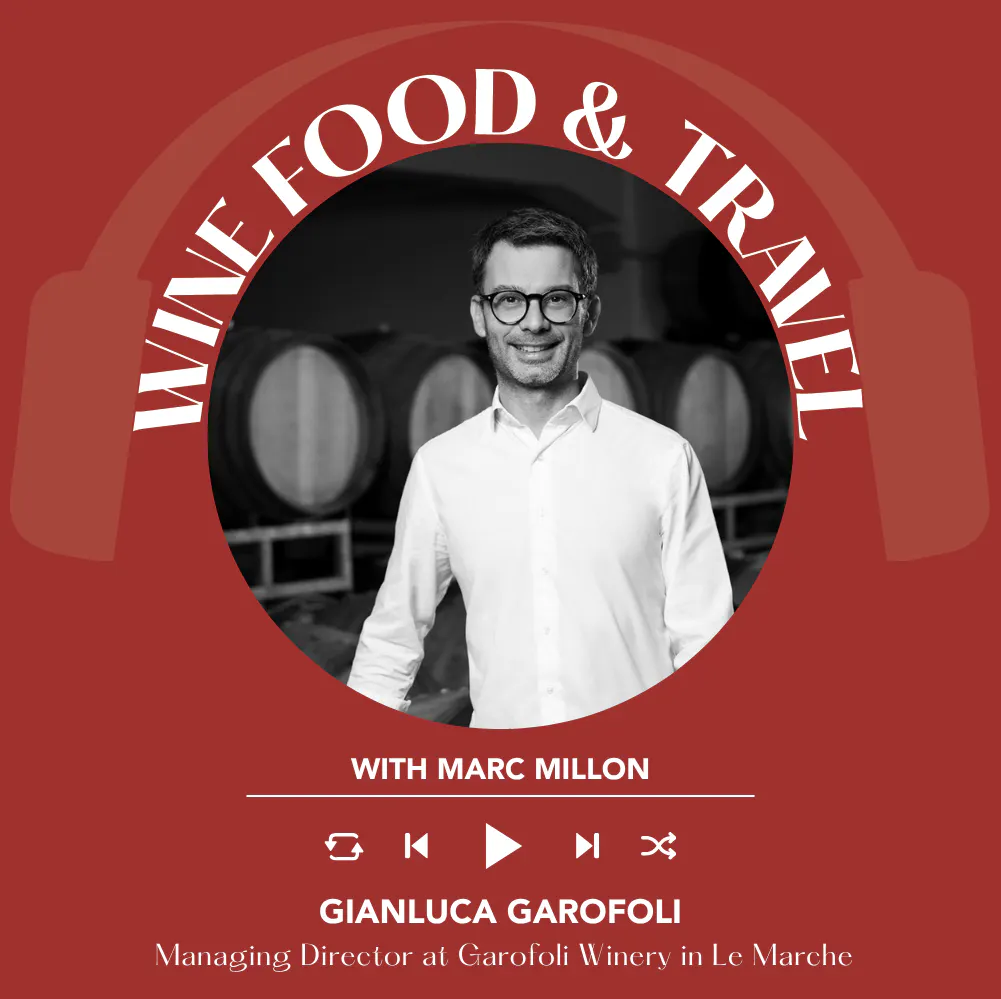
Ep. 2767 Le Marche: Verdicchio and the Wines that Shape the Region with Gianluca Garofoli of Garofoli Vini | Wine, Food & Travel with Marc Millon
Episode 2767

Ep. 2712 Exploring Brda: Exceptional Wines and Slovenia's Culinary Traditions with Lan Kristančič of Movia | Wine, Food & Travel with Marc Millon
Episode 2712

Ep. 2700 Sardinia Beyond the Coast: Agripunica, Basso Sulcis & the Legacy of Giacomo Tachis with Salvatore Santus | Wine, Food & Travel with Marc Millon
Episode 2700

Ep. 2624 Friuli Cuisine & 2 Michelin Stars: Inside Agli Amici with Emanuele & Michela Scarello | Wine, Food & Travel with Marc Millon
Episode 2624

Ep. 2618 From Mezzadria to Modern Sangiovese: The Castellare di Castellina Legacy with Alessandro Cellai | Wine, Food & Travel with Marc Millon
Episode 2618

Ep. 2605 Beneath Orvieto: Tufo Soils, Caves, and the Magic of Muffa Nobile with Enzo Barbi of Decugnano dei Barbi | Wine, Food & Travel with Marc Millon
Episode 2605