

Ep. 1212 Anissa Helou | Wine, Food & Travel With Marc Millon
Wine, Food & Travel
Episode Summary
Content Analysis Key Themes and Main Ideas 1. Anissa Helou's personal and professional journey, from growing up in Beirut to becoming an acclaimed food writer and chef. 2. The transformative power of food as a link to cultural identity and heritage, especially for diaspora communities. 3. The impact of the Lebanese Civil War on personal connection to food and the motivation for documenting traditional recipes. 4. The unique and historical culinary landscape of Lebanon and its ancient wine culture. 5. The distinctive nature of Sicilian cuisine, highlighting its historical influences, particularly from Arab cultures. 6. The difference in travel experience when researching food versus other fields like art. 7. Future plans for culinary education and writing, including a cooking school in Sicily and a book on regional Lebanese food. Summary In this episode of the Italian Wine Podcast, host Mark Millen interviews Anissa Helou, an esteemed chef, consultant, and food writer specializing in Middle Eastern cuisines. Anissa recounts her upbringing in Beirut and Syria, revealing how her initial hedonistic interest in food evolved into a profound connection to culture and identity, particularly after the Lebanese Civil War. She explains how the conflict spurred her to document traditional Lebanese recipes, serving as a vital link for the displaced Lebanese diaspora. The conversation also touches on Lebanon's long history of wine production, which persevered even during wartime. Anissa shares her decision to make Sicily a second home, drawn by its unique produce and cuisine, which she finds reminiscent of her Middle Eastern roots due to significant Arab influences. She discusses specific Sicilian dishes like *pesto trapanese* and *couscous*, emphasizing their distinct regional characteristics. Looking ahead, Anissa reveals her plans to open a cooking school in Sicily and publish a new book exploring regional Lebanese food through its historical and religious connections. Takeaways * Anissa Helou's passion for food transitioned from personal enjoyment to a dedicated career in research and writing. * The Lebanese Civil War played a pivotal role in her decision to write her first cookbook, aimed at preserving culinary heritage for the diaspora. * Food serves as a powerful means of maintaining cultural identity and connection to one's homeland, especially for those in exile. * Lebanon has an ancient and resilient wine tradition that continued through periods of conflict. * Traveling and researching food fosters deeper connections with people and cultures than other forms of travel. * Sicilian cuisine is notably distinct from mainland Italian food, characterized by Arab influences, sweet and savory combinations, and unique regional dishes. * Anissa Helou plans to establish a culinary school in Sicily and delve into the historical and religious dimensions of regional Lebanese food in her next book. * Food provides a sense of conviviality and pleasure, irrespective of challenging circumstances. Notable Quotes * ""My interest in food until I started writing about food was purely hedonistic, you know, not at all cultural or kind of, you know, wanting to research it or just wanting to enjoy and find out about it."
About This Episode
Speaker 2, a professional chef and writer, talks about her love for the craft of Italian wine and her love for the restaurant industry. She also talks about her experiences writing about food and her desire to travel back to her hometown. She discusses her love for her local chef and her desire to visit her hometown. She also talks about her love for her culinary techniques and the excitement of the market. Speaker 1 asks about her plans for a cooking school in London and Speaker 2 explains their cooking school in London. They also discuss her desire to do a culinary tour in the future and her plans for a culinary tour in the future.
Transcript
Some of you have asked how you can help us while most of us would say we want wine. Italian wine podcast is a publicly funded sponsor driven enterprise that needs the Moola. You can donate through Patreon or go fund me by heading to Italian wine podcast dot com. We would appreciate it Oh, yeah. Welcome to wine food and travel. With me, Mark Binin, on Italian wine podcast. Listen in as we journey to some of Italy's most beautiful places in the company of those who know them best. The families who grow grapes and make fabulous wines. Through their stories, we all learn not just about their wines. But also about their ways of life. The local and regional foods and specialities that pair naturally with their wines and the most beautiful places to visit. We have a wonderful journey of discovery ahead of us, and I hope you will join me. Welcome to wine, food, and travel with me, Mark Millen, on Italian wine podcast. Today is my great pleasure to welcome Anissa Helu. Cheff, consultant, acclaimed food writer who I have long admired, who has introduced readers above all to the many and diverse cuisines of the Lavant and the Middle East. Anissa is a prolific writer and the author of numerous books including the James Beard award winning feast, food of the Islamic World, Levant, recipes and memories from the Middle East, Mediterranean street food, and many other titles. Welcome, Anissa. Thank you very much for being my guest today. How are you? I'm very well. Thank you for having me. Now, you're en route at this moment. I'm catching you neither in your London nor your Trumpany House. No. I'm actually in Milano, and having come back from right from Marrakash. And before that, I was in Lebanon and in Turkey. So I've been on the road really traveling everywhere. Oh my goodness. Now I know you have had and you continue to have a rich and and varied life. Can you share with us a little bit about your background, about where you grew up? Well, I'm half Lebanese, half Syrian. But I was born and brought up in Lebanon in Beirut, actually. Yes. And, and I spent my summers or most of my summers in Syria and my father's kind of homeland, which is called Heiluh. And so my first twenty one years, the first twenty one years of my life were spent in, in the Middle East, I mean, between Lebanon and Syria, but mostly in Lebanon. And when I was like a teenager, I wasn't I've I've always been interested in food, to be honest. I've always been my mothers and my grandmother's kitchen best and my aunt in Syria as well. Life saw everything. I was very curious about everything they did, and I, of course, I wanted to taste everything. But my interest in food until I started writing about food was purely hedonistic, you know, not at all cultural or kind of, you know, wanting to research it or just wanting to enjoy and find out about it. And most of the time, I didn't cook. In fact, when I was very young, I didn't want to cook at all because I didn't want to be domesticated. Okay. So so you were, I guess, just absorbing all these exciting and wonderful foods that for you were home cooking both in Beirut and and in Hulu in Syria. Yep. Yeah. I mean, and it's it's very interesting because when I finally decided to start cooking, I it was during the Civil War in Lebanon at a time when there were no communications. There were about six months during the Civil War when you couldn't, like, call back. I mean, I couldn't call my mother. And it turns out that I knew how to cook mainly because I had watched them, you know, my mother, my grandmother, my aunt, and whoever I I knew, I had watched them cook. And so I had learned basically by Osmosis, Okay. So you were by then studying in London. Is that right? Yeah. I left, Lebanon at twenty one. And, what what year was that, Anissa? Seventy three. It was two years before the civil war. Just before the civil war. And first, I did a short course in interior design, and then I decided that I didn't want to be an interior designer, and then I did the Sotheby's works of art course. And for twenty years after that, I worked in the art world. First, at Sotheby's, and then on my own as an art consultant. Okay. So the Beirut that you grew up in was was a beautiful cosmopolitan city with a with a European outlook as well as a Middle Eastern one. And I guess there was a wonderful mix of of, of cuisines? Well, yes. I mean, well, Lebanese cuisine, I mean, I I mostly ate Lebanese food when I was in Lebanon, but there were, you know, when I used to go to the Saint Josh, which was the kind of you know, kind of fancy, beach, sort of resort. We would either eat Lebanese or we would eat European food, you know, western food. But it was Lebanon In those days, I you know, I'm I'm one of the very few who doesn't who doesn't think that Beirut is a beautiful city. In fact, as far as I'm concerned, it's pretty ugly and has been developed without any planning whatsoever. But the most the attraction of that city is the Dolcevita, not now because of the economic crisis, even though it still has a certain amount of it. But in those days, it was a kind of you know, a very pleasant city to live in, albeit very provincial, because it was small and there wasn't enough culture. But we did, you know, there was the Balbek Festival. I mean, there were things happening in Lebanon that were very interesting. What about, the Lebanese wine industry? Of course, Lebanon is a wine producing country that goes back thousands of years. This is one of the cradles of of of wine. Was wine part of society and culture growing up and and family? Not necessarily family because my parents didn't drink, and I didn't drink until I left lebanon, and in fact, a little bit later. But wine has been, I mean, is very much part of, Lebanese kind of, let's say culinary and wine culture. And there are great wines that are produced there. You know, I still favor the sort of class that everybody knows. But there are many, many more, you know, many more wine growers and, you know, winemakers who produce beautiful wines. And who continued to produce them even under the most extreme circumstances during the war? Absolutely. They never stopped. I mean, Chathamizal was one of the very what what I mean, was exceptional. I mean, others as well, but nobody stopped producing wine in the, during the civil war. And in fact, there were lugs during the civil war where people lived normal lives. And then, you know, fighting started again. But this said the city was very destroyed. And look, I mean, a lot of the country I mean, and and a lot of people who were killed. So it was a tragic fifteen years. Yes. It must have been. And I guess it must have been terrible for you to be hearing and seeing this on the news and feeling far away. And I guess in that way, food would have been one way of linking you very much to your home. Yes. And in fact, one of the reasons you know, for writing my first book, Lebanese cuisine, was actually to, to offer a collection of traditional classic recipes or to all those young people who had been displaced by the wall. Apart from the fact that I wanted to record my mother's recipes because she was a great cook. And, you know, I mean, she's still with us, thankfully, but I thought that one day she won't be, and it would be great for me to have, you know, her recipes recorded. So So I had two purposes for writing that book, and and it had it served that purpose because a lot of the diaspora Lebanese diaspora, I love this book, and use it very kind of, regally and and give it away as well. So so, yeah, food and cooking when I got into it, was a way to to stay connected for me and for others as well. Right. And a and a way to to maintain that identity, especially as you say, for a diaspora that was forced to leave the homeland. Absolutely. Absolutely. I mean, it's very interesting. When I used to teach in America, whenever I kind of met with Arab Americans or Lebanese Americans, they didn't speak Arabic. But they all knew the food and were very keen on it. So it's it's the one thing that they everybody carried, or carries with them. Yes. So, really, it's as you say, it's part of one's identity, even if you haven't even if it's second, third generation, that's, I think, the beauty of connecting through food. Absolutely. And also, I mean, I learned when I started writing about food. I I found that it was very it was quite a wonderful occupation because when I was in the art world, my traveling was very glamorous, but kind of anonymous because I didn't really connect to people except those I was working with or at auction or whatever or even in restaurants. It was a kind of a different experience, but traveling for food and researching food, you then talk to anybody or everybody you meet. And and most people will want to talk to you and share recipes or stories or you know, anecdotes. And it just makes traveling so much more interesting, really. Yes. Absolutely. I know exactly what you mean. It's a it's actually a doorway into people's entire lives. Yeah. And culture as well. And then you, you get to know the, the country and its people from a different angle, but a much, you know, a much closer angle, let's say. Yeah. Yeah. I guess, and then what you're saying both in Lebanon and and say in Syria, a country you've also written about, conflict and trouble, especially for people forced into exile, that preparation and enjoyment of traditional dishes, has a real heightened importance and poignancy. Italian wine podcast. If you think you love wine as much as we do, then give us a like and a follow anywhere you get your pods. Absolutely. I, you know, at the beginning of the Syrian uprising, I I decided to write about the refugees and meet the some of the refugees in Lebanon and to see, you know, how they kind of you know, how they cooked and and what they took with them. And it was it was very interesting because because of their reduced circumstances, they couldn't cook the way they cooked at home. And, you know, in these countries, and in most, like, food, culture, you know, food cultures. You know, people eat across the board. I mean, there is no kind of class difference, as far as, you know, like in Italy, you know, poor people and rich people. I mean, obviously, they don't buy the, the lesser privileged don't buy expensive ingredients, but they all eat very well. And so when I went to visit the refugees and, and to write about, you know, how they were cooking and what they were missing, etcetera, it was kind of very poignant because they couldn't afford you know, the same food that they cooked at home so they couldn't buy meat, and they couldn't, you know, in some cases, they were, like, seriously disadvantaged, and they couldn't buy practically anything. But they still one of them invited me to lunch, and she still produced a beautiful lunch, regardless of not having meat. And, you know, and it was it still food is such a kind of, extraordinary medium to regardless of the circumstances. I mean, in some in tragic circumstances, it is very poignant, but it it still has a kind of sense of conviviality. Yes. That that in that daily enjoyment, the pleasure that that eating well gives all of us. Sadly, a lot of people don't eat well even when they have plenty of means to do so. That's true. I guess these are complex cuisines as well with rich and long histories and and, you know, ingredients unique to place. So it's wonderful to be able to make those connections. Yeah. Absolutely. I mean, you know, I've been now writing about food for the last thirty years, actually. And, and I, I still find it very fascinating. You know, wherever I go, I still kind of am curious about finding out about, you know, like, either new recipes or perfected. You're like, I've just come back from Marrakesh, and one of my passions in Morocco is Komda Gazette. And, you know, I chase the kind of ultimate, you know, Komda Gazette wherever I go in Morocco. And this time, It's a it's a Moroccan pastry made with almond paste, basically Marzipan, and wrapped the Marzipan is wrapped in a very, very, very thin layer of pastry, and it's baked hardly baked. So it's kind of very soft and moist, but with with the texture, and it's flavored with orange blossom water and mastic in some cases. So the the the dough is made with orange blossom water, and the marzipan is you know, like the almonds are crushed with sugar and a little bit of mustard. So it has a slightly sort of intriguing flavor, but it's it's the kind of delicacy. It's so delicate. I mean, It's just a very refined, very sophisticated, you know, almond pastry. It is totally exquisite, and I was very lucky to meet, actually, in a, in a nonprofit setting, called Amal where, you know, they help women kind of become independent through cooking. Their pastry chef was absolutely wonderful and had produced the most delicious conda Gazelle. Yes. And as you say, something like that that is I suppose a food that would have been passed down for generations to have that that skill and and to make such a sophisticated pastry out of simple ingredients. Absolutely. Now you're on route to Sicily now. You have a home in Trapani, and that has become an important place for you. Do you divide your time between London and Sicily mainly with travels in between? Yeah. Yeah. I mean, I spent the summer in London because it's too hot in city, but I like being in Sicily also because Sisi I mean, apart from the fact that it's a very beautiful island, the food there is very interesting. The produce is as close to what I was brought up with as possible. And in fact, that's one of the reasons why I chose Sicity because I'm sure, you know, Mary Taylissimetti, who's a great friend of mine, and and has written the the book on Cecidian Food. And so I went to visit her for the olive harvest, and it kind of hit me that it was like going to Mashdalhebu, I mean, different circumstances, different landscape, obviously. But this is the, the, the approach to seasons and, and the attention to seasonal produce and great produce and, you know, kind of a real attention to how dishes are cooked and what, you know, ingredients are used and everything. It kind of hit me that that was the perfect place for me to go by going home without going home. That's so interesting. I know Mary Well and her daughter Natalia. So I've been to, to their their farm on a number of occasions, and there's a a real naturalness to everything that they're doing. Of course, I guess part of the attraction for you is this melting pot cuisine that's so exciting about Sicily, a cuisine that's different from any other region in Italy due to the history of this largest island in the Mediterranean. Absolutely. I mean, the the the the Arab influences are kind of not that noticeable, but, you know, you still the in as you say, it's very interesting because the the cooking, sicilian food, and and cooking is very different from mainland, Italy. Whatever the region. And, you know, the combination of sweet and savory, the use of, you know, like, bread crumbs, and the almond pastries as well, although they're different from, you know, the Moroccan ones or, you know, whatever is used in the need in Lebanon or Syria. There's this kind of connection really. Yes. The Arabs brought so much. They were really enlightened agronomists when they were in the island for two hundred years. Introducing citrus, irrigation. Sugar. I think a lot of vegetables. Funny enough. I was discussing it with Mary to see if we could write something about, you know, the sort of influences And we decided that it was quite difficult because, well, it was I mean, they they had left a long time ago, but also the cooking had developed. And it was, it was kind of not that easy to find direct references. To various Arab dishes, let's say. But the general, I mean, principles you could, you know, like the combination of sweet and savory, which is not that common in mainland, in the rest of the, you know, in the rest of Italy, the use of Isn't there a theory that the the Arab actually introduced pasta? Well, that's a past a kind of I don't know if it's true or not. Charles Berry actually wrote about it, for, one of the symposium. He he's, he's, I mean, he wrote a paper for one of the one year at the symposium, the Oxford Symposium of Food and Cookery. But I have a terrible memory, so I don't remember exactly. But I think it's kind of, it's debatable. I think it's more likely than Marco Polo. I think the Marco Polo theory has been kind of discredited really. Yes. Yes. Now you're on the west of Sicily in Tropany by beautiful Arice. One of my favorite places, a wonderful hill town that overlooks to see. What about the are there particular dishes that you enjoy, ingredients you enjoy? Well, one of my favorite dishes actually in Rapani is not Guiscus, but the pesto trapanese, which is very different from the pesto genovese. And I discovered it there. I didn't know it before. And So this is made with tomatoes, and is it almonds? Yeah. Almonds, tomato, lots of lots of garlic, tomatoes, almonds, and basil. And, of course, olive oil. But it's, you know, there's a the the really serious cooks will tell you that it can't be made in a in a food processor. It has to be made by hand. And but it has a wonderful texture because the almonds are a lot harder than the pine nuts you know, in the pesto genovese. So you do get the the you do get the crunch of the nut, the head of the garlic, and the traditional way of serving it is with fried potatoes and fried, aubergines. Or eggplants, which is very unusual. I mean, so you have this pasta dish with kind of slices of fried aubergines and wedges of potatoes kind of around the pasta. And whenever I go to a restaurant and I order it, I made sure to ask them if they're going to serve it with the fried at least the fried aubergines. I've not had it that way myself. I've I've had it actually, perhaps, on swordfish. Yeah. That's interesting. I don't think I've ever had it on fish, but it's a wonderful sauce. I mean, it's great on on toasted bread. Yeah. And, of course, you mentioned the cuscoos, cuscoos being something very much only found on the west of Sicily, the cusco stipeche. Exactly. I mean, they they do it in Japanese. Their families do it with meat or with vegetables, but, I mean, the classic one is with, with fish. I'm not desperately keen on that. I mean, it's it's much closer to the Tunisian cusco, and I'm sure that that is the kind of reference than to the Moroccan one. And the cusco's in in Tripoli is different from the North African cusco's because it's more grain than, you know, pasta because the North African is grains of salmon in a, you know, covered with flour, you know, with springing with water. Whereas, I think the cusco's, the sicilian cusco's is kind of cracked great. I'm not going to swear to it, but I'm almost sure it is. Yes. I've seen people bringing a chef, in Masara Delvale, bringing it together with a semolina, I think, and water, and and just working it, and almost tossing it in his hands, and gradually the grains come together. And then, and then, of course, he steams that. Yeah. It's a bit coarser, and and has a little bit more texture. Quite coarse. But it's very good. It I mean, and and also there are lots of different things that the, the fish in Japanese is amazing. But, I mean, there are other Yes. Coastal towns where the fish and the, the the raw shrimp, you know, from Mazzara Delvalho, they're the best. That's where they are. The gambara rosso. Absolutely. Now, Nisa, you're not just a writer. You're also a teacher. You have a a cooking school in London. Do you have plans for something similar in Sicily? Well, I bought a beautiful piece of land. In fact, that was the first thing I bought in Sicily just under Ereje with the most spectacular view, and it has a ruin on it, which I'm going to restore and turn into cooking school. And I've started planting, you know, fruit trees and olive trees and almonds and pistachios on the land. So, hopefully, in the next couple of years, I would have a cooking school there. And then I will do courses, and maybe kind of culinary tours as well. I I don't have my cooking school in London anymore because I sold my loft you know, where that I had this beautiful kitchen. But I teach occasionally. Like now, when I was in Marrakesh, I did, a couple of demonstrations, one, because I was invited for the first Marrakesh book festival. And so I did a class in the cooking school of the La Maison Ajaab, and then I went to Amal, you know, this kind of nonprofit organization. And I cooked with the ladies there, so it was really interesting. Now, Anissa, can we look forward to a book on the Cucina Siciliana? No. Because I don't feel confident enough to, write about sicilian food myself because, I mean, even though I I partly live there, I you know, and I know enough, but not I mean, I know a lot, but I'm not enough to write a book, but my next book is on Regional Lebanese food. Oh, interesting. I'll be yeah. It'll be quite interesting because I'll link it to the different religions and the history. So it'd be kind of historical, but at the same time, a cookbook. Oh, fascinating. And it's it's a kind of unusual angle because not very many people most people think of Lebanon, you know, like tiny country, there isn't that much difference it's a great cuisine, but, you know, they know the classics. So I'm going to kind of delve deeper into it and find the connection, historical connections, religious connections, where the dishes came from, what influences. So I'll be spending a lot of time in Lebanon you know, researching the book and then in Sicily testing it, testing the recipes. Oh, wonderful. Well, we'll look forward to that. Anissa, it's been a real pleasure spending some time with you this morning, learning about your rich and vibrant life and work. Thank you so much for being our guest today, and I wish you all the best. Thank you. It was lovely to talk to you. We hope you enjoyed today's episode of wine, food, and travel with me, Mark Miller on Italian wine podcast. Please remember to like, share, and subscribe right here, or wherever you get your pods. Likewise, you can visit us at Italian podcast dot com. Until next time.
Episode Details
Keywords
Related Episodes
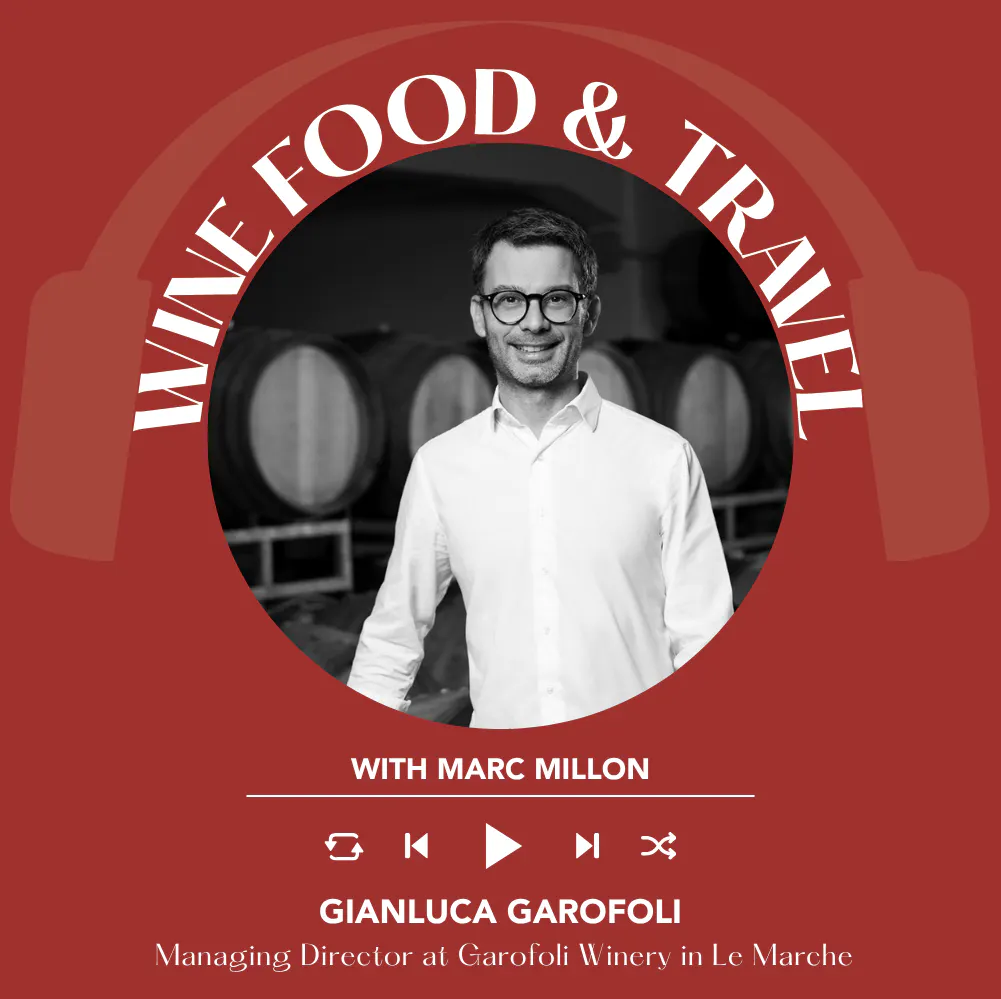
Ep. 2767 Le Marche: Verdicchio and the Wines that Shape the Region with Gianluca Garofoli of Garofoli Vini | Wine, Food & Travel with Marc Millon
Episode 2767

Ep. 2712 Exploring Brda: Exceptional Wines and Slovenia's Culinary Traditions with Lan Kristančič of Movia | Wine, Food & Travel with Marc Millon
Episode 2712

Ep. 2700 Sardinia Beyond the Coast: Agripunica, Basso Sulcis & the Legacy of Giacomo Tachis with Salvatore Santus | Wine, Food & Travel with Marc Millon
Episode 2700

Ep. 2624 Friuli Cuisine & 2 Michelin Stars: Inside Agli Amici with Emanuele & Michela Scarello | Wine, Food & Travel with Marc Millon
Episode 2624

Ep. 2618 From Mezzadria to Modern Sangiovese: The Castellare di Castellina Legacy with Alessandro Cellai | Wine, Food & Travel with Marc Millon
Episode 2618

Ep. 2605 Beneath Orvieto: Tufo Soils, Caves, and the Magic of Muffa Nobile with Enzo Barbi of Decugnano dei Barbi | Wine, Food & Travel with Marc Millon
Episode 2605