

Ep. 1692 Stevie Kim Interviews Marco Saladini & Dr. Craig De Blois | wine2wine Business Forum 2023
wine2wine Business Forum 2023
Episode Summary
Content Analysis Key Themes and Main Ideas 1. Analysis of the Canadian alcoholic beverages and wine market, including consumption trends and consumer preferences. 2. The unique and complex monopoly-driven distribution system for alcohol in Canadian provinces. 3. Challenges and opportunities for Italian wine producers seeking to enter or expand in the Canadian market. 4. The critical role of sales agents/importers in navigating the Canadian wine market. 5. Effective marketing strategies for Italian wines in Canada, including the importance of engagement and direct participation. Summary This episode of the Italian Wine Podcast features a discussion with Marco Saladini, Italian Trade Agency Commissioner for Canada, and Craig De Blois, a prominent wine importer and president of Noble Estates. Recorded as part of the Wine to Wine Business Forum series, the conversation delves into the intricacies of the Canadian wine market. Marco provides a comprehensive overview of the market's structure, highlighting the dominance of provincial liquor control boards, shifting consumer preferences away from beer towards spirits and RTDs, and the growing trends of non-alcoholic and organic wines. Craig, speaking from an importer's perspective, emphasizes the challenges and necessities of working within this monopolized system, particularly the crucial role of finding the right sales agent. Both speakers offer practical advice for Italian producers, underscoring the importance of understanding provincial regulations, building strong relationships, and engaging directly with the market through events and educational initiatives. Takeaways * The Canadian alcohol market is evolving, with declining beer consumption and a rise in spirits, RTDs, and non-alcoholic options. * Provincial liquor control boards hold monopolies on importation and distribution, making Canada a complex market to navigate. * Choosing the right sales agent is crucial for Italian producers due to agents' expertise and relationships with provincial monopolies. * Ontario and Quebec are the largest wine markets in Canada, with Italy being a top imported wine category in both. * Canadian consumers show increasing interest in organic/natural and non-alcoholic wines, particularly among younger demographics. * Direct engagement, participation in trade events, and consumer education are vital marketing strategies for Italian producers. * Italian winemakers distinguish themselves by their willingness to travel and engage directly with the Canadian market. Notable Quotes * ""The alcoholic beverages market in Canada is a changing. And the change is driven by evolving consumer preferences that are steering away from beer in favor of other options, such as spirits and, ready to drink or RTD beverages."" - Marco Saladini * ""In Canada, the agent represents and promotes a brand towards provincial monopolies, handling sales channels and executing marketing strategies."" - Marco Saladini * ""It's hugely important to find a great agent because, you know, they're they're all types working here."" - Craig De Blois * ""The great thing about Italian wine producers is they travel. We see more Italians in Canada than any other wine producing nation, which really I think is a huge advantage..."" - Craig De Blois * ""Italy, you know, they're coming here every year and and they're bringing our top some l a's and wine media to Italy every year to engage. I think Italy is really the benchmark. I think for me in terms of managing a country's line industry."" - Craig De Blois Related Topics or Follow-up Questions 1. What are the specific legal and logistical details Italian producers need to know when selecting an agent in Canada? 2. How do the major provincial monopolies (LCBO, SAQ, AGLC, BCLDB) differ in their listing processes and marketing promotion opportunities for international wines? 3. Given the rise of non-alcoholic wines and RTDs, what are the long-term implications for traditional wine sales in Canada? 4. Beyond trade shows, what other specific digital or online marketing strategies are most effective for Italian wines targeting Canadian consumers? 5. How has the consolidation trend among wine importers and agencies in Canada impacted opportunities for smaller, niche Italian producers?
About This Episode
The Italian wine podcast is a community-driven platform for Italian winegeeks around the world, with the hosts discussing the importance of international markets and the shift in consumer preferences towards beer. The alcoholic and nonalcoholic wines in Canada are declining, with the need for sales agents to choose the right ones and the challenges of finding the right sales agents and the need for the right sales agents to handle the sales channels. The wines and alcoholic beverages in Canada are experiencing growth, with younger consumers being interested in alternative formats and styles and a growing online industry for consumers to buy premium wine online. The industry is also seeing a shift towards online retail, with the need for the right sales agents and the importance of participating in annual wine trading events.
Transcript
The Italian wine podcast is the community driven platform for Italian winegeeks around the world. Support the show by donating at italian wine podcast dot com. Donate five or more Euros, and we'll send you a copy of our latest book, my Italian Great Geek journal. Absolutely free. To get your free copy of my Italian GreatGeek journal, click support us at italian wine podcast dot com, or wherever you get your pots. White to wine business form is a training and networking event for anyone involved in the wine business held in Verona on November thirteenth and fourteenth. This year, the forum will involve over ninety international speakers in over fifty sessions, On topics ranging from marketing and communication, sustainability, strategy, new market trends, and market focus. In collaboration with the Italian trade agency, a number of market focused sessions will be broadcast in a podcast series on the Italian wine podcast, a media partner of the wine to wine business form. Hello. My name is DB Kim, and welcome to the Italian wine podcast. This is actually a special series. It's part of a special series from the wine to wine business forum, which actually took place already on the thirteenth and fourteenth of November just a few weeks ago. I don't know when this episode will be airing. And the purpose is to focus on key international markets for a Italian line. Today, the focus is on Canada and our special guest. We have two special guests, two interviewees, Mr. Marco Saladini. He's the Italian trade agency Commissioner for Canada, which I believe includes Toronto, Montreal, and Vancouver. And then with him, we have also Craig de blois. How do you pronounce that name? Your last name? Yeah. That's pretty good. De blois. Okay. I didn't want to butcher your name straight away. And Craig is Antining Porter and president of Noble Estates, wine, and spurs, and we'll find out what that is all about. So I'm just going to go straight in to the talk today, Marco. Cha Marco. Good job. No. Charles, TV. How are you? Hi, Marco. Would you like to tell us a little bit about yourself, just a brief overview, where have you been? I know you've been a devotee of Italian trade agency. Yes. Well, I started with the agency in nineteen ninety two. I was posted in Rome for the longest time at the Economics Studies Office and then I managed to finally go overseas and served at the World Bank and then in Vietnam, and then I returned to Roman again out to Chicago and finally, Toronto. So that's in short my career. I have a wife and two wonderful children, and we go around the world. Okay, stop. I don't wanna have in more information. Okay. Alright, Marco. So you are very, very much the man we were looking for today. And, of course, Craig De Blois, whining porter. Craig, tell us a little bit about yourself. My background, I played professional ice hockey. Spent eight years in international banking before finding my passion and love for wine, and I've been in the wine industry now for twenty years. And, have owned a great agency called Noble States for the last ten years. What we're going to do is run this session, like, as if it were wine to wine. Have you ever been Craig? I have not. I travel to in Italy every year. Yeah. So I hope to get you some time in the future, foreseeable future. And what we do is we lay out before we start the session, the learning objectives of the session. They usually last around half an hour. And our learning objectives today is, of course, the introduction to the local wine industry in Canada. It is, of course, with monopolies, importers, and distribution channels. So we want to understand the each role of these important players. The marketing strategies for Italian produced if we can, of course, we don't have enough time to do a deep dive, but just kind of the overview. And what the future trends are? That is kind of the layout today because Canada, of course, is It is complicated in terms of alcohol, distribution, import system because everyone just think, yes, Canada equals monopoly, but it's not as easy and simplistic as that. I suppose. So let's dive right into it. Marco, why don't we start with you first? Would you like to give us a skinny overview of the wine market? Perhaps, you know, give us a little bit about the demographics and what your perspective is in terms of consumer preferences. Sure. Well, let's start saying that the alcoholic beverages market in Canada is a changing. And the change is driven by evolving consumer preferences that are steering away from beer in favor of other options, such as spirits and, ready to drink or RTD beverages. And in addition to this, the shifting preferences, there is an overall decrease in alcohol consumption, a trend that is particularly prominent among, younger consumers and mirrors similar patterns seen globally. Now consumers' behavior, beer is the beverage choice for most Canadians accounting for a thirty five percent share of the total alcoholic beverages market. But like in other markets, its importance is diminishing. Its share of the market has slipped ten percent since two thousand ten. So ten percentage points. Sales volume of beer. That's beer. Yeah. That's beer. And, it declined since twenty sixteen also in sales volume. Now the wine market, whose share of the alcoholic beverages market remained largely unchanged in this period. It's dominated by red wine. And sales there are four point three billion Canadian dollars or CAD. When you hear me say CAD, that means funny Canadian dollars, which is about one point five CAD to one euro. So that was two thousand twenty two while white wine raked two point seven billion CAD, and spirits and RTD alcoholic beverages filled the void left by beer. And, now they account twenty six and eight percent of the market. Respectively with RTD's experience a very particularly very fast increase. On the demand side, the Canadians decrease overall consumption of alcoholic beverages again in two thousand twenty two. And consumption stood at ninety seven point five liters per capita, which is not small, I'd say. And this represent a reduction of nine percent though since two thousand eight. And generation z Canadians where the most likely to say that they were reducing their alcohol consumption in two thousand twenty three beer in particular drastically decreased. Now our last trend is non alcoholic wines that continue to show strong performance in two thousand twenty three as health consciousness rises among consumers nationwide and producers also recognize this as a new opportunity and have intensified their efforts, particularly in the launch of new and innovative products. When you say no alcohol, is that does that include low alcohol? No. This is just non alcoholic points. Okay. Oh, boy. I don't know if I should be happy or depressed. So why don't you give us an overview? Of course, the different markets in terms of the system, the infrastructure system of importation, regarding the regulations, the different rules to the different regions. Which is the most important, which is the most significant region? Ontario. Ontario. Okay. Let's start that. The marketing of wines and alcoholic beverages in Canada is in the hands of, liquid control boards, as we all know. And they hold the monopoly on importation and distribution in every province except Alberta. They are entirely independent, which is why the procedures and measures, they adopt vary from province to province. How many province just to put everybody on the same page? I reckon that there are ten provinces in Canada and eleven territories if I'm not wrong. Craig, can you jump in? I haven't taken high school geography for for a long time, but that sounds about right. Okay. So, yeah. I mean, in Alberta, that was the only province where a trade and distribution were liberalized since nineteen ninety three, but importation is still controlled. And so what happens is the monopolies purchase wines and spirits, including in their sales repertoire, which is also called listing, and take care of storage and physical distribution of products. Now the only exception to that is British Columbia where the monopolistic entity requires that importation and storage be carried out by the agent who also bears the burden of warehouse expenses. So you could see that there are several differences and one should be aware of those. So what would be Marco, the challenges and opportunities with these kind of arduous importation, liquor board rules as if you will, especially for the Italian wine producers into Canada? There are many. But I would like to focus on, one crucial factor, which is choosing the right sales agents, and, Craig then might confirm or not by considerations. In Canada, the agent represents and promotes a brand towards provincial monopolies, handling sales channels and executing marketing strategies. So sales agents with their expertise and established relationships can open doors navigating different channels. To choose the right agency, the producer, the Italian producer should set distribution and sales goals first and then try to match them with agencies that align. And there are also other factors like, agency size, ethics, a plan to represent once brand by the agent, geography, portfolio of the agent. And, of course, larger agencies may be suitable for established wineries, while smaller ones might want to bet or focus on growing brands. Collaboration between winery and agent, so it's vital, especially for new entrants. And the winery should provide comprehensive information about vineyards and, winemaking process. Because stories need to be told, and products need to be characterized and contextualized. Agencies on their side, the sick partners who collaborate on three main grounds sales team education, as as we just mentioned, customer interaction and marketing support or funds for for promotion. So here we come, the cost of doing business with an agent is, of course, a deciding factor. And the winery will have to design a budget covering distribution. Sales commission, marketing, and advertising expenses based on their desired volume. So warehouse fees, shipping, fuel surcharge, in store programs, our other elements to be taken into account when budgeting for this. So the combination of all these factors leads a winery towards a specific agent that will possibly fill their borders. Sooner of it later. Yeah. What are the future trends in your opinion, Marco? Well, we can see that the number of people that are purchasing organic or natural wines is growing rapidly. And indeed, twice as many people, bought organic wine in two thousand twenty one as compared to two thousand nineteen. So that's a big growth. Now generation z, is also at the forefront of this trend, because almost one in four of this age group, purchase organic or natural wine in the last twelve months. Some other things about younger consumer. One is that they're open to alternative formats, especially cans, and single serving bottles which are both suitable for their lifestyle. And the fact that twelve percent of them also purchased non alcoholic wine in the same period. So last twelve months suggest that these areas, although niche represent an opportunity. RTD, again, make for a particular threat to wine in the future, given that the high preference, attributed to those by by generation z. And, finally, even though wine prices are rising, consumers seem to remain loyal. So premium segments above fourteen cads represent a quarter of all sales, and the costs shift towards higher price points, which happened in the past, is expected to continue, even though Canadians now admit to buying slightly less often and seeking deals when they can. All line retail is another point I want to touch upon. This is more vibrant than in the past and is coupled with the willingness to innovate, promote different formats and styles. And it could contribute to achieving, what seems to be one of the key goals of the Canadian wine world. Attracting and retaining young people. So millennial generation z consumers, and for Italians, investing on the digital sales channels could be a good idea. Are you enjoying this podcast? There's so much more high quality wine content available from mama jumbo shrimp. Check out our new wine study maps. Our books on Italian wine including Italian wine unplugged, the jumbo shrimp guy to Italian wine, Sanjay, Lambrusco, and other stories, and much much more. On our website, mama jumbo shrimp dot com. Now back to the show. So, Marco, what are the main commercial distribution channels in Canada? How can you sum that up? Let's say that, alcoholic beverages reach the Canadian consumer, through retail outlets, mostly managed or authorized by the monopolies, then restaurants in Quebec and Ontario only just, I mean, for taking them away or personal importation. And wine clubs and restaurants, purchase alcoholic beverages, both at retail outlets and directly from the producer through the so called private importation. In this case, with limits on quantities, but without restrictions on the choice of product. So they don't have to go by the listing of the monopolies. They can import whatever they want. The monopolies, by directly from the producer, even though the agent is the preferred intermediary for the mono poly in dealing with the producer. So they all not always mostly deal with producer through agents. And the federal law, indeed, grants exclusive right to import alcoholic beverages into Canada to the monopolies, and no one else can introduce large quantities of alcoholic beverages except them. This explains why the figure of the monopoly in the distribution chain is a central one in all provinces, and even those where the marketing has been privatized. Now in terms of, who sells, I mean, retail dominates the beverage landscape since almost ninety percent of all sales are in store with, state stores as the most used channel. And there are signs though of a still emerging online industry seeing how eighteen percent of regular wine drinkers have purchased wine online in the last six months with a four percent increase from the previous year. Now we could take a look at the main provincial monopolies, seeing how much they sell, and, you know, what's their positioning in the in landscape? Like, for instance, LCBO, the liquid control board of Ontario, with a population of fifteen point four million reported at thousand twenty two revenue of seven three point billion CAD increase of two point two percent from the previous year. And the wine actually declined three point eight percent in sales, but stayed the second largest category with twenty two point one percent of sales and one point six billion CAD of sales. Vintages, though, which are premium wines, they grew in sales by eight point two percent and so rose to ten point one percent of a LCBO, the Monopoly annual sales. The Monopoly has six hundred seventy seven branches, stores, an e commerce platform, and offers fifteen thousand seven hundred products from eighty two countries. One thing that is that's funny to know is that, they want limit the weight of bottles, class wine bottles that are sold for fifteen a cat or or lower. They should be light just for environmental reasons. So we moved to SAC. The socitas are called the Quebec. It's the Monopoly in the French speaking province of Quebec, which has eight point eight million inhabitants. They reported a five percent increase in revenue in two thousand twenty two, and they sold four billion CAD worth of alcoholics, alcohol beverages in two thousand twenty two. And wine sales were standing at sixty eight percent of total sales. So quite a large proportion, reaching two point seven billion CAD with a three point three percent increase in value and a slight decrease in, in volume. The SAC has eight hundred thirty seven outlets and, very diversified product range and services that delivered throughout Quebec of with orders placed online. And they offer fifteen thousand nine hundred products from seventy six countries. A curiosity there is that, in line with the habits, which is, popular in the French speaking province of having a glass of wine with meals at one's home, Quebec allows the sale of non premium wine So lower quality wines, I mean, in grocery stores, you can get your groceries and wine when you go to the supermarket. Then we move to Alberta. The AGLC controls alcoholic beverages, in that province. Which is home to four point five million people, and they manage licenses and a revenue collection. While as we said, private enterprises handle all the other aspects of our call marketing. So the government markup is based on alcohol content and the private liquor stores are the only urban alcohol retailers. There were two thousand four hundred private alcohol specialized stores in Alberta in two thousand twenty two, and they sold two point seven billion CAD with the wine contributing approximately by the tune of zero point six billion, which is smaller proportion than in other provinces. On the other hand, Alberta had thirty thousand different alcoholic products in two thousand twenty two, which included fourteen thousand seven hundred wines. And last but not least, British Columbia, which, has its BC LDB liquid distribution branch, which is responsible for alcoholic beverage distribution, importation and marketing in a province populated by five point thirty two million inhabitants. They hit a revenue in two thousand twenty two of three point nine billion cards, including a thirty three percent share from wines between Alberta and the Eastern provinces, which, although decreased in quantity by three percent. As compared to twenty one. And they have hundred and ninety eight stores, two distribution centers. And, also, in the in the province, there are seven hundred seventy private stores, so not run by the monopoly. Two hundred twenty one rural agencies, two hundred seventy privately owned wineries that sell on-site. So it's this wine growing and wine making is big in the British Columbia, and twelve independent wine stores. Creosities that, since two thousand fifteen, the local wine sales in supermarkets were authorized. And previously, there had been also a store within store model for imported wines. So that completes my tour of Canada. Marco, is there a kind of a document or something that we can share with our audience, like an overview? The companies can write to us and we will provide it to them. Yes. Definitely. Okay. Alright. So they can write to you. Let me bring on Craig, Mr. Craig De Bloife, he's still awake. I'm here. How long did you go? Alright. Craig, Listen. How long have you been a wine importer? I've been, twenty years now. This is actually just past my twentieth anniversary. And where are you based? So I'm based in Toronto. I own an agency in Ontario called Noble Estates. And I also own an agency in Quebec called Noble Solutions. So, as Marco alluded to, the two greatest provinces for wine in Canada at the risk of angering my friends in in western Canada in the merit. Yes. So you have two different agencies. Servicing two different provinces. Is that correct? Exactly. Okay. And can you kind of contextualize your wine importing business? First of all, how many importers are there? Or give or take? Many, many importers. I think in Ontario, there are over four hundred registered importers. You kind of alluded it to it earlier. There are are many different types of importers. We have big national agencies and then we have provincial agencies. So each market, each province is so different. The rules and regulations that, you know, we obviously, support and encourage the provincial model. I think, you know, with a big national agent as you can get lost in the shuffle a little bit. Because it's so difficult to navigate, right, in a way. It seems simple, monopoly, but in a way, it is quite difficult and complicated. It is. And that's our job. Right. You know, that the agent is here to guide you through the rules and regulations of the LCBO, the FAQ, whether it's labeling, or or just, you know, sales strategy. What is your portfolio look like in terms of your supplier base? So half of of our business is Italian. If you think about it, Italy Mhmm. Is number two in Ontario, behind California in terms of imported wines. It's also number two in Quebec. A very close second to French wines imported into Quebec. Yeah. I mean, our portfolio, we cover we cover Italy. We have number one prosseco with Botega. Number one, Amaroni with Tadeski, wine of the year for wine spectator from Argiano. So are you distributing also the maze Row wines? The Gallo brands distribution? They're distributed by Gallo, I believe. Right? Not in Canada. Uh-huh. Okay. Certainly most Italians like to carve off Italy and really don't group it as North America. I mean, yeah, Canada is a very different market from the US. I see. I suppose you can give us kind of the nuts and bolts of some operational useful tips into entering the market if you were an Italian wine producer. Yeah. I mean, I I think at this point, you're quite late entering the market. I mean, it's Italy has been a huge category in Canada for many years and most agents I would say have have a a pretty strong portfolio of Italian wines because it is such an important category. And the great thing about Italian wine producers is they travel. We see more Italians in Canada than any other wine producing nation, which really I think is a huge advantage and, you know, the Italians know the Canadian market. If you're looking to enter the market, I mean, there's still some great agents that are just starting or are kind of up and coming agents. And those are, I mean, that's something that, Marco and his team can help find those hidden gems, but it's hugely important to find a great agent because, you know, they're they're all types working here. I suppose, you know, as an Italian wine producer, you said it's too late to enter Canadian market in a way because everyone has a solid portfolio. Right? But are most than wine importers, are they Are they pruning their portfolio or are they still looking for, new Italian wine produces? It depends on the agent. I mean, for us, you know, we have a a really solid portfolio. I mean, if there's something interesting and really sexy, the comes along, then then we're always open to the conversation. But now I would say we're not really out actively looking to grow our portfolio. And I think that's probably the case for a lot of, a lot of agents here. It's very similar to the US. I see a post. Well, yeah. And we are seeing a bit of consolidation and it does make it harder to find a portfolio. You know, our strategy really is to find the best from each region. There are regions like Barolo and Bernelo and Amarroni where we have more than one producer from those areas. But generally, we try to keep it tight and focused and have one champion. So I suppose you're very close to the market. So what are your latest perceptions with regards to Canadian consumer preferences with regards to Italian wine specifically. Marco mentioned the interest, global interest, really, and ready to drink and white claw. And that doesn't worry me so much. If that's sad me to know when I have to tell you. Yeah. It's well, it tastes like cardboard. And I think people are just looking for a cheap buzz with low calories, but but I I am confident that it's a stepping stone. And the hope is that these consumers will graduate to Italian wine, you know, something with with a story with quality with, you know, a family behind it. We are a little concerned about the reduction in consumption, but that comes and goes. Look, Italy, in Canada that, you know, we have a huge x pack community of Italians that have immigrated here over the last seventy years and they love Italian wines. We also have some of the greatest Italian restaurants in the world are passionately great ambassadors for Italian wine. So, and many Canadians travel to Italy. There's an aspirational quality to Italy, and the rich history and culture is something that And the Dolcevita. Right? I mean, everybody. Exactly. So I think Canadians, you know, we're a cool climate here. Marco mentioned that red wine is dominant. We're seeing a shift away from that. It's freezing here in Toronto today and, you know, I probably will have a nice bottle of borolo tonight, but we're seeing a lot of interest in Italian whites and pecorino Vurdicchio of Vermontino. I mean, these wines are becoming a little more mainstream where historically it was kind of the real experts that understood the quality and and great wines that were coming. So I think, you know, we're seeing white. Prosecco's been so dominant here in Canada and continues to do well. Yeah. It's nice to see Italian wine lovers being more open to experimenting with maybe wines that aren't necessarily guarantee or or or tuscan and looking at other regions like maybe Calabrio or Sicily. I mean, Sicily is is really booming here, like, in many markets. But is Piamonte still kind of the sexiest drive or rather Piamonte Aetna of the situation is is that still the case? Because a few years ago, that seemed like everybody's go to sexy Italian wine. Yeah. Yeah. For sure. Look, there is, as barolo prices are increasing, It's nice to see that right Nebulaolos are being purchased and and there is a customer shift whereas, you know, ten years ago, it was hard to sell. You know, a nice long in Nebula. But, you know, Italy produces amazing wine at every price point. And offers great quality at every price point. And that that's, you know, I think a big part of Italy's success. As I said, you know, the Italians come to Toronto. They come to Montreal. And just one, like, you know, question because you know, I work with one spectator. And Arjona, you really got lucky, dude. Right? So you got number one wine. And what happens to a brand like that? Well, they're they're great ambassadors, and they engage with the LCBO buyers. They engage with the LCBO product consultants who are are the frontline experts of the LCBO and they engage with our team. And I think, you know, engagement is a huge reason for Italy success and they do it better than any other country. Just as an example, I would in in Bordeaux in September with two of Canada's best wine writers, and neither of them had been there in twenty years. And it just shows how, I mean, we need a little more from Bordeaux, but Italy, you know, they're coming here every year and and they're bringing our top some l a's and wine media to Italy every year to engage. I think Italy is really the benchmark. I think for me in terms of managing a country's line industry. Okay. I suppose that dovetails right nicely into my last question also because Elena booked me another call at four PM, which is in about twelve minutes. So back to Marco, I know, well, you spoke a little bit about some of the advice that you have with regards to, you know, focusing on the education side, but what are the other marketing strategies for Italian producers to create greater awareness? Of Italian wine, in your opinion. Craig just mentioned one, which is participating with us to our annual wine trading tasting across Canada with us. When does that happen? What are the dates? It happens in, late October early November. And there is a a big, let's say, attention by the producers to when the opportunity to sign up comes. So don't miss that on our website. But, of course, also try to participate in the yearly promotions, with the provincial model policy, organize quarterly tasting via your agent, with the on premise outlets, like restaurants, bars, hotels, work online to promote e commerce sales or in general awareness of your, product and try to educate the consumer and the professionals working with the Canadian, some of the years that are reputable and have a following. Now the good news is that, the ITA data entry agency, which I manage, can help Italian producers and other relevant stakeholders with all of these marketing strategies at lower no cost. So just contact our fantastic wine team, which spans all across Canada riding to Toronto at h a I c e dot I t. Yeah. I think that was a good plug there, Marco. Especially the bit about low to no cost. Do you like that? Yeah. Yes. I think that's good. Good stuff, Marco. Sure. Yeah. We're going to wrap it up now. But, Craig, where can people find you? How do they get in touch with you if they'd like to reach out to you? Yeah. Well, we're, Noble of states, craig d at nobelistates dot com, and always happy to, answer questions and speak with our friends in Italy. Are you doing any social media in conjunction also with your suppliers? We're quite aggressive with our social media. I think it's really important to be a full service agency. So that's We have a team selling to the LCBO stores. We have a team that sells to restaurants through the LCBO's consignment program, and then we also engage quite aggressively with wine media, Psalms, and promote through social media and event. Thank you so much, gentlemen, for joining us today on Italian wine podcast. That was Marco Saladini Italian Trade Commissioner for Canada, and, of course, Craig the wine importer in two provinces. Thanks again for joining us and hope to catch you on the rebound on our next episode. Ciao, Steve. Take care. Thank you. Oh. Thank you for joining us on another installment of on the road edition hosted by Stev Kim. Join her again next week for more interesting content in the Italian wine scene. You can also find us at Italian wine podcast dot com. Wherever you get your pods, you can also check out our YouTube channel, mama jumbo shrimp to watch these interviews and the footage captured of each location.
Episode Details
Keywords
Related Episodes

Ep. 2145 The influencer marketing playbook | wine2wine Business Forum 2023
Episode 2145

Ep. 2138 What you need to know before approaching the US Wine Market | wine2wine Business Forum 2023
Episode 2138
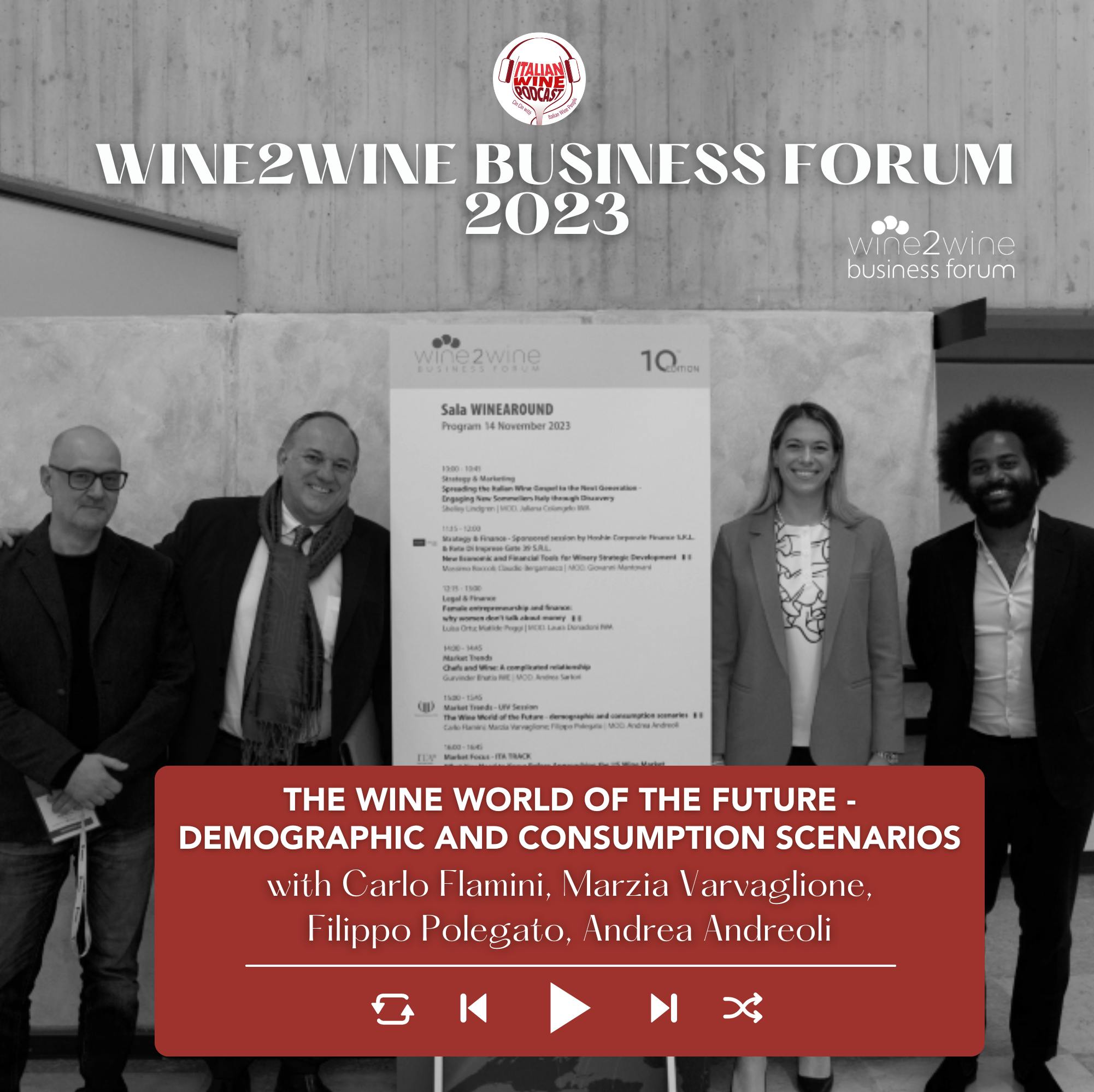
Ep. 2131 The Wine World of the Future - demographic and consumption scenarios | wine2wine Business Forum 2023
Episode 2131

Ep. 2123 Chefs and Wine with Gurvinder Bhatia and Gino Colangelo | wine2wine Business Forum 2023
Episode 2123

Ep. 2115 Why women don't talk about money with Luisa Ortu, Matilde Poggi, Laura Donadoni | wine2wine Business Forum 2023
Episode 2115

Ep. 2106 Massimo Boccoli, Claudio Bergamasco, Giovanni Mantovani | wine2wine Business Forum 2023
Episode 2106