
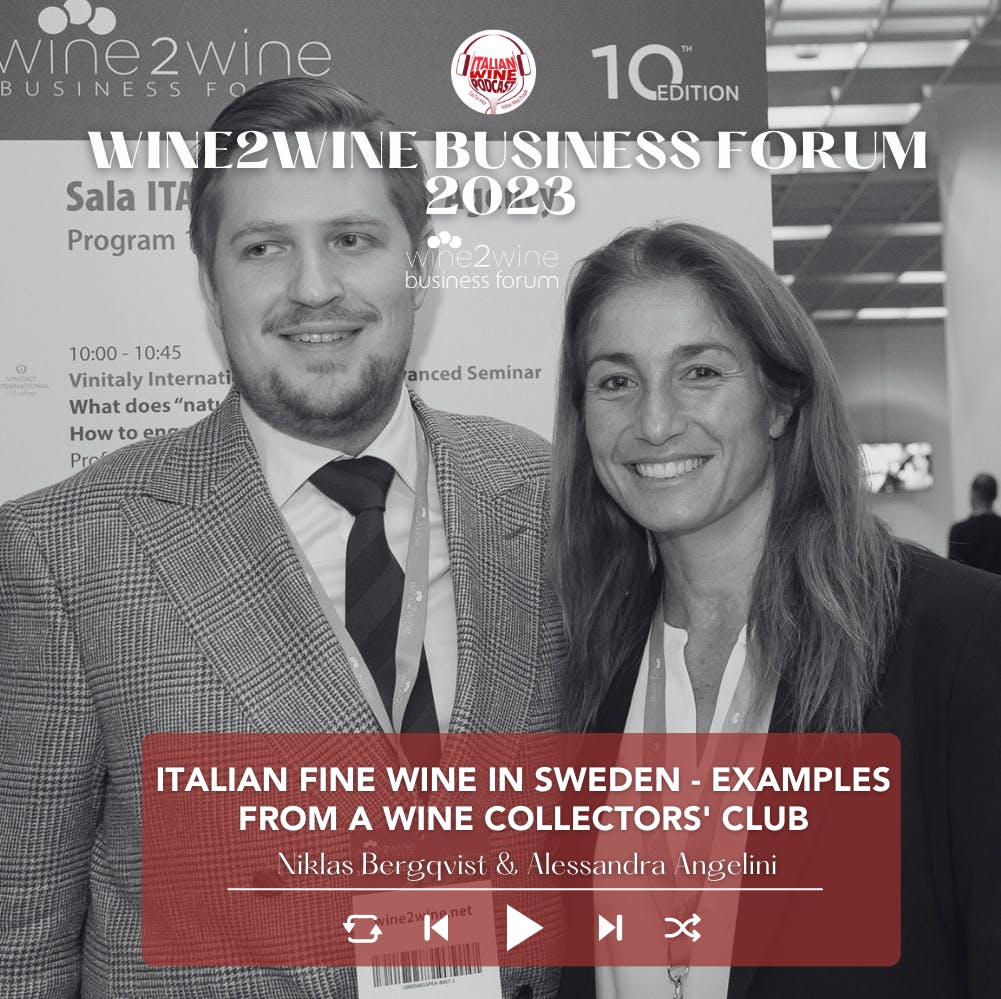
Ep. 1791 Italian Fine Wine In Sweden | wine2wine Business Forum 2023
wine2wine Business Forum 2023
Episode Summary
Content Analysis Key Themes and Main Ideas 1. The unique structure and operations of Vinchelangrapp, a members-only wine storage and club service in Sweden. 2. The impact of Sweden's state alcohol monopoly (Systembolaget) on wine sales and consumer acquisition. 3. Analysis of wine collection trends in Sweden, showing the historical dominance of French wines and the increasing interest in Italian wines. 4. Specific Italian wine regions and DOCs gaining popularity among Swedish collectors (Barolo, Barbaresco, Brunello, Sassicaia). 5. The role of wine education and community events in fostering wine culture in Sweden. 6. The evolving landscape of wine acquisition, including increasing online purchasing from outside Sweden. Summary In this episode, Nicholas from Vinchelangrapp, a prominent wine storage and club service in Stockholm, provides an insightful overview of Sweden's unique wine market. Founded in 1986, Vinchelangrapp serves nearly 900 members (both private and corporate) by offering secure wine storage, a club room for tastings and events, and expert sommelier services. Due to Sweden's strict state monopoly (Systembolaget), Vinchelangrapp does not sell wine, focusing instead on inspiring members and facilitating their enjoyment of their stored collections. Nicholas shares detailed statistics on the composition of their members' wine cellars, revealing that while French wines (especially Bordeaux and Burgundy) historically dominate and still hold the largest share, Italian wines have significantly grown in popularity. He notes a strong increase in demand for Italian classics like Barolo, Barbaresco, Brunello di Montalcino, and Sassicaia, even as ""Super Tuscan"" IGTs maintain value. The discussion also covers the various channels through which members acquire wines, highlighting the challenges posed by the monopoly's allocation system and the growing trend of cross-border online wine purchases, a practice recently affirmed by EU law. Takeaways * Vinchelangrapp is a long-standing, non-retail wine storage and club service in Sweden, offering a unique model due to the country's alcohol monopoly. * Sweden's Systembolaget strictly controls the sale of alcohol for off-premise consumption. * Despite the historical dominance of French wines, Italian wines are rapidly gaining market share and interest among Swedish collectors. * Key Italian wine regions performing strongly include Piedmont (Barolo, Barbaresco) and Tuscany (Brunello, Sassicaia). * Swedish wine consumers, particularly collectors, are highly engaged in wine education and community events. * Cross-border online wine sales are an increasingly important, and recently legally affirmed, acquisition channel for Swedish consumers. * The value of Burgundy wines in Swedish collections significantly outweighs their volume. Notable Quotes * ""The reason that we don't sell any wine is, of course, the simple fact that in Sweden, the monopoly, Sustien Bologuet are the only ones that are allowed to sell wine for off premise consumption."
About This Episode
The speakers discuss the success of their Italian wine production and their use of their club room for private dinner and promotions. They also discuss the evolution of the wine industry and the impact of new members on the industry. They touch on the importance of wines for indigenous groups and the value of wines for Swedish members, with a focus on the monopoly Sustainbologgi and the ability to buy wine straight from importers. The license for Italian wine certification is pending, but people are more likely to buy wines from outside of Sweden's borders. They suggest viewers to donate through Italian wine podcast dot com.
Transcript
The Italian wine podcast is the community driven platform for Italian winegeeks around the world. Support the show by donating at italian wine podcast dot com. Donate five or more Euros, and we'll send you a copy of our latest book, my Italian Great Geek journal. Absolutely free. To get your free copy of my Italian GreatGeek journal, click support us at Italian One podcast dot com, or wherever you get your pods. Official media partner, the Italian One podcast is delighted to present a series of interviews and highlights from the twenty twenty three one to one business form, featuring Italian wine producers and bringing together some of the most influential voices in the sector to discuss the hottest top fix facing the industry today. Don't forget to tune in every Thursday at three pm or visit the Italian wine podcast dot com for more information. Hello, everyone. Thank you for being here, and I'm happy happy to be here today and to talk about Sweden, which is a country. I've come to love over the years and to know over the years, even traveling all over not only for the wine, but I'm happy to introduce Nicholas, which is a very talented, young Swedish, and he's grown up to be a wine educator. You started as a sum if I don't go wrong. And now w set, and now you're studying for the final step, and you're almost at the final stages of the master of wine. So he's dedicated your life to educating and wine. You're an Italian wine expert. So you're taking you're bringing Italy to Sweden, and you're gonna tell us a bit about the fine wines in Sweden and talking about what you do and and I'll leave you the word. I'm happy to hear. Thank you, Alezandra. And, I'm especially happy about the young part. But I think me and Alezandra, we are the the same vintage, and I was traveling in Kianti Classic in the beginning of this week. And I met a few wines that were all, labeled as being that were actually younger than me, which I felt that it didn't make me feel young. But welcome, everyone. And what I would like to do now is that I would like to start out with making a presentation of, and what we do. And after that initial, presentation, I we will have a look at the collections as they are now, the wines that we are storing for our members. And afterwards, we are going to have a look at the different channels that our members use to acquire their wines. So going to the basics here, we are located in Stockholm in Sweden, a very central part of the town. And, Vinchelangrapp, it was founded by my boss in nineteen eighty six. So we have been around for a long time. Currently, we have about just below nine hundred members, and these members are the ones that are registered. So each member is registered to a compartment in which to store the wines and is also allowed to have a co member which means that in reality, we have more like sixteen, seven hundred members. And all these members about seventy five percent are private members. So wine lovers of different kind that want to store the wines with us for their own consumption, but twenty five percent are corporate members. Some of which are banks, etcetera, that use us as a place for having different kinds of meetings and representation and things like that, but also wine importers that use us as a venue for promoting their producers and wines. So the main thing that we are focusing on is wine storage. And we store wines both by the bottle. So the picture that you can see on the left is basically how our sellers are built. We have a little bit more than six hundred square meters of sellers and nine fifty different compartments. So some are just for thirty, forty bottles of wine, some are for four hundred bottles of wine. But then we also have a very big venue down in the Stockholm Free Harbor will restore wines by the case as well. And all of these wines, it's up to the most of the members to do this by themselves, but they can be locked into a database so that you can easily track your own collections and see you can sort these lists on the origin of the wine, the value of the wine, and also see our recommendations for when to drink the wines, etcetera. And this database is also linked to live so that for wines that have a secondhand value in the wine market, you also get regular updates on how these wines perform. To the right, you can see a picture of what is our club room. So even if storing our members wine is sort of the the main idea behind what we do, my boss always had the idea that he wanted to spread the wine culture and making people enjoy wine as much as he did. Back in nineteen eighty six, wine consumption was still fairly rare in Sweden. It was not we are naturally more into spirits and beer that we can produce by ourselves. And by having a club room, he felt that it would be a good way of promoting knowledge about wine and always having some leaders working there that can take care of the members and open their wines and answer questions about the wines. And many of our members prefer to drink the wines blind and as in tastings, and then we prefer everything for them. And at the moment, we have at least four samliers in the company just to take care of this. And apart from the club room and the storage of the wines, we also have that we use for different things. So one of them is a bigger hole where you can seat about fifty people or have a tasting for a hundred people in in a walkaround fashion. And we also have a smaller room that where you can seat up to fifteen people. And these are in one part used for the members, as a way of if they want to have a private dinner or celebrate a birthday or something like that. But we also use them as a way of inspiring the the members to buy more wines. Yeah. That's, of course, important for us. So we hold a lot of tastings at very different levels. Sometimes it's, especially on Saturdays, we have, like, a one, one and a half hour tasting. That's usually pretty basic. It might be everything from how you taste wine in a sort of structured way. To the most typical white grapes of the world or red grapes of the world, but also more specialized things. And also a lot of more specific master classes and some of our members are very, very knowledgeable and very interested in in buying at a much deeper level too. And some of them are also interested in more formal wine education. So we have also been doing over the years, some collaborations with, some of their school in which I also teach. And doing wine courses or WSTT level two and level three. And I think we have probably had something like two hundred students passing through that system too. And the bigger hallway, we also use for dinners So inviting Michelin Star chefs or other famous chefs to come to our place and cook a tasting menu for which the members can open their own wines and enjoy them. And then, of course, we do winemakers dinners and such things too. So when am I coming to Sweden? We I'm sure that we can find a suitable date. So I think the thing that's a little bit special about us as if you compare to other countries is the fact that we don't sell any wine at all. And the reason that we don't sell any wine is, of course, the simple fact that in Sweden, the monopoly, Sustien Bologuet are the only ones that are allowed to sell wine for off premise consumption. And it actually fascinates me a little bit that we have been around since nineteen eighty six without selling any wines because I think that in any other market, that would be sort of the most natural thing to make your your money out of. But We don't sell any wine. We can only inspire our members to buy wines. And if we look what we have in the sellers at the moment, we have about one hundred and thirty four thousand single bottles of wine registered, but we estimate this to be rather two hundred thousand bottles for the simple reasons that some people, when they become new members, they already have a pretty large collection, and it's already logged in to some other kind of database, and then they don't want to spend all the time registering the wines again. Then I have a picture. What is actually the first wine book that was released in in Sweden and then released my boss who is on the on the left here, Mr. Colion Grangqvist. And this book is from nineteen eighty five. And he wrote this first book and also had some TV shows at that time where he and his colleague, Nelkristian, they were opening very, very fine wines like Chateau and Chateau Leblanc, and they said in prime time, Swedish television tasting these wines and sort of describing them to one another. And I don't think that it's sold any bottles of either Osong or Chevron, but, people in Sweden, they at least got an impression of drink some wine. Yeah. Or got ideas about people that love wine at least. But I think that picture is kind of explaining if we're moving on to the next picture that we have here. It's, unfortunately, it's showing all the part of it at the same time. I would want you to see is sort of the evolution throughout the years. And if we start at two thousand ten, which is, of course, many years after the the seller was actually open, French wines were slightly less than seventy percent. So sixty seven point nine percent of all the wines that we stored for our members. Also, if you look at the second place, it's Italy with thirteen point nine percent of the wines and then Spain at four point three percent Portugal after that in USA. And as you can see, we're more or less in the same the most important countries are also the countries that are producing the most wines, but with a strong French dominance, And moving on to the numbers from twenty eighteen, we can see that even if France is retaining its top position, and still, I mean, a very, very big part of all the warrants, all of the other countries are slowly, slowly growing. And Italy most most of it. And also if we move on to twenty twenty three, we can see that this trend is something that definitely continues. And very little changes apart from Germany getting up to a fifth place there, but It's also true that if we would look at a sort of a top ten of these wines, all of the wines below place number five would be very close to one another. So if they can if we take snapshots of the collections at certain points throughout the year, then it's likely to be smaller changes even in a very short short while. And do you believe Portugal came off the list because sweet wines are going? Yeah, I absolutely think so. What I unfortunately don't have so much concrete numbers about this, I mean, the actual evolution because there is, of course, always members that they sell off part of their wines, and there are some members that, well, they're not interested in being with us anymore, and then we get new members. So there is even if the absolute numbers of wines would still be pretty much the same throughout the year. There will always be of a certain effect if if someone that is collecting a certain type of wine quits then, of course, it will have a major impact at least for a short while. But I think Germany has been growing very strongly in the last few years. I think it's a country that has been traditionally important for the Swedish market. And I think with what they're doing at the moment, a lot of people are interested buying those wines for aging. And, of course, these are just the numbers if we look at volume. And if we move on to have a look at the wines by value, instead, we can see that France, of course, is even more dominant. But we're still more or less with the same countries. I mean, the same order. Yeah. At least, still the second most important, even if it's not at as big a share of the total value as it is of the total volume. And I don't think that I have so much to add really at this point. But slowly, slowly, all of the other countries are gaining on France. But do you believe this change is happening because how the monopoly is changing. So there's more access to a lot of other wines, how the taste of people are changing. What's changing, and I noticed in Sweden is also the gastronomic Let's say environment has changed a lot. You have many more restaurants, many more high level restaurants coming up. So maybe there's more interest in wines from other countries that are not brands. To some extent, absolutely. And I think it's it's most of all curiosity and the fact that people are more interested in tasting new wines. And I think the average Swedish wine consumer is more most concerned about the finding a wine that they find nice and that they just want to drink without thinking too much about it, but we have a very large part of the population that are really into wine education and like to read a lot about wines and learn about wines and travel a lot. So I definitely think in Italy's case, one of the main reasons is why it's growing so much is that we spend a lot of time in Italy on average. If we have a little look on the regions instead, what we can see is that what we're coming from is a very traditional style wine cellar. If we would have moved back to the eighties, then most of the wines that would we would have stored would be border wines because that was what wine collections was most about then. And we have seen that over the years, for example, border is it is still the most important region by volume, but it's still it has a smaller share for each each year, whereas with Champagne, for example, in Burgundy, those are regions that are still growing very, very strongly. And as you can see, by volume, then afterwards Burgundy, we have Pemonte coming up afterwards. And then we have their own value. And after that, we have toscana. And quite different if if we have a look at the value instead, where we can see that burgundy, even if it's only the third most important by volume, it's by far the most important by value. And we can also see that p amount, even if it's the fourth most important region by value, it's only the sixth month by value. Yes. And I think one of the reasons for that is if you compare, for example, looking at the numbers of Piamonte and toscana, I think the main reason there is that toscana used to be the more important region of those two. And people, especially were very interested in different kinds of Bordeaux styled Supertuscans, whereas people are buying less of that now, but they are still very expensive wines, which means that you have they are important by value. Whereas Piamonte has kind of become a region where people like to buy wines for long aging and investment grade wines, but they also buy wines that are meant for more immediate consumption. So we would definitely find some Barbera wines and and so in the sellers also that are not meant really for aging or for investing, but people like to buy them and put them away for a year or two before they drink them. And if we're moving on to the next slide, then we have sort of the some information about a single origins within Italy. So the top ten regions by volume and by value or breaking it down to DOCs and DOCGs. And what I don't have here is any data of the actual evolution of these wines, which I I do have that data. I'm those of you who are interested in these numbers. Afterwards, I will be able to add them for you before I send those out. For example, what we can see here is that if we we look at all the Italian wines that we have for our members, at the moment, but always about twenty six percent of those wines. And that has been an increase. It used to be in twenty eighteen. It was more like nineteen percent of the collections. At the same time, the toscana IGT, which is the second most important at the moment, it used to be rather thirteen, fourteen percent of the collections in twenty eighteen. And also if we have a look at Bruno de Montalcino, it used to be more like five and a half percent, and now it's almost ten. So it's the total opposite of the IGT category. It has been growing pretty strongly over the last five years. So there's more interest for the indigenous, let's say, more indigenous groups and wines. Absolutely. And it's international style. It's more looking to that we are and discovering. Absolutely. And the same would be true for Barbar Esco, for example, it's almost also it used to be more like four percent of the collections, and now it's moving towards nine percent. The region that hasn't been growing that is making a traditional style is Kianti classical, which used to be more like six percent of the collections in twenty eighteen. But I think it's also important to consider that within the toscana IGT category that we have as the the second most important, which you really can't see here because the broader category is less important now, but there has also been a pretty strong change within this one where many Bordeaux style wines have been sold or at least people are not buying them anymore, whereas people have a bigger interest in the, San Giovanni super tuscans of of Chianti classical like La Chanello and Chaparello and that style of wine. Exactly. And moving on, Bolgari is also an area where we have a slightly lower percentage now. Amalonna della Balicella also used to be a larger part. So probably five, six percent of all the wines in twenty eighteen and moving towards the lower end now. Lang is more or less at the same level, but I think that's mainly because we still have all the Gaia wines from the years that they made them as longer wines. They're registered in that way, whereas with the newer wintages, they are registered as Aasekaya is also a DOC. We can actually see that it's a a slightly lower volume now than it used to be in twenty eighteen, but in that case, it's more about some members that had pretty large collections of it that quick. So it's in the board of styled wines from the area. I would say SASkaya is the one where we have seen by far the most new bottles coming into the cellar. And then, as I said before, we have a as a top ten, which I would say there are only a few of those wines that were been bought with the intention of actually aging them. And I think when it comes to the value part of all of these different regions, you can see that those numbers are, of course, slightly different, but it's also something that's more dependent on the actual price levels in these different areas. Obviously, Bullghetti has a big jump up. If we have a look at the last little slide that I have here, I just like to make a short presentation of how our members acquire the wines. So if you want to buy a a bottle of wine in Sweden and bring it back home, your only real option is going to this monopoly Sustainbologgi. And especially for wines that are made in limited editions and are investment grade wines, you often have to buy these wines on the internet because they're mostly released very small quantities at a certain time, and then you have to log in to your account, and you have to try to get your hands on a few bottles. And the monopoly is working very hard with with allocations, which means that it's you can usually find these wines at very good prices. But you're seldom allowed to buy more than one or two bottles. And for our members, that's not really interesting because it's a lot of time to spend just to get your hands on two bottles. Through the monopoly, you're also allowed to buy wine straight from the importers. So if an importer can guarantee you that you get the case or the points. Exactly. Exactly. Then then you can buy it that way. And then the monopoly is also arranging options. So any Swedish person can sell wines from their own collections to others through those. It would be very illegal to sell your wines in another kind of auction. And if you are very strict about the rules, it would be absolutely illegal for me to sell a bottle to you in Sweden. But, of course, it will be very hard for anyone to shake. Then, of course, especially with the most coveted wines that are the most hard to find. Many of these wines are bought in the country of productions. So, for example, a member that's looking for a certain bottle of wine or burgundy wine, they they are most likely to have an allocation with the producer and go there and fetch the wines by themselves. Then we have an increasing but still very, very small online retail. And online, I do not mean people going online at the Sustien Bologate site and buying wines from there, but rather people buying online from other parts of Europe, an interesting phenomenon, something that we speak about in Sweden as distance traders which is a kind of company that's run by Swedish people for the Swedish market, but is registered in another country. Most often in Denmark, but people are also doing this out of France and etcetera, where you have a home page that is in Swedish, and you sell the wines, but the company is registered in another country, and then you ship the wines straight to the consumer in in in Sweden. And this is something that a monopoly has tried to stop for a quite long time. And there was a pretty recent ruling, I think, earlier this spring that said that the companies that work in this way, they are doing it in accordance with European law. So it's there is nothing illegal in doing it. The only important part is that you pay Swedish taxes, etcetera. Coming back to America, Van Italy International Academy, the ultimate Italian wine qualification will be held in New York City from four to six March twenty twenty four. Have you got what it takes to become the next Italian wine ambassador? Find out at ben Italy dot com. And, of course, there are already some online retailers around in Europe that are already doing this too. And then, of course, there is a possibility even if it might be harder for you to get the wines from the point of purchase and back to Sweden by buying from a retailer or an auction house in another part of the EU. So sort of summing all of the things that I set up French wine is still dominating our collections, in particular, in terms of value. But there is an increasing interest in wines from other parts of the world, and especially Italy is doing a very good job. But so far, it's mostly about the classics. And at the moment, Barolo, Barbaresco, Brunoo, and also SASaya, they are the ones that are the most interesting wines. And as I mentioned before, with these court rulings, we will definitely see changes in the near future with people being more likely to buy wines from outside of Sweden's borders. Thank you, Nicholas. Thank you for your insight on the fine wines of Sweden, and it's Thank you everybody. Thank you, please. Listen to the Italian wine podcast wherever you get your podcasts. We're on SoundCloud, Apple Podcasts, Spotify, Himalias, them, and more. Don't forget get to subscribe and rate the show. If you enjoy listening, please consider donating through Italian wine podcast dot com. Any amount helps cover equipment, production, and publication costs. Until next time, Chitching.
Episode Details
Keywords
Related Episodes

Ep. 2570 Promoting wine - achieving success in a hostile environment | wine2wine Vinitaly Business Forum
Episode 2570

Ep. 2561 An Inside Look into Wine Enthusiast’s 100-point Rating System, Upholding Blind-Tasting Protocols, and Scoring Non-Imported Products | wine2wine Vinitaly Business Forum
Episode 2561

Ep. 2402 Margherita Andrenacci interviews Erin Kirschenmann of Wine Business Monthly | Next Generation
Episode 2402
Ep 2332 Compiling a Vintage Report with Michaela Morris DipWSET, IWE | wine2wine Business Forum 2024
Episode 2332

Ep. 2239 What’s next for wine – What wine for what’s next | wine2wine Business Forum 2024
Episode 2239

Ep. 2145 The influencer marketing playbook | wine2wine Business Forum 2023
Episode 2145