

Ep. 1835 Everybody else's wine is always lower alcohol | wine2wine Business Forum 2023
wine2wine Business Forum 2023
Episode Summary
Content Analysis Key Themes and Main Ideas 1. The growing market for no-alcohol and low-alcohol (NOLO) wines driven by changing consumer health and lifestyle trends. 2. Consumer demographics and motivations, including millennials, Gen Z, health-conscious individuals, and those seeking to moderate alcohol intake. 3. The technological processes and associated costs of producing NOLO wines, particularly de-alcoholization. 4. Regulatory challenges and varied legal definitions for NOLO beverages across different countries. 5. Marketing, communication, and consumer perception strategies for NOLO wines, including packaging and value proposition. 6. Comparison of the NOLO wine market with other non-alcoholic segments, especially NOLO beers, and its future growth potential. 7. The role of consumption occasions (at home versus on-premise) and brand strategy in the adoption of NOLO wines. Summary In this episode filmed at the Wine to Wine Business Forum, Marcevar Valiano, President of Agivi (the association of young wine entrepreneurs), interviews Margarita, Global Brand Ambassador for Rotkäppchen, a market leader in alcohol-free wines in Germany. The discussion centers on the burgeoning no-alcohol and low-alcohol (NOLO) wine market, which is experiencing rapid growth due to evolving consumer demand for healthier and more conscious consumption. Margarita highlights that millennials and Gen Z, alongside movements like Dry January, are driving this trend. She delves into the challenges producers face, particularly regarding inconsistent regulations (e.g., Italy not allowing ""wine"" on NOLO labels) and the significant investment required for de-alcoholization technologies like the spinning cone column system. The conversation touches on consumer expectations, noting that while NOLO wines taste different from traditional wines, they offer an inclusive option for various occasions. Despite production costs being higher, consumer perception often places a lower value on NOLO wines, leading to a pricing dilemma. Margarita emphasizes the importance of effective marketing and communication, stressing that NOLO products should be integrated into existing brand profiles and positioned as a ""care-free drinking pleasure."" The segment concludes by comparing the NOLO wine growth to the more established NOLO beer market, projecting substantial future growth for NOLO wines as a vital new segment for the wine industry. Takeaways * The NOLO wine market is expanding rapidly, driven by evolving consumer trends towards health, moderation, and inclusivity. * Millennials and Gen Z are key consumer segments for NOLO beverages, seeking alternatives for various social and functional occasions. * Producing NOLO wines involves complex and costly de-alcoholization technology, which impacts the final product price. * Regulatory inconsistencies across countries (e.g., labeling restrictions in Italy) pose significant challenges for NOLO wine producers and market expansion. * Consumer education is crucial to manage expectations regarding the distinct taste profile of NOLO wines and their value proposition. * Marketing should integrate NOLO products within existing brand narratives, focusing on benefits like ""care-free drinking"" rather than just health. * While consumption is currently strong at home, there's a growing opportunity for NOLO wines in on-premise settings like restaurants. * The success of the NOLO beer market provides a positive precedent and potential roadmap for the NOLO wine industry's growth. * Projections suggest significant volume and value growth for NOLO wines in the coming years, making it an attractive segment for wineries. Notable Quotes * ""It is an innovation led by consumer needs that are changing from a marketing perspective."
About This Episode
The Italian wine podcast, led by hosts and representatives of Agivi, aims to create a dialogue between young people and the wine industry. They discuss the success of their own brand in Germany and Spain, and their focus on targeting consumers of the younger generation. The industry needs to tackle this segment of the market, and the brand is offered an alternative to traditional alcohol-free wine products. The importance of educating consumers on the differences between alcohol-free and alcohol-infused beverages, investing in technology, and establishing a segment before promoting alcohol-free wines is emphasized. The industry needs to work on establishing the segment and development, and the growth of alcohol-free beer and the potential for growth in the future is discussed.
Transcript
The Italian wine podcast is the community driven platform for Italian wine Geeks around the world. Support the show by donating at Italian wine podcast dot com. Donate five or more Euros, and we'll send you a copy of our latest book. My Italian Great Peak journal. Absolutely free. To get your free copy of my Italian GreatGeek journal, click support us at italian wine podcast dot com, or wherever you get your pods. Witewind business forum is a training and networking event for anyone involved in the wine business held in Verona on November thirteenth and fourteenth. This year, the forum will involve over ninety international speakers in over fifty sessions, on topics ranging from marketing and communication, sustainability, strategy, new market trends, and market focus. In collaboration with the Italian trade agency, a number of market focused sessions will be broadcast in a podcast series on the Italian wine podcast, a media partner of the wine to wine business forum. Hello, everyone. Thank you for coming. My name is Marcevar Valiano, even if I'm a producer from Poliam, today I'm here as the president of Agivi, for the people who doesn't know Agivi. Agivi is the association of the a young entrepreneur who belongs to the y word. And when I say y word, it means, from press, to producer, to manager for all the young people behind, below, sorry, the forty years old, who actually are very passionate about, about wines, and that wants to create, relationships, who wants to share the past and the knowledge about the the wine word. Thanks to ski Steve Kim every year since ten years to nowadays, we have the opportunity to have our own space, at the wine to wine. And, the aim of the GB is to create, kind of, dialogue between us, between the young people and the people who are seated in front of us, is not gonna be a lecturer today. It's going to be a real dialogue with some people who know better than all of us, what is happening in the world. The reality is that the one word is changing so fast. We have heard, from, a previous, worship that, is not only changing, the way of consumption, is changing, also the time, of conception of the wine or or drinking, in general. We are here. We I'm introducing Margarita is the global brand ambassador of rock caption. And, we are going to speak about to talk about, the no alcohol, low alcohol wine. We were supposed to be three of us, but tommaso, the the third guy actually, couldn't make it for what reason. So we are going to expect from you a lot of question at the end, so we can feel some extra time you're gonna have at the end. Margrita, do you want to start, maybe telling us, starting from a market trends, about know how call and, what we are talking about. So first of all, thank you, Martia, for having me here. It's a pleasure for me to be here and represent a company which is actually a road captioned mum, which is the actually the market leader in the segment of ICall Free wines in Germany, which we know is the first market for ICall Free wine in Europe. I believe that in this sense, I can bring quite a privileged perspective in the past year, I've been working very closely with the team of research and development in Germany as we will be launching two new wines in the market. I can tell you that this is a very exciting topic on one hand because it brings innovation. And it is an innovation led by consumer needs that are changing from a marketing perspective. On the other side, I can tell you that it can be quite frustrating sometimes. In terms of, especially regulation and legislation. We know that, the harmonization of laws is still ongoing, so it can be quite complex to navigate just to give you a contact. So, basically, what is happening is that, we are still working, on some Ministry decree. Nowadays, we have kind of a draft that finally allowed the producer in Italy to make, know, alcohol, low alcohol beverage, because we cannot call it wine, So no alcohol, alcohol, cold beverage, in a distillery. So the producer, the uni uni is trying to bring, inside the the winery this kind of process for so many reasons. And the first one is also, a quality reason because, transport, and, tell me if I'm wrong, but transport, the product, the the beverage, from one side to another one, means, putting the the beverage the wine to some, pollution problem. So it's very important to us to bring all this process, inside the wine itself. And this is something that is only happening in Germany, Spain, and maybe it's going to be happening, in France, as well. So we are trying to keep it, also in the one that is in Italy right now. What about the target? So who who is, and who are are going to be the, the consumers. Do you already see a target some person who are going to be next consumers of this beverage? Yes. I would in a second, we'll talk about the target. I would first just briefly introduce you to the overall topic in term of, as we mentioned, the earlier trend of consumptions. So we obvious, obviously see that there is an increasing need for consumers to consume in a conscious way. So health and lifestyles are at the forefront of the mind of new consumers, which are actually millennial and generations there. On top of that, there is a need for moderate the alcohol intake. So we have seen a research from IWSR that has been carried out in seventeen countries. And actually, they showed that half the entire drinking population is actually to loo looking to reduce or moderate their desired intake. So this is actually the segment that we, as alcohol free wine producer, need to target. On top of that, we can definitely see that there is an increasing trend of movement like Drive January on Erne Sobber October. In twenty twenty three, an instant data showed that nineteen percent of Americans actually as crazy as it might sound, decided to go completely free from alcohol for an entire month. So obviously, this is showing an actual trend. It is clear that all these three topics that I've just mentioned in a way tied in in the topic of inclusivity. We know that inclusivity is on top of the agenda of industries, countries, companies. So in a way, the wine industry here has an opportunity. We look at the food industry. They offer solution for vegans, vegetarians. In the same way, the wine industry has the opportunity to cater for these people that decide not to drink or cannot drink for health reasons. For example, so It's a gap in the market. We are aware that is a small segment. It accounts for only one percent of total wine sales in the world, but it is growing. And there is the interest. What is interesting is also to look outside the wine industry. So I would mention the case study regarding Heineken. The Dutch brand has launched its first zero point zero beer in twenty seventeen, sixteen, actually, and they are now present in forty global markets. And what is striking is that one of the key markets for them is the UK. We know that UK consume a lot of beers. And actually five percent of total, revenue comes from this product. So it is clear that the market is showing an indication. It might take some times, but the trends are there and they are growing. Do you think, we can see a link between, the market share of this new product has five percent with the the new lows, about the the label. So the labeling and the red labeling coming from the Ireland. Of course, that can offer an angle to producers to actually in a way, not avoid, but having an alternative product that, of course, will not have to carry those strictly strict regulation about wine. So It is, I believe that it isn't an option, not for everyone. I believe that brands that are very established and very classic in a way might struggle, but there are new brands that come in the market or brands that are more, let's say, lifestyle and pop that can definitely jumping this on this train. I think that what is important is it, it is true that the growth will come from millennials and generations zed, but also the consumption occasion, it is important to, be analyzed. We can see that alcohol free from always wine intelligence research. The occasion of consumption happened alongside the normal consumption occasion for alcohol. And what do we mean by normal? We mean that someone might come home in the evening and want to have a glass of wine, and they will have an alcohol free beverage. So they can have one in order to moderate their alcohol intake or it might be even for functional reason, people might be at a party with friends and family, but they need to drive later, or they need to work the day after, and they don't want to be in government. We can say maybe it's that, that No alcohol, low alcohol wine, is not gonna be a substitute, of the wine itself, but maybe just a different offer that we can, make a a paragon with maybe a beer or a ready to drink, a beverage or something else? What do you think? I believe that, of course, that is offering the opportunity to the wine industry to actually tackle this kind of new segment of the market. We also know for experience, we are all wine people here, and we know that in terms of having a glass of wine is not only about the taste profile. It's also about the experience. It's about the rituality, the gesture, So, of course, having an alternative that is actually available for people that cannot or do not want to drink, it's an opportunity that we need to jump on basically. As you were mentioning, so we are seeing that people are kind of substituting wines some of the time. So these people are called substituters. And beside that, there are people that are called actually blenders. And these are the people that would start would match, basically, mix the two wines in the same evening. So they would start with an alcohol free wines, and then they would move to a full strength one. And why that's happened obviously for the needs of moderate, the alcohol intake at the end of the evening. So, actually, the trends that the market is showing are very interesting. And they are clearly highlighting a path that new generation are actually embracing. And this is something that I believe the wine industry cannot overlook. It's something that need to be taken in consideration, despite the fact that we are talking about the niche market. Yes. Actually, last year, when we talked about the gen zed, and their way to consume and choose, what they want to drink, the focus was, on the experience. So I perfectly understand, your point. But if we want to give, give them an overview on the different markets, how do you see do you see actually a difference between west and east, in Oldwood, Newward, what's your experience. So we can definitely see here we have some numbers. The growth is actually driven by the US, which is quite obvious in term, obviously, of the size of the market. We know that traditional, well, traditionally in the past years, US have been very focused on low alcohol, but actually the trend are now showing the no alcohol, the no alcohol beverage industry, wine industry is growing at a much faster rate. So, IWSR is forecasting, volume growth in the next four years of seven percent in volume and eleven percent in value. This is quite striking, obviously, considering that the wine industry at the moment is having a difficult, let's say, moment. And the trend is as actually improved for from the previous one. What I think is interesting, it's to notice that behind US, is Germany. Obviously, as I mentioned, is the second biggest market in the world, closely followed by France and Spain, which are traditional, very traditional wine market. And they in this way are showing a willingness to be open to the new trends that are coming to the market. And I think this is something that for the European wine industry is very interesting. Also, because behind the France in Spain, there's all always Italy, so we can kind of predict maybe a new trend also in our old market, who knows, that can be also, point of interest. Just for interest, I would show the how the market is actually performing in Germany. Which is interesting. You can see that there has been a drop that in a way coincided with COVID. Obviously, people probably at that time needed a lot of alcohol. So they actually the trend was kind of, decreasing but is now showing a value, increase of eight percent and is projected to grow even faster. We know that within this category, sparkling is basically acting having the lion share. So the sparkling alcohol free wine are the one that have the biggest share of the market, although steel wines are growing at a very fast market rate. So is it possible to write the variety on the label only if it's a low alcohol called wine and not low alcohol, no alcohol because if it's no alcohol, we can't write the variety on the label itself. So do you think it can help, making low alcohol with the variety on the labeler, or is a totally different kind of, of market a consumer? I think in a way it is they are usually grouped together, but in a way we know that from a tasting profile, we are talking about different product. So we know that the Italian regulation is quite restrictive. That's basically can be a limit for the Italian alcohol free wine that are exported in the world. But I believe that we need to keep them separate from the low alcohol because in term of testing profile, they are very different. Okay. Yeah. No. The next question was, how much can change? I mean, in a blind tasting, today, we had a great tasting, with the two master wines, and, in terms of tasting, do you think, you can really feel, in a blind tasting the difference between a no alcohol, low alcohol wine, from a a normal wine. I believe that it is actually very different. So you'd taste the difference with your eyes closed. Like, there is no point, I believe, to putting them to put alcohol free wine next to an alcoholic wine. And we know that in this sense, we are aware in the industry that we need our task is to manage expectations. So we know that consumers do have expectation from a tasting point of view and also We need to manage the fact that the alcohol free wine usually have a low value perception. So I would start with the low value perception. We have seen that, of course, bad memories tend to linger in the minds of consumers for much longer. The industry has been evolving a lot. Technologies has been actually improving. The first attempt of alcohol free wines probably might have been disappointing. So the industry need to work in terms of convincing consumer that what they are tasting is some different. Of course, you are taking out alcohol. And we know that alcohol has a great impact on wine, so in terms of body, in terms of testing profile. Of course, taking alcohol away will make the product different. So you need to look for something different. It has also a functional meaning that is different. Of course, you can enjoy at the same, let's say, consumption of occasion of an alcoholic wine, but you will not feel the alcohol at the end. So we need, I believe, to kind of educate consumer in this sense. And what I believe is interesting is to actually get the experience from the broader food and beverage industry. So we know that consumer tends to form their opinion on the product before tasting them. And that might happen because of the packaging and how they stand out on the shelf. So actually producer today need to invest a great deal in making this product stand out on the shelf and convincing actually the consumers that what is inside. Yes. It's different from the standard wine profile, but it's something that brings you a completely different experience in term of taste. So education, I believe, is a way to make consumer aware. Italian wine podcast. Brought to you by mama jumbo shrimp. Being a winery, being a producer on the market. Why, has a producer should I insert in my portfolio, no alcohol, low alcohol product? Well, I believe that this can happen because, of course, all the reasons that we mentioned before, as we have seen, as I mentioned earlier, I believe that alcohol free wines are not something that every brand can produce. We have seen that the consumption of this product happened mostly at home. So it is, for brands that are actually available, you can see in, GEDO and off trade and supermarkets. And what is interesting is that in supermarket, this product are actually available in the same area than alcohol alcoholic wines. And that's why because as we mentioned before, the consumption occasions happens are the normal consumption occasions. So consumers need to be ready to find this product in the same position as an alcoholic point. What I would like to just give a deep dive now to everyone given that I bring, let's say, a German experience is the fact that, of course, what companies need to do today is companies that are actually producing ankle free wine, they need to invest obviously in technologies. And I would bring the case of road caption Moon, which actually in two thousand and eight, launched its first Alco free wine. So it has been quite, let's say, forward thinking in a way. And in twenty fifteen, implemented this actual, this new spinning cone column system that is the first one in Europe, the only one in Europe, I would say, and that is very innovative because it allows to obtain very, top quality alcohol wine. And this happens because we work with the extraction of the aroma of the wine in the first place through the spinning corn system. And then the de equalization process happen up straight afterwards, and it's very brief. So it actually doesn't have a huge impact in wine. And then you have this at the final stage. You actually blend the wine aroma that you extracted the in the first place with the dealkalized wine. And this actually gives the occasion to get a wine that maintain flavor aromas that in a way reminds to the the original grape variety that you have actually in the glass. So what I believe is key is obviously to invest in technology, which can be very obviously it's very costly for companies. So it is clear that is an effort that has to be joined in case of smaller businesses. The objective of a brand to have an ankle free wine is to actually penetrate a segment of the market that is growing that where consumers are actually increasingly showing interest and eagerness to actually enter. And from a marketing point of view, I also believe that it gives you different angles to entering market where you cannot promote wines. We know, for example, the dark markets. We have the example of Cooper's Creek, for example, which is non alcoholic wines that has been promoting its brand. And obviously, this has a narrow effect on the alcoholic range as well. So I believe this is a huge opportunity as well that cannot be overlooked. And we are seeing that brand from new, the new world are actually quite quickly to react. So I believe that we have an opportunity here and the market is evolve quickly as you said. And companies actually have to evolve quicker in order to show adaptability to an evolving market. The role of communication, you talk about packaging before. So it has to stand up on the shelf, and, be very attractive. But how do you manage communication on your social media with no alcohol, with no alcohol, wines, low alcohol wine. Do you have a different channel, different page, or do you communicate on the same page in a different way? And the tone of voice you use which kind of differences you, you forecast also for for the next month? Well, I believe that we do not need to communicate in a different platform. Because it's the same point as the consumption occasion. It happens it happens alongside normal consumption occasion. So it needs to be included in a brand profile, basically. So our goal is actually to communicate the existence of this product alongside the standard alcoholic beverage. And this is a strategy that will be ongoing, will not going to change. And the tone of voice doesn't have to be completely different. It depends obviously on which brand you are talking if you are a very established classical brand. Of course, you will have a completely different tone of voice compared to a new upcoming or let's say more lifestyle brands. So it needs to be to fit in the overall communication strategy of the brand, but I would not see it separated from the actual, let's say, standard communication. Okay. So that's our, let's say, points, that's our reflection and thoughts about, the no alcohol or alcohol wines. Thank you Margarita for this, for your point of view and to share, your experience because, you are market lead leaders. So thanks a lot for being here, today. And, do you have any question, for for us? You were you were talking earlier about the conception occasion. And you were saying that the consumption occasion is pretty similar to the consumption occasion of, let's say, regular wines. But then you said that still the consumption is mainly at home. So people don't really consume a lot of alcohol free wine in the West ones. So my question is, do you think this is because, there is, let's say, a trade by the year? So, let's say, is the trade the restaurant owners that are not really believing into bringing alcohol free one year restaurants? Or is it because maybe people, I don't know, even though I guess they have the same reason, so they have to drive after going to restaurants. So they have, you know, they cannot drink because they work, but they still would I don't know. They may be a little bit shy on going on alcohol free wines in public, and they want to go on, let's say, they want to rather have a Coke or something else like what do you think it's it's the reason of behind this difference. So I believe that it is mostly because it's a new kind of segment of the industry. So as for beers, we are definitely seeing an offer if we look obviously bars now, even in Italy, they offer alcohol free options. I believe that it's just a matter of time. We know that the industry, our industry can be quite resilient to certain topics. And, obviously, our duty as a marketeers is actually to promote this product and explain that the function is actually, okay, it's differ it's it's the same and is to actually include people and having them experience, emotionally experienced the same as people that are actually enjoying an alcohol, a full strength algal wines. So it's I believe it's just a matter of time. And who knows? Maybe in the US market where every kind every state is actually have a different regulation about alcohol and licenses. Maybe it can be also an alternative way to sell in the restaurant with no license for alcohol, a beverage, a wine with no alcohol. Who knows maybe it's gonna be an opportunity it is going to be open in a in the US market. Yes. Absolutely. Yeah. And I believe that, I participated to the first talk this morning about the US market. And, actually, was actually, it was actually showing the growth rate of people that are they are completely abstinent. Yes. Abstinent. Yeah. From alcohol. And so, and this percentage is growing. It is true from the older population, let's say, but then we have the younger that are in between twenties and thirties that decide actually to not drink. So there, again, the wine industry has a new opportunity. These people might not want to try wine and they will start to drink alcohol free alcohol free wines So there are a lot of, I think, of shades that need to be evaluated and explore in this, new, let's say, segment of the market. I hope that's not a nice question, but I was wondering if this one can age like, if I I'm imagining tannins, probably, and does this affect the price of the wine? Don't know anything about prices, about this, like, the target and everything. So I was wondering. That's actually interesting, I believe. Because, no, it has actually a shelf life of thirty months, an alcohol free wines. So that's something that we need always to bear in mind. And, we have seen that actually what we need to work on is the cons consumers usually are not willing to pay the same money or even more for an, an alcohol free wines, which actually is kind of, let's say, a problem for us because we know that The alkalizing one is actually more costly than, because it adds, a step, a process on top of the normal fermentation and aging of a wine. So that is where, we need actually to communicate to consumers and make them aware that this product actually come from wine. So you have a fully fermented and partially aged wine that then undergo the process of dealkylization that is very it's costly in term of time. And as I mentioned earlier, in term of investments for the companies. So what's the average price of, a low alcohol, no alcohol wine? What's the margin? I would say? So I would say for experience, as I look at the German shelf, they can go up to nine eight ninety nine. So it depends really on the brand that is launching because you would always want to match your alcoholic range, of course, in order to not be to not have, variation. So you they can go from two ninety nine to up to ten and then even above. It is obviously, obviously harder to then now divide the market and have a premium segment. I think it will take much longer, obviously, but as it is a new segment, it needs time. In terms of marketing and communication to consumer incising this opportunity, is there any other key factors that you would reckon in in terms of communicating rather than, you know, associating a no no beverages with health and wellness, which can be rather dull. But is there any other, segment, in in marketing and communication to increase to to size this opportunity. I would say that an alcohol free wine is a care free drinking pleasure in the sense that you do not have to worry about driving later. So it's not only about health and lifestyle, as I mentioned earlier, but it's also about functional reasons that evening where you might be driving, you might be tired. You might have to show up in the office the day after, and you have a meeting, and you cannot be hangover. So on top of the lifestyle and health, there is also that functional reason that needs to be explored and communicated because it offers a different angle. And you can drink also in a pregnant Thank you for the whole explanation, but we were focusing about, classical sort of, packaging. Yeah. So we're speaking about a normal glass, but I think also the can as packaging would be something that you are also exploring, but, is a two part question. And the second part is, from your company, you have also ready to drink, which is, I think, it's much more easier way to, improve the non alcohol product. It it will be interesting to see how is the potential at which both, which will be probably the drive for this, type of market. Absolutely. So just in term of cans, of course, you can have diff as I mentioned earlier, the industry needs to work to make to work on stand out packaging. This can be bottles or actually cans What I believe is that we are already kind of forcing the consumers out of the comfort zone of wine. So the standard bottle shape in a way help today, but that doesn't mean that tomorrow there won't be and can't alcohol free wines. I believe there are already in the market. For the ready to drink, market is something that need to be considered and to be actually explored. Let's say we work for sure in the ready to drink market. And as we saw this morning, it is the, segment that is showing the highest increase overall and globally. So in terms of alcohol free, we can definitely we we could definitely work with an alcohol free spirits, for example. So these are all options that are available in the market today. So and worth exploring. But I believe that as it is a segment that is just starting, you have to be established first. So you establish the segment and then you work on the let's say development. Thank you. Charles Margarita. You were talking that is a very cheap entry level quality type of wine. So why is so cheap that is a wine that require a very expensive treatment and why you are not trying to establish this this type of wines in the segment that is just a little bit above. Well, I believe that it depends on the scope of course of a company. So there are companies that are focusing on a certain segment of the market. So they will actually work on promoting the same level for the non alcoholic range. And then this doesn't I I say Cooper Creek, which is I would say it's not super premium, but it has a premium perception has started to work. So it always depend on the brands that you work with. And there are some brand that allows you to open the space for new products and some other brand that lets say are more resistant. So it depends also on what you are working with. Today, I'm working with a brand that actually is at, I would say semi premium level in the off trade market. So we can actually offer a product that is on the shelf at around eight point nine nine euro, which is expensive if we think about the German shelf. But then there are brands that are offer lower product and higher, but that depends really on the company and the values that the company has. Hi. We've been having I call free beers for actually a long time by now. Do we have any numbers on the percentage of low alcohol or no alcohol beers in respect to the normal traditional beers just to know how much it could actually boom because the difference between a normal beer and a non alcohol beer is not that much because the alcohol you have to get rid of is not that high. But with wine, it's so much different, and that's why at the end, the product has a completely different taste in, respect to the original product. So, okay, it's booming now. It's fine. We have to study it. But in respect to what happened to Nonalomir, do we really is it really gonna grow? How much is it gonna grow? How much is the investment? Because it's a huge investment, as you said? Is it worth? Can beer tell us anything about? Well, I think that it's actually we need to look at beers as the first mover. So they have a competitive advantage compared to wine. They started much earlier. It is true that the level of alcohol that need to be dealkalized is much lower, but that doesn't change much, I would say. In terms, our research and development team is always saying that, actually, it doesn't matter. The level of alcohol is more about the quality of the juice. That you are de alkalizing. In term of numbers, of course, beer today in the overall, if we think about the IWSR forecasted eighteen billion euros is the total overall business of the alcohol free beverage. And wine is about not even two billion. So obviously, as I mentioned, the beer is playing the lion's share here. And it will probably do in the next years, but that doesn't mean that there isn't space for wine to grow. No. I said eighteen billion is the overall alcohol free, projection of value in well, actually in twenty twenty three, eighteen billion, and not even too is about wine, alcohol free wine. So you can see. And most of it, I don't have the percentage, right, about beer. It's covered by beers, actually. From, Unyana Taganagini forecast of numbers, the wine is going to be increased, they're on volume around one percent every year. The classic wine and sadinohalco. Alcohol wine is going to increase from seven to ten percent year by year from here to twenty twenty five. So it's going to be something that every producer should be look look at. We are really done. Thanks a thanks a lot. Thank you. Listen to the Italian wine podcast wherever you get your podcasts. We're on SoundCloud, Apple Podcasts, Spotify, HimalIFM, and more. Don't forget to subscribe and rate the show If you enjoy listening, please consider donating through Italian wine podcast dot com. Any amount helps cover equipment, production, and publication costs. Until next time.
Episode Details
Keywords
Related Episodes

Ep. 2570 Promoting wine - achieving success in a hostile environment | wine2wine Vinitaly Business Forum
Episode 2570

Ep. 2561 An Inside Look into Wine Enthusiast’s 100-point Rating System, Upholding Blind-Tasting Protocols, and Scoring Non-Imported Products | wine2wine Vinitaly Business Forum
Episode 2561

Ep. 2402 Margherita Andrenacci interviews Erin Kirschenmann of Wine Business Monthly | Next Generation
Episode 2402
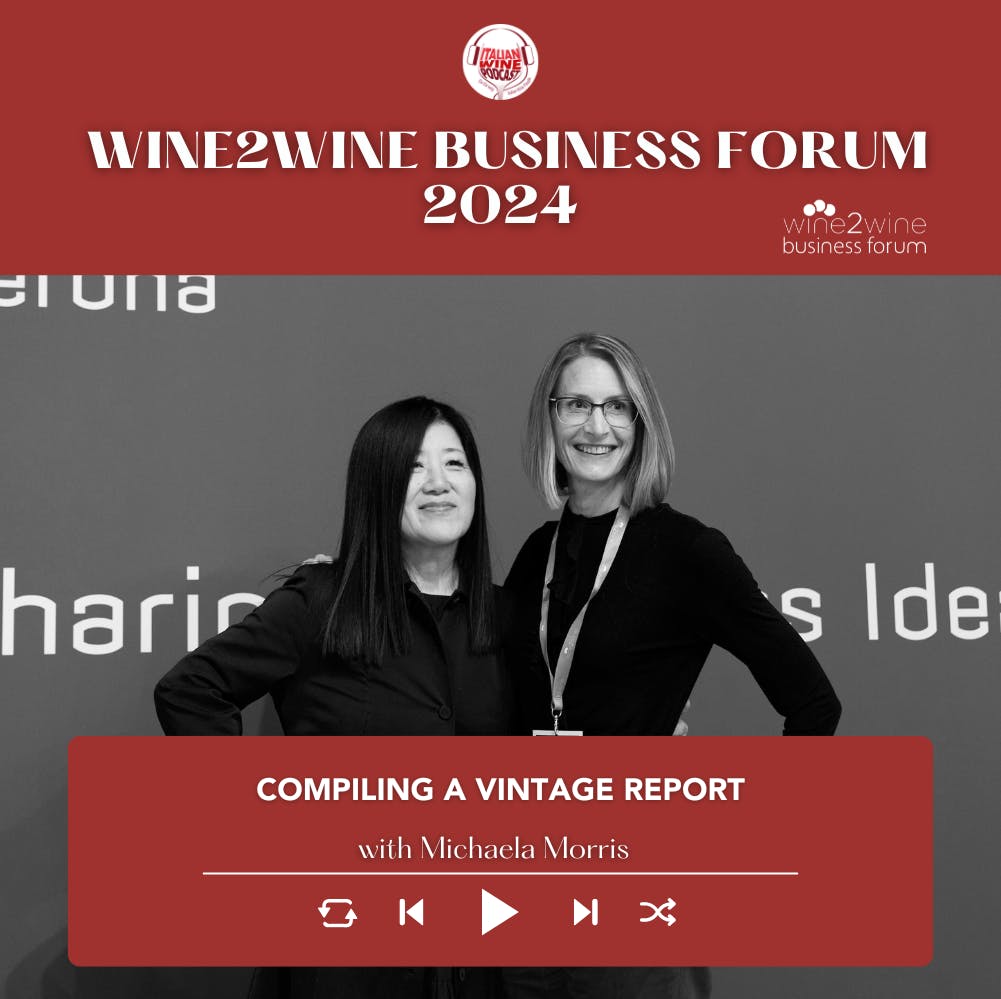
Ep 2332 Compiling a Vintage Report with Michaela Morris DipWSET, IWE | wine2wine Business Forum 2024
Episode 2332

Ep. 2239 What’s next for wine – What wine for what’s next | wine2wine Business Forum 2024
Episode 2239

Ep. 2145 The influencer marketing playbook | wine2wine Business Forum 2023
Episode 2145