

Ep. 1885 Cracking the Scandinavian on-trade market | wine2wine Business Forum 2023
wine2wine Business Forum 2023
Episode Summary
Content Analysis Key Themes and Main Ideas 1. An in-depth overview of the Scandinavian wine market, focusing on Italy's position. 2. Analysis of market characteristics across Sweden, Norway, and Denmark, including monopoly systems and import dynamics. 3. The evolving preferences for Italian wines in Scandinavia, particularly the dominance of Piedmont. 4. The pivotal role of sommeliers and restaurants in shaping wine trends and distribution. 5. Practical advice for Italian wine producers seeking to enter or expand within the Scandinavian market. Summary In this episode of the Italian Wine Podcast, Krister Benson, founder of Star Wine List, provides a comprehensive look at the Scandinavian wine market, with a specific focus on Italian wines. He details the distinct market structures in Sweden, Norway, and Denmark, highlighting the retail monopolies in Sweden and Norway versus Denmark's free market, and the importance of the on-trade (Horeca) sector across the region. Benson discusses the significant shift in consumer preference from Veneto wines (Amarone) to Piedmontese (Nebbiolo/Barolo) in recent years, especially in top restaurants and wine bars. The discussion emphasizes the influence of sommeliers and their role as gatekeepers, providing insights into what they seek in new Italian listings. The episode concludes with practical advice for Italian producers on finding suitable importers, understanding market nuances, and leveraging personal relationships to succeed in this complex yet lucrative market. Takeaways * Italy is a leading wine supplier by volume in Scandinavian markets, particularly Sweden and Denmark. * Sweden and Norway operate retail monopolies, making the Horeca (restaurants/wine bars) channel crucial for discovering new wines. Denmark is a fully free market. * Piedmontese wines, especially Nebbiolo and Barolo, are currently the strongest trend in Scandinavian fine dining, surpassing previous demand for Veneto wines. * Sommeliers and restaurants serve as key influencers and gateways for Italian wines, offering diverse selections beyond monopoly offerings. * Finding the ""right"" importer – one with strong connections and a focus on the desired market segment (e.g., Horeca vs. monopoly) – is critical for Italian producers. * Direct engagement, visits, and building long-term relationships with market players are highly beneficial for producers. * Scandinavian restaurant wine pricing can be high for entry-level wines but offers good value for high-end selections. * There's growing interest in diverse Italian regions, sustainable wines, and those suitable for plant-based or seafood-focused menus. Notable Quotes * ""Going to the monopoly store, it always feels like going to the dentist."
About This Episode
The Italian wine market is fragmented and price-sensitive, with many large and small distributors present in Norway and Denmark. The industry is fragmented and price-sensitive, with a high demand for wine bars and restaurants, and many consumers are interested in classic and natural wines. The industry is also fragmented and competitive, with many large and small distributors present in Norway and Scandinavia. The importance of storytelling and sustainability in wine sales is emphasized, and consumers should present themselves and check importer before making a decision. The importance of wine scores and acting on different producers is also emphasized.
Transcript
The Italian wine podcast is the community driven platform for Italian winegeeks around the world. Support the show by donating at italian wine podcast dot com. Donate five or more Euros, and we'll send you a copy of our latest book, my Italian Great Geek journal. Absolutely free. To get your free copy of my Italian GreatGeek journal, click support us at italian wine podcast dot com, or wherever you get your pods. Y twenty business form is a training and networking event for anyone involved in business held in verona on November thirteenth and fourteenth. This year, the forum will involve over ninety international speakers in over fifty sessions on topics ranging from marketing and communication sustainability, strategy, new market trends, and market focus in collaboration with the Italian trade agency. A number of market focused sessions will be broadcast in a podcast series on the Italian wine podcast. A media partner of the wine to wine business forum. Hello, everyone. Hello. Hello. Hello. Hello. So, yeah, you, at least, you know, they saved the best for last. Right? Thank you. Yes. But welcome. My name is Osa Joanson. I'm a Swedish wine journalist based in Tuscany. I write in five countries in three languages, and I'm a teacher at the school of Sumlear in in Sweden. Do wine education, and I have started the first podcast about Italian wine in Sweden, and I also have a small production of olive oil that I bottle and label by myself. But if you ask my children what their mother does for a living, they will just say she drinks wine and label things. So that's kind of the thing. Today, we're gonna try to understand a little bit better the Scandinavian wine market, especially the entree and who could be better to tell us about bad than Krister Benson, the founder of Star Wine List, the wine profile of the year in twenty eighteen in Sweden, journalist and entrepreneur, and has, in a very short time, taking Star Wine List not only outside of Sweden or Scandinavia, but, has become a very important international brand. We're gonna do an overview over Scandinavia, and then we're gonna zoom in more and more. Can you say you will take us on this journey. So I hand over the ball to you. Thank you very much. Thank you. Thank you, Olsa. Thank you for coming. Last slots on the day. So, I know your old friends and family are becoming the counterpart. And, it's been exciting two days. So, I'm very happy to be here with you as well. I know we, we sat in the program as well. A few questions to address. How do market individual markets of Denmark, Sweden, and Norway compare? How do the importance of distributors operate? What's the role of Psalms and how can Italian producers get on distribution listings in top Scandinavian restaurants, saving that phone for us. So we hopefully can address that today. A little bit about our wine list. It's a restaurant guide with wine and focus. Now we started, six years ago in Sweden and now in thirty seven countries selected by wine professionals, including OSa, who's created the guide to Tuscany for us, Houston ambiguity in Milan, and other places. So, if you're looking for a place to go and drink wine in different cities and countries, check it out on the website and the app. We're gonna go through this fairly quick. There's quite a bit of information. So if you want the deck afterwards, just leave me a card and we'll send it, but we'll try and be fast about it. Looking a bit of the big picture on the markets and what's happening. Looking at the wildest in the top restaurants and wine bars in Scandinavia and, looking at which are the Italian producers that are placed in a lot of them. And also asked a number of Psalms what they're looking for when it comes to Italian wines. We're moving forward a bit very basic Scandinavia in Sweden, Norway, Denmark, twenty one million people, approximately Stockholm and Copenhagen in the big cities. There are differences Norway is not in the European Union, so different rule supply all have local currencies called Karuna, but the Danish Curone is actually connected to the euro. So it follows closely where the others are floating and have dropped compared to the euro. You know about the monopolies, in the Norway countries. But in fact, it's the retail markets in Sweden Norway that have monopolies, monopoly stores. Whereas the entree, the hurricane markets are free and open for importers to import what they want and sell to restaurants, whomever they want. And Denmark is super free. That's the free country in the Nordics where we like to go and enjoy life. Yeah. They they always seem a little bit more happy than we do. Yeah. I think that's because of this picture, really. You know, you've been free, happy with it. It makes a lot of sense. But, you know, you talk about the, in, monopoly markets. And of course, Finland, which is a nordic country, but not usually when you talk about Scandinavia. So that's why you lift it out of this presentation. That's a monopoly retail as well. But just one thing, Krista, when you say that, Horek, channel is free, you still need an importer. You can't sell directly to the restaurants. They have to go through an importer in the different countries. In Sweden, Norway, yes. But, you can base if there are hundreds and hundreds of importers. A lot of some leaders start their own small one person import farm, get a license just because they wanna import wine to the restaurant. So that's what I mean, but it's it's very free in that regard. It comes to the restaurant. And that is also something where, for us, in Sweden Norway, actually the wine bars and restaurants are much more important, to us than maybe in other countries, because that's where you go to taste new things and hear stories, and learn things from the psalms because you don't get that in shops. If you live in Copenhagen, London, you go to the great wine shops, and you learn and you taste. We don't have that with the monopoly. So the restaurants and wine bars are even more important. Yeah. Going to the monopoly store, it always feels like going to the dentist. Yeah. Like, it's very. Yes. You worry they're gonna pull teeth and not just the the money from them. A better picture of Sweden. Ten percent, approximately, of volumes of wines are sold in restaurants, ninety percent of the monopolies. Italy is number one when it comes to the market. It's, it's a big producer. When it comes to restaurants, there are large restaurant groups, especially when you go down into chains and everything, but also in in in good restaurants. Large importers, of course, bur work with big volumes And there are large distributors as well with food and wine that have influence, but it's very fragmented and quite free when it comes to small, medium sized imported, distributors, and restaurants. And it's, there's a lot of a lot of choice there in the small round. Norway also Italy, number one, supply and country, about ten percent there as well going into the Hurricane. It's outside the European Union. They have their own rules. It's very strict rules for alcohol marketing, I know one wine bar in Oslo where they even have the local authorities come in and say that they were displaying the wine bottles too much, in the wine bar. So it's very strict when it comes to alcohol. Yeah. Same thing here, large importers work, big volumes, There's quite a bit of consolidation among importers in Norway and the restaurant groups as well, even on the high end in Oslo. Quite a few belong to groups that are picking up more restaurants. Denmark, the free country. Italy is number one in volume, but actually it dropped to number two in value last year after France, very fragmented market. Supermarkets are the biggest wine sellers, and they buy direct from Europe. So it's different. You have wine specialty shops online as big and Harkis about seven percent, of the market. It's also some, you know, it's hard to read these numbers sometimes because it's sold on to the rest of the Nordics. I know I was working with wine in London, and there was quite a bit of champagne all these sort of the bottles that actually been shipped to Denmark first. So these gray markets going on in that respect famously price sensitive, especially in retail, there are always offers going on and and the people complain that people only buy an offers Harka, very fragmented. Of course natural wine has been a big thing. Copenhagen being the big natural wine city in in Europe after Paris basically and still important. Although it's become more connected to the mainstream, I think, across the Nordics talking to importers just before this, you know, hearing what's going on, there are several large importers that work across the Nordic markets, Sweden, Norway, because they're good at working with monopolies. There's been quite a bit of movement, consolidation, among the importers. There was a merger between Altia and Arcus. Huge players become Anora across the Nordics, and a lot of brands move around there because of that and people. The merger was two years ago, but the Stockholm offices are just getting together as we speak. So it's a bit of it's a bit turbulent as people say. Which creates opportunities, of course, when things move around. When it comes to the economy, of course, interest rates have been hitting people and inflation affecting consumers. And we hear that as well. There was a boom after the pandemic people are, okay, enjoying life, spending more in bottle wine. That has clearly come down a bit to normal levels when it comes to price. And we hear that, you know, restaurants say, well, still a lot of people going out, but they're buying a cheaper bottle of wine than last year. Berundy, which is huge, in these markets, is getting pricey and getting out of the reach for, by the glass selections, which creates, of course, opportunities for others to come in there. I thought we'd have a look on on the Scandinavian wireless which are the producers that have the best most number of listings in our world of top restaurants and wine bars and including looking at the Italian producers that have done well and are there in those markets right now. And these are in Scandinavia. We have about five hundred top wine bars and restaurants on Star wine list. So that's the universe we're looking at. It's not the lower end. And if you look on Sweden first, The ten top listed producers in in our world in in Sweden, Ashley Champagne, which is huge, in in the Swedish wine list. It's a massive, part. Burgundy is also huge. And you see three Italian producers that are actually among the ten top listed producers in in top wireless in Sweden, big names from Italy, of course. And DRC from Burgundy, how does that work? Well, Burgundy is huge, in these restaurant markets. We looked at the whole data a few years ago and about twenty five percent all the listings, in the top restaurants were from Burgundy. DRC has large allocations going out and stick because you don't sell the DRCs every week. They kind of stick on the ones a bit. So below the top ten, you have a lot of Burgundy producers. If we expand to the top hundred producers going into the suite stock switch wireless, there are sixteen from Italy. And here you see the effect of Gitmont and the grip. That Pittmont wines has, in this market. Some outliers, Sicily, Forodori, and Suscany and Nvidia Pepe, joining that ranking as well. Denmark, classic stuff, champagne burgundy, even some Bordeaux, the classic on the wireless Spain, Pinges of course, being a Danish producer, that started it and Ryan has seen. Are you thinking, okay, what about all natural wines coming into to Denmark and being the the capital in in Copenhagen, where where's that? Well, it sounds like the top ten. And a lot of the wine bars for saying Copenhagen that are hardcore and natural, they don't even have wine. You know, you have the glass bottles along the wall. So they don't enter, you know, the wildest to to have a look at it, basically. A bit fewer Italians entering the top hundred here. Piedmont still strong, Tuscany, Imudio Pipe, and Norway, burgundy, huge. They have some, and this is a complaint from Swedish sommeliers, by the way, that all the good burgundy goes to Norway because they have good connections there. And, you see in the bottom there, an average top Norwegian wireless is very classical. Red Burgundy and German precincts are very strong. Interesting to have the Jira there as well. A bit fewer eight Italians in the top one hundred producers here with Pierre leading here as well. And is the prizes there also? No. I just think that once upon a time and not very long ago, everything in Scandinavia was about, and I remember, like, ten years ago, you met people who said, I don't think anything else, but I'marona when I go to a restaurant. And now it's all about Piedmont. So how did that shift? Yeah. That was, there was a shift. And, as you say, Venutto, Amarona, and Dolpocellas, and the Repas have been huge and there are still huge in retail, in monopoly. But the trend and what people are talking about and what's happening now, it's definitely Piedmont. Nebioolo Barolo are the key words for what people are talking about and looking for and buying. We look that a bit more when we come into the third part. Yeah. Just one question. And what's the markup in Scandinavian restaurants? You know, wine wine in, all the northern Scandinav restaurants, especially Norway and Sweden is expensive especially for the cheaper wines. It's, you know, three, four hundred percent but expensive stuff can be really good value. So if you're looking for, it's sometimes even a bargain if you travel, we know we have people traveling in from Asia, etcetera, just to go drink burgundy in Norwegian and Swedish restaurants because you kind of get the trip for free if you're looking for the top end stuff. Whereas if you're looking for house wine and you live in Italy or France, you get a shock when you come to to the countryside, and buy the glass prices. And how do you feel your opinion? You did see so many wine lists, through your work. How stable are they? Do they change a lot? Because they did these that you have seen, they're very classical. So what what do you say about that? When it comes to the listings? Yeah. Like if you get in, is the are you gonna stay there? Or is it? It depends on, I mean, the larger restaurant groups and big restaurants, they usually do a bit of a tenders as well, right, for the big volume by the glass listings and do a deal for that. But they also have a lot of freedom for the samliers, to choose stuff besides the deals what's hip can change very quickly, but I think the bigger brands that builds up that loyalty and brand both among the guests and the songs they stick around. Another question, the buyers at the restaurants or the summer years who are they most influenced by? Is it like wine? Do they read wine magazines? Or, do they follow-up with the international trends mostly? Or do they listen to their customers, or how how do you think? What's your opinion? That's a good question. I think it's a mixed younger generation, of course, much more social media and other some people that are influential that they follow, looking for some are even looking for, you know, which are some import firms looking for, in other countries as well. You know, if you you kind of like an American Porter in of Cool wines in New York, they look for the stuff coming from them. But it's some, you know, also follow their importers. They know, you know, a lot of their smaller import firms, they, you know, hire people from the restaurants, and then you have ex colleagues and and the ones that you trust, and you follow their advice and their trips and their stories. Only hear what the songs think, what they're looking for under guests. So we asked a number of them that we know, a couple of questions to get the views from what's happening now and what they're looking for. And what are you currently looking for in new Italian listings for your lists What are the guests asking for? And, what advice would you give to an Italian producer looking to go to the Scandinavian market? And we picked out a number of them from different countries that we think are influential. And we start with, Peta And if you say peters to someone in Sweden Norway, they know exactly who you mean. He's on a first name basis. He's a rapper. He's twenty five years, one of the most successful guys entrepreneur, podcaster, wine importer, restaurant owner, does a million things, real nebbiolo lover that he he says. So his place is called Getonin up in the ski resort in the North Water, and you find all these wireless and information on on Starwines, the app, etcetera. If you wanna check out the wireless afterwards. His work alone and his podcast and everything he does and it's hundreds of thousands of followers on social media drives probably ten percent of the tone of rubber kid molecules in in the world, I think. He's really pushed that hard. On the wildest in the restaurant up north, they have seven hundred Italian listings, five fifty from kidmont. His ambition is to have every barrel of proser that ever appears. It's gonna be under one. Since he's he's part of several parts of the trade, his tip, you know, was to be a really long term focus, but also be careful to find an importer that not only works in monopoly. Quite easier for importers in Sweden to be good at working with the monopoly, whereas working in the restaurants, it's much more work if you, like, if you're gonna, you need to do the tastings and meet the people and be out a lot and have sales people out, whereas if you're a pro at Monopoly, basically, and sit in the office and work in Excel, and it's, the tenders, and I'll contact some monopolies. It's a totally different work. Look at what they're doing. If you look at any quarter, it's almost his tip. Italian wine podcast. Brought to you by mama jumbo shrimp. Italians. We have quite a few, of course, working Andrea Consomni from Milan, runs a great restaurant in gothenburg called Astreaga. I think this is quite typical when when he's looking for wine, what they're gonna list it's important with the craftsmanship, relationships. I wanna meet the winemakers. I wanna sell wine some friends, not corporations. This is, of course, something that's strong among many so many years as well to, you know, to have kind of that connection with people. What a guest's asking for. And just like you mentioned, he said, you know, ten years ago, more people are always asking for Vinetor, and now it's only nevial in the restaurant. It's a northern Italian restaurant, right? But, and, tip for producers, finding persons that share your spirit, but also look at your friends' importers or what the importers are carrying. You feel like you fit into that ethos, and the group, to be honest. And the he also says the guests, and, again, are very knowledgeable. I mean, people who know a lot about wine, taste a lot of wine, thinking, you know, really high level of knowledge in this opinion. Yeah. And there's also a boom in wine education. You can see that that all the summer year educations and it's it's really a boom, a great interest in learning because they're don't know if you agree, but I think Scandinavia and especially Sweden and Norway, they're quite anxious. They're afraid to do something wrong when it comes to wine. So they really want to have like a diploma saying, okay, I know a little bit, so now I can order the wine since we're not a wine producing country. Well, we have a hundred hectares now. So not only Ikea, but still they're very anxious when it comes to wine, my opinion. Yeah. Yeah. I mean, you wanna follow your neighbors. And now when you get some trend going hard like the Piedmont wines, it gets very strong movements. This is the restaurant Piedma Vennor. I put it up because it's, it's kind of the wine destination in Sweden since small town in South Sweden, and you'll see they have a lot of awards in our wine list awards. They're massive wine sellers, six thousand different wines, a Michelin Star worth a trip. And what they said, it's like, yeah, among the wine savvy guests, people know about wine, Piedmont is big. It also Pronelo and produces with a cult following in regions like Abrozous sicily, Numbria. For instance, the media paper that you saw previously, you know, you get that cult image and people wanna have it. Whereas, average consumers, so to speak, have moved from asking from El Paso in Emerald to Piedmont, mainly Barolo, and others such as asking Italian wine. People like Italian wine, just say, you know, what happens in Italian wine, and they're open for for that. And they serve a lot of different regions and and looking for different regions and types of ones around Italy. People are interested in in this, but don't know that much about outside this. I think also, you know, it's right now November in Sweden. It's super dark and super cold, and that's basically most of the year, except for June. Congrats. So, yeah. I know what you why you moved to Tuscany. They're big red wines make a lot of sense. You know, it's, it's, you need comfort, you need something big red to warm you up. And it used to be the vanetta wines, and now it's become trendy to do the Barolo wines and Piedmont instead and Lund gave from all that stuff. Tip for them, producers, you know, yeah, traditional distinctive wine, clear essential place for them. It's, you know, their wine gigs and wanna highlight different regions. Another Italian. It's a great restaurant, you know, highly ranked by Gabriel Rosa. Typical also that Italian restaurants want to have all the regions. They're not just following the latest trend. Find something new besides the classics. Guests here, but all of Bernelo, super strong, super tuscans, says last year was a lot of the Sicily Yetna. Also, his getting is a great knowledge of wine. Some asked to try things that you know, I tried before, and his tip was finally stable importer. It's very competitive. Even though it's a ton of Italian wine, no part of the wine world is easy. Right? You need to work hard. He gave an example actually about a a Kianti producer that he talked with that, had a small importer in Stockholm that shut down, and now he, the producer has to find a new importer and finally, you know, people are quite hard to to work with and find the right home for it. So that was his tip. We crossed down to the free country, Denmark, Ollie, from New Zealand, working the Frank Group. That's a chain, not a chain, as a group of really good bistros and wine focused restaurants, They won the awards there down to the right when we did a couple of weeks ago in Copenhagen for the best wine lists. I think this is also something that some years look for. You know, okay? They need the big regions, language, testing wines, but also outside the big regions, look for stories that guests can relate to. Like Daines love to ski in Northern Italy. So he said, two, three year old dolomite wines, you know, they can sell the story and people recognize the region and and connect to that. His opinion also, like about twenty percent as huge wine lovers look for produces the love and unicorns, decent prices. Many drink red as for heavy reds. I think it was interesting. His his comment was, you know, Danish Mark is very fragmented. Select for, you know, what you're looking forward to end up, and he also had opinions about the price points that if if you are, you know, you know that you're high, perhaps a higher priced, then the online sales, etcetera, it's gonna be harder if you don't have the name. Whereas, if you work with restaurants, they can sell the story, and they, they like to, you know, producers they like. Second part, another non Danish sum in our collection. I wanna show this one because it's it's, it's a group of three plant based restaurants, or vegan restaurants. ARC has a green Michelin, a green star for Michelin, one or was for best single wireless It's very, like a lot of restaurants, with focus on sustainability, vegan menus. Of course, farming, seller work plays a massive part on how they pick wines. And even though people it's a lot about the heavy reds, but in fact a lot of the menus, if you go to good restaurants in the Nordics, plant based, there's a lot of fish seafood, on the tasting menus, there's hardly any meat anymore. It's like maybe one meat ish out of eight or fifteen. So the heavy red has only one slot out of, like, seven in a tasting menu. And the rest will be white or light reds or orange, like you said, in orange wines, macerated wine from Italy, really food friendly. So that the farms are much more looking for that than the heavy red. Normal pet nut. Come with a good story. You two are focused. Jumping up to Norway, not much left in the presentation, also massive restaurants, and I think mentioned here as well that Norwegian seafood, Norway, of course, being a very fish sea closer to the sea, lots of oil money to spend, Argentina, get a quote too full. That's really well. Also here straight to to story traditions, tipacity and originality. And of course, it's it's it's the gatekeepers, right? The songs are looking for something to pair and share outside what people are already looking for. And this is Cotton Dayborne, who runs, what I think is probably the best wine bar in in the Nordics territory, it's not slow. You need to go there. It's a great place. I have a lot of selection by the glass with carbon, very interesting, and what she said, you know, diversity of regions, grapes, and styles. And I think what she said is true here, that people are happy with all Italian wines. People love Italy in general. People are still asking for people don't really see the difference between ethnic and Sicily if you're a foreigner and trusting classic. And by dynamic wines, they say people are asking for as well. And the tip for a producer makes the label easy to understand and put the grapes on the label. That will be first going into the end, takeaways. It's only why it's huge in Scandinavia come to trends and what people recognize. Petmon has taken the number, but it's one spot, and people talk about that a lot. And sometimes they, a bit like they confuse Aetna and Sicily for a lot of consumers, Barolo is just another word for our Piedmonto, neviolo, or it's a big, big, good red, high quality wine. Guest consumers love the big reds, whereas Psalms, of course, want to pair it with the food and look for interesting new stories and regions, look for other types of Italian wines. The on trade markets are very diverse and fragmented, competitive, but there are, you know, look at which ones that are doing things where, and I think, of course, choosing importers if it's with your objectives will go for the on trade. And you have a lot of information. You can find, you know, we look at the importer. What other producers do they work with? Do they work with the restaurants? You can check on store wine lists if they're on the wine lists and try and find the information there. Of course, if you have a lot of time and resources to go to the markets. I think that's a huge plus. I think that's the big difference between a lot of these producers who have had the time and energy and focus on their markets to come back make the visits, make the friends, and stand out from the crowd like that. Those are good, advices for sure because the hardest part seems to be when you talk to many producers to find the right importer. So your advice is to go to Sweden and present yourself and check them up before. That's what you're saying. That's your your advice to an Italian producer? Well, I think, you know, there if it had been one simple solution for everybody, we would all be you would all be rich, and we would too. So I I think, you know, as someone said in these days as well, look at know what you are, what you can do. Look, you know, which are the ones that you think you fit into, what you can manage, and maybe it is a great monopoly produce, importer and has good connections and monopolies, and you get good listings. Why not? You know, that's, easy money, so to say. Whereas, if you don't have that opinion option, of course, the on trade is where you can actually act and do something remotely is much more difficult if you don't have the connections to knowledge or the, you know, how to get in there. So it feels like the entree is easier to act upon because you can actually run there and do that, meet people, get out and do stuff, but it's, it's a lot of work. Of course. Well, thank you. We're going to open up for some questions. Thank you. In Canada, in general, wine score are still important. And if so, which are the generalist that are most followed. That's a good question. I think it depends very much on the segments You know, if you're collectors, yes, I would say it still is, it's not as dominated as was a couple of years ago with parker points, etcetera, it's more fragmented. There are Swedish media, wine media that do scores that I think people follow less scores, but then recommendations. You know, if there's a story in the big media on Fridays, you know, okay, this week, we're looking at these six ones that were great and recently released. People like, okay, that sounds good. Without really seeing the scores. Generalists, influencers are followed, but not as much scores, I think. What do you think? No. I think you're right. The most recommendations, both on social media and, yeah, influencers there. And I different segments in in in the different wine magazines. But the thing is, from my point of view, I write for the, main wine magazines in Sweden, is that they mostly want you to write about wines that, of course, are available in the market. So the challenge from my point of view is to tell stories from Italy that are not yet listed and that is becoming a bigger and bigger challenge. That's one of the reasons why I started my podcast to be able to tell the stories that no one wanted, but that are normally the most interesting ones. For example, going to Delletta in, La Cigna or to, ma'amoyada and meet Giuseppe. For example, those wines are not listed. But those are really good stories, which I don't think scores are super important. I think, for example, when Gamuro also comes to Sweden and they have their big events, I think that makes a difference. I think going, as you said, to the market, as a consortium or through the Gambraso, etcetera, and actually talk to people and come out on social media, even though you're not listed on the Swedish market, I think that can make a difference. I give really long answers like an Italian, right? You're Italian. I have a question. Are the, restroom that you take as a, as an example, imports, wind by themselves, they they can do it. Right? They can if they get an import license, at least in Sweden, the Danish ones, they usually buy both from importers and and direct. That's, as I mentioned, free market. This of these ones, that I shop in Sweden one has an import firm. And some just do to supply their own wishes if they've been to some place and think, yeah, we'll have this wine and nobody takes it and they have their capacity. They'll have their own import firm, bring it in. So there are no rules against that. A lot of Sommbiers as I mentioned, have their own import licenses. But otherwise, you have to go through an importer. And their importers, like as they said, specialized on the Horeca segment only and their importers working with both the Monopoly and the Horeca and there are importers working only with the monopoly. So that's why they're all saying find the right importer because you have to know where you want to be colored, like, cellular wines through which channel. Alright. I think we made it We made it to wine to wine Listen to the Italian wine podcast, wherever you get your podcasts. We're on SoundCloud, Apple Podcasts, Spotify, email, IFM, and more. Don't forget to subscribe and rate the show If you enjoy listening, please consider donating through Italianline podcast dot com. Any amount helps cover equipment, production, and publication costs. Until next time, chi qin.
Episode Details
Keywords
Related Episodes

Ep. 2145 The influencer marketing playbook | wine2wine Business Forum 2023
Episode 2145

Ep. 2138 What you need to know before approaching the US Wine Market | wine2wine Business Forum 2023
Episode 2138
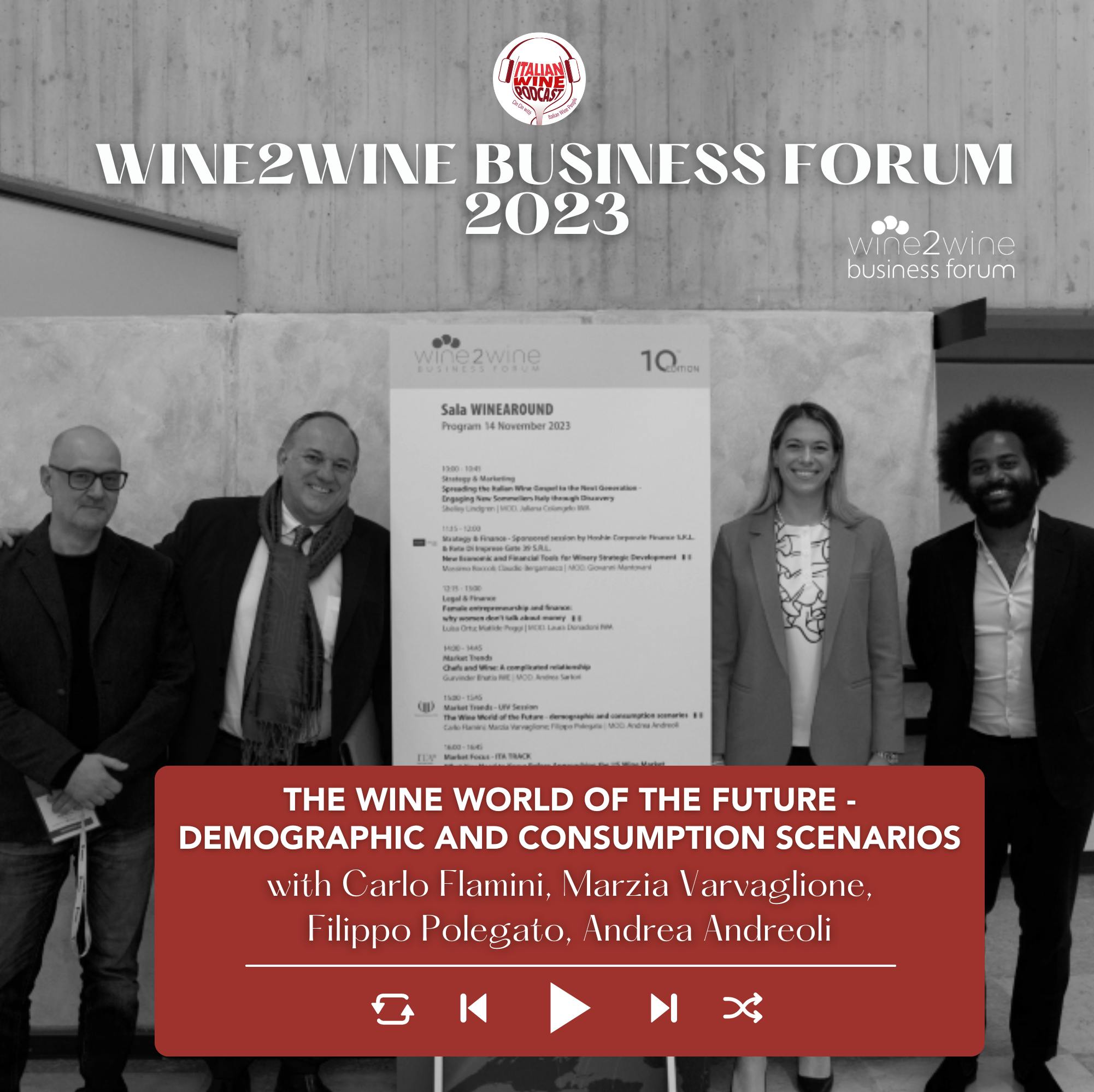
Ep. 2131 The Wine World of the Future - demographic and consumption scenarios | wine2wine Business Forum 2023
Episode 2131

Ep. 2123 Chefs and Wine with Gurvinder Bhatia and Gino Colangelo | wine2wine Business Forum 2023
Episode 2123

Ep. 2115 Why women don't talk about money with Luisa Ortu, Matilde Poggi, Laura Donadoni | wine2wine Business Forum 2023
Episode 2115

Ep. 2106 Massimo Boccoli, Claudio Bergamasco, Giovanni Mantovani | wine2wine Business Forum 2023
Episode 2106