
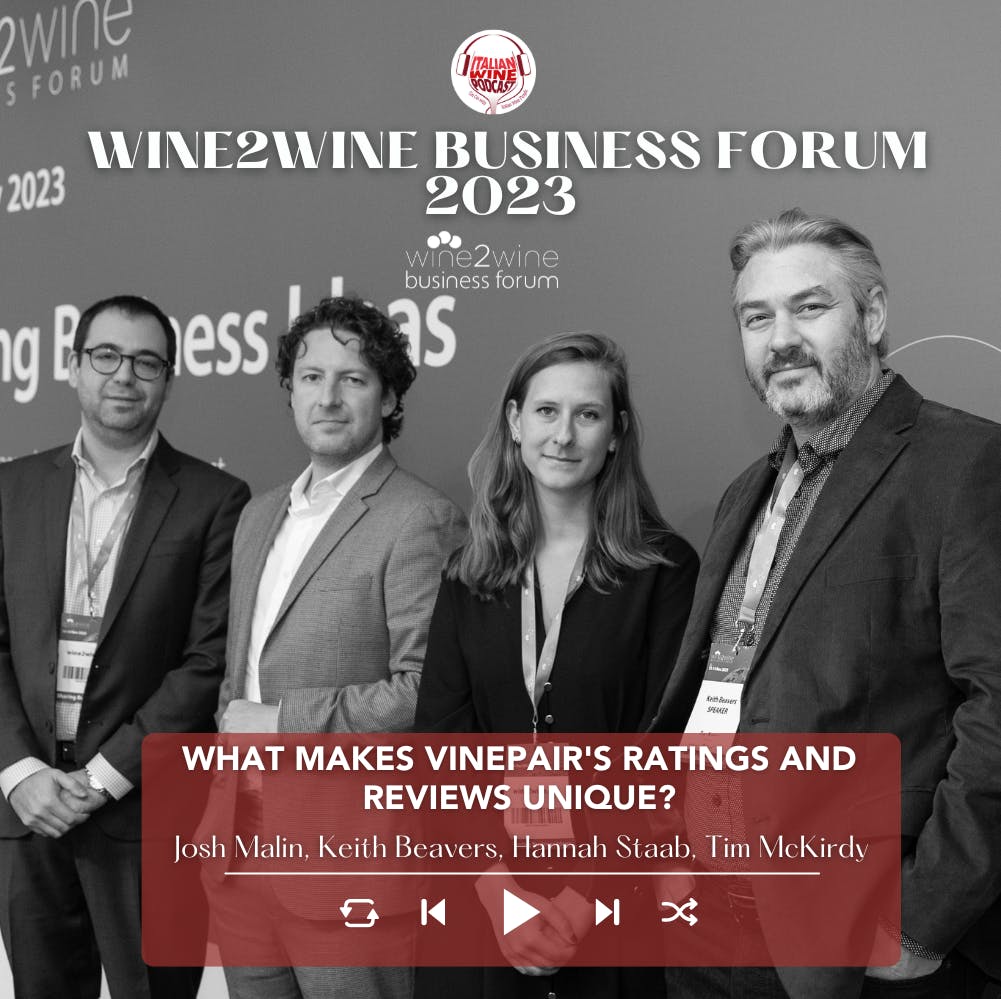
Ep. 1947 What Makes VinePair's Ratings and Reviews Unique? | wine2wine Business Forum 2023
wine2wine Business Forum 2023
Episode Summary
Content Analysis Key Themes and Main Ideas 1. VinePair's Unique Wine Review Philosophy: The core focus is on VinePair's departure from traditional blind tasting, advocating for a non-blind approach that mirrors consumer experience. 2. Accessibility and Free Content: VinePair's commitment to providing free content for readers and a free submission process for producers. 3. Comprehensive Review Process: Explanation of how wines are evaluated for individual reviews, themed roundups, and annual top lists. 4. Storytelling in Wine Reviews: Emphasis on integrating the story behind the wine (winemaker, region, history) into reviews, rather than just technical tasting notes. 5. Consumer-Centric Approach: Tailoring reviews to provide practical information relevant to consumer decisions, such as price, occasion, and comparative suggestions. 6. Diversity in Wine Coverage: The aim to cover a broad spectrum of wines, from established producers and regions to smaller, emerging, or ""boundary-pushing"" ones. Summary In this episode, Josh Malin, Tim McCarthy, Hannah Staff, and Keith Pierce from VinePair discuss their publication's unique approach to wine reviews. Founded ten years ago, VinePair aimed to be an accessible platform for millennial and Gen Z consumers interested in wine, beer, and spirits, offering all its content for free without paywalls. Their most distinct differentiator is their non-blind wine tasting methodology. They argue that consumers rarely taste wine blind, often knowing the price and producer, and that other forms of criticism (food, music, film) are also not conducted blind. VinePair's review process involves a free submission system for producers, and wines are considered for individual reviews, popular themed roundups (e.g., ""best chillable reds""), and annual top lists. Keith Pierce, the Tasting Director, explains their structured, criteria-based scoring system, emphasizing that scores are assigned solely based on the tasting experience, independent of the wine's story, which is researched *after* scoring. Reviews go beyond mere descriptors, aiming to tell the story of the wine and its maker, connecting readers to the product on a deeper level. They also include practical consumer information like suggested occasions and comparative recommendations (""if you like this, you'll like this""). The team demonstrates their tasting process with three wines, highlighting how context informs their assessment, and reaffirms their commitment to transparency and consumer relevance in wine criticism. Takeaways * VinePair was founded to provide an accessible, free resource for a younger demographic of alcohol consumers. * Their signature approach to wine reviews is non-blind tasting, which they argue aligns with how consumers experience wine. * VinePair offers free wine submission for producers and free access to all reviews and content for readers. * The review process is multi-faceted, including individual scores, inclusion in themed roundups, and consideration for annual 'best of' lists. * VinePair prioritizes storytelling in reviews, aiming to connect readers with the human and regional history behind the wine, beyond just tasting notes. * Reviews include practical consumer information like price, ABV, suitable occasions, and ""if you like this, you'll like this"" comparisons. * The scoring is done objectively based on the tasting experience, with the score finalized before integrating the wine's story into the review. * VinePair seeks to cover a diverse range of wines, from established brands to smaller, emerging, and unique producers. Notable Quotes * ""Nothing is tasted blind at VinePair."
About This Episode
The Italian wine podcast is a community-driven platform for Italian winegeeks around the world. The hosts discuss their experience with the tasting process and explain their approach to tasting and recommend their own review process. They emphasize the importance of knowing the product being reviewed and the industry's views on tasting. They also discuss their focus on the most popular and diverse wines from across the US, different regions, and wines from across the US and Europe. They recommend their tasting system and share their own tasting system and tasting criteria. They also recommend their tasting review section for being informative and interactive, and discuss the importance of the storytelling in the review process. They recommend the wine in a specific region for occasions and situations, and thank everyone for their questions and encourage them to check out the Italian wine podcast.
Transcript
The Italian wine podcast is the community driven platform for Italian winegeeks around the world. Support the show by donating at italian wine podcast dot com. Donate five or more Euros, and we'll send you a copy of our latest book, my Italian Great Geek journal. Absolutely free. To get your free copy of my Italian GreatGeek journal, click support us at Italian One Podcast dot com, or wherever you get your pods. Official media partner, the Italian One podcast is delighted to present a series of interviews and highlights from the twenty twenty three one to one business form, featuring Italian wine producers and bringing together some of the most influential voices in the sector to discuss the hottest topics facing the industry today. Don't forget to tune in every Thursday at three PM, or visit the Italian wine podcast dot com for more information. I am Josh Malin. I'm one of the co founders of Vinepair. That's the publication we're all members of here. And we're gonna talk today about how we taste wine and how we do that quite differently from other publications. But before we get into that, I'm just gonna do a brief overview of what Vyme pair is, why we started it, and why that ultimately led us to a place where we taste the way that we taste. So we started Vinepere ten years ago, almost almost ten years ago. At the time, there wasn't a publication that myself and my co founder, Adam, really wanted to read that spoke to us that we thought made sense for us as millennial consumers and drinkers. One of the first big things that we felt was missing was a publication that wrote about wine, beer, and spirits. We had a belief that millennials, and now Gen Z increasingly as well, drink differently than previous generations, and that we where, we like everything. So since then, the data has borne that out, if you look at surveys in the US, if you did a big Venn diagram, right, wine, beer spirits, that largest chunk of that Venn diagram would be the center where they drink everything. So we set out to do that. We wanted to create something that was accessible. So from day one, we've never had a paywall, never had a registration wall, the site is totally free to read. And because of that, we now reach about forty million consumers on a monthly basis across our website, newsletters, social, podcast network. You may have heard about that in Adam's talk earlier. So yeah, that's us, you know, what we've by speaking to our consumers from the place where we are, we've built trust with them. And we didn't feel at first that reviews were something we were gonna do. But very quickly, we started to hear from our readers that they wanted product recommendations from us. So that originally led us to do, lists of product recommendations, but no individual reviews. That eventually got us to a place where he said, you know what, we do need to be doing reviews. Our consumers are continuously asking for them. But we didn't wanna do reviews in the same way that everyone else was doing reviews. We felt if there was nothing new to add, then why do it at all? So that led to our fairly unique review process, which is not blind. Now I'm gonna hand it off to the editorial team led by our managing editor, Tim McCarthy, who can explain in detail that tasting process. Thank you, Josh. You everyone for coming out today. It's a pleasure to be here with you today. As Josh mentioned, and as you may have seen in the title for today's tasting session, this is what makes vine pairs unique what makes vine pairs reviews and approach to tasting unique. And I'm looking forward to sharing a little bit more about that with you folks today. Josh mentioned, and I think this is the major thing that sets us apart. Is that nothing is tasted blind at Vinepere. And we have pretty strong reasons for that. Our opinions are quite strong on that, and we're gonna get into those today. But there's a few other things that make us different too that I want to mention first. Everything on Vinepere is free, and everything about the tastings and submission process is free. As a producer or an importer, you don't need to pay to submit a wine for us to consider for review. If we publish a review, you do not need to pay to use the score that we assign or to use our marketing materials. And for our readers, there's no paywall. You do not need to pay to read our reviews or view our scores. And that also leads into a second thing that I want to talk about that makes our reviews different and our process different. If you were to submit a wine to wine pair, you're actually submitting for a threefold process. Every wine that's submitted to wine pair, we consider for a review, and we will assign a score and tasting notes, and maybe a longer review. Those wines are also considered for roundups that are dependent upon categories or regions, imagine the best chardonnays or best chianti, and that's very important because when it comes to how drinkers discover new wines, if you're a producer, you would much rather be included in one of those roundups than solely receiving a review. Because something that we know as a media company, and we know from our readers, is that your chances of being discovered on Google, because someone came across your bottle and Google to review, are much smaller than someone searching best Kianti. Best red wines for chilling, best red blends of the year. That's how people discover and search for new wines. So again, if you submit to Vinepere, you're considered for review, you're considered for roundups that we run throughout the year, And then finally, and this is pretty fun because actually tomorrow, our top fifty wines of the year list is publishing. Tomorrow morning, it's gonna go live. We're very excited about it. Some great Italian wines in there. I'm not gonna say if the number one wine is Italian, but should check it out tomorrow and find out for yourselves, but every single wine that arrives in our office, in our offices throughout the year is considered for all three things. And I think that's a very important part of the process. But now back to why we don't taste blind. We want to approach wines when we're tasting them as consumers do. We know that consumers have a lot more information on hand compared to if the wine were in front of us blind today. One of the main things they know is price, and they're going to base their purchasing decision. If they don't know the producer, based upon price and probably a score. And we think that price is an important part of what comes into us considering us encountering that wine. So that's part of it, but also we asked ourself a question and we don't have an answer for this, which is which other field of criticism out there is the topic at hand, the product being reviewed blind. It doesn't happen in food. It doesn't happen in music. It doesn't happen in film or theater. So why should wine be any different? And so those are the main reasons that when the wines arrive at Vinepere, when we taste them, we will have the bottle in front of us, and we will be encountering that wine with exactly the same knowledge that consumers have. So if there are producers out there today, Lovely to meet you all. I'm going to hand over to my colleague Hannah Staff now, who's the assistant editor at Vineperer, and who heads up our submissions process. And Hannah's gonna explain a little bit more to you how that process works, We've also got a few handouts throughout the desks here. I'm sure we can get some more of two at the end of the talk with all of this information on there. But Hannah, take it away. Yes. So if you're interested in submitting wines to Vinepair, I'm going to laid out in detail right now, so we want to make it as easy as possible for everyone to, send in the wines for review. So, as Tim mentioned, we have some, handouts out there that have a QR code on them. We will make sure that you get one at the end. If not, you can go on our website and to sign up for our submission form. And once you fill out that form, you will be added to our email list. So throughout the year, we do several submission requests, where we'll send out a request for submissions for our roundups like the best chardonnay, best rosays, etcetera. So once you get that email, if you have a line that you'd like to submit that would fit into that category, let's say, best Rosets. You can submit that wine at absolutely no cost. The only requirement that we really have is that the wine is available for purchase in the US, that's important because we want our readers to be able to find the wine and buy the wine. So all that you really have to do is follow the instructions on the email to send in two bottles and fill out our submission form with information on the wine. Thanks, Anna. I want to follow-up here in terms of what kinds of wine are we looking for at Vinepearl? What are the kind of bottles and producers that we want to see? Are we only looking for mass producers? Are we only looking for the most prestigious properties out there? Are we looking for smaller up and comers? What do we look for in our submissions? I think that's, another part of what makes spine pairs so unique is that we really look to cover all corners of the wine world with our reviews. We'd like to represent a wide range of producers and regions. So we do want to represent those very classic and historic regions and producers that are well known, but we also want to reach a bit further and represent those maybe smaller producers or, underrated or up and coming regions that maybe aren't typically represented, really well in the media. So we are very interested in overall sourcing from passionate winemakers who are making wine with a story and a point of view because, whether it's a very, very prestigious estate that everyone knows or a small producer, that, is maybe pushing the boundaries of the region that they're in. We wanna share that story with our readers and those stories are what help our readers connect to the wine. So I think a good example of this was our best chillable reds of the year list this year. So we've noticed throughout the year that everyone is really enjoying the kind of light bodied, chillable red, so we wanted to make, kind of a list of the best of the best. So we wanted to include wines from all over the world, different regions, ones that people know well, or, and maybe more underrated ones that people can discover for the first time. So that list had great beaujolais, great mencia from Spain, wines from across the US, as well as amazing Italian wines, like Ferpatto from Sicily, Skiava from Alto Adi Jay and a great Balpolicella as well. So that's kind of the variety and range that we're looking for for our reviews and roundups. Are you enjoying this podcast? There's so much more high quality wine content available for mama jumbo shrimp. Check out our new wine study maps. Our books on Italian wine including Italian wine unplugged, the jumbo shrimp guy to Italian wine, Sanjay, Lambrusco, and other stories, and much much more. On our website, mama jumbo shrimp dot com. Now back to the show. I think another great point here for us that Josh mentioned and that Hannah's alluding to there too is that when Josh and Adam founded Vinepere, they wanted to speak to people who they felt like drank the same way that they did and that who were their age or maybe younger now as we see Gen Z moving into the drinking market. That means that throughout the course of the year, we will be focusing on categories that haven't traditionally got recognition. So skin contact wines, orange wines. These movements that we see, people of our age, different, I'm gonna say, slightly more obscure, but hopefully not two, three, four years from now, varieties are region that we see our generation drinking, and we want to highlight. We don't want to just highlight the most prestigious or the most established regions and grapes. And the pair and the person leading up that charge when the wines arrive at Vinepere, is our tastings director here, Keith B with theirs. Keith. Can you take it away in terms of what characteristics specifically? Because Hannah has mentioned the types of wines we wanna receive but what characteristics are you looking for from the wines that arrive at Vinepere? Hi, everybody. How you doing? My name is Keith Pierce. I'm the tastings director of Vinepere. And when a wine comes across my tasting desk, I'm looking for balance. I'm looking for complexity. I'm looking for the elements of the wine that build the wine and create balance. If that is a sound tannin structure, if that is good acidity, lifting up the fruit, if that is, just roundness, layers. If the aromas are in a certain place, this is what I'm looking for in the wine. I'm also looking for the for the What is it? Is it? What? The variety? Is it represent the variety? Does it if it does not represent to the variety, is there balance there as well? Are they doing something different? Okay. Then is it acidity? What is what is it that's making this interesting as well? Also, I'm looking at the region itself and what the region provides, and if the wine represents the region properly. Again, I think we can all appreciate that some of that information might be available to us if we taste blind, but not all of it. And that allows us to approach every tasting in the way that we think we should here at Vinepeare. Keith, you've also been integral in coming up with our ratings and scoring system. Again, those are explained on the handouts that we have here today, but can you talk us through, because it's a point scoring system, but can you talk us through, what might be the difference, say, between an eighty seven and an eighty nine or ninety one? Like, People know that ninety one's better than eighty five, but why? And what constitutes that difference to you? So our tasting our scoring system is broken out into groups of numbers. Each group of numbers has a list of criteria that we use. One thing about wine is wine is not objective and it's subjective and I think that reviewing wine is also subjective in a way because you you're taking something this beautiful ancient drink and it's trying to assign it to a number, which is a very tough thing to do. So within these groups of numbers and the criteria, for example, the ninety three to the ninety six, if I find out the wine is outstanding, it's getting to ninety three. That's gonna happen. Now if everything is in the right place okay. So this is an outstanding wine, but everything is where it should be, the acidity, the tan, and the fruit structure. It's just it's sitting really nice. Then I'm gonna give it a ninety four. If this wine is, let's say, from a certain region, and this wine is representing that region to the to a point where If one of our readers were to buy this wine, they would have an absolute experience of the of this region in this blend or this variety, then the then it would go up from there. So I take every piece of information I get from the wine, and I I have this on hand at all times as a tab on my computer because I'm very careful about what I do, and I wanna make sure that I'm assigning the right score with the right criteria. So what happens after you taste the wine? Can you talk us through the process? You've tasted a wine. You assign a score based upon the criteria that you've just laid out there. What then goes into writing a review? Because I think this is another aspect of our coverage that does set us apart and looks different than other reviews that you find online. Wine is Amazing. It's beautiful. It's ancient. It parallels human history. There's a story in every wine. And if we fall in love with the wine, we wanna find that story. So our reviews are not merely descriptions. Those will be there. Texturer. If any aromas come up, I will not get obscure with my aromas. I will be very open with it. If for some reason there's an aroma, I feel that I can get, but the reader may not know. I put a parenthesis and I kind of explain it a little bit. But what I first do is as I'm tasting the wine, I take notes about the wine itself, everything I just talked about. Then I go find the story. I go to the winemaker's website. I go to the region. I look around. I try to find something special about that wine because the there's a human that made this wine. And if I love it, I want people to know the human or humans that made that wine as well. So we try to always find the story and write a review that includes that as well as a description. We try to seamlessly go between the two. I wanna get into that storytelling a little bit more, but I just wanna confirm something here. I wanna get your assurance So you assign a score to a wine after tasting it, then you look into maybe the history or the background of the producer, maybe the farming techniques that might not be available there. On the bottle. Does that score ever change after you've assigned it and looked into those things? Absolutely not. My my interaction with that wine and what's happening right then and there is the interaction. And that's the score. That score stays that score all the way till publish. Getting back to that story aspect just a little bit. That's the way that we wanna read reviews at at Vinepere because When you think about the scenarios you might typically encounter or wine, whether you're a store or whether you're in a restaurant with a wonderful sommelier, they're not going to come up to you and list five, six, seven descriptors and then talk about the breakdown of the blend. Sure that makes the wine unique, but that's not how you sell wine. That's not how you introduce people to wine. And that's not what people remember about wine. If you're telling someone about a wine that you've experienced that a Someli has sold you or retailer, oftentimes you remember a factor too about what makes their story unique. And we wanna share that with our readers too because we're not just wine tasters and reviewers. We're storytellers. One thing I'd like to say also is our reviews are not just the review. If you go I think on if you look at one of our handouts, if you go into our site and see any any review, the review itself is part of an experience in itself. The review page has meant other things going on there, and it's really fun, and it's very interactive. We have the score. We have the alcohol. We have the price. We have a link to where to buy it. And we also have occasions that we believe the wine would do well with. And in addition to that, we have if you like this, you'll like this. So not only do we have the story in the description and getting you excited about the wine, but we have a lot a lot of other criteria not criteria, but we'd allow other information for you to help enjoy that wine. And then below that, we also have links to content that are that relates to the reviews. So it's an entire experience, one review is a whole experience. Again, I think that's exactly how you encounter wines in in the set in the retail setting. Right? Someone's gonna ask you, first of all, what do you normally like to drink? Or number two, if it is retail? What's the occasion? Is this a week night that you're just having a red with friends, or is this a special occasion? Is it a birthday? So that's an additional aspect to our reviews there that are very easy to see, before you even get into the review body. Let's get into a review. So what we're gonna do now folks, we're gonna taste through three wines together, using our process. We, as you can see, have the bottles here in front of us. I don't think you're able to, but we're gonna go into these as if we were tasting wine for an official review. So yeah, Keith, I'll let you lead the way and kick it off for us. Yeah. So I think if you can maybe share, we're not going to talk about, we're not going to mention the producer here, but we will tell you the, other aspects of the wine that, that we know and we would have on hand here. So I know that this is the Vitavka grape. I know it comes from Frulli, and I am familiar with that variety. So therefore, as I taste it, I will compare it to other Vitavka's I've had and how I believe the wine expresses itself. Which expresses itself in different ways. I know that as well. So let's see how this one does. You're also familiar with Vintage at this point and alcohol content. Right? Exactly. So right away, I'm getting a nice floral note. I'm getting a mineral kind of a mineral driven white wine. Kinda like a kinda like grabbing a stone out of a babbling brook. I know that was a little poetic, but sometimes I think about that because minerality is a little it's a whole other seminar. There's a slight sweet note to it. Did you get that? Yeah. It's very, very aromatic, very fruit forward. Often Hannah, will be part of the chasing process as well. She helps edit my reviews, and it's often nice to have somebody who also has taste the the the wine to help, get the edits right. I think that's an important thing to note as well here. Just as Keith goes through the nose and the palate himself again on his own here. Not everything it tasted, not everything at Vineperes tasted solely by one person. In fact, oftentimes, it's tasted by multiple persons. We mentioned some of those tent pole roundups, some of the biggest roundups we have of the year. Hannah mentioned best Roses, ITs are top fifty wines of twenty twenty three for tomorrow, but other categories would include best sparkling rosays, best champagne. And oftentimes those are tasted, especially for the roundup in which round which wines will make their way into the final roundup. We want to come to that idea kind of as a committee and share our different perspectives as a team rather than based on on the voice or the the palette of one person alone in that particular field. So this wine, I'm I get wonderful minerality notes on the nose. I get a nice floral note, a slight kind of like whisper of sweet, like maybe a little bit of honey in there, maybe a little bit of acacia. The palette is very sound. The acidity is just right. It adds to the structure of the wine. It has a nice sort of grip on the palette, but it's not too much of a grip. It's a really wonderful expression of the Vitoska grape. I do know that the Vitoska grape is a cross between Clara. And Malvasia Bianca, so it also really reflects the sort of parentage, if you will, of of the variety. And if I'm looking at my scoring system, I already know that wine is very good. I already know it's an eighty nine. That's where I'm starting there, but I could go up. I see that the wine shows the skill of the winemaker. I know that this wine is vitasco and it's done very well. Therefore, the winemaker loves this variety and is doing making it with love and passion. And I would absolutely recommend this wine hands down. So already we're at ninety two, but I also believe it's a representation of the region and it's outstanding. Now I don't know that it's a ninety six, but I could go up to ninety three for this wine. And what I would do is I would sit here and I would think about that. I would just kind of like really be honest with myself, look at the look at the scoring system and think where do I really think this lies? And this is where the subjectivity of, of scoring wine comes from, because I'm only human. And I wanna make sure, but I wanna make sure, and we're signing a number, and I wanna make sure I'm doing it correctly. So I would probably give this wine a ninety three. Fantastic. And then at that point, you would go on to write the larger review. But at this point, what we're gonna do is move on to line number two. I can tell you folks right now, the information that we have here in front of us. This is a valpolicella from twenty twenty two. At thirteen percent alcohol. I know that this is a Valpolicella. I understand that this is not a repasso. This is one of the more this is like the the first introduction to these varieties. Corvino Rondina de Molinara Corvino name. So I know that's a blend. And I also know that this is sort of the joyous sibling of the quadrate quadruples? I see. Not triplets because there's but it is sort of the fresh example of these of this blend. So already, if I'm smelling fruit forward notes, which I am. This one is already showing me that it is a Valpol h chelyab, and it has nice floral, not floral, but more fruit forward notes with a slight floral hint to it, which is also nice from Valpol h chelyab in Coravina. While you're tasting that. Can textually talk about where would you be typically looking at the swine for a valpo chiller roundup or a chilled red roundup, you know, something else? We would love to do a valpo at chiller roundup. And that would be great. It but this would also be considered for a chilled red wounder. We love chilled red wine, and it's very popular right now in the United States. And any red wines with a nice high acidity can can that can benefit from a slight chill. We'll we would put it on the list as well. The the body of this wine, the texture of this wine is great. The the the tannins are subtle, but present. The fruit is concentrated, but vibrant. The acidity is the one element in this wine that's breaking it all apart. If the acidity was a little bit lower, it would be a little bit denser, a little bit more flabby. But because of that slight that the beautiful acidity contrasting the initial tenant structure, I think it's a very balanced wine. And I would give this wine in ninety two because it is an abs I would I would not I would absolutely recommend this to anybody. So if I were not very, familiar with the style of wine and wanted to kind of explore different regions, what would you say this is similar to? Like, if you like blank, you would like this wine? If you like Merlo, if you like Piena noir, if you like I mean, if you like Bard, these I would recommend wines made from varieties that are lighter in body so that if you know them and you go, like, if I say pinot noir and you drink this as an American, you would understand that. The pinot noir we have in the United States can be really heavy, and it can be very light, but this kind of represents that sort of middle ground. And just to to clarify in the question that Hannah was asking, that drink if you like, that's not a part of the tasting note. Every single review has structured fields for they have fields associated data, right? In some places, the ABV, but another field that every review has is once that says drink, if you like. And then there are one to three examples of that. So it's not Again, it's part of the greater review, but it's not in the tasting note itself. It's something that is front and center clear. So if you're just eyeballing the review, maybe you don't want to read the whole tasting note, I see a score, I see a this works for me. So that's something that's important in how we present everything that we produce associated with a review. And everything on everything on the website is clear it's clear. It's it's well margined not it's not confusing. You're gonna see it. It's all there and very clearly all the information you need to go out and buy the wine and make the decision of whether it's something for you or not. So Can we head into wine number three now, Keith. And just as you start to familiarize itself with that, I can share that this is an Alianico, fourteen point five percent alcohol, twenty thirteen vintage, and just as you're nosing that, Keith, one more thing to note. Oftentimes we'll group wines in those roundups that we mentioned, for occasions, situations. Next week in the U. S. We have Thanksgiving coming up. It's a very popular drinking holiday. There's a lot of people on Google right now searching best red wines for Thanksgiving, best, white wines for Thanksgiving. So we're including wines oftentimes. We're recommending wines for occasions, as well as categories or regions. Keith, tell us about the nose at this point. So twenty thirteen Aleonica is still a baby. Obviously, this is one of the most varieties on the planet besides Tannada and Sacramento. Oh, I love Sacramento. So good. And I also love Alianicos that actually this is the variety that got me excited about wine in the first place. Twenty years ago. This is a very interesting Alianico in that it is a little bit reductive. It has some oxidative notes to it. I'm I believe that that was intentional because the wine is starting to open up right in front of my eyes. The oxygen's getting in there. It's starting to soften it up. And these oxidative nodes are now where when initially smelling it, we're a little bit overwhelming that have now integrated into the wine and are starting to add to the complexity and interest of the wine on the nose. So on the nose, the descriptors are mostly oxidative, but I am getting slight floral notes, a little bit of mineral notes going on as well, but the oxidative notes are sort of the main focus here, but that's okay because it's comfortable and as the wine volatilize is it volaty? Volaty? I can't say it right. It started to open up. So let me give it a taste. I also love the color. I also know right away of the rusty edges of the wine that it has been aged. Although I do know the I do know the the vintage, it's nice to see the rusty edges to indicate that, yes, it has been aging and it's aging well. Okay. The beauty of this wine is in its simplicity because it's still aging. This wine needs more time, but the fruit is showing that it is sound. The tannin structure is very prominent, but that tannin structure does not overwhelm the palate. The fruit wants to have its voice. It wants to say something, but it just needs more time for the tannin to do its thing and melt back into the wine. So that's really great. This is a very rustic wine. It's a very rustic example of aulianical, and it's not your typical sort of like structured wine you would get from some other aulianicos. I do believe the wine is not very layered. It should be a little bit more layered. I but I do think it is sound. So I would get this wine in eighty eight that it is is a good wine. It's just not very layered. And if I were to taste this wine next year, maybe the the score would be different. Thank you very much, Keith. We're gonna open it up to questions in just a second, but I just wanted to say thanks again to everyone. And two takeaways for you here today. If you remember nothing else, if you take nothing away from this, vine pair, we proudly taste wine non blind, and submitting a wine is threefold, and it's free. So thank you everyone. Okay. That's it. You guys. Let's give it up for the vine pair team. Thank you very much. Okay. As any time we say, I think vine pair is unfamiliar. Let's say, less familiar to the, especially the European producers wine industry, but you guys should go check it out. Okay? On the other Our third largest readership is in the UK. So people are reading us over that. Oh, okay. Alrighty. Send us your wines. Okay. Exactly. So I would That's what QR code does. There's Matilda in the band. She has one thousand wineries. So we need to spread the gospel. The other thing is I wanted to say something. I was there. Oh, I was there intern. I did, like, like, I think, like, a month. Maybe two days. Yeah. Some are in turn. Exciting group. And I think you guys should check it out. It's different. Okay. I wanted to bring something different in terms of the wine just audience. So I know that especially the Italians, you're unfamiliar, you need to go check it out. Okay? There's also a lot of spirits going on, but I think it would be important for you to do that. Alrighty. Thank you very much, you guys. Listen to the Italian wine podcast wherever you get your podcasts. We're on sunk out Apple podcasts, Spotify, email ifm, and more. Don't forget to subscribe and rate the show. If you enjoy listening, please consider donating through Italian wine podcast dot com. Any amount helps cover equipment, production, and public costs until next time.
Episode Details
Keywords
Related Episodes

Ep. 2570 Promoting wine - achieving success in a hostile environment | wine2wine Vinitaly Business Forum
Episode 2570

Ep. 2561 An Inside Look into Wine Enthusiast’s 100-point Rating System, Upholding Blind-Tasting Protocols, and Scoring Non-Imported Products | wine2wine Vinitaly Business Forum
Episode 2561

Ep. 2402 Margherita Andrenacci interviews Erin Kirschenmann of Wine Business Monthly | Next Generation
Episode 2402
Ep 2332 Compiling a Vintage Report with Michaela Morris DipWSET, IWE | wine2wine Business Forum 2024
Episode 2332

Ep. 2239 What’s next for wine – What wine for what’s next | wine2wine Business Forum 2024
Episode 2239

Ep. 2145 The influencer marketing playbook | wine2wine Business Forum 2023
Episode 2145