
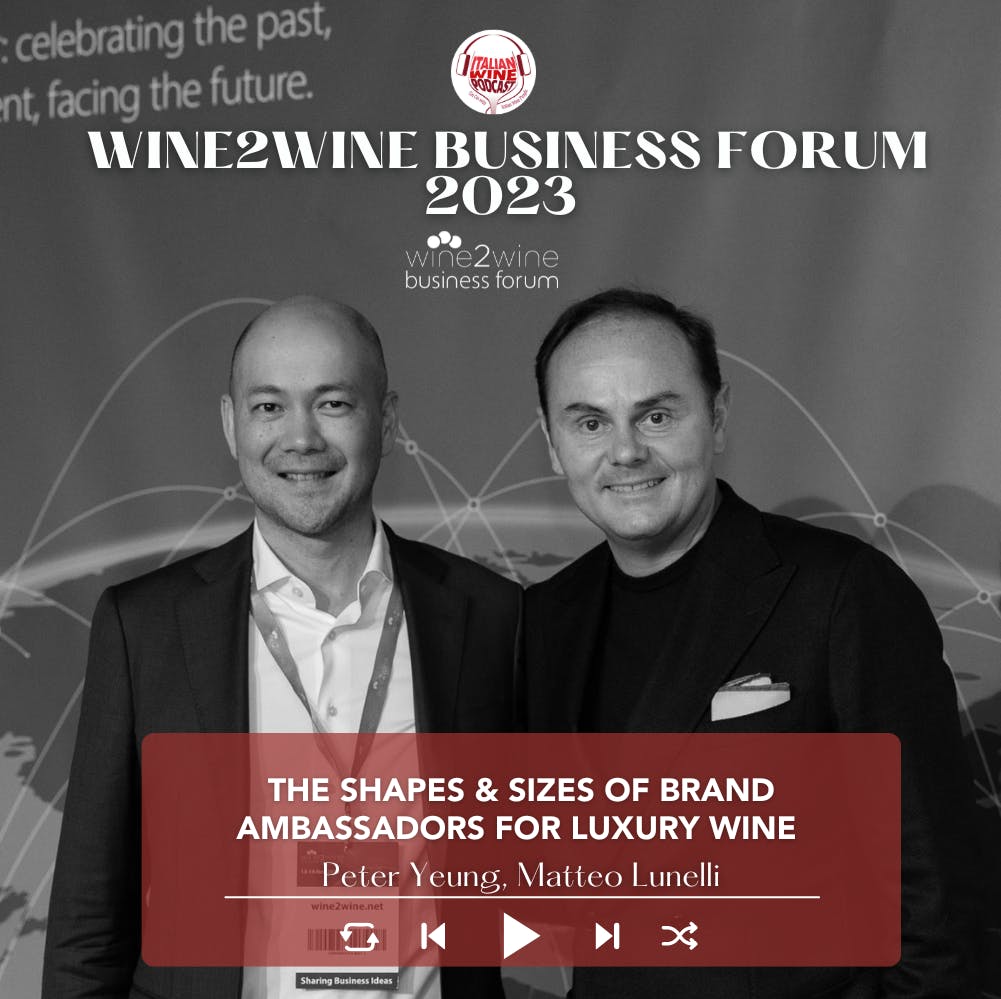
Ep. 1977 The Shapes & Sizes of Brand Ambassadors for Luxury Wine | wine2wine Business Forum 2023
wine2wine Business Forum 2023
Episode Summary
Content Analysis Key Themes and Main Ideas 1. The evolving role and definition of wine brand ambassadors in the industry. 2. The distinct functions of brand ambassadors for small vs. large wineries. 3. Essential attributes and skills that make an effective wine brand ambassador. 4. The significant return on investment (ROI) that brand ambassadors can generate. 5. The crucial role of brand ambassadors in navigating the US 3-tier wine distribution system. 6. Leveraging social media as a powerful tool for brand ambassadors. 7. Key events and engagement strategies for brand ambassadors in the US market. Summary In this episode of the Italian Wine Podcast, host Manuele Panin interviews Peter Young, a wine business consultant and author of ""Luxury Wine Marketing,"" about the pivotal role of brand ambassadors in the wine industry. Peter begins by defining a brand ambassador, noting the diverse forms they can take, from full-time winery employees to part-time roles or influential customers. He explains why brand ambassadors are particularly vital for luxury wines, where brand storytelling and ""pull"" are paramount. The discussion highlights the differences in ambassador roles: for smaller wineries, they are often founders or winemakers focusing on sales and direct consumer connections, while larger companies employ dedicated teams focused on education and trade relations. Peter outlines key attributes for effective ambassadors, including communication, charisma, storytelling, and authentic passion for the wine. He underscores the significant ROI of ambassadors, citing direct sales, long-term customer acquisition, market insights, and brand awareness. The conversation then focuses on the US market, where ambassadors are crucial for bridging the gap created by the 3-tier system between wineries, importers, distributors, and consumers. The importance of social media for ambassadors – allowing freedom of expression while aligning with winery messaging – and key US events for engagement (large food/wine festivals, charity auctions, and intimate customer dinners) are also explored. Takeaways - Brand ambassador roles are flexible, ranging from full-time dedicated positions to part-time responsibilities for existing staff or even influential customers. - For luxury wines, brand ambassadors are indispensable for communicating the brand's story and fostering consumer demand (""pull""). - Smaller wineries often rely on founders, winemakers, or sales/hospitality heads as ambassadors, with a strong focus on direct sales. - Larger wineries typically have dedicated brand ambassador teams, primarily focusing on education and trade outreach. - Effective brand ambassadors combine strong communication, charisma, authentic storytelling, and a deep passion for the wine. - Investing in brand ambassadors yields a high ROI through direct sales, increased customer lifetime value, valuable market feedback, and enhanced brand awareness. - In complex markets like the US, brand ambassadors are critical in bridging the communication gap between wineries and consumers within the 3-tier distribution system. - Social media is a vital platform for brand ambassadors to amplify winery messages; wineries should encourage authentic expression while providing guidance. - Key US events for brand ambassadors include large food and wine festivals (e.g., Wine Spectator Wine Experience, Aspen Food & Wine), charity wine auctions, and intimate customer dinners. Notable Quotes - ""Everyone at the winery should be a brand ambassador."
About This Episode
The Italian wine podcast is a successful industry and is crucial for brand ambassadorship. The importance of brand ambassadors is a full-time employee, and it is more important for luxury wines than commercial wines. The importance of sharing messaging and sharing successes through attribution and referral sources, identifying the right people to use in various roles, and being a good brand ambassador is emphasized. The importance of social media communication and setting up meetings for events like wine and food events, charity wine events, and wine and spirits events is emphasized. The brand is crucial for smaller winery to connect with importer, distributors, and clients, and is a powerful way to engage with audiences and promote the brand.
Transcript
The Italian wine podcast is the community driven platform for Italian winegeeks around the world. Support the show by donating at italian wine podcast dot com. Donate five or more Euros, and we'll send you a copy of our latest book, my Italian Great Geek journal. Absolutely free. To get your free copy of my Italian GreatGeek journal, click support us at Italian One podcast dot com, or wherever you get your pods. Official media partner, the Italian One podcast is delighted to present a series of interviews and highlights from the twenty twenty three one to one business form, featuring Italian wine producers and bringing together some of the most influential voices in the sector to discuss the hottest topics facing the industry today Don't forget to tune in every Thursday at three pm or visit the Italian wine podcast dot com for more information. I guess I will speak in English since the very beginning since Our guest, Peter Young is, American. And I think we also have, some international guests. So it's, it's a pleasure to be here, Charles Stevy. Evibel Trrentino. Steve, thank you very much for, for inviting me to introduce this session, which is, you know, I see many of you are coming. I think we are still competing with the launch. Which is which is always, which is always a tough challenge, but, it's, it's a pleasure to be here and to to introduce, this session, which, will, talk about, the role of Randall Ambassador. So I will, I look forward to hear from, Peter Young, who is, an entrepreneur, who is, specialized on the marketing on fine and high end wines. Peter is, a leading wine business consultant who develops strategic business plan and innovative market plans for the wine industry. He's, the author of the book Luxury wine marketing. And the host of X Chateau wine podcast, which gives insight, analysis, and perspective on news and trends of the wine industry. And, beyond my, Waimait King, he focused really on marketing, finance, and consumer trends. I think that, this can be particularly interesting also for the producer who are here because I believe that the challenge for all of us in Italian wine is to continuously reposition the image of Italian wines toward the luxury hand and to continuously provide more value to our great wines. We know that, Italian wine has great quality, as amazing tradition, we need to be better and better in making all the world understand how excellent our wines and how they deserve a luxury positioning. Inside of this strategy, I'm sure that, Peter will give us some interesting insight on the role of brand ambassador, especially in the US market, many of our wineries already have a brand ambassador selecting the right brands ambassador and making sure that it work closely with the winery and sometimes with the importer is always, extremely important. I believe that, most of all, we need to find somebody who share our values, share the vision of the winery. And is really able to embody the value that we want to display. But, I will not take a lot of time away from, Peter, and, I will, leave to you, Peter, the stage, for your presentation. Afterwards, I will perhaps comment and then we will open for question. So thank you very much and welcome Peter. Thank you for the kind introduction. I think, you know, you said all the takeaways already, so maybe I'm done, but when Manuel reached out for this year's wine to wine and said the theme was Italian wine Ambassador. I said I don't really know anything that much about Italian wine ambassadors and said, well, it's wine ambassadorship more broadly. And I said, okay. I I can work with that. And one one thing that's come up a lot for me in the last several years has been the role of, a brand ambassador for particularly for wineries. And how important they are and why they drive can drive a lot of revenue for different whiners, especially at the Hines, so especially for luxury wine. And, so this really presentation takes a lot of data and and research that I've collected Writing the book with Liz Tash, luxury wine marketing. It also plays into, my role helping to manage several high end California wineries, realm sellers in Costa Brown, in particular. And I happen to meet Bobby Suarezarez who is the senior manager of wine and Masters globally for Pierja Way and Mom at the master wine symposium this June. So I convinced her to get on the X Chateau podcast and did an interview that we published several weeks ago. And so a lot of those insights are also embedded in here. So this is a combination of all those different pieces of, of data. So the first thing is what are we talking about when we say brand ambassador? Cause it's a term used in many different ways. So defining it is pretty important. And, you know, it can be anything from a role. Like, I think Matteo has some people called brand ambassadors at his winery. And so that's a full time employee whose name is brand ambassador, and that's more common, I'd say, for larger companies than it is for smaller ones. It could be a full time employee that has the role of a brand ambassador as well as doing something else. So, you know, at Costa Brown, our winemaker, Michael Brown, was also a very good brand ambassador. And our head of sales Dan Costa was also a brand ambassador, but that wasn't their full time job, and they didn't have the title Brandon Baster. So it was a part time role. It was a role that was part of their jobs, but not like their main focus. To there could even be part time people or people who only have a loose affiliation that you sometimes will call a brand ambassador. At realm sellers, we had, this guy who was based in New York who was really a customer, but we gave him the title of brand ambassador. He had an email and some cards and He basically got paid in in free wine, but he helped us with events and connecting with a group of people in that region to help promote the brand. And sometimes we say, you know, customers are brand ambassador, whether that's a restaurant sommelier or a retailer or just, you know, a consumer of your wine, they can play a brand ambassador role if they're promoting a brand. And so sometimes we use that language as well. And, so I just wanna cover all those bases and say that today, we'll focus primarily on the first two people who are employed by the winery and play at least, you know, significant role as a brand. So why is it more important for a luxury wine versus more commercial wine And I think because the brand's story is so much more important at the higher end of wine where what you're really trying to do from a marketing perspective is create pull for your wine and pull for your product. So for instead of, you know, more commercial wines where you're trying to push that product into a restaurant, into a store, into a part where it's the packaging, it's the placement of where the wine is that's driving a lot of sales, that pull of a brand that you know about and you're actually searching for. So, you know, one could say the easy example would be something like DRC or domain to the Romini Conte. People have heard of that wine. They know the story behind it. They know it's like the best burgundy in the world, so they're going out and seeking it versus, you know, Obero de Valaine going and saying, Hey, can you buy my wine and put it on your shelf. Right? It's the opposite. And so In those situations, the story is so much more critical. So for luxury wines, it's sold in different places and fine wine retail, high end on premise, and, direct to consumer in certain markets like the US or Australia and New Zealand. And and so the story is so much more important than it is for commercial lines and why there's a need for people to at least play the brand ambassador role if not have a group of people that are called brand ambassadors. That said, I try to promote this idea as much as possible that everyone at the winery should be a brand ambassador should play the brand ambassador role in some way. Because the people who are working for you, your team, them sharing the same message that you're sharing externally is critical to having, you know, authentic connection with all the people that, you know, come in contact with all the people of the winery. So making sure that even people on the winemaking staff, even people in accounting, you know, or other things that aren't really actively talking to customers and promoting the wine, see the same messaging that you're sending out externally so that they can share those same messages and convey the same details so that everything is aligned and, you know, is is consistent and more authentic to what it is versus if they're saying something else and your marketing person is saying something different, then you may not have that alignment that ripples through the market. I I think that people should be generous with their employee wine allocations to make it easy for people to share the wine. Right? So that they, you know, can have the opportunity to go to friend's houses or, you know, for the holidays and whatnot and bring your wines to share. And may and don't not feel bad that they're, you know, giving away something of of tremendous value, which is some luxury wines can be. And then when it's possible, celebrate the successes as a team. So that if You know, you're doing that ideally through tracking customer act with attribution and referral sources so that you can understand the impact that you're having as a team getting the word out and understand when successes happen so you can celebrate them and and reinforce that culture within the line. One of the key differences, and I talked about this a little earlier for brand ambassadorship, and their roles and how it differs is between smaller brands and larger ones. So when you're a smaller company, you know, like, this end here is Harlem Estate in Napa, just, you know, about two thousand cases or so. It's usually a part time role for a full time employee. Like I said, at Costa Brown, it initially it was, you know, Michael Brown and Dan Casa, the founders who played mostly that brand ambassador Ambassador role as they as we grew and they left and they weren't actively involved anymore became the head of of sales and marketing. But so at at smaller wineries, usually it's, you know, part time role. It's usually, more sales oriented. So they'll build their network with consumers and with, you know, people who are buying your wine customers and their friends to try to expand the sales delivery, sales effectiveness of of the winery and the brand. And so I think the sales element is a much more critical component at a small winery than when you're at a larger winery, like the example of Pierce Jouais from the podcast, they have a team of thirty people globally that are have the title of brand ambassador And they're primarily focused on education and educating the trade primarily or doing different events and trade, trainings. And they don't act they're not actually responsible for the sales because they have a whole separate sales team. And a whole another marketing team. So they don't do any of the marketing. They don't do any of the sales. Their literal role is just as brand ambassadors primarily to educate trade. So it tends to be more education focused tends to be more trade focused because when you're a lot bigger, you're mostly selling into trade versus direct to consumer. When that happens in your when you're bigger, your production size is bigger. So you got more wine to to go around. So what are some of the key attributes of a good brand ambassador? Well, of course, being able to communicate clearly is important. I think what's important is being able to identify in a room, say you're at a dinner or at a charity auction or some other event. How do you identify who you should talk to, who you should make connections with and who will be someone who can influence other people? That I think is something that the great brand ambassadors end up developing as a skill set and and figure out what's really what's really effective. I used to call those people at at Ramcellars, where the founder WAN was the brand ambassador for the most part. We I, you know, I went around. I asked him, like, how do you, how do you become so good to this? What's the secrets behind it? And he's like, well, some of those customers who they may buy a lot But they don't actually influence a lot of their friends. They don't talk to they don't promote it with their friends. So some customers that actually don't buy that much, they buy a little bit, but they're a big fan of your brand, but they're very influential within their little line community in their area. And that's actually the person that you need to get to know better. So we I kinda coined the term for him, like the collector connector. So it's both the wine collector, but someone who's also connecting. And we would do wind dinners occasionally and You know, it wasn't us selling the wine or getting people to sign up for our mailing list. It was the customer doing it. And so that being able to figure out who those people are and identify those and build those relationships is really important. Having some charisma is always helpful. It's usually not hurtful unless it's in a bad way. But it's not that doesn't mean that you have to be the most outgoing person in the world to be an effective brand ambassador to use the example of Lon from realm again He's actually an introvert and, you know, but and so it takes a lot out of him to do what he does for a living, but he's also a great storyteller which captivates the attention of the people he's with. And he's a great connector in and of himself. So one of the things that I learned being around him was that he was creating value for his, customer network outside of the wine itself. So, yes, we made great wines and tell about that and where it's from and whatnot. But he would he would say he would look at you and say, oh, you're you're wearing boots. You do like boots. Is that interesting for you? And then I happen to know this guy in Chicago or wherever, who's this great craft artisan of boots. And one of the things when you're working in luxury wine is you get to meet a lot of other people who do really interesting things and are generally are pretty good at their craft or their profession. Because they can afford the expensive lines. And making a lot of those connections is super valuable within a group and keeps that group generating more on its own. So we had dinner once in Atlanta with the chairman of the NYSE who was asking us for connections being based in, you know, San Francisco and Napa for connections in the Silicon Valley to feed his pipeline of companies into the NYSE. And so that sort of like connection and value add outside of the wine itself is, I think, for me, what makes a huge, what makes a great brand ambassador, especially for luxury wine. And then of, of course, you need to be passionate about wine and particular your own lines because if that's if that's not authentic, then you got a big problem. So who are the people who are naturally good candidates to be brand ambassadors? And I think again that same access of smaller brands versus larger brands is important. With with smaller brands, people like founders or family or the winemakers are so tied in and have such deep connection to the winery that they are great candidates if they're open and willing and able to do such a take on that role, or it could be heads of sales and hospitality because oftentimes you're using hospitality, to build or to to either initiate or build a connection. So when VIPs come, you want you often want your brand ambassador to be the one hosting them so that they engage with them and are able to build a longer term connection or they went and met someone at some other place some other event, and that person happened to come to where your winery is. And and then you that same person hosts them so that you're building a deeper connection and really, expanding on the the level of connection, and it doesn't have to be like, you know, you don't have to see someone every month to really build a good connection and and and wine. It could be once or twice a year even, and I think that really starts to build over time. For larger brands, you know, often because it's more education and more trade focused, having some of the common wine credentials, it is important, like, if you're a master wine or a master sommelier or whatnot, people or wine educators, the Pier Jouet team, I talked about, their team in both Japan and France actually teaches the wine scholar Gills, Champagne certificate, and they help create it. And so they're promoting Kerjouet and mom, which is also in their stable, but also Champagne in general. And so being being that person who is seen as the authority, for that category is very helpful in the role of Brandon Master and saying then, and a great example of this happens to be peers away, right? Or or mom or or whatnot. And then wine sales people also can be very effective at at being a brand ambassador for some of the larger brands. You know, I don't know if this is still true today, but I know prior to COVID, a lot of the boardalay were sending their children to Hong Kong and China as brand ambassadors to build their network out in that region that was for a while, the most important wine region or customer base in the world for Buroro wines. So why why do any of this and hire these people? Because the ROI or the return on investment can be very, very good. If you're doing direct sales and direct to consumer and that person is responsible for sales, There's an easy correlation to see like how much revenue they bring in versus how much, they cost. I think it's important to look at the long term benefit of some customer new customer acquisition. So not just the sales are bringing today, but if they're bringing a new customer, is the lifetime value of that customer is a lot more than one year's worth of sales. It might be, you know, ten times or whatever the number is. And that's a much higher number that you wanna give that person credit for. Than just like an immediate sales number to anything from actually getting more market data for wineries that are primarily wholesale driven. They, you know, especially if you're in Bordeaux or something like that and it's going through Lapplause and then importers and retailers and merchants and and whatnot, you don't often know what's happening in the line or the feedback you're getting if that resonating with consumers or not. If your story resonates with consumers, if your pricing is resonating, you you get some of that from the trade as feedback, but you could get actual, real data, more data from consumers with the branded masters actually talking to them. And then, of course, building brand awareness is also very important, but harder to to quantify in a lot of cases. So how do you get the best? How do you select the right person for your winery? You know, I I use this example of Dana Patrick, because, I don't know if she's here. Amanda Macrosson, I was looking at her podcast, Wine Access, unfiltered because we were doing an interview for X Chateau, which I think is coming out soon. And she interviewed Danica Patrick. And, you know, I thought, well, gosh, if if the wine brand ambassador for her brand doesn't know anything about race car driving, like, if she hired me, I would be terrible at it because I don't know anything about race car driving. I couldn't tell you what the difference is between F one or NASCAR or anything like that. So and I think Ferrari is a a sponsor, right, of of one of those, and I don't even remember which one because that's how terrible I am in knowledge of race car driving. That I would be a terrible choice. Are you enjoying this podcast? There's so much more high quality wine content available for mama jumbo shrimp Check out our new wine study maps, our books on Italian wine, including Italian wine unplugged, the jumbo shrimp guide to Italian wine, Sanja Vazzy Lambrusco, and other stories, and much much more. On our website, mama jumbo shrimp dot com. Now back to the show. And the regional fit can also be important. I was in Singapore, where my mom is from. And I was speaking to a importer of wine who said I and I'm I'm pretty sure it was Harlan. If my memory serves me right, there's a few years ago, hired someone French to be their brand ambassador in Asia. And he said that just didn't work. It just didn't for it didn't resonate because they, you know, they would expect someone who's American and can really talk to the Californian, ethos of of wine or someone who's local. Who can, you know, understand more of the local customs and how California fits in into the local context. And so that I think was a short lived experiment and they replaced it with someone who was American, I believe. But having the right fit for the right region that you're targeting because usually brand ambassadors cover like an area like a salesperson. They have like a region, is also important. And then so, you know, what are the key takeaways here of this presentation, that brand ambassadors can have all sorts of shapes and sizes. That's the the title of the presentation, from part time, role to a full time position. The size of the winery has a big impact on who the potential candidates are to play the role, and what role they play. And, you know, I think the ROI can be quite high for having the right and good brand ambassador. We talked about the different ways of which ROI is generated. And that selecting the right ambassador really needs to incorporate the unique elements of the winery and, other relevant attributes like, like the regional position. So Yeah, that's my presentation. Hopefully, there's some knowledge there that's useful, and then I think we'll do some Q and A. So thank you very much, Peter. I think, as you mentioned, when we speak about the brand ambassador, obviously, it's a it's a large concept. For smaller winery, as you mentioned, it's usually the the family or the owner or the winemaker who does it directly. But, obviously, for a winery that grows and wants to position on, appropriately on different markets, then this model obviously became, becomes less scalable because you also need help to these people, West do who have to, to focus on their on their job at the winery. So, Yeah. But they can't do it all. Right? You're you're No. I I do my part because, obviously, I I need to do it but, then we need, for example, I think that what we can focus a little bit more, since it's, probably the market you know best is the United States. So if we look at the market of wine in the United States, there is the three tier system. So normally, if you take away the the the the the few wineries that have a direct distribution, so have their own importer in the in the United States, which in Italy are very few brands. Most of the brand have an importer and a distributor. So usually this the risk of this three tier system is that the winery is far away from the market. So in my opinion, the role of a Brenda Master is really to, to be a key person that links the winery to the importer, to the distributor, to the client, and make sure that the information goes up to the winery and help the winery itself to define a strategy. So that's, I don't know if you wanna comment on that, but that's certainly in the United States, a very crucial role. So we have, we started many years ago with, our brand ambassador at Ferrallitrento was Janie Stewart, who was, he was, he is, an m sommelier, who had a very strong experience on, in, in restaurant business. And he helped us in building a network of a community of, of, Somelier and customer that starts to love the brand and organizing trips to Italy. And so this has been end. In addition, it is somebody who helps you to to connect better to the market. Yeah. It's a matter of priority. Right? I think if you look at a distributor like r and d c, which is the number two distributor in the US, they have something like ten thousand SKUs in their portfolio in their book. Right? So you're saying for you, your wines are the most important because they're your wines. For them, it's somewhere on that rank of ten thousand and they can't pay that much attention to it. So they need help. Right? They're very good at what they do in terms of distributing the wine, collecting the tax, just delivering all those things, but that that's not. And the same for the importer, right? Your importers most likely not only carrying your wines and has you know, tens to hundreds of different skews and and wineries that they represent. So they're doing and promoting your job and hopefully doing work outside of what the distributor is doing as well, partnering with the distributor. And then the winery can then partner with with the others. I know, as an example, it's more a domestic example for the US, but the Duckhorn group, when they were owned by TSG, before they went public, their last ownership group, they expanded their direct sales force, seven times in their period because they saw the ROI was so good because they knew that the distributors weren't gonna be able to sell their wines on their own. So their salespeople went out even though it was all sold through distributors still except in California, but and that that had a huge uplift in their sales. And so it's very similar if you're on the export part to have a brand ambassador partnering with your importer, partnering with your distributor, and that's not to say they have to do work with all the time, but they can be independent we're doing work independently and doing work together, but always having that open communication and feeding in what's happening to your importer and your distributor so that, you know, the the flow is still there. Then something I wanted you to focus on perhaps is also the role of social media. So nowadays, we, the wire connects to his customer also through social media. So I believe the Brenda Masadore should enter into this, into this, let's say, game into this, social media communication. How do you think they can do it? Have you seen some best practice? Have you seen, what is your, what is your, your, your feeling? Well, Laura Catana, I think had a great presentation on social media earlier and about being different and posting things, more versus waiting for them to be perfect. But the brand ambassador, for sure, because the brand ambassador is gonna be someone who's at a lot of events, who's gonna be meeting people, who's gonna have the opportunity to take cool photos with interesting people and and really play the message of the brand over and over again. So they should have access to the account, whether it's a central account or their own personal account. And be amplifying the message of the winery everywhere they go, and should really be both both their personal and the the winery account. Obviously, on the winery, then it sometimes become difficult because obviously for the brand to manage his image is always very delicate. But, you know, each winery should define probably is on, equilibrium also depending on the knowledge and the expertise of the brand ambassador itself on social media. I think that, for example, if my personal view is that if the brand ambassador as his own account, is more free to express itself, and it can give a different angle versus the the the winery account. But the the the idea is should be that, the the account of the Brenda Master should create traffic and link and tag the the winery account. So it's, especially if we are talking about, for example, Instagram, which I believe you will agree is probably the most important one. Yeah. And I think one of the keys is not to be too restrictive. To let them to provide feedback. So if they're doing something, you don't like, tell them I don't like that. And here's here's a better way to do it, but to give them some freedom of expression because you want them to post more versus less, because for something like social media, it's relatively short lived. It doesn't have, you know, for some, like, Snap or TikTok or others. It's gone after a few days, right, or or weeks. And then it's usually not very searchable. So it's not something that lasts a long time. It's not like writing a book that hopefully is relevant for decades. And, you know, you'd wanna be more careful and measured about what you say there, but, it's something that short lives. So let them have more freedom of expression and then provide feedback in a constructive way of what they could do better. Another question I wanted to ask you is, which can be useful for our audience is about What are the events, the main events which you think a Brenda Ambassador should attend in the United States, if we are talking about luxury and fine wines, because all of us probably know about some of them, but you can have a different angle or inputs. Yeah. I think in the U. S. There's three main types of events. There's sort of like the big wine and food and wine events, things like the wine spectator wine experience or wine and spirits, top hundred, or, you know, Pebble Beach food and wine, Aspen food and wine, nantucket, etcetera, that are pretty big. They have a broad audience of people. You're one of dozens of producers, if not hundreds, pouring, you know, at the at the event. And while they can be really powerful to build connections and things, I think cutting through that that Hayes or the the the the competition cutting through all the other people around you requires either having a seminar or setting up meetings outside of that. You know, I think of the people who are most effective when they go to VIN Expo are mostly setting up meetings in advance because all the people are there as opposed to just, you know, pouring or wandering around and randomly meeting people. So I think being a speaker or doing a presentation or special tasting or having even a small event outside of the main event can be a powerful way to engage, within that kind of context. Then in the US market, there's a lot of charity wine events. I I remember someone, I think maybe Danny Breger was mentioning, the pebble be or the Net Naples, wine auction. There's things like that all over the country, like the high museum wine auction where a lot of pretty affluent people who are pretty into wine within their region are there, and you're gonna have other wineries there, but that's a little bit less, competitive and more relaxed space to really start to get to know people. We would often do at at realm sellers like dinners with customers in that region around there when we're there. And you meet people there and then build a relationship and then do wine dinners with them around the same time when you're back the next year or some other time. So that's another good one where I think the right customer base is there. And then, you know, there's also much smaller wine events where it's more intimate and you can have a deeper conversation with these consumers. So that could be you know, a tasting or presentation at a country club or wine storage facilities sometimes have, events, or even like customer dinners is a big one in the US that a lot of direct to consumer brands will do where we'll have a dinner at a customer's house. They're providing the food or cooking themselves. They're often even providing the wine that they've bought from you, and you may bring some special bottles, but you're showing up there. And for them, it's a great benefit because They show off to their friends. Hey, Mateo from Ferraris here at my house. Right? And I have this relationship with him and we're drinking these special wines and he probably brings a special bottle that is hard to acquire for there and you really get to meet their friends. And as I said earlier, those hosts that are good at then saying, and you should buy Ferrari's wines. If you have wine to offer something like that or sign up for their email list or their allocation list or whatnot. Those are the types of people you want really want to target for those kind of events. Just going back to the main events, you mentioned, so the wine experience of wine spectator, you mentioned Aspen Nantucket is, which I heard is organized by, you know, about it? It's similar. It's a food and wine, like, event, yeah, on the island of Nantucket, which is a resort vacation town and outside of Boston. And then you mentioned the top one hundred Oh, yeah. Wine and spirits, stop hundred. Which takes place in, San Francisco, and I think they may have I'm not sure if they have one in New York maybe. Okay. So I think our time now is up, but I I guess we we really said many interesting thing, then obviously each winery will choose its own strategy. Something that you also mentioned is that the fact that the brand ambassador can be more or less involved in sales. Obviously, you know, for example, at our winery, we tried to balance the two objectives. And so our band ambassador has also been involved in sales, but as well on education and and and managing the community. But, so each one of us will find its own strategy in the future, but I think your comments and insights were were very helpful. So I'd like to thank you very much. So let's give it a close to Peter. Listen to the Italian wine podcast wherever you get your podcasts. We're on SoundCloud, Apple Podcasts, Spotify, email ifm, and more. Don't forget to subscribe and rate the show. If you enjoy listening, please consider donating italian wine podcast dot com. Any amount helps cover equipment, production, and publication costs. Until next time. Chichi.
Episode Details
Keywords
Related Episodes

Ep. 2570 Promoting wine - achieving success in a hostile environment | wine2wine Vinitaly Business Forum
Episode 2570

Ep. 2561 An Inside Look into Wine Enthusiast’s 100-point Rating System, Upholding Blind-Tasting Protocols, and Scoring Non-Imported Products | wine2wine Vinitaly Business Forum
Episode 2561

Ep. 2402 Margherita Andrenacci interviews Erin Kirschenmann of Wine Business Monthly | Next Generation
Episode 2402
Ep 2332 Compiling a Vintage Report with Michaela Morris DipWSET, IWE | wine2wine Business Forum 2024
Episode 2332

Ep. 2239 What’s next for wine – What wine for what’s next | wine2wine Business Forum 2024
Episode 2239

Ep. 2145 The influencer marketing playbook | wine2wine Business Forum 2023
Episode 2145