
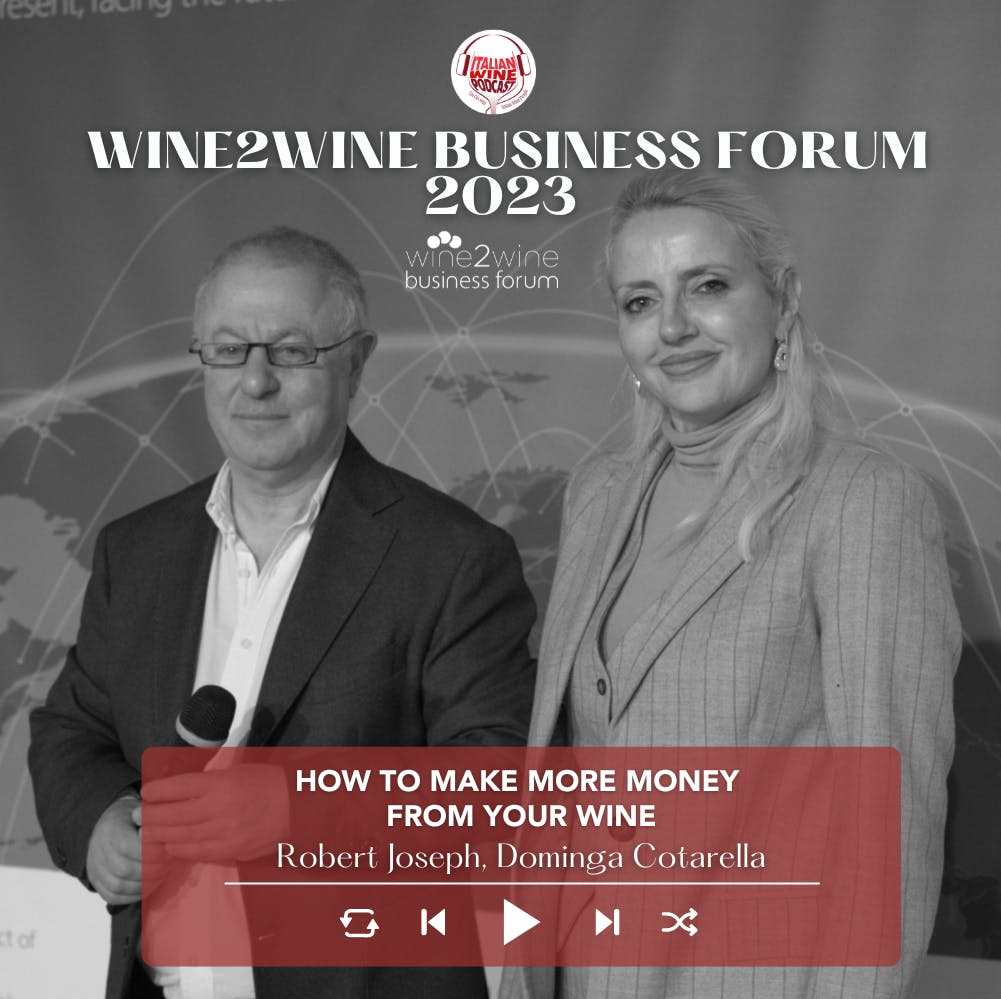
Ep. 2033 How to make more money from your wine | wine2wine Business Forum 2023
wine2wine Business Forum 2023
Episode Summary
Content Analysis Key Themes and Main Ideas 1. The Shift from Customers to Fans: The central argument is that the wine industry should stop chasing ""customers"" who buy based on rational factors like price or scores, and instead cultivate ""fans"" who buy emotionally and are loyal regardless of minor fluctuations. 2. Critique of Traditional Wine Marketing: Robert Joseph challenges conventional wine marketing practices, including reliance on terroir, historical narrative, appellation systems (DOC/DOCG), and cost-plus pricing, arguing that these methods commoditize wine and hinder brand building. 3. The Power of Emotional Connection and Branding: He asserts that wine, like luxury goods or fashion, is an emotional purchase. Successful brands tap into desire and create an emotional bond with consumers, leading to premium pricing and loyalty. 4. Transcending Appellations: Wineries should strive to rise above the commoditization inherent in appellation systems by building strong individual brands that stand out, rather than being pulled down by bulk wine prices or regional averages. 5. Rethinking Pricing and Distribution: The speech highlights the flaws in cost-plus and competitive pricing, advocating for value-based pricing driven by perceived brand value and the selection of distributors who understand and can convey that value. 6. Modern Marketing and Content: Joseph touches upon the evolving marketing landscape, emphasizing the importance of rich, emotionally resonant content over traditional SEO and factual information. Summary In this address at the One to One Business Forum, renowned consultant winemaker and author Robert Joseph passionately argues for a radical shift in how the wine industry approaches marketing. He posits that wineries should stop selling to ""customers"" who seek rational value and start cultivating ""fans"" who are emotionally invested in a brand, much like fans of a music band or a sports team. Joseph critiques traditional wine marketing pillars such as terroir, historical narratives, and appellation systems (DOC/DOCG), claiming they often commoditize wine and create a race to the bottom in terms of pricing. He asserts that pricing based on cost-plus or competitor rates is ""stupid"" and that wine is fundamentally an emotional purchase, akin to luxury goods like BMWs or iPhones. Successful brands, he explains, like The Prisoner or even specific Aligote producers, transcend their appellations by building a strong emotional image rather than relying on regional identity or factual superiority. He urges producers to differentiate their messaging, focusing on the consumer's emotional experience rather than self-centric stories of soil and history. Joseph concludes by urging the industry to stop selling wine as a mere product and instead sell an emotional experience, building fandom rather than just customers, and embracing content-driven marketing over outdated SEO strategies. Takeaways - The wine industry should prioritize cultivating ""fans"" (emotional, loyal buyers) over merely acquiring ""customers"" (rational, price-sensitive buyers). - Traditional marketing based on terroir, history, or appellations can lead to commoditization and hinder premium pricing. - Wine is an emotional purchase, and successful branding taps into desire and emotional connection, similar to luxury fashion or technology. - Appellation systems, while offering intellectual reasons for existence, can paradoxically drive down prices by creating a baseline for cheap production. - Cost-plus pricing and pricing based on competitors are flawed strategies that limit profitability and innovation. - Wineries must transcend their appellations by building strong, differentiated brands that stand out. - Effective wine marketing focuses on the consumer's experience and emotional response (""about them, not about us""). - Future marketing will rely heavily on rich, emotional content that AI can leverage, rather than keyword-based SEO. - Marketing budgets in wine are often significantly lower than in other luxury goods or spirits industries, contributing to branding challenges. Notable Quotes - ""You don't want customers... What you want is fans."
About This Episode
The Italian One podcast introduces a series of interviews and highlights from 23 to 1 business form featuring Italian wine producers and wine business international representatives. The hosts emphasize the importance of having a clear and coherent story for customers and fans, and discuss the differences between customers and fans in the movie industry. They also discuss the challenges of raising prices for wine and the importance of messaging in the industry. The speakers emphasize the need for passion and enthusiasm in the wine industry and encourage people to stop selling wine to customers and start selling an emotional product that happens to be made of grapes and comes in a bottle with a cork or screwcap.
Transcript
Who wants to be the next Italian wine Ambassador? Join an exclusive network of four hundred Italian wine ambassadors across forty eight countries. Vineetly International Academy is coming to Chicago on October nineteenth is twenty first. And Walmatikazakhstan from November sixteenth to eighteenth. Don't miss out. Register now at Vineetri dot com. Official media partner, the Italian One podcast, is delighted to present a series of interviews and highlights from the twenty twenty three one to one business form, featuring Italian wine producers and bringing together some of the most influential voices in the sector to discuss the hottest topics facing the industry today. Don't forget to tune in every Thursday at three PM or visit the Italian wine podcast dot com for more information. Good evening, everyone, and thank you to be with us at the last panel of the day. So you are great, great people. So, it's a real honor for me to be here. Really, in one to one business, forum, but, it's an honor to introduce our special guest. His career, his experience story, are really a great example, a great model to be inspired by, to tell in two words, your experience is noisy. I try. I tried, but I, in two minutes, I'm going to leave you, the scene. Just the words, consultant, winemaker, other of, as many as twenty five books on wine, Israel, some something more, co owner of Lagarnois, cocreator of greener planet, associate editor of manninger manningers, wine business international, and a lot of new projects. What can I say in life, Robert? There are two kinds of people. People are just spectators of their life, and people have the main protagonist of their life. Your experience, I should say it's really, really an example, a model for a lot of people, not only for young people, but even for people who are involved in wine industry for a long time, like me, like, you know, a lot of people in front of us. So thank you. Thank you so much for your example, concrete, coherent example, and I it's my pleasure to introduce Robert Joseph. Thank you. And thank you all for coming because this is the you are the hardcore, and I love you being the hardcore here. So I don't know if we end this presentation mode. Are we working yet? Yes. We are. So, I don't know what I ever did to to Stevie, but Stevie loves to give me this last slot and loves to give me a really easy topic. Like, how to make more money from you? I nothing seem nothing complicated about that. Anyway, I'm gonna try in forty two minutes and thirty nine seconds. So what I want you all to do now and by the way, you're all gonna need to get a notepad, piece of paper, do it in your phone, or whatever. I want you all to imagine that you're not in the wine industry. That may be difficult for some people but just try, please. Now I would like everybody now quite quickly to write down the name of one branded product that you buy and pay a premium for. You pay more for it than you need to. So I'm gonna show you some suggestions here. So anybody who, would shop from bottega Veneta, or, obviously, the owner of Senior Vino, or an Alfa Romeo or BMW, just well, don't don't watch me write down something yourselves. I'm just giving you some thoughts here. Nurofen is ibuprofen. Any supermarket will sell you the same product under their own label. Barack is a multivitamin pill any pharmacy will sell you something that does the same job, but you will pay a premium for those. You can buy more expensive coffee than La Rata. Ili, but they are more expensive than the supermarket owned label, which might be similar or as good. That anybody know what that is? Yeah. It's the iPhone. You know, it's the iPhone for the number of lenses. Montblanc, Burberry, had to be patriotic to my country. Claren's Emez remover, very expensive suitcases. Everybody written down something? Now the thing that you chose, did you choose it because it had a hundred point score? Did you choose it because any critic anywhere? Did you do a lot of due diligence online saying, is this better than that? Or did you choose it because at some point in your life, you had decided or somebody had persuaded you that it was better than the other things for you. Not saying it was better. Not saying that Stella McCartney is a better designer, but you might say Stella McCartney suits me better or not me necessarily. But somebody might say Aman suits me and somebody else might say Versace suits them. But we have all made our own choices By the way, quick question. Stella McCartney, well, we kind of know her father and stuff, but any of these other brands, do you all know the stories? If I go back here to another story behind I'll be behind Lavats behind BMW behind Burberry. When I ask people, not usually. So that's quite interesting because we've all been told over and over again that it's all about stories And I have a bit of a question there about whether we really know the stories about the products that we buy, and we're all thinking that, oh, if we just have a story about our why and everything's gonna work. So I was at a conference literally four days ago in, gold in Quimbra, and Bruce Dickinson of Iron Maiden, the heavy metal band that I don't listen to very often, but twenty million albums, and he gave a terrific keynote presentation, and I have stolen a little bit of it here. You don't want customers. Is that a bit strange? You know, we're selling stuff? Why would we not want customers? What is a customer? So this is a customer. These are customers. They are wandering around a store, and they will leave that store without buying anything. They wander down the streets every day, looking at it, oh, I'll look at this. That's quite nice. Maybe I'll buy that tomorrow. Or maybe I'll buy it online next week or whatever. Those are customers. What you want is fans. Dickenson gets a lot of fans, but what he says is that fans, the difference between a fan and a customer It's a fan, it's somebody who actually wants to buy your product, whatever happens. So these are people queuing up for something. This is in India, people queuing up to buy the iPhone. They don't even know if the new iPhone is better than the old iPhone. It probably is. Is it worth the money? I don't know. I just need the new iPhone. And when I think about fans, I think about music. Obviously, it's being prompted by Bruce Dickinson. Some of you may be old enough to know, Van Morrison or, Bob Diller. They're both interesting because anybody who has been to a few concerts has almost certainly had a bad experience. Van Morrison, who's one of the great songwriters of the twentieth century and early twenty first century, is one of the most unpleasant human beings on god's earth. And when he's in a bad mood, which is usually the case, he is not much fun. And it the story, and I can't swear this is true, but the story is that when he's booked to do a ninety minute gig, if he's halfway through a song, at ninety minutes, he'll just walk off halfway through. I may be exaggerating, but that's the story. He is the living opposite of Bruce Springstein. Bruce Springstein just sings and sings as no breaks. He goes through. He just gives and gives and gives. They both have millions of fans. The difference though is that if you go to a Springsteen concert, you know you're gonna get a great experience. If you go to a stones concert, you know you're gonna get a great experience. Beyonce, the same. With Van Morrison, you don't. Bob Dylan, it's famous for trying out new stuff. And if you go on the wrong night and if the new stuff doesn't work, you may not have a good time, but you're a Bob Dylan fan or a Van Morrison fan, or in my case, the fan of a not very good English football team. Which I will go along and watch Loos. And I'll still go and watch them lose next week because I'm a fan. So what is the difference between a fan and a customer, a fan in the Napa Valley joins a waiting list to buy the wine. They don't know how good the wine is. The wine hasn't had its hundred points yet or whatever. They just want the Harlem Estate or screaming eagle or whatever it is. And there's a whole thing here telling us how to join the right kind of list. You can have a founder's list or a mailing list and whatever, and what is going to get me the greatest chance of getting hold of that why. That to me is fandom. It is the opposite of waiting and thinking, oh, hey, that's got ninety five points or a hundred points or it's attractively priced or whatever. These people are not looking at it rationally. It's a desire, and it's the same desire we see in fashion. How often does anybody say, oh, what a beautiful pair of, Labusian shoes? You know, they're great value. When did anybody buy shoes because they're a great value? You buy shoes because you love the shoes. So let's bring back to wine. What stops a wine from being like these other products? Now I may shock you with some of the things I'm gonna say. Your DOC, your DOCG. How can we say that? This is some this is the pillar of the cathedral of wine. So Aldi, Barrolo, twelve euros ninety nine. It's not great. It's got three point one on Vivino, but it'll be okay. It'll drink okay. I don't have the price on the little Brunoo. I have to say that Little are also brunello at the moment. But, you know, keep watching. They'll have some, trends on the size of the harvest. Now what does that mean? What it means is that I am gonna go to the bulk wine fair, in three days time in Amsterdam. And I'm gonna wander around and there is gonna be a whole raft of wine for thirty, forty, fifty cents, a liter. This year, a bit less because we've had a short harvest. But, you know, whatever the year, This year, there will be New Zealand bulk wine because New Zealand made more wine. Last year, there wasn't any New Zealand bulk wine, but there's also shabbily. There's also Kianti. Maybe some barolo. So the prices at the Belt wine fair go from thirty cents to five dollars a liter. What it means though is that each of those wines is a baseline for that Appalachian or DOC. So that if I am in Rioca, let's move out of Italy for a second, somebody is selling Rioca at that price. And there is Bordeaux Roush at those sort of prices. And what does that mean? It means that we have uprooted ten thousand hectares of Bordeaux, and we are going to uproot ten thousand hectares of Riocha. And we are almost certainly going to be up routing vineyards in Italy and other vineyards in Europe because the problem with the Appalachian system, the DOC system, is it commoditizes wine. It means that the Swedish monopoly or Tesco in the UK or Costco in the US says we want to buy cheap Pino Grigio. We want to buy cheap chianti. They will buy the cheapest drinkable chianti or the cheapest drinkable chablis they can find because that's what they do. They are retailers. How does that affect me if I am a producer of Shelby or Chianti or whatever? I am competing with them. And the big problem with this is because I am competing with them and I'm bringing my price down. What do I not have? Any marketing funds? So I have maybe most wine businesses, and you may, have your own figures, but five to seven percent. Is the marketing budget for most still wines, heading up to compared to twenty, twenty five percent for champagne or spirits. So if we're gonna launch a vodka, we are going to build into our vodka brand a lot of money to get all of those bars to sell our vodka. We're gonna have a lot of money to get into duty free. We're gonna have a lot of money against money on advertising and pouring. With wine, we don't have that. Wish champagne, we do. And the more private label and cheap versions of our appylations we have, the less money we have to promote our brands, and the less able we are to compete. So it's a spiral that makes everything cheaper and cheaper and cheaper. There are exceptions If you are in Bruno or Barolo or Margolo or Margo or Pojak or Napa, that's easier because everybody's pulling those. In those places, prices are pulled up by the top. But even so there will still be cheap versions of Margaux, for example, and certainly in France, Santemillion is the case. There are people who are able to buck this trend, and this is the interesting thing. Robert, do you prefer the question at the end or Anybody stop it, whatever, please? I have a question. Go ahead. Yeah. You talk about appalachian. Yes. We agreed that appalachian had to be to involve claim. But in a country like our country, in Italy. We have more more or less three hundred seventy DOC. I thought it was more, but yes. We have seven a seven eight DOCG. Yes. So for a little, not the big one, for a little producer, for a little winery, it's not easy to move outside. You're right. But the problem for me, and I'm not against them, but the problem with them is they encourage laziness. Because what happens is I then I trust the consortium to make it all happen instead of me making it happen. I always say that every region, every wine region wants to have its own Apple, DOC or whatever, like every country wants an airline. Well, I got news for you, Swiss Air went bust. Swiss Air belongs to Lufthansa. Air Gabon in Africa didn't have enough people who wanted to fly on air Gabon. The fact that we've created a DOC does not mean that that DOC has a commercial reason to exist. It may have an intellectual reason to exist because it has a particular grape, a particular soil, or whatever. But it does not necessarily have a commercial reason to exist. There's no necessary people are not gonna come and buy it. So that's that's our problem. So within the appalachian, whether you're in a small one or a big one, it is up to you to transcend the appalachian. You have to say, right, I'm not gonna be pulled down by what's happening in Aldi and Little, I have to be above it. So here is my example, when I lived in Burgundy, Aligote was the acidic, basic wine that you blended with black currant to as a as an aperitif. Nobody with money or taste to drink Aligoti voluntarily at any kind of smart dinner or whatever. There were a few good producers. It's true. The owner of Romani Conte had his own Aligoti video. So please, it was rare. Today, Koshduri can get three hundred and thirty euros for a bottle of Aligote. I think it's over four hundred. So it is possible within a category or an appellation to transcend it, but it isn't easy. And the best example in Italy, of course, if we look in history was Gaia in Babaresco. Before Babaresco, became a more expensive appelation, thanks in part to Guy. In the US, we don't have the same model of appelations. As we do here, they have appelations. Napa is definitely in appelation, but it's not quite the same here. Because we don't have the restrictions on grape varieties and yields and so on. But these stories, I think, are quite interesting because Donald Vineyards in Paso Robles, how familiar is everybody in this room with Paso Robles as a US appellation, a few hands, but most people know Napa. Most people know Sonoma. The expensive vineyards are in Napa and Sonoma. They're not in passive roblets. But the pro this producer, these two brothers in in in Lebanese guys have managed to create a brand that transcended their regions sufficiently for a Australian based multinational global conglomerate to, I think, stupidly, but it doesn't matter, pay nine hundred million dollars to buy the brand, possibly even a billion dollars because they had created enough of an image for their brand in a secondary if you like Appalachian within the US, within California. And even more to the case, the prisoner, which was is basically had no home This is a brand created by a guy called Dave Finney. Basically, he was blending different grapes, including what we would call second class grapes from all over the place, and he these were California, blends, And he gets here, we've got fifty dollars or fifty euros for one. The prices go up to about a hundred, and Constellation paid two hundred and eighty five million dollars for his brand with no winery, with no vineyards why and how did he manage that? Because he had this extraordinary label from Magoya Print, which is, you know, why would you have a label of a man in handcuffs on a bottle of wine for goodness sake? But he did called it the prisoner The blend was attractive. He did get some good scores, got into restaurants, it took off, and it had a huge margin that was very appealing for constellation because they could ramp up production with that margin and make a lot of money on it. So it is possible to make a lot of money out of wine if you start thinking outside of the traditional box. The second problem we've got paradoxically when it comes to raising our price is our existing price. So I love this. If you haven't seen the the comedy clip on YouTube, second cheapest wine, it's worth watching, but I just stole this picture from it. But the big question is how did you how do any of us choose the price for our wine? So the first first answer is cost plus. It costs me one euro or two euros and I charge two euros times x, x, x, x, and that means I'm selling it for four euros or five euros or whatever the price is. This is the most stupid way to price wine. Why is it stupid? Well, the first thing is you don't know how much wine you're going to make. So the year that you have half a harvest because of frost or hale or anything else, you know you're not gonna have very much money. So that's the first problem. The second problem is that you are comparing your cost to your neighbors or anybody else, and we'll come onto this. It may cost you more or less than your neighbor because you may have just planted your vineyard or you may have just invested in new equipment or a winery. But that cost plus is going to either be less or more than your neighbors. So it's not necessarily realistic. Does hermit's? Does Louis Vuitton charge a cost plus model when they're selling their handbags? Or indeed krug. But the second thing is we charge what our neighbors charge. The going rate for Kianti or Shabbli or whatever is between x and y. So all of my neighbors are charging five euros excellars or between four and six or whatever. So maybe I charge six or maybe I charge seven because I'm really ambitious. But my neighbors maybe are charging less because of the reasons I've already told you. Maybe they haven't invested in anything for a long time. Maybe they inherited their vineyards. Maybe they have slave labor. It doesn't matter, but they are charging a low price. So I'm competing with them. It doesn't work. And then we say we charge what our customers are prepared to pay. This is the most intelligent answer. Except that who are our customers? And why are they prepared to pay the price that they're prepared to pay? Are they actually fixing that price on what our neighbors are charging So if our customer is the Swedish monopoly, what they are prepared to pay is the lowest price on the tender for a drinkable wine. So, actually, the question is when it comes to what your customers are prepared to pay, which customers are you selling to? Maybe if your customers are only prepared to pay a low price, you have the wrong customers. Now maybe there aren't any other customers. That's another issue, but maybe there are other customers you could be selling to. Maybe not in the same volumes, but maybe selling less wine for a higher price might be more profitable. Bearing in mind, as I said, that if anybody is not paying a high price, they're not placing a high value on your product. The other thing is if I'm only charging so in my case, I have a wine in the US for twelve dollars, at retails for twelve dollars. We sell we sell three point eight million bottles around the world. And as I said in the US, it's twelve dollars. Twelve dollars is too cheap in the US. You really, as you heard from Danny Rega yesterday, you want to be fifteen dollars and up. How do you get from twelve to thirteen to fourteen to fifteen when everybody knows you're a twelve dollar product? It is not easy. You can go down in price. It's very hard to go up in price with any normal product. So as I said, what you may have to do is to create a new Cuve brand or label. So what I'm hoping is that the reserve wine we've introduced, which will come in at eighteen dollars. We can build sales of that and maybe not rely on our twelve dollars wine as much and maybe eventually we could scale down our twelve dollars and sell more of the reserve. Number three, and this is uncomfortable for many of us. We all have distributors. Now, they may be distributors when you're in the US, the three tier system. You may have one per state. You may have a national distributor in your own country, your distributor, could be your own salespeople, they could be, the restaurants, the retailers you sell to. Are they the right people? Are they the right people or are they if they're not the wrong people, which my pictures are suggesting you maybe, if they're the right people, are they seeing your product in the right way? So let's go back to my twelve dollar wine. If the sales team from my US importer knows that my wine is a twelve dollar wine, are they going to be very good at selling it or my other wine for eighteen dollars? If in their mind, I'm in the twelve dollar category, they are going to have to do a mental leap to be able to be selling my product at a higher price. And it may be that that distributor may not be the ideal distributor for me generally or certainly not for my higher priced wine. Messaging. What is your messaging? And this is really the crucial part. Everything up until now has been if you like background. So what do most of us have when it comes to messaging for telling people about our wine business? We have a website. And if anybody here is proud of their website, they're probably unusual. And we have texts that talk about terroir history. So there's some images, I think. So why do people buy your wine? How many people come to your winery and say the reason I'm buying your wine is I want to taste your terroir. Has anybody ever said that? I don't think so. We say to them, I make wine that represents my terroir. You should appreciate it, but they're not asking for us to taste our terroir. My family, we've been making this wine for five hundred years in our family. What has that got to do with the stuff that somebody is gonna drink this Saturday evening? Whether my great grandfather or my great great great grandfather made wine is not going to affect their experience. Of the liquid in the bottle. It may be a story that helps in some way, but if they don't like the stuff in the bottle, it's not gonna change it. Wine is an emotional purchase, and this is a slide from, again, the conference as at last year, but I've said last week, but it's also, going around. Essentially, this is research that Don Perignard did in, Spain. But it's been done in other ways elsewhere. And what's interesting, if you look at those scans, these MRI scans of the human brain, the difference is on the left at the top is conventional factual information. This is my wine. We have chalky soil, limestone, whatever. We have a cabernet sauvignon vines or Sanjay, and we have this clone, and we use eggs, and we use wild yeast, or whatever. The one with all the yellow lights and more red is where there is some emotion conveyed by the person telling the story. And this in this case was a sommelier. Now when we talk about stories, this is not necessarily a, quote, unquote, story. It is the passion, the enthusiasm that the person talking about the wine showed. So he may only have just said, this is the most exciting champagne I've ever had. I love champagne, but, you know, there's a lot of them, but this dom perignon has got such depth of flavor. It just makes me it transports me. It's gonna make all sorts of food taste better and so this is emotion. And that lights up the brain. And those parts of the brain are not rational, but they are the parts of the brain that actually are the ones that work when we fall in love. They're the ones where we go into all sorts of irrational things, which include spending money and spending more money on something than we should rationally do. So this is what's happening in our brain when we see a BMW. When we see that our friend has got the new iPhone, and I've got the old Samsung. When we see that Stella McCartney's new seasonal releases just come out and you say, oh, yeah, I want that. That's that right hand bit of the brain at the top. What we do is this. By the way, can I tell you the chat GPT doesn't always get it right? I love this. So we have We have grapes, we have soil, we have barrels. Well, at least he's smiling, but I mean, you know, that's our general messaging. And what is true about these three It's about us. It's all about me. What don't I tell you about where I went to school? Why don't I tell you about my house? Do you wanna hear about my dog? Wanna hear about what I did on holiday last year? It's about me. And this makes me think about speed dating, something I haven't had to do at least not yet, fortunately. But the thing about speed dating is I understand it is that you have three, four, five minutes. One person to one person. So what do you do? Do you spend four of those five minutes telling the other person about how you like going, shooting, and hunting, and you love going to hot places, and so on, and then you allow them to speak. And in that last minute, they tell you they're a vegetarian. You say, okay. Shooting and hunting may not have been necessarily the thing to say. Wouldn't be be better to actually say to that person? Tell me something about yourself. And they say, hey, I'm a vegetarian, and I hate heat. I hate hot places. Then you might say, well, this isn't my kind of person, or you might say, actually, this is my kind of person. Maybe I'm not gonna do as much shooting, of wild animals while maybe having a relationship with this person. So about them, not about us, and the people we want to buy the wine. So this is a photograph that was taken for my brand, two weeks ago in Tablisie, Georgia. And these are just four people enjoying my wine. This is what wine is about. Wine is not about soil and stones and stuff. What we need to do is to trigger the appropriate emotions the emotions that are going to actually make people feel good about our stuff. So you've had Dan, I think, doing a lot of this stuff. He's talked a lot about this, I think. And I can only repeat some of the things I didn't hear his presentation, but I know the sort of things He's been talking about because Dan Petrowski has made this work. And one of the things I loved, and I decided not to steal for this, presentation is his website homepage. Because this is a man who is making wine in Napa Valley, California, and what is the main picture on his website. It's a picture of beautiful houses in Italy, in the Mediterranean. Because what does he want you to do? He wants you as somebody buying his wine to imagine yourself in that place in Italy where you are currently not because you're in Denver. Or you're in Detroit. So this is my French wine, the Grande War, unconventional French brand, as I said, twelve dollars, sixty five countries. This is in Poland. So our logo has a black sheep on it, and our Polish Polish importer actually, does all sorts of things with the sheep, puts a berry on it, uses lots of cartoons and so on. We sponsor the Ghent, wine festival, oh, sorry, music festival, jazz festival, And because I discovered ChatGPT, we do images like this because we don't take the brand too seriously. This is my other brand, which, if anyone wants to taste it, you can taste it at the end of this It's not cold, but you still taste it. And this is a restaurant focused thirty dollar wine from Georgia. Very different, messaging. So here, I just it's still unconventional. So I love the the ring and the the fingernails that that we had on the girl on the left left, but I want to really send the message of Georgia. So, basically, some of the wonderful buildings, the wonderful characters, the faces, very different messaging, but I'm still trying to get emotional response. I want you to look at that priest and think that that's that's fun. He's twinkly, he's interesting. I wouldn't mind having the stuff that's in his glass, but I wouldn't do this, for example, for my La Grandeire French White. Finally, and I am really looking at times right, lack of awareness amongst your target consumers. And again, this is you've been hearing about this in the last day or two, but I have a horrible feeling that the wine industry is gonna discover SEO about a week after it's been buried because SEO is increasingly irrelevant. SEO is basically key words, key search terms. What AI is about is content. Why Dan has got a brilliant model is because he's got huge amounts of content that the AI can feed on when treasury wine estates actually created its own AI website and so on and a brand, they were able to do that because there is so much material already online. If you haven't actually fed all that material into the internet, it will not work. You will not get the AI response. In conclusion, stop selling wine to customers. Start selling an emotional product that happens to be made of grapes and happens to come in a bottle with a cork or a screwcap, but it's beyond why. And don't sell it to consumers or customers sell it to fans. This ladies and gentlemen is one of my favorite products in the world. It's not my favorite product to drink. I usually call it Campari for children, but I come to in Italy every year And I am surrounded by wine producers who go on and on about their terroir and their grapes and their barrels and how lovingly they produce their wine, and then I go to and they're all drinking this with prosseco. And this is flavor chemistry in a bottle, and there are other cheaper versions of that product that you can buy, but that nobody buys. So That is where I stand. A few images from my La Grande website where this is the idea is that it's where you wanna be. Thank you very much. Listen to the Italian wine podcast wherever you get your podcasts. We're on SoundCloud, Apple Podcasts, Spotify, HimalIFM, and more. Don't forget to subscribe and rate the show. If you enjoy listening, please consider donating through Italian wine podcast dot com. Any amount helps cover equipment, production, and publication costs. Until next time.
Episode Details
Keywords
Related Episodes

Ep. 2570 Promoting wine - achieving success in a hostile environment | wine2wine Vinitaly Business Forum
Episode 2570

Ep. 2561 An Inside Look into Wine Enthusiast’s 100-point Rating System, Upholding Blind-Tasting Protocols, and Scoring Non-Imported Products | wine2wine Vinitaly Business Forum
Episode 2561

Ep. 2402 Margherita Andrenacci interviews Erin Kirschenmann of Wine Business Monthly | Next Generation
Episode 2402
Ep 2332 Compiling a Vintage Report with Michaela Morris DipWSET, IWE | wine2wine Business Forum 2024
Episode 2332

Ep. 2239 What’s next for wine – What wine for what’s next | wine2wine Business Forum 2024
Episode 2239

Ep. 2145 The influencer marketing playbook | wine2wine Business Forum 2023
Episode 2145