
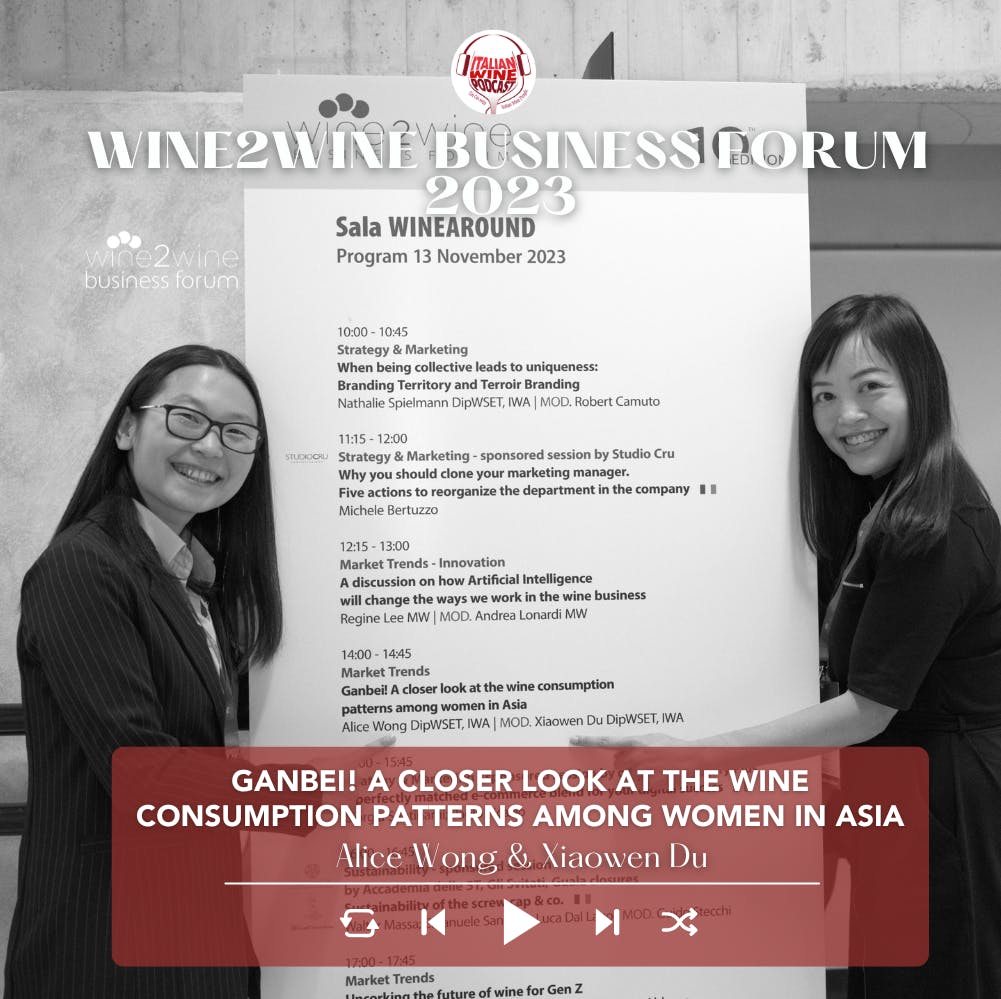
Ep. 2071 Ganbei! A closer look at the wine consumption patterns | wine2wine Business Forum 2023
wine2wine Business Forum 2023
Episode Summary
Content Analysis Key Themes and Main Ideas 1. The significant but often underestimated market potential of Asian female wine consumers. 2. Challenging stereotypes and misconceptions about Asian women's wine preferences and consumption habits. 3. The immense diversity within the Asian female demographic across various regions (East Asia, Southeast Asia, etc.). 4. Analysis of key Asian wine import markets (Japan, China, Hong Kong, South Korea, Singapore) and their unique characteristics. 5. Factors influencing Asian female wine consumption, including health perception, lifestyle aspirations, social status, and the ""She Economy."
About This Episode
The Asian market is a diverse one, with women representing a larger percentage than men and women being more interested in the type of wine they drink. The speakers discuss factors contributing to this, including women being more diverse and women being more interested in the type of wine they drink. The speakers also touch on the importance of education and the average annual income for women in Asia, as well as the success of local wine schools and student bases. They emphasize the need for female win influencers and researching the topic to showcase the success of the wine industry.
Transcript
Who wants to be the next Italian wine Ambassador? Join an exclusive network of four hundred Italian wine ambassadors across forty eight countries. Vineetly International Academy is coming to Chicago on October nineteenth is twenty first. And Walmatikazakhstan from November sixteenth to eighteenth. Don't miss out. Register now at Vineetri dot com. Official media partner, the Italian One podcast, is delighted to present a series of interviews and highlights from the twenty twenty three one to one business form, featuring Italian wine producers and bringing together some of the most influential voices in the sector to discuss the hottest topics facing the industry today. Don't forget to tune in every Thursday at three PM. Or visit the Italian wine podcast dot com for more information. Good afternoon, everyone. I hope you just had a wonderful lunch. Welcome to our session on Asian's Female one consumption behavior. So at the very beginning, I just briefly introduced who I am. So my name is Xiawan. But, you know, in Italian, Chow is a magical word. You can say hi, you can say goodbye. So I just say, okay, just call me. So it's like, so it's a very simple to remember. Then, so I live in Italy since twenty sixteen. I currently work for So it's a winery in multiple channel Tuscany. So our winery also owns two distribution company. So one is to distribute classic SRL to distribute ones to Italy and also another distribution company which we distribute Worldwide, called classical International. So I'm working as a marketing manager. So my principal job is marketing, but I'm also a one maker and a one educator. So and currently I'm a master one, stage one student. So you can see Asian women can be crazy. Okay. So now I'm going to introduce the speaker of the session. Her name is Alice Wong, first of all, she is a great friend of mine. We met in twenty eighteen. So when she was doing the vehicles in Hong Kong, that's the first enhanced version of the vehicles with a new faculty at the time, Sarah Heller, MW, and Henry Davar, Italian one expert. So let's addyson, Alice passed the first time, and she was one of the seven people passed the first time. And then our relationship started from there. I saw her very often, so she came to Italy twice a year, maybe even more often than that. But twice a year, I saw her because she will come here as a five star one judge. Also for one to one. She's our always very engaged with, with a VR community. Alice, actually, she she grew up in Hong Kong, but she received her further education in New York. So I think for her, she can call Hong Kong as well as New York as her hometown. But since she's so frequently traveled to Italy, now I think Veronica is her third hometown. So Alicia is doing a lot of things in Hong Kong to promote Italian ones. There is, an event called Vino Conkeviso. So it's an event dedicated to Italian one. And, Alicia is one of the organizers, besides she she is co cofounder for a project or a company called Vinney Hughes, Vinney Tilled Asia. So they offer tailor made one pastings and food one pairings to promote a lot of wands and also to, give their clients different choices in terms of, food and when pairing, ones from all parts of the world. So not only she's a very highly qualified one professional, she is also trained as a physiotherapist. So, actually, with, a session with Alicia, she can guarantee you come out of the session pain free because either with physicality or with ones, that's her her magic. Besides that, she also involved in quite a lot of projects with, with Italian ones, and she's a deputy master of the cavalierry, the Hong Kong delegation. So she's very involved with tattoo full as well as ones. Because her connection with the US, she's also part of the she's a chair actually of the food and beverage committee of the American Club in Hong Kong. So they are doing a lot of events all the years to promote different ones from different regions. So to honor her contribution in promoting Italian ones, Alicia was the winner of the two thousand and twenty Hong Kong Living influencer award. And they are, as you all know, there are so many types of Asian women. And so I'm very eager to learn more from Alice's research on this topic. So now please join me to welcome the speaker of the session, Alice Wong. Hi. Thanks, Sharon, for the introduction. I'm very honored to have my good friend as my moderator. Thank you for coming everyone. We were just saying as we as we sit here, all the women were sitting on the front, all the men were separated sitting on the back wall, not all, but most. It's quite an interesting observation. When I, first, show my friends about this topic that I'm doing today, Most of my friends would say, oh, Alice, this is just your drinking diary, right? Or, is this another campaign to promote feminism? Well, strongly support female winemakers, obviously, they deserve all the accolades and celebration for the hard work they do. I just feel that at some point, there is also another group of important female that sometimes are not discussed enough about, and that's the female consumers especially the ones in Asia. Do they matter? Are they important enough to work any discussion? So here I want to have, research on this topic. In terms of consumer behavior, there are many different types of studies. We see, studies going according by countries, by age group. For example, today earlier, at wine to wine, one of our fellow, ambassador, Artim, was doing a discussion on central Asia. And then later on today, another ambassador William is doing a session on gen z. So we see discussions about region, about country, or by generation. But there isn't many focused studies on female, wine consumers, not alone, let alone, like, Asian female drinkers. They're usually just generally lumped together in other discussion. I believe most of you know that, Asia accounts for the highest percentage of the population in the world. Any idea, the percentage? How much we're talking about? Asian in the in the world's population? Course, sixty percent. So sixty percent. So if the world the world now has seven point eight billion people, sixty percent is about four point five billion people. And women in Asia represent forty eight percent. Of that amount. So we're really talking about thirty percent if you do the math, sixty percent of population, half of them are women, about thirty percent of the world's population is women, and that number is substantial. So the potential for this market is tremendous. But not a lot of producers take advantage of this information. I always have producers coming to me and say, oh, Asian female like light body wines. But then I have other producers that will come to me and say, well, I can't sell wines in Asia because men only drink red wines. Well, then there you go. If you make white wines, and you think Chinese men only drink red wines, then why don't you try to sell to Asian women? You will have a big market. So, for silver today, I wanna start by talking about the overall diversity of Asian female, the significance of the Asian market, whether it still matters, and who the key importing countries and regions are. And then we'll go straight into, wine consumption. We'll talk about whether Asian female drink wine, drink enough wine. Can they afford to buy and do they buy, or do they just tag along? What do they like to drink? And most importantly, why? They drink the type of ones they're drinking. What are the factors that contribute to those behavior? And then finally, on application, how do we approach these Asian female effectively? So one point I wanna make, is that when we in this session, we use the term Asian female interchangeably. We're referring to all female in Asia. So there are women in, who lives in Asia, but they are not of Asian descent, and there are women are Asian by ethnicity, like Shawwin, but she doesn't live in Asia right now. So for our purpose today, when I say female in Asia, Asian female, I'm referring to all women living in Asia at this time, regardless of their ethnicity, as long as they live in Asia. That's what our discussion is. Alright. So when we say Asian women, what was the first image in your in your head? What pops up first? Chinese Japanese Thai, the conservative Are they religious? Are they hardworking? Are they hardcore? Are they small and petite? Are they quiet? They're shy? Are they painting ears? So now Asia female are really diverse. They're very, very different in a lot of ways, and, it's very hard to generalize. Asia is made up of forty eight countries. So because it's so big, it's usually divided into five to six regions. So we have West Asia, Central Asia, South Asia, North Asia, East Asia, and Southeast Asia. West Asia is generally what we call Middle East in a way. And then we have Central Asia where we had the discussion earlier. And then South Asia that covers countries such as India, Afghanistan, Bangladesh, Nepal, Pakistan, Sri Lanka. Now, the countries that are considered North Asia sometimes overlap a bit with those in East Asia, but for sure Russia belongs to North Asia. And, for countries such as China, Japan, Korea, they're sometimes considered North Asia, but nowadays, and for this purpose, we consider them as East Asia. Along with places such as Hong Kong, Macau, and Taiwan. And finally, we have Southeast Asia that covers a whole bunch of places like Vietnam, Cambodia, Cambodia, Malaysia, Indonesia, the Philippines, etcetera. Sometimes these countries are referred to, what we call Asian, a s e a n, and it stands for association of Southeast Asian nations. So Southeast Asia itself is the most diverse of all. They represent over a hundred ethnic groups and a population of six hundred fifty five million people who speak more than a thousand different languages and dialects. So the point I'm trying to make, the first key takeaway for today is Asian FEMA is so diverse. You would expect some level of variation in terms of their lifestyle and their consumption pattern. And in terms of alcohol consumption, because of the religious background for the countries in West Asia and Central Asia, they have very strict regulations on alcohol. So we'll focus a bit more on the key players of the Asian market. Okay. This, study is by OIV, done in two thousand twenty one. It shows here the, country with the highest, one consumption in the world, by volume. So the Americans drink the most. They contribute to fourteen percent of the world's total wine consumption. And after that, we see a few European countries, France, Italy, Germany, UK. When it comes to Asia, China ranks number six along with Spain and Russia. And then down all the way on the right, you see the other Asian country, which is Japan, and it ranks number seventeen, and it contributes to one percent of the world's wine consumption. And for our purpose, because we're mostly talking about one export, to Asia. Let's look at who the major imports are in Asia. So this graph, again, is also about the same report from OIV. This is done in terms of volume and also value. So a few interesting things here. First, in terms of value, the Americans are drinking more expensive wines you can see her by volume, the Germans import more, but the value of the import is much lower than that of the Americans. And then we can infer that American strength more expensive wine the calculation I have here, the spending on import wines is about four and a half euro per liter versus the Germans. It's about one point nine euro per liter. So if we extend this price per litter ratio, the country that actually drinks or drinks the most expensive import wines is a Japanese. Okay? On their level, I'm gonna read it out here. They their import quantity is two point four million hectoliter. But the amount of money they spent is fourteen thirty nine million euro. So by calculation, they spend about six euro per liter. So more than in more expensive than Americans, almost three, four times more than what the Germans spend. And one other interesting item that's not on this graph, but from this report, from an international organization of finds and wines, is that out of all the wines that the Japanese import, sixteen percent was sparkling wines. Which is a lot higher than all the other countries in this report. So it just proves that, the Japanese have a strong preference for bubbles. And, the other Asian country on this graph is China. The value of the import one is somewhere between the Americans and the Germans. They spend about three forty euro per hectoliter of wine. Now another note on this report, by o OIV is that they mostly focus on the countries. So places such as Taiwan, Macau, and Hong Kong are not included. So we look another report that focuses just on Asia. So here, we still see Japan and China are still the top two in Asia Pacific. And if we don't count Australia and New Zealand, we now see who the other major Asian players are. We have Hong Kong as number three. Singapore and in South Korea as the fifth. So one thing to notice is that four of the top five one import market is in East Asia. The only one that's not from East Asia is Singapore, which is considered Southeast Asia. But regardless, you can see on this map, pretty much all the highest importer of wine in Asia is either in East Asia or in Southeast Asia. The only country that's outside of these two parts of Asia is India. So India, even though now the population rate overtakes out of China, they have more people now. But the consumption level for import wine at least is nowhere close. It's all the way at the bottom of the chart. Alright. So China, Hong Kong, Japan, South Korea, Singapore. What about the women in these places? We're talking about women. What is their social status? What is the perception of Asian female drinkers? Can they handle alcohol? Are they just party goers or do they just go to ladies night? I have to say when I do the research for this topic, I just type Google, Asian women, and alcohol. The thing that keeps coming up is usually in a negative tone about addiction, about drinking. And I try to do the same search on men. I still see re results that come up about health, but it's more about cancer. I've seen more, results like pop ups such as lifestyle and investments. So it's just interesting observation. And down there, the little cartoon, it was also interesting. I don't think you can read the words there. But I'll read it out to you. It's from Singapore from a few years ago, and that character on that car is called Alice. It says Alice is wild and reckless. On top of being careless, she gives up her cash to fly around rash and talks about being fearless. So this picture is actually about one of the campaigns that Singapore government started a few years ago to encourage women to drink less to prepare the bodies to have babies because at that point Singapore has a low birth rate. So I just thought this picture is quite interesting because nowadays people keep talking about how Singapore's booming, and they are. But in a certain way, there are still very conservative especially when it comes to the role of female in society. And I also think it's funny that it's called Alice. Now they, like, they know me. Now I have a little bit more statistic just on, the Asian markets on the five countries. Or regions. I put the US there just because it's a biggest consumer of wine in the world, so it's just for reference. Please, there is a big typo on the, on the on the chart. I think my elbow was pressing on the zero when, I was typing this. So the world only has seven billion people. I don't know why I put so many people for China. The Excel conversion change that. It's really one point seven billion for China. Okay? Not that many. So sorry about that. But it is still one of the highest in the world between China and India. Hong Kong is a city, not a country, but in terms of population, it is a bit more than Singapore, and Singapore is a country. And then if we look at the other two major countries in Asia, Japan, and Korea, a lot of people think these countries are similar but you can see here the population wise, Japan's population is more than double of South Korea. So just to put things in perspective. And but then the other way to think about is this South Korea population is almost three times more than Singapore. So I think in terms of market in Asia, South Korea really has a huge potential and we'll see a little bit more later. Now in terms of statistic on gender equality, this is something a bit more specific for Asia again. Just two things about the education level and the, average annual income for these places. So one of the key things you can see that a lot of people assume, well, Asia is still dominated by male. Women are expected to stay home, look after kids, look at their families, But we can see here, in a few places, the education level for women, is actually higher than that of men. And even if it's lower, the difference is not that huge. But then if we look at the next row and you see the income level, that, for sure, women across the board in every place make less money than men, even for the US. So with this information in our mind, we'll see about the consumption pattern, what they like to drink, and why. So yes, a lot of times I heard about people's assumption about women in Asia like to drink light body wines, sweet wines, sparkling wines, low alcohol wines. So again, I went on the Google and search, and I typed what kind of wine do women in Asia like to drink? And this will also tell me in general if they drink wine at all. So I think you can see there. I typed that search and it pops up red wine. Easy. Done. It says two thirds of Asian women prefer red wine. So that's sixty six percent is quite huge. But then I keep on checking, and I found another report, well, another post on Singapore. A bunch of observations by this person, is a wine merchant, and it sets there. White and sparkling wines have more female fans than male, which is opposite of what we saw earlier. So it's contradicting information. So how do we use it? So I keep on looking more. And, the research that we saw earlier, about two third of, Asian women prefer red, It actually came from the Phoenix school study back in two thousand ten. Okay? They, surveyed twenty eight hundred women, from the top four places of the four biggest one market in Asia, China, Japan, Korea, and Hong Kong. And these, almost half of these women are less than thirty year old, so they are young. Okay? And it sets forty two percent of women drink more than twice a week in Japan. So they are regular drinkers. They're considered regular drinkers. Wine drinkers. And in China, more than half the women choose to wind themselves. So they are decision makers. And then where that's all also where it says they prefer red wines. Okay. And I talk a bit more about why in the next slide. One of the reason was health. So it says eighty six percent of all Asian women claimed that drinking wine is compatible with maintaining a balanced diet. And thirty eight percent of Chinese women said that drinking wine is good for their health. So that's pretty interesting. So not only Asian women don't think drinking wine is unhealthy, Some women actually think that it is healthy, which is quite obvious to what we saw earlier that drinking wine shows that you're wild and you don't care about your health. That's quite different. They actually think drinking wine is great for you. So the other parts of this study, shows that the Chinese ladies don't really care about the taste of wine. They care more about the health impacts, which is quite different from what the Japanese and Korean ladies would think. And the other interesting thing we'll talk more about later, most Asian female at this stage think that wine is a product that shows elegance that is a reflection of their lifestyle. But only the Japanese women, consider wanting to be a traditional product, and we talk about why later. Now, this is I don't know if anyone of you heard about this. Japan, women's, wine award. I think one of the reasons that it shows that Japanese think that wine is a traditional product is to maturity. Of the wine market. They have wine has been quite an established business in Japan for much longer than in any other Asian countries. So you see here, This occur in Japan one award. This association has a few purposes. Their purpose is to increase wine consumption, expand opportunities for women in a wine industry, and also find wines that will go well with Japanese home cooking. So all the judges on the panel for these award are women. This award has already been running for ten years. And last year, it received over four thousand entries from twenty eight countries in the world. So this award is just an example to show that how mature the Japanese wide market is, and women are also very involved and active to promote their own industry. And now compare Japan to another place in in Asia in Singapore. Okay. You see clearly here, this is not specific for women. It's, across the board for Singapore. Beer is a preferred choice in terms of alcoholic beverage. And the main reason is, about tax, okay, in Singapore because they wanna discourage alcohol consumption. They text according to percent alcohol level. So the the more the higher the alcohol contents, the the the beverage has, the more they get taxed. Now speaking of alcohol level, there's another interesting point. For Singapore, consumers choose beer over wine because of his alcohol content. That's also similar, but kind of opposite for the Koreans. So in Korea, more and more women actually go for lighter boots. And when I say lighter boots, what is the national drink for, Korea? Soju. So soju is twenty percent. And soju and Korea, if most if anyone of you happen to South Korea, they can really drink. So but if you keep drinking soju, it's quite something. So women nowadays tend to steer away from what does it taste like burning alcohol? I I I probably forgot because after two shots, I forget that I was doing. I've I've drank soju before. They they they really vary from very plain taste to something very rich. But they usually, the culture for Korean is they just go for shots, go for shots. It's rather neutral in flavor. So inter if you compare, alcohol level wine is obviously a bit lower, comparing twenty percent to twelve percent. That's also true for Japan, and the national drink for Japan is sake. Again, women in Japan nowadays prefer wine just because of the lower alcohol. And the report I read says forty percent of women in Japan, drink wine at least once a month compared to thirty percent in men. And then on the other hand, for rice wine, which is, sake, only sixteen percent of women preferred women, compared to twenty eight percent. Now, we also have a similar situation for China. So, shall we, what's the national drink in China? Baidu. Baidu. Baidu. Okay. She's pronounced it properly. And what's the, percent alcohol for bio. Forty fifty. Okay. And what does it taste like? Well, the good ones taste quite quite complicated. They are even training courses to detect the different flavors of bio Alright, but it's a totally different category. And alcohol is so high. Yes. So it's similar in, and we're talking about even higher alcohol content. So, around forty five to fifty five five percent alcohol, depending on which one you're drinking. So a lot higher than than wine. So again, for China, that's also another trend that, they're for women at least, they're looking more and more into men, drinking wine. So again, if I have an importer that tells me it's so hard to sell wine in China because everybody in China only drinks by Joe. What have you talked to the women or the men? That's the question. So the one of the reasons, many producers or export managers haven't thought much about Chinese women market is because the lack of knowledge and their spending power, which is the phenomenon called Xi Economy. Okay? I have a study from, Accenture, a company done in two thousand nineteen. Some statistics China has more than four hundred million female consumers aged twenty to sixty. They account for more than ten trillion Chinese dollar, which is about one point three trillion euro worth of consumption every year. And what does this mean? That number? It means that Chinese female collectively is the third largest consumer market in the world close to the combined market of Germany, France, and the UK. And the report also went on to say ninety seven percent of urban Chinese female have a job, have an income among them sixty eight percent are homeowners. That's quite high. And remember, when we saw earlier in China in the chart, the percentage of people having a college degree are higher in women compared to men. So even though they make less money now, but the expectation is the gap is supposed to go smaller. And also one important thing is for these women because now they have the knowledge, they're looking to spend money on self improvement and continuing education. So with that amount of disposable income, they're looking to improve their lives. They want to enjoy themselves. They want to be trendy. They want to have fun. Many of them are foodies. And what about wine? So this is, another chart that I got from the Chinese consumer report, the CBD data report. There are different these are the different reasons that Chinese women like to drink wine. Most of them associate wine as something fun, something new, something pretty. It fits into the image of what they think a more than lifestyle should be. So one question would be, well, if, Chinese women drink wine because it's something new, they look for something fun, What will happen one day if wine falls out of fashion? What would be the best way to foster the long term growth of wine? So earlier, I said we should not generalize. But I think one thing I can qualify and, Sheldon, too, is that most Asians are the geeky, and, and we like to get certificates. We're very practical. Wine courses are doing very well in Asia. Most people thinking are instead of spending money on some random wine tasting, why not spend a bit more money to get a real education, to get a real certificate that is recognized worldwide? So the WSTT market in Asia takes up about twenty percent in the world's total. And and that's a very important observation from my personal experience, that many Asia students for wine courses are not from trade, which is quite different. In other parts of the world, I took my WSTT level two and three when I was in New York, and they compared that to what I saw in Hong Kong. In my class, back in two thousand sixteen. Almost half the class were in trade and half the class were the other kind of professionals, doctors, lawyers, certified public accountants, like Shelly said, I'm actually a physical therapist. Until I become also a wine educator. And that continue to be the case. Now that I teach, I will still say the same. At least half of the students I teach are not, from the wine trade. They just want to study wine seriously. Because they want to know what they're drinking. They are serious about the the product. And up here, you see a quote from, Ian Harris. It says forty three percent of WST diploma graduates women and eight out of the past ten highest scoring diploma students have been female. Why do female do better? Because we just have better taste. Okay? We have better tasters. So this report is, as research done in twenty twenty. It says women have almost fifty percent more of factory cells. Okay. We taste better. We hear better. We feel textures more accurately. And we this is important. We are more ready to increase our sensitivity to smell. So it means that we we are better to begin with and we learn faster. So it's not a coincidence when, in Hong Kong, there are four masters of wine. I think many of you know Sarah Halla, Sarah Helen, Deborah Mybert, Jenny Chulli, Jennifer Daugherty, all the master of wine in Hong Kong are female. I think it's a pretty strong validation point that female are better tasted. Now speaking about, women being better taster and a lot of times more serious drinkers, I I don't know if you've seen pictures of of if you've met any, Chinese report and people mixing expensive wines with ice or Coca Cola. I don't know. I've I haven't seen that myself, but I've I've read many reports and seen pictures about that. The assumption is many men tend to buy expensive wine just to show off. Okay. These are things that you tend to see less frequently in women. Also in terms of binge drinking, the incidence is higher in men. The survey in the ministry of health in Singapore. For example, done a survey done between twenty twenty and twenty twenty one show that the prevalence of binge drinking is thirteen point eight percent in men and just five percent in women. So what do we learn from all these research? Female drinkers in Asia tend to majoring they may drink less in terms of volume and in terms of alcohol level. But potentially are more serious. They drink better, and they're able and willing to pay. So I hope by now I have convinced you that there is a strong potential for the market of Asian female in Asia. So how do we market to them? What's the best way to reach out to them? Asian female do look up to, other influential figures. Besides these master of wines in Hong Kong, there are a few more that's, worth mentioning we have Phongi Walker, who is a master of one in China. She's, even though she's, she actually speaks Chinese, so she's very well respected by locals. And in Japan, on the right here, early, we talk about the Secura Japan women's one award. The lady is called Yumi Tanabe. Okay. She has her own wine school and her own book Yumi Tanabe's wine book, is considered the Bible for many wine students in Japan. The lady in the middle, Junco Watanabe. Her focus is on a fine wine market. She used to work for Christie's and Zaki's auction houses and her book in terms of her insights in a wine investment. Was so impactful that it wasn't even in the section of food and wine. It was in the section of economics. So just a few names that, that's worth mentioning. And besides these figures, Asian female tend to seek out communities, and organizations they can trust. So some of the more well known societies, not specific just to Asia, but it's quite worldwide. It's the night of alba. Champagne society, the Bordeaux society, command, burgundy society, commandery to the Bordeaux, and the shame. These societies are members only. They give a sense of prestige and exclusivity. And they sometimes give discounts, but more importantly priority access to limited products. And the bondings between these societies are very strong and very long term. And, besides these societies, one other valuable partner that I would suggest everyone to reach out to is local wine school. Okay? When we talk about wine students, we're not talking about college new grads. We talk about a very wide spectrum. From the point, people can reach their drinking legal drinking age to the point of retirement. And a lot of times when these students finish their wine courses, they don't just say goodbye. They keep in touch with the teachers. Many of these wine local local wine schools have an extensive student database. They whenever they're events, they don't just reach out to current students. They look for the alumni. So I think, shaman mentioned that I'm an organizer for an event called Vino Conneviso. So it's an official event that I work with the Italian Council General and Echei to promote Italian wines in Hong Kong. So we have this event in Macau just last month, to promote Italian wise. When I approached suppliers and talked about this event, the response was just okay. They are not too convinced about the Macau market. They think, They only drink Portuguese wines because they were they were a colony of Portugal. At some point, they don't care about Italian wines or people who know what they are drinking, must be ultra rich people. So what we did was we reached out to the local wine schools in Macau. We told them that, look, we have this Italian events that will show over a hundred Italian wine events supported by the consulate, and they were super excited. They went to all their alumni, all the current students, And as you can see in this picture, it's a walk around tasting, and it's jam packed. We have close to five hundred people. We're gonna fit more. The events were sold out. There's a wait list. And the suppliers and the students' feedback regrates. We told them this event, we're not just showing the premium products from Tuscany, Petmonte, Veneto. We showed native Italian print varieties such as Gagliopo, timorazo, Albana, people were there to look for something interesting. They want to learn. And the feedback from the suppliers, wow, these people actually not know what they're drinking. They are not just here to get drunk. So one of the things I found very, very important is if you reach out to the right people, people who care about what they drink, you can pull off really successful. So for the take home message, we're required to say that. Right? Remember, Asian female are very diverse, try to appreciate the she economy. And again, everything is relative. When we say relative, it was, like, the example of alcohol level In one place, beer, wine is high enough alcohol for some, but in other places, alcohol is low for others. Tax is an issue. And, for in for female in Asia, less is more. They may not drink as much in terms of quantity, but they are more able to pick up the subtle nuances in wine. They are more serious about detecting these things in wine. They may be just drinking better wines. And if you want to reach out to these markets, work with local wine clubs, wine schools, and of course, Italian wine investors. Thank you. Thank you, Alicia. It's such very carefully research topic. It's really interesting that Aditi shared with us many perspectives. So I will ask my first question to follow-up. So I know in the audience, we have some Italian producers or the Cape players in the Italian wine industry. So when a Italian producer wants to go go to Asia and if they have to pick one country, which country you will suggest. First, I would strongly suggest you not just to go to one country because the benefit of Asia is everything is so close together, sort of like Europe. It's no reason why you go to one country and not the other when it's right next to you. But it to answer your question. It depends on the price point and your products. If you're selling products that are more on a premium level, you may be better off in a more mature market to start off with, such as, Japan and Hong Kong. And if it's more entry level, wine, you may want to go to, places like South Korea, which is really booming. Sorry. I'm not a big fan of Singapore. I hope nobody is from here in Singapore. The tax is high. The market is small. The logistics is great. So one of the reasons in the earlier chart that Singapore imports a lot of wine is because they actually export, import and re export. So it's not so much reflection of the, local consumption. It's just because of the logistics. But I think South Korea right now, I think you know, is really, really flying. Mhmm. Yeah. It's indeed booming. Yeah. Okay. So maybe you can take one question from the audience if someone has a question. Okay. Fine. Even though everything is relative and there is a large diversity, is there a movement of feminist feminism movement in Asia and would, woman be more, sensitive to by wines made by a wine girl who's a woman? I I have seen definitely events, especially around March every year when it's international women's day that is focused on, female winemakers. But once you pass April, I don't think the noise is there. I don't think, just saying that it's a female winemaker would work. You have to extend that information. Is it is does it show that the wine is more elegant? Does it show that the wine is carefully made. It's not the type of wine that you just focus on jammy concentrated flavor. I think, that needs to be tied into other value. I don't think if you'd only say it's a female winemaker, it will it will fly off. I will wait in here. So I agree with Alicia, Alice. So, yeah, it's very important actually to tell your story to the Asian women because they want to be inspired. And they want to see a role model. So if a female one maker tells a story correctly, you will inspire the local women and they will support you. So, yeah, it's not just your female, but also what you have done to reach your current, like, you make this one and what's the story behind it? What kind of trouble you have been through? Because we kind of believe if you are excellent, you went through some difficulties. So tell your story and inspire the female Asian females. Thank you. Thank you. Thank you for attending. Listen to the Italian wine podcast wherever you get your podcast. We're on SoundCloud, Apple Podcasts, Spotify, email ifm, and more. Don't forget to subscribe and rate the show. If you enjoy listening, please consider donating through Italian wine podcast dot com. Any amount helps cover equipment, product and publication costs. Until next time.
Episode Details
Keywords
Related Episodes

Ep. 2145 The influencer marketing playbook | wine2wine Business Forum 2023
Episode 2145

Ep. 2138 What you need to know before approaching the US Wine Market | wine2wine Business Forum 2023
Episode 2138
Ep. 2131 The Wine World of the Future - demographic and consumption scenarios | wine2wine Business Forum 2023
Episode 2131

Ep. 2123 Chefs and Wine with Gurvinder Bhatia and Gino Colangelo | wine2wine Business Forum 2023
Episode 2123

Ep. 2115 Why women don't talk about money with Luisa Ortu, Matilde Poggi, Laura Donadoni | wine2wine Business Forum 2023
Episode 2115

Ep. 2106 Massimo Boccoli, Claudio Bergamasco, Giovanni Mantovani | wine2wine Business Forum 2023
Episode 2106