

Ep. 2098 Uncorking the future of wine for Gen Z with William Predhomme, Valentina Abbona | wine2wine Business Forum 2023
wine2wine Business Forum 2023
Episode Summary
Content Analysis Key Themes and Main Ideas 1. Marketing to Gen Z: Understanding the unique characteristics, behaviors, and digital native nature of Generation Z (born 1997-2012) in the context of wine consumption and marketing. 2. Evolution of Marketing: Shifting from traditional, static advertising to interactive, engaging, and personalized communication strategies. 3. Technology Integration: Leveraging accessible technologies like Augmented Reality (AR), Near-Field Communication (NFC), and Artificial Intelligence (AI) for enhanced consumer experience and engagement. 4. Authenticity and Ethical Considerations: The paramount importance of genuine storytelling, transparency, sustainability, and ethical practices to resonate with Gen Z's values and build brand loyalty. 5. Role of Ambassadors and Human Connection: The critical function of brand ambassadors and human interaction in conveying the human-centric nature of the wine industry and fostering genuine relationships with consumers. 6. Global vs. Local Identity: Balancing global outreach with the preservation and communication of unique local identities and traditional values. Summary In this session, Will Predom, introduced by Valentina Bona, discusses effective strategies for marketing wine to Generation Z. Predom highlights that Gen Z, being the first fully digitally immersed generation, requires a different approach to marketing. He advocates for a shift from static advertisements to interactive and conversational methods, emphasizing the value of two-way communication. Predom illustrates how technologies such as augmented reality (AR) on labels, NFC tags, and AI can be utilized by wineries to create immersive experiences and personalize communication, noting that these technologies are becoming increasingly accessible and cost-effective. He stresses the non-negotiable importance of authenticity, ethical practices, and genuine storytelling, as Gen Z possesses a ""BS detector"" and values brands aligned with their beliefs. The discussion also covers the vital role of wine ambassadors in translating the industry's human and cultural aspects to a global audience, bridging the gap between traditional wine culture and modern consumer expectations. Predom acknowledges challenges like health-conscious drinking trends but asserts that genuine connection and relatable narratives will continue to be key. Takeaways - Gen Z is digitally fluent and responds best to interactive and authentic content. - Marketing should aim for conversations and engagement rather than just broadcasting. - Emerging technologies like AR, NFC, and AI are becoming affordable tools for wineries to enhance consumer engagement. - Authenticity, ethics, and sustainability are crucial values that drive Gen Z's brand loyalty. - Wine industry ambassadors are vital in conveying the human story and fostering connections. - Small, traditional wineries can adapt these concepts by starting with simple video clips and interactive elements. - The ""sense of place"" and cultural narrative of wine are powerful selling points for the Gen Z demographic. - Despite technological advancements, human interaction and genuine passion remain core to the wine industry. Notable Quotes - ""Gen Z is the first generation which has been totally immersed in digital from start to end."
About This Episode
The 23rd to 1 Business forum highlights Gen Z's importance of communication and understanding consumer dynamics, while also emphasizing the need for locality in the digital age. The success of the ambassador program and community's importance are also highlighted. The importance of digital communication and social media platforms is emphasized, along with the need for creative marketing tools and digital platforms to be able to innovate and cost effectively. The importance of creating immersive experiences, personalization, and community engagement is emphasized, along with the need for technologically-equipped people to be prepared for the future.
Transcript
Robots aren't taking over. Ais, well, maybe they are and we just won't know it if it happens. Right? It would be a disaster. Oh, come on. We we know some people who are robots and they don't really produce some of the nicest wines, do they? Official media partner, the Italian One podcast, is delighted to present a series of interviews and highlights from the twenty twenty three one to one business forum, featuring Italian wine producers and bringing together some of the most influential voices in the sector. To discuss the hottest topics facing the industry today. Don't forget to tune in every Thursday at three PM, or visit the Italian wine podcast dot com for more information. Welcome to everybody. I'm Valentina Bona. And today I have the pleasure to introduce you to Will Predom, who's not just a great friend and a, we met many years ago in, but also in my hometown, overlooking some beautiful concerts and making some very nice memories while enjoying some good wine. For from ten years so far, Will is also, leading basically the role with his, marketing and communication company called just by him. He stays in Canada and Ontario in, Toronto. Thank you very much. I'm sorry. In Toronto. And, I think that today what is going to tell us is going to be quite eye opening. Because it's going to lead us through how degeneration said, and I believe that the youngest people now are eleven years old. So there is a lot to think ahead. He's basically going to throw us idea on how these new wine drinkers, could be taken into our beautiful world and what we can do to engage them more and more. Thank you, Valentino. Thank you, everyone. So today's session, Gen Z It is a confused confusing moniker. Right? And that's essentially what this is. We're talking about, a a group of people. And as Valentina stated, the youngest is eleven. We are not currently marketing to eleven year olds. But the technology that they have grown up with and the ways that they learn, the ways that they think all the way up to twenty six, and there's a bleed into the millennial generation, etcetera, etcetera, etcetera, etcetera. All of this is is linked together. As a bit of a backstory, ten years ago, I left hospitality. I was a sommelier for many, many years, and, I wanted to build something different. I wanted to communicate what you, what number of you are all doing with the audience, not just in the Canadian market, but to understand that fully. So I went down this journey And my my company now, we work specifically with trade associations around the world, marketing to Canadians at all at all levels. And it's business to business marketing, which is really important. While you all make tremendously good, unique wines, you need to be able to sell it. And each market has different ways of doing so, but then there are some fundamental basis. So what we'll cover today, we have a couple key learnings. So setting the stage for today, I don't have a magic bag full of all the answers. I'm hoping that you come away thinking a little bit differently. About marketing or communicating with not just this generation that I'm referring to, but to everyone. And some of these concepts, and they are concepts are are not written in stone, and they will continue to evolve. So starting off with bracing the change in consumer dynamics. I mean, with with Gen Z, it's the first generation. Which has been totally immersed in digital from start to end. I'm the last of the millennial generation, if you can believe that, nineteen eighty one. So one of the big differentiators there, when it comes down to communication, is, is that we understand what it was like before having all this digital influence. So you can kind of bridge that gap. Now imagine your first memories in an iPad has been kind of omnipresent. Right? We it's almost related to growing up being told you're watching too much television. Right? I'm sure we were, but now we have the same dynamic existing with a younger generation, except perhaps they have the capacity to be able to absorb it a bit more. So understanding that, the power of interactive marketing, we're going to move into how marketing has evolved. It's no longer just your static. Here's our you know, print ad. Here's our digital ad. Here's our website, which we absolutely require a need. In fact, we're seeing some data going back to tactile and sensory influences to ensure that you're getting that communication along, but it's not just that. It's interactive. The value that you get from, communicating in a way that you receive information back is something that Gen Z greatly values, and you see in the data going forward that it is incredibly valuable. The integration of technology, I'm sure you've heard AI numerous times heard this whole thing. I am not going to harp on that. But I will talk about how we can observe and integrate these tools into our, our lives as a resource. They will not solve all of your problems. They will not give you all of the answers. Much like a carpenter starts their career off as an apprentice, learning how to use the tools of the trade. The tools that we're using here with technology are exactly that they take some time to get used to. But they are wonderful and accessible, tools for you to use in order to succeed. Balance and global appeal with local authenticity. Think global, b local, blah blah blah, that means nothing in this context. Right? What we're looking at here is we have unprecedented access to everyone in the world unlike any time before in history. And what gen z is showing to crave is that authentic touch but then trying to retain the the locality while being a product from Italy or from South Africa, from wherever and communicate with those areas and bring that to those individuals. This distinctly resonates with gen z. You're gonna see a lot of tie in with previous generations as well. Like, it's very much the same yet different. We're gonna go through a little bit of that. And let's loop it back to the ambassador program that, Vin Italy as spearhead for the last ten years, which is the major premise for why we're here. I was fortunate enough to go through the program. I believe it was eight years ago. Give or take. And, the the influence that this program and those who attend, who have taken it and what Ven Italy has invested in over the last ten years to create these ambassadors we're gonna talk about a couple of the things that you can do if you are one. Or if you're looking for, some of that equity that has been brought out there, that that brand equity or that that training equity, we're gonna talk about some of the tools that can be applied. If you are one, or what you should look for through the Ambassador Program. Alright. I'm just talking a lot, Valentino. Do you wanna hop in here at all or no? I don't wanna put you on the spot. I do have a number of questions for you Oh, good. Which are coming. Yes. Oh, they're coming. Yes. Alright. Sweet. So let's talk about what Gen Zee is. Right? Big buzzword introduction to Gen Z anytime between ninety seven and twenty ten. Sorry, twenty twelve. My apologies. So you're ranging from twenty six years old to eleven. This is not set in stone. This is a range. You know, it's not that specific, but it really does refer to that generation that has never lived without some sort of technological influence, right? That's it's quite remarkable to think about it like that that they're you can't take that away as well. So their behaviors and habits are are very different. They're evolved. They're, they're stronger set. In, in behavior due to this. We're gonna talk a bit about what that looks like. They're key traits. Visual and interactive content. We've seen this, who here has at least one social media app on their phone. Raise your hands. Come on. Show me something here, everyone. For those of you who have been able to avoid this, I'm really envious, the influence and the pervasive, nature of it all. But this is something that is very commonplace. As you're born with it, you know, it's where you get a lot of your information from. Right? And utilizing this, not just in pictures, but interaction with videos, etcetera, has been, resonating greatly amongst this generation. You see it bled into the millennial generation, and trends are showing that that's just gonna continue as technology evolves. So relative to gen z's consumer behavior, they spend considerable amount of time online. We already know that, influenced by social media, but also by peers. This is really important here. This goes to a couple of the next points, but the, the influence that those around them, which are also influenced by social media has a strong the strongest, resonation between that generation than any other generation beforehand, which makes it quite hard to be able to crack into. It's an intimidating factor. If my friend is telling me that this is great, I'm immediately going to go out and do that. It is almost it is far stronger in this generation will continue to do so. So how do you speak to the over, overarching community? We'll we'll delve into that a little bit more, which leads to your values and brand loyalty. We sound like corporate clips, you know, of something from a mission statement, but, there is a huge BS detector that both the millennial and the gen z generations have. Right? There's a knowledge of when you're being spoken at and spoken to. This resonates quite a bit. And, having genuine, communication, genuine thoughts resonates far greater with this with this group of individuals than just the common, you know, word speak of of marketing in general, which is quite exciting for someone like myself who genuinely and passionately loves this industry, the tactile nature, the fact that all of you are creating something and expressing and trying to communicate this. It's noble, and there aren't too many that are in these rooms that are saying, you know, I just wanna make millions of gallons of wine without a face on it or without a story. This this, that's just really not hugely part of this community that's been built here. So leading to the importance of authenticity. So authentic. You can't fit well, you can fake it for a little bit. But again, you'll be run over fairly quickly with this generation if you are found to be, lying or outside of your scope or whatever it is. And truthfully, your stories are amongst they're the ones that they want to hear communicating that whole other whole other thing, but that being said, you have something to talk about. And it's it's quite attractive. And under they they like the innovation. Now no one has ever said that the wine industry when it comes down to marketing has been particularly innovative, but I am going to show you a few examples from you know, larger organizations to smaller organizations to parallel industries that you can take that information and adapt. As we continue to go down, go towards the future with all of these technological advancements, access to the the ability to innovate and cost towards those has gone down, and it continues to go down. So we don't need to be absolutely right up front driving away with most innovative social programs, etcetera, just to have some knowledge makes a lot of sense, and knowing that this is valued, that innovation is definitely something that that they're looking for. And then looking at the digital landscape, digital platforms. We've talked we haven't talked yet, but, you know, our social platforms are some of those, the Snapchat, the TikToks, the, depending on what what, culture you're coming from. I mean, WeChat, some of the older ones, some of the newer ones. This this is how communication is done and will continue to be done in these manners. And, if you're like me, I still don't get Snapchat. I'm still trying to figure it out. It doesn't really quite make sense to me quite yet. Though I know that it has a huge influence. And I also know that their marketing campaigns have been traditionally expensive, but also are dropping an expense because of the emergence of new technologies out there and ways to communicate. So opportunities exist. Well, I will stop you here one second there too. I'm sorry I have to sit down because this is not doesn't really go up too much. But remember that here you're speaking in front of a crowd of produces. At least, I can see many friends and colleagues here, which are small family owned, very traditional wineries in a stupid traditional country, which is Italy. So I think that we are all a little bit scared to say that you know, the next generation for wine will look only at how the communication is made. You know, we live in an area where truffle is very important, and now they just, open this beautiful truffle museum in Alba, instant data, which I found really interesting when visited, said that people remember only one percent of what they touched, two percent of what they hear, and five percent of what they, what they see. So even through all of these systems, but yet they remember thirty five percent of what is now. And I think this is key when talking about these stores into, into wine. How would you reply to that? No. That's absolutely a great way, and that's why I'm glad you're here to bring it kind of into the conversation. We're going very high level here, right? And to your point, it's sensory experiences. How do we communicate this with the current generation or your target market right now, let alone the future. That's not necessarily the point of this this, this seminar here. I I don't have that magic, you know, the magic wand to be able to give you all the information of how to solve it But what I will reiterate is that you have tactile sensory products that are incredibly, sought after those stories to be able to tell them. And I wouldn't necessarily begrudge the fact that technologically advanced, marketing tools, etcetera. They're not really built for the wine industry unless you're a large commercial brand. But what you do want to do and you do on every single bottle already is you tell a part of your story. And how do we how do we just take one little step forward with this knowledge knowing that there are systems in place. There are is a demographic which wants to which is craving what you are actually producing. We've if you've never been to Italy and someone says Italy to you, you immediately can can conjure up what that feeling is, which is a gift. Like, that is a really remarkable thing. We have some tools. We're going to talk about which, where we are talking about, which helped to bridge that, that gap. So starting off with simple communication, you've done some really excellent work at Marques de Barolo in communicating your story about your family. Every time I see something from your your posts, I see a member of your family talking and it's constant communication. There's it's not just pictures anymore. There's small video, video clips so on and so forth. This is remarkably effective in this this room. There's a canary in the coal mine, which is pretty much every other business out there, that is that is selling in in a certain capacity. And you could take components of that to be able to apply at the most fundamental levels. So I'm hoping that's where you get that. I don't know if it, again, answered your question completely. So you kind of make a transition from what you see then you're trying to bring people to actually Yeah. It starts. And make that experience part of their own life. Yes. It starts it starts with awareness. It's almost like, if you, you've got some, you know, extra bills in your credit card. No one ever really wants to open up their statement after Christmas. Right? Look at your statement and you're like, oh, no. I gotta deal with this. But then you do when you look at it, you're like, I can deal with this so on and so forth. I can figure this out. This is very similar. And we can continue to, you know, go the traditional way, which is, again, absolutely necessary. You've built a foundation that is incredibly hard to reproduce, but starting with awareness and then transitioning into these other aspects, I wanna make sure you just at least know what's coming towards you. I think that's super important, and it's not a bad thing at all. And a lot of people are in the same boat. So talking about something that we can do that you do already incredibly well and perhaps can communicate a little bit more about. There's been a few, I believe doctor Laura Catina spoke on, agritory agritourism, right? Hospitality, agritourism, That's one of the best things about coming over to Italy is the agritourismos that the wineries tend to incorporate in once they get to a certain level because it's full on experiential. People crave this. Right? It's getting easier and easier to communicate that that fundamental touch. And this resonates with just about everyone, that Gen Z consumer. We can almost move Gen Z over here because they are definitely going to be building. You've got a little bit of time, but you can start applying this right now and getting on that that that kind of, that track in order to, to be able to communicate when they do become of age. There'll be another generation coming behind. You'll be ahead of the game. Right? But moving into interactive marketing, it's not just one thing. It's a conversation. We are we're no longer just pushing. We are now pushing and pulling. We are engaging you, and you have statistically, this, first of all, this presentation will be available to you afterwards, the very back. There's a, the very last slide. There's a reference, page for where all of this information came from. And these are all reference based HBR, etcetera, etcetera, etcetera, that we've delved into, to putting into the this this program here, but introducing that there is a shift going on, you know, applying these, these interactive techniques, whether it be having a tasting that isn't necessarily just here to here, like I'm doing right now, but bringing you into it and, having that conversation utilizing, you can go as far as utilizing poles, etcetera. But sometimes just asking opinions and bringing people in, into those conversations, making them feel part of it, you can do that easily much easier easier now than than before from afar or from from close. Okay. So interactive content. Again, I brought up your please check out the, Marques de Verulos, their Instagram feed rate there. But you've get nearly twice amount of the interaction from video than you do from still pictures. And we're talking about sometimes fifteen to thirty five second clips done on an iPhone. And the memorable nature of that, you've already brought up a few statistics of visual versus auditory versus everything, bringing all of that in now. We can't smell yet through our computers. Through our iPhones. We will see. I think they started that. They tried that in like nineteen sixties, and it didn't quite work out. Smellivision, I think they called it. I don't know if we're gonna get there, but nonetheless, incorporating, video, that's your, that's your fundamental start. Start there. Couple clips, and everything can be also copied. So take a look at your favorite. Social media posts, take a look at online, find out what it is exactly that makes a great one. A little quick little phone clip, you would be shocked at, how effective those are. Some of the most effective posts. I was fortunate to build a digital, subscription based wine model, many, many years ago. One of the most popular posts was taken off of a six year old, it was an idea given to us by a six year old's YouTube channel, and it was unboxing. We've seen the unboxing videos. You just can't help but watch, and some of the simplest sort of things, and those those kind of efforts from a very basic level. You don't even need to be in them have created more of a, a, a different type of energy around it than just verbal or visual. So we must create a sort of expectation to engage people. Expectation is always great. Again, recognizing that you have, you have this wonderful product that represents more than just the wine itself. It represents a lifestyle. It represents something that people are craving. That's why Italian wine does so well in export markets. There's been a successful, branding of that image. And it delivers. That's the coolest part. So to be able to to be able to speak to that, to create some anticipation, or show me that you are just your person in front of me instead of a a commercial, not to say that those don't work. But that probably isn't the majority of us in the room here. Right? So communicating in that capacity, simple, good step. There's a pathway out there. Managing our consumer expectations. So gen z immersive experiences, not just speaking. An immersive can be just about anything, anything that involves that dialogue and exchange, the the benefits, brand loyalty, loyalty to, and you have a responsibility almost not just to your wine, your winery, but to your region. And, sometimes we overlook the fact that a collective of individuals and wineries, if you are a small family owned, and perhaps not as well known, but bringing that message out that you are a place will have a stronger influence than having, having your one winery alone leading the charge. That's and we've seen this in places such as, you know, Barolo, Babaresco thirty, forty years ago. I believe they're giving away the land. And then there was, well, relatively speaking, right? But then now this brand identity has been created due to, whether it was willing or not, but, the emergence of a sense of place. And you have that throughout all of Italy. Most wine regions that succeed to have grasped onto that peak, Napa Valley, Burgundy, Bordeaux, they recognize they're part of a a greater whole. And interacting, with the consumer going forward is going to be the way to do that. So just towing a story. Sorry. No. It's saying just that I think that what we are doing just now, communicating and exchanging ideas is what helps also us producers, to be able to send the right message. We don't feel as much as alone as probably the generation prior to our was, but we do feel more connected and for sure the tools that you're explaining are a good opportunity to move even forward in this. Absolutely. It it it's It can be very lonely out there, especially if you've been an established producer and you're watching these generations come forward and you feel like you can't talk to them, which is often the case in certain capacities when we try to talk from our own perspective. But the cool thing is you have the content already. It's more so how we communicate that with them is what we're trying to tackle here. So, engaging we've already talked about that engaging in personalization. We're going to be moving into what that looks like. So with targeted media, etcetera. It's becoming more native, meaning if you're going to post something, on any of your platforms, it's now native going to be going towards your target audiences one way or the other, which is a personalization aspect. Now you can enhance that. We're not gonna talk about that right now. Those abilities exist just in a native capacity. But, these are all things that are coming. Some you opt into, and some are just native if you just apply some of the fundamentals. I think it's also important that we change a little bit our mindset because, again, being most of us, very traditional in the way we communicate, is is we it is true where you said we do have the content, sir. Sometimes it's just difficult to flamed them through the right platform, the right platform, the right social media, whatever, because there is a very specific language that you should use, culture, languages, and we'll get into that. That leads into the global versus local components. Right? It's nuanced. And the recognizing it to begin is that. So working with, targeted experts in certain fields, if you're if you're selling domestically? Just, like, great. You already know that. But looking into external markets, there's resources available just even through a simple search that can kind of give you an idea of where you're going to be targeting even starting with geography and language, etcetera. That's gotten a lot easier. So without having to over complicate it by making these choices, make your fundamental business choices and start to apply. Who wants to be the next Italian wine ambassador? Join an exclusive network of four hundred Italian wine ambassadors was forty eight countries. Vineetly International Academy is coming to Chicago on October nineteenth, twenty first. And while Mati Kazakhstan from November sixteenth to eighteenth, don't miss out. Register now at Vineetly dot com. In the for what concerns your experience, which trade the markets you're looking at? Because you're not only focused on Canada. No. So Canada is interesting in in that we purchase more and we import more than we can consume. That's why. And when putting this together, doing our best not from a Canadian perspective, and we have very similar issues as well, as far as marketing our wine industry domestically. We don't market it really on export because we, again, we don't produce enough. But our communication levels are at the same level. I would argue in Italy, France. Some of the places that communicated very well, California. New Zealand, Australia. We're starting to see from from the larger levels. Right? But, we're not we're not all that that different except we have more experience in bringing things in and being able to kind of communicate with, even within our own environment. We have Quebec, which is French speaking, very different culturally. They drink Pepsi instead of Coca Cola. It's a very it's a very unique spot. And then you go to West Coast. You have more of a Pacific Northwest, vibe, we go to Alberta. And my colleague and friend Gervinder last year called me out for saying this, but, you have a bit of a wild west nature there more than anything. East Coast. It's we have this diversity of tiny population, but the big thing is we bring in more than we can can produce ourselves. So it exposes us quite a bit to all this diaspora of of exported product. So it makes it a bit easier easier for us to perhaps understand that aspect. And, that's where this is largely coming from. And you also have a lot of client space that old countries. Right? Yeah. About fifty percent. We have old countries, the fun countries. We work directly. We've worked with, financially in the past, Calizione. We worked with, Kathy classical, Consourzio Bernelo Dimontoccino, in the US, Oregon, Washington state, all agriculture based, but largely places that we we bring in, more products from that have a story and the things that we can't produce. Right? We just don't have that ability. So what I'm saying that there is a craving for this kind of experience, we don't have it. And we're coming from that target audience. Now marketing to the United States, ten times larger, fifty states, fifty different cultures, if if you will, you could take us as a test subject for the most part. It's a small kind of, sampling. Other markets that you're targeting, there's some really phenomenal, perspectives on on new and emerging markets right there. I would love to be able to understand how to market to them because a lot of this will apply when it comes down to access to tools and information. That's the biggest part about this whole thing. This is universal. What is going on? Gen Zee is It's not just a North American Canadian concept. This is a a generational component, and it has to be linked to cultural and aspects related to, exposure to the tools that are out there. Right? So in Kazakhstan, they will still have access to the same tools that we have in Canada, that you will have in Italy, and that generation will be exposed to that as such. So nowadays, we have more, let's say, horizontal opportunities rather than the past where which makes it more complicated, doesn't it? Right? It's like, oh, great. We have all the access in the world. Wine quality, and wine access has never been greater than it is right now. Yet it's harder to kind of communicate that aspect. Right? And, we can go to all the seminars that we want. And that's by focusing on just what is going to be available. What is available right now? Delving, putting a toe in. Like, I won't lie. I used AI to draft the concept of this based off of my business's background and target it towards this audience. Using that other AI program to be able to formulate the slides in order to be able to present to all of you here. Right? So and it wasn't very, like, I can do it. I'm not technologically savvy, but, taking a little bit of time to understand these things has helped quite a bit, and it it it can speak a little bit more fluidly than I would off, off just the top of my head. And it takes a it's pretty much free. And when it comes to our industry, do you have some examples to share? Sure, dude. These are successful. Now, I wanna put in context. There are three examples here. One is directly related to the wine industry, and we've probably all seen it or heard about it or If you haven't, you can understand the scale of it. And this was a campaign that was completed, perhaps, five years ago. And that would be the nineteen crimes. I don't know. Is that available, or have you seen any of this over in Europe at all? No. It's a Treasury Estates brand. They used augmented reality, right, very expensive at the time to be able to put up, but basically, pick up a label with your smartphone, camera goes over top of it. All of a sudden, you see a person on the label start. Talking. Right? It was super trippy when this came out, but it increased their initial order or their initial run of four million bottles to seventeen and six months. So four million to seven or certain cases, four million cases to seventeen million cases. Big, big, like, we are not there yet. But what I will say is that augmented reality that they spent tons of money on and created this really great business case case studies has become nearly free and accessible to everyone, which whether you're applying it or not look into it, it does not need to be complicated, but you're able to incorporate something on a label when someone takes a phone, puts it right over top. It will and that will get cheaper and cheaper and cheaper. Could just be your vineyard. Just kind of all of a sudden could be like the the leaves of of the vines or I was thinking about this earlier on. Imagine it's fall and you pick up that bottle and you your phone over top of it and then it shows you a snapshot of the fall, the vineyard as it looks like in the fall. You do the same thing in the summer. You use the same thing in the spring. These are things that are accessible to you now. And and very inexpensive to do to apply. It's still a little bit there, but they're resonating with this generation. They're walking around with a phone in their hands the entire time. Have you seen the new Raybans with the, You have the cameras. Right? They don't look like the Google Glass where it look like a broke Jordie La Forge, you know, from Star Trek. It they are they're stylish. They're cool and they're creepy as well. Right? Cause the the amount of that privacy laws will come and so on and so forth, but that ability there is resonating and will become more and more, accessible. That's comes down to access. Right? So nineteen crimes expensive at the time, big successful brand. What do we learn from it? Well, we have all the data of success, and then we have a lessening of costs relative to doing something as simple as that. So that will become more incorporated and that stuff resonates. Now we're gonna move over, to a, an adjacent industry. So this is a distillery from Kentucky. And feel free to look all this stuff up if you want, but the, the rabbit hole was really kind of cool. They created a you are here campaign. In fact, I've seen this, to a certain degree, Kia T Glasgow, launched its UGA map, which is an interactive map. You can put it up on the screen, move it around, etcetera. You can go online, kind of fly over top. And this is an amazing, step in the right direction of being able to have a conversation. Like, you you you're not quite stepping into that. We aren't getting into VR yet, but that will happen eventually as things get more and more accessible. But here, they basically created a sense of place in Kentucky and you you would scan the label. It would bring you to that spot. You could walk through on your phone interactive almost like a house tour. And it was highly successful for them, giving them a sense of place. You felt like you were there to be able to describe certain aspects. It is disproportionate, the amount of time and effort and mindset that individuals put towards wine in their daily life. Even if it's just a second of picking something up off of a shelf, it's quite remarkable in all the choices throughout your day. There's a disproportionate amount of time being thought about what is going to what they're buying and what they're going to consume later on. So getting that little snapshot inside of it is kinda cool. And it it started off with labels themselves to back labels, you know, the original chateau or the vineyard or whatever it may be from and and here, even the font and type set gives you a a sense of place. It's continued evolution of that. And then moving a little bit farther down the road here, but this is incorporated e commerce. Which, it's probably just as complicated here as it is pretty much in every other market in in the world, but, there's a significant tax base that's starting to contribute and opening up the lines of e commerce, if you will. This is a great example. The BonViv basically, take a picture of the the label, acted as a QR and created a vending machine where you could take a look at all of the flavors and click one. It would go right to your e commerce store and send it over. Do you have e commerce opportunities such as like drizzly, etcetera, etcetera. In In Italy, you? Yes, of course. Yes. Of course. So in places like Canada, we barely do. Right? Even though it sounds like we should, our laws have prohibited that, and we're starting to get into that a little bit more with the e commerce direct to consumer. But those sort of aspects, if you are already utilizing some of these delivery services, these e commerce services to be able to link those is becoming easier and easier. Again, all of this relates to a generation that has everything in their hands, has always had everything in their hands. How do we get from what you've created to them? So all we're kind of open into. Alright. Trends in the global wine market. Alright. So smart, has anyone applied or experimented with smart bottling? Smart modeling adding a little, chip to your capsule or label. So this is something, again, used to be quite expensive, becoming less and less expensive right now. But, putting an NFC logo or a little tag basically It can be incorporated into the labels. They're they're basically little beacons. So as you walk by, it will ping your phone to a certain way and depending on how your how your privacy settings are, which have you have you noticed that, like, every web page you go to, you have to accept the cookies now. It's like, is that, like, a new thing? Or is that Italy? I don't It's pretty wild. Like Or you can actually choose the most people just to be quick. They say accept all. Yeah. I totally do that too. A little bit of time, then you can yeah. No. I'm way too impatient for that, and I think I think they play on that very much. Yeah. No kidding. So that that leads to the point here that, while there are privacy laws, etcetera, there's always going to be a way to go around them. But these NFC tags, you're going to start seeing them as options. And this is another way developed to work with the millennial generation, the generations coming afterwards, but they're all fighting for your information. As you walk by, you might not notice it then, but later on, you've see you've it knows that you've walked by your bottle. Another bottle, it'll target you immediately. Used to be about fifty cents per, depending on your your your volumes that you do, per label or per per capsule to put these on. They're getting closer to three to five cents now. And will continue to get cheaper and in fact more incorporated. You don't even see it. So really kind of cool and it allows again that kind of access. So maintaining your local identity, I mean, that's if you're from Italy. It's going to be quite hard to be able to kind of break outside of that. Right? But being able to communicate that on a global level, like a really great example. New Zealand will change their marketing and flavor profiles slightly based on the markets it's targeting. Right? We don't need to do that now in fact here. We probably want to to embrace that a little bit more and be definitively built upon. So the role of digital marketing and global outreach, social media platforms choosing them. We've already talked about this. We're kinda going round and round, but depending on the market you're looking at, we chat to TikTok to whatever. These are some of the channels, and they should be also again in a addition to. If you're already doing traditional campaigns, please keep on doing those. There are references in there that bring you their more touch points, you know, if a if a print magazine is something that you're working with incorporating the ability even now with those really ugly QR codes for whatever reason those things actually came back that totally worked. But nonetheless, that that ability to communicate twice is definitely in there. So don't throw the baby out with the bathwater. And sustainability and ethical considerations. I think California's done a tremendous job in really embracing the fact of, like, that is their mission. It is quite defined. They are leading it. Lee andardo Dicaprio did this when he was like thirteen years old. Everyone thought he was crazy talking about organic, sustainable blah blah blah blah. It is a real thing. This resonates tremendously, fundamentally, diversity, inclusion, ethics resonates wholeheartedly with this generation, which is quite refreshing. You know, tech, we could probably skip this stuff. I don't think we really need to do that a little bit augmented reality. I think it's very much adventurous for us, but it was interesting to hear how, of course, we have to pay attention all what the new opportunities are. Again, we are talking in Italy where, the, producers are mostly, you know, small family owned, probably they don't even with few exception have the budget for looking at this as per right now, but it's important to keep it in mind. I have a provocative question for you. If you don't mind, that goes a little bit outside what we are looking at specifically. Do you think that the noodles, especially, if you're looking at the monopolies in Canada or Northern Europe, all the attention that they're putting on, let's say, healthy behavior when it comes to drinking, alcohol, is going to be mitigated by a better communication. Yeah. That's the can of worms. Well, we've all experienced it, and that trend is, is going to continue on. So I would dig it down to the fundamental aspect. There is more of a focus on authenticity, honesty, ethics, trust. Right? So we've already seen an attrition in many markets reduction in sales. We have in Ireland, have in Canada, have in New Zealand. These are the canaries in the coal mine. So to, we can we can see that there will be it'll be harder to sell products. Applying some of these things might help. They are getting less expensive. They're getting more accessible, and I guarantee you as you go on into the future no matter where you're at in your wineries, you know, development or what you're doing, inevitably go into a bottle shop, and you're going to start to see these things where you're going to start getting tagged one way or the other. So that's one aspect. Communication will be key, but your story, your authenticity is probably the thing that's going to keep you going, staying true to what you're doing, owning it, not trying to sell something that it isn't, and you'll feel better about it as well. These guys here, roll of ambassadors. It's largely the same. As an ambassador myself, it used to be in this kind of capacity here, interacting, doing interactive marketing campaigns. You're you're telling the story, but it's not just telling the story. It's bringing you into it. I wish we could have done something like that round table or groups etcetera, etcetera, doing polls would have been super cool. Big production for one individual while trying to work, etcetera. But having a, having that dialogue is incredibly important, and you have that that ability. You also have the insight. That's ten years of of learning, of experiencing, being able to bring that up in an effective way. Incredibly important. You have these relationships. I look around this room here. There's a number of people that I've known present company included for many years that we have relationships stronger than ever before, and you have advocates and someone who can tell your story right there. So you have these people around here who have invested their time to be able to tell your story. Please take advantage of it. And if you are an ambassador, realize that you are, and you're here to help to tell their story, not yours. Brand advocacy and promotion, when they say brand, not necessarily winery. Like a brand, it's an image. It's a feel. It's, you're translating this for not just gen z, not just millennials, but when you go back to your market, you are a representative. You are an ambassador. How you present the the effort that's been put in is going to go forward, and that responsibility is pretty awesome to have. Experiential marketing initiatives. Challenge you. Please go out there, have a tasting, not just me to you, incorporate people. Have them bring a bottle. You know, ask them to contribute. That rate there creates a dialogue. And all of a sudden, someone has bought into that, that seminar, that discussion. And you've brought that. Absolutely powerful. Works out incredibly well, and it's leading into communicating in that two way street. Be ethical, pretty easy, and provide some feedback. So, basically, it is important to be very technologically prepared by human people, are so keen our businesses. Absolutely. Robots aren't taking over. Ai, well, maybe they are and we just won't know it if it happens. Right? It would be a disaster. Oh, come on. We we know some people who are robots, and they don't really produce some of the nicest wines, do they? You want some of those that, that, that human interaction. That's why we're all here. It's still a very human industry, and I'm not here to promote this. Like, if I could, I would be doing everything handmade and communicating person to person and hopefully be able to have a nice lifestyle that way. Right? Having an awareness that these are here, they will continue to be here. They will be tools. You can choose to use them or not. You can augment what you're currently doing, and they will get less expensive and more accessible as we go along is that is the only message I wanted to bring to you right now. That's along with your your takeaways. Adapt to the, like, we already have with millennials. It's just more and more so. Ambassador, you've got a job. Take a look at the technology. Just take a look. It was really hard for me not to go down the rabbit hole with this over and over and over again stick stick to it because you can keep doing that. Find one aspect, do a quick little search, ask some colleagues that are involved, communicate with each other, remaining true to your brand, to your wine, and being able to communicate it, understanding there's multiple cultures around the world, absolutely imperative. And future proof your strategies. What that means is basically just keep looking. Stay aware. Everyone's gonna tell you one way or the other that this is the way that's the way There is no way. Just exposing yourself to these things, making a choice on them or not making a choice. It's absolutely fine. I have a luxury of having data at my fingertips, and my company is built to be able to help to communicate that. Right? I selfishly want your wines in Canada. It's really simple. Right? And if we could build that along the way, we only work with tactile human people, my my information's here. I've got a tremendous team of support, and, we'd love to be able to help you out if we can. Anyway, that's everything. Valentina, thank you for bringing us down. Thank you. Thank you. Human level. For making this happen and for giving us all a different perspective on what our opportunities are without, however, forgetting the tangible Tangible. Aspects of our industry. Listen to the Italian wine podcast wherever you get your podcasts. We're on SoundCloud, Apple Podcasts, Spotify, HimalIFM, and more. Don't forget to subscribe and rate the show If you enjoy listening, please consider donating through Italian wine podcast dot com. Any amount helps cover equipment, production, and publication costs. Until next time, chi qin.
Episode Details
Keywords
Related Episodes

Ep. 2145 The influencer marketing playbook | wine2wine Business Forum 2023
Episode 2145

Ep. 2138 What you need to know before approaching the US Wine Market | wine2wine Business Forum 2023
Episode 2138
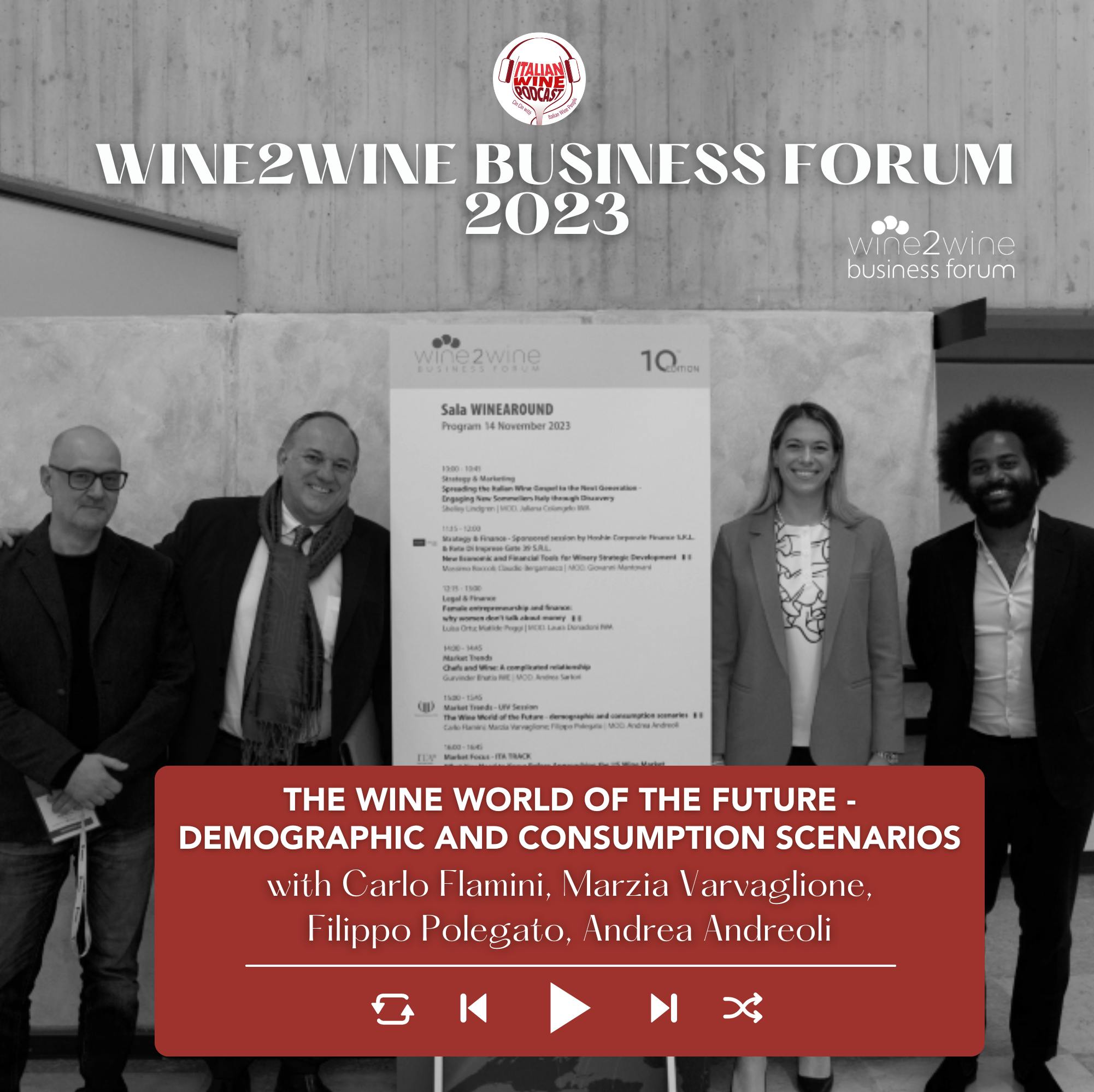
Ep. 2131 The Wine World of the Future - demographic and consumption scenarios | wine2wine Business Forum 2023
Episode 2131

Ep. 2123 Chefs and Wine with Gurvinder Bhatia and Gino Colangelo | wine2wine Business Forum 2023
Episode 2123

Ep. 2115 Why women don't talk about money with Luisa Ortu, Matilde Poggi, Laura Donadoni | wine2wine Business Forum 2023
Episode 2115

Ep. 2106 Massimo Boccoli, Claudio Bergamasco, Giovanni Mantovani | wine2wine Business Forum 2023
Episode 2106