
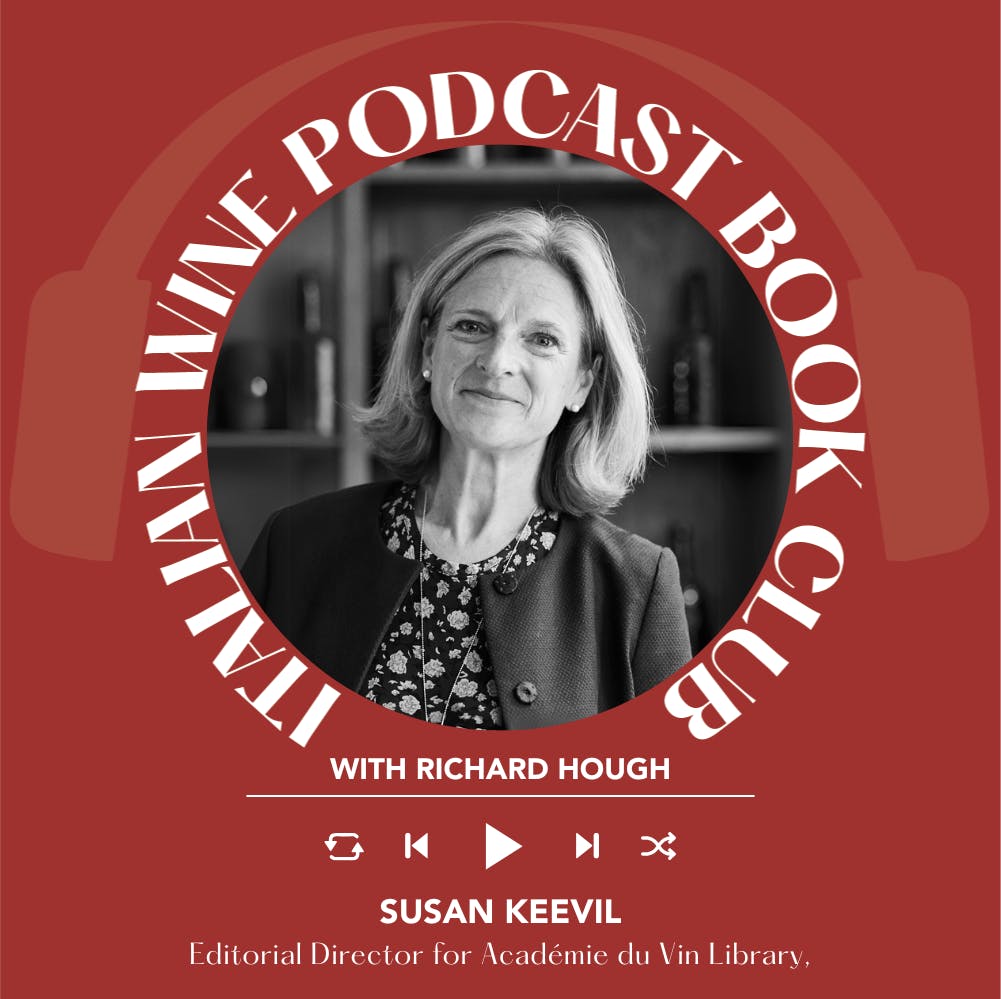
Ep 2315 Susan Keevil | Book Club with Richard Hough
Book Club
Episode Summary
**Content Analysis** **Key Themes** 1. The rapid and transformative evolution of Chianti wine and its global recognition over the past century. 2. The historical and cultural significance of Chianti, including its symbolisms like the Black Rooster emblem and legal geographical demarcation. 3. The personal journey of Susan Keevil in the wine industry, highlighting hands-on early experiences and progress through influential wine writing and editorial roles. 4. The modernization and quality improvements in Chianti viticulture through key initiatives like the Chianti Classico 2000 Project. 5. The interplay between tradition and innovation in defining Chianti’s identity and winemaking techniques, such as changes in grape composition. **Summary** The conversation with Susan Keevil blends her own wine career journey with insights into the history and evolution of Chianti wine. Chianti, once symbolized by rustic fiasco bottles, has undergone rapid transformation in just seventy years to become a prestigious wine region globally. Its legacy traces back to the 13th century, with legal geographical boundaries established by Grand Duke Cosimo III in 1716, making it one of the earliest officially delimited wine areas. The region and its wines have been marked by cultural stories, such as the legendary Black Rooster emblem, and continuous development projects like the Chianti Classico 2000, which ushered in modernization with new clones and improved viticulture practices. Keevil’s own trajectory from cellar work in Australia to editing Decanter magazine parallels this theme of deep respect for tradition combined with adaptation and growth in the wine world. **Key Takeaways** - Chianti is historically significant as one of the oldest demarcated wine regions (since 1716) with evolving wine styles and quality standards. - The Black Rooster symbol and medieval tales underscore Chianti’s identity, blending folklore and regional rivalry. - The Chianti Classico 2000 Project was critical in modernizing grape clones and winemaking methods, aligning tradition with innovation. - Susan Keevil’s passion for wine developed from academic geography studies and hands-on cellar work to editorial leadership, illustrating diverse pathways in wine careers. - Decanter magazine provided a collaborative and dynamic environment fostering wine journalism and expertise in the 1990s and 2000s. - Changes in Chianti’s wine composition, especially the reduction of white grapes after 1996, reflect shifting tastes towards more structured, age-worthy wines. **Notable Quotes** - "Chianti will forever be associated with those hot bellied fiascals and broad jackets, what Burton Anderson in the book describes as the epitome of rustic elegance." - "In 1716, Cosimo III de' Medici issued an edict legislating that the three villages of the Lega del Chianti as well as the village of Greve were the only officially recognized producers of Chianti." - "In 1987, the Consorzio Vino Chianti Classico worked on the Chianti Classico 2000 project, resulting in extensive replanting and modernization that launched the modern era of wine production." **Follow-up Questions** 1. How has the quality perception of Chianti evolved internationally since the Chianti Classico 2000 Project concluded? 2. What are the contemporary challenges facing Chianti producers regarding climate change and market demands? 3. How has Susan Keevil’s editorial work influenced public understanding and appreciation of Italian and broader world wines?
About This Episode
The speakers discuss the importance of the "any bottle" concept in the Italian wine industry and their love for the craft. They talk about their experiences with writing and creating covers and marketing for books, as well as their love for the craft and their interest in creating standalone articles and creating a cheese series. They also discuss the importance of Tuscany in the Italian wine industry and its association with historic art. They also mention the importance of writing in the area and its potential for new discoveries. They provide advice on writing and editing habits, writing about the town, and recommend the book Tuscany from the Academy of Land Library.
Transcript
Chianti will forever be associated with those hot bellied fiascals and broad jackets, what Burton Anderson in the book describes as the epitome of rustic elegance. In Verona, you can still find those fiascals of Chianti in the supermarket shelves. What is it that makes it such a resonant and evocative region and wine? I think that it's just the speed at which it's all happened for Chianti. For in seventy years, it's changed so much. Hello, and welcome to book club with the Italian wine podcast. I'm your host, Richard Hoff, and I'm delighted that you're joining us as we get between the vines with some of the best wine writing out there. So sit back, pour yourself a glass, and enjoy the show with the Italian wine podcast. This month, our guest is Susan Keevel. Susan is a former editor of Decanter Magazine and the author of The Witch Guide to Wine, currently a writer and editorial director of the Academy du Vin Library. Before we talk about the book that you've been involved in, the book that you compiled on Tuscany, I want to explore a bit about your personal background, your interest in wine, and your early career as a wine writer. I understand you had an early professional experience as a cellar rat cooling Chardonnays in Australia's Hunter Valley. Now I can't if that was a really exotic sounding, introduction to wine or or whether being a sailor rat is something something a bit more, I don't know. Tell us a bit about that experience. It wasn't that glamorous, I have to say. And it was it was not my first job, but I just landed in Australia, and it really was wham bam right in the deep end. I think because I had in my I did a geography degree at London University, and part of that degree was a module called the historical geography of viticulture. Wow. And for some reason, I think the employers at Rosemount thought that that qualified me to make wine. I don't know why. We had two shifts, a day shift and a night shift, and I was on the day shift fortunately, and Greg Wellbyshow was the guy that had my job on the night shift. And he obviously was steeped in bone and burgundy and and all of that. And I was just handed a spanner, a large, large spanner, and said, right, tank number 16 or whatever needs cooling. Can you sort it out? So I had to go and call this ferment, and they all disappeared for a smoke out when I was left to it. I had no idea what I was doing. So massively thrown in the deep end, but, you know, I've never known learned so quickly. Not glamorous at all. I ended up cuts and bruises running everywhere. They used to call me the greyhound, really skinny and just ran everywhere. Yeah. But I anyway, I loved it. That was my starting point. Fantastic. And sometimes being thrown in at the deep end like that is is the best way? Yeah. I guess I guess so and and learning quite so fast. Yeah, perhaps it was. I I ended up really loving Chardonnay and found it finding the whole thing absolutely fascinating. And did you have an interest in wine before that? Had you gone to Australia specifically with Yeah. You absolutely did. I mean, I it was sort of in the background as I was growing up. My father, so he liked wine and not beer, and so it was it was there. And then, when I went to university, alcohol was quite a big presence and wine came into the geography and, you know, as I say, studying the geography of viticulture and the way the vine had moved around has moved around the world as culture does with with the different sort of, migrations, the vine went with them. And then so so that sort of study was good. And then actually getting to know what it tasted like, in a broader way was was fun as well. So, yeah it was a gradual fascination, by the time I got back to England after I'd been away for a year I knew that I wanted to get involved in the wine industry somehow. Okay. And then so, just happened to see a friend of mine saw a job in The Guardian, advertised for Mitchell Beasley, which was for a wine editor. That sounds perfect for me. But I wasn't an editor in any way shape or form and so I, you know, I was really brave and I applied for it and they said well you're not you're not qualified at all but we really like you and they took me on. But they took me on as a researcher. So I was I was a Google if you like. Because you know while you know in those now we kind of type our questions into a nice white box on a screen then we didn't have that. So they sent Susan out on the streets of London to go and photocopy stuff at the British Museum or a library here or there everywhere. So a lot of treading around. Okay. So from from that very hands on experience in Australia to another quite hands on experience, I suppose, in in the world of publishing. Am I correct in thinking that you worked with Hugh Johnson on the pocket wine book? Left with my baby. Yes. I did I did work on my own, not initially, but, started Art and Science of Wine with James Halliday, and Hugh Johnson was my first book with Hugh. It was so good to meet him and James of course was a very lovely Australian character, and they're great to work with. And then I, yes, I did work, move on to the pocket wine guide which was, you know, that was great. That was a whole world of wine and talking to people, to specialists in each region that the book covered, was was an amazing experience for me. And obviously I had to sort of note down the detail, but I ended up ghost writing it for Hugh, although the, you know, the words were there, but I would kind of update it every year. And we had about, you know, nearly 20 different co editions. So it was translated into, you know, many different languages. You know, we had MAX in the very early days of MAX, but it wasn't like today where you could just sort of whiz everything off. You had to kind of through a tricky process to get that book out. I can imagine. From there, you you landed a dream job as editor at Decanter. What kind of time scales are we talking here between your early involvement and the the world of publishing and then Yeah. So I was I did about five or six six editions of the Pocket Wine Book. And then I went to mid nineties or went to Decanter. I kinda was ready for a change, but my my now husband was out in California doing a postsynaptic postdoc qualification in California. So I decided to go and work in California. That's what I was gonna do. So I went out for three weeks and visited and looked for a job out there, flew back home. And then I got a call from Sarah Kemp at Decatur just out of the blue saying, do you want to come and work for us? And I said, well, I thought, well, I don't really because I want to go to California. And then I and then, I thought, well, maybe I'll do it for six months. So, you know, the rest is history. I went I joined Decanter and actually ended up flying out to California rather a lot and worked very well. Decanter was just an amazing place to work at. It was just, you know, to turn up there and, see that, you know, my byline could be I could write reports on a tasting or something and that and there would be my name in the magazine. It was just, like, such a joy. I loved it. Because with books, you're very much in the background. But, I'm guessing that kind of office culture as well that perhaps isn't quite so much the case today with remote working and smart working and people dispersed all over the world. In those days, there would have been an office and a Yeah. You had to be there five days a week, definitely, if not more. None of the part time working. It was but that was that was great because, you you know, if you ever had a question or a or a something to a joke to tell or well, you could just sort of run things through everybody. And it was, yeah. I love I love that actually. It was a great experience. So you'd have the ad team next door, you know, with their constant demands on on on our end. And then we'd have, you know, a bunch of us editors and designers putting the whole thing tog
Episode Details
Related Episodes

Ep. 2787 Prosecco Superiore by Dr Susan H. Gordon | Book Club with Richard Hough
Episode 2787

Ep. 2763 An Italian Dream by Alec Ross | Book Club with Richard Hough
Episode 2763

Ep. 2739 A Bite-Sized History of Italy by Dr Danielle Callegari | Book Club with Richard Hough
Episode 2739

Ep. 2703 How to Sound Wine Smart with Maryse Chevriere | Book Club with Richard Hough
Episode 2703

Ep. 2666 A Valpolicella Masterclass with Elisabetta Tosi and Giampiero Nadali | Book Club with Richard Hough
Episode 2666

Ep. 2608 Pub Culture, Natural Wine & Island Terroir with Katie Mather | Book Club with Richard Hough
Episode 2608