
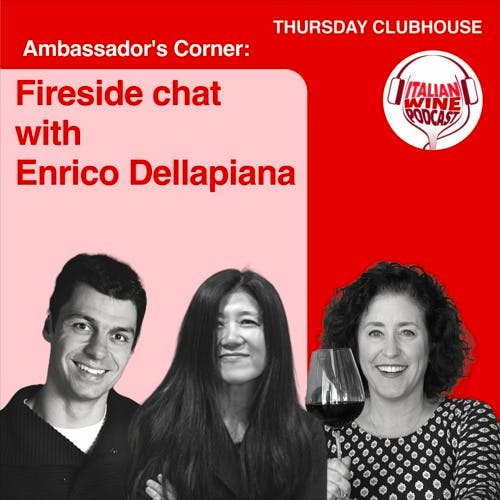
Ep. 657 Jodie Hellman Interviews Enrico Dellapiana | Clubhouse Ambassadors Corner
Clubhouse Ambassadors Corner
Episode Summary
Content Analysis Key Themes and Main Ideas 1. The evolution and significance of Rizzi winery in Barbaresco, founded by Enrico Delapiana's father. 2. The unique geological characteristics (Cerrovalliano and Tortugiano marls) and microclimates of the Barbaresco region and its specific crus (Rizzi, Nervo, Pajore). 3. The distinction between Barbaresco and Barolo, and the nuanced differences in wines produced within Barbaresco's various sub-regions. 4. The importance of preserving traditional grape varieties like Dolcetto alongside the dominant Nebbiolo. 5. The successful venture into producing Alta Langa sparkling wine and its growing popularity. 6. Enrico Delapiana's personal passions — painting and basketball — and how they are integrated into the winery's identity and his winemaking philosophy. 7. The collaborative spirit among Barbaresco producers and the family-oriented approach at Rizzi winery. Summary This special episode of the Italian Wine Podcast, recorded live on Clubhouse, features an ""Ambassador Corner"" session hosted by Joy Livingston. The core of the episode is an interview between Italian Wine Ambassador Jodi Helman and Enrico Delapiana, owner of Rizzi winery in Barbaresco. Enrico shares the unconventional origins of his family's winery, started by his father in the 1970s, defying societal norms of the time. He delves into the unique terroir of Barbaresco, explaining the geological differences between specific crus like Rizzi, Nervo, and Pajore, and how these influence the distinct flavor profiles of their Nebbiolo wines. Enrico passionately discusses the importance of continuing to produce wines from traditional grapes like Dolcetto, highlighting their historical and cultural significance. He also recounts the story behind the winery's successful foray into producing Alta Langa sparkling wine, an idea championed by his insightful father. A significant part of the conversation revolves around Enrico's artistic talent in watercolor painting, which adorns his wine labels (especially the Boito reserve magnum bottles), and his lifelong passion for basketball, which he views as a metaphor for teamwork in winemaking. The session concludes with audience questions, touching on food pairings and the collaborative nature of the Barbaresco wine community. Takeaways - Rizzi winery in Barbaresco was founded in the 1970s by Enrico Delapiana's father, who made a significant life change to pursue winemaking. - The Barbaresco region is characterized by two main soil types, Cerrovalliano and Tortugiano marls, which contribute to distinct wine profiles. - Specific crus like Nervo (more tension, verticality) and Pajore (more richness, power) produce different expressions of Nebbiolo wine due to their unique soil and exposure. - Enrico Delapiana advocates for the continued production of traditional grapes like Dolcetto, emphasizing its historical importance for the Piedmont region. - Rizzi winery has successfully ventured into producing Alta Langa sparkling wine, seeing significant growth in production since 2013. - Enrico integrates his passion for painting into his wine labels, creating unique, hand-painted designs for special releases like the Boito reserve magnums. - His background in playing basketball has instilled a strong belief in teamwork, which he applies to the winemaking process and family dynamics at Rizzi. - The Barbaresco winemaking community is portrayed as collaborative, with producers supporting each other rather than competing. - Rizzi winery offers guest apartments for rent, providing a direct immersive experience for wine tourists. Notable Quotes - ""My father make the the best decision of his life and, unfortunately, also for my life, and the life of my sister and, our family because, we live in, a little, paradiso, we can say, A little heaven in the middle surrounded by vineyard."" - Enrico Delapiana - ""Nervo, you have to remember that Nervo is mean nerve. So it's more Nervous wine. So the tension, very straight, and not so rich and powerful, but it's the characteristic for me of the elegance of barbares and in particular the areas of trace."" - Enrico Delapiana - ""[Pajore] give the wine more rich, more sugar, more powerful. So easy to remember, powerful, narrow is a nerve. So this is a quite, funny."" - Enrico Delapiana - ""Non only are they getting a work of art inside of the model, but people are buying a, an individual one of one of a kind work of art on the outside of the bottle with the labels on the magnum."" - Jodi Helman - ""I think that's the the the wine. It's like her heart."" - Enrico Delapiana - ""When you are in this in the winery, you are in a team. So it's important that's, the person that's worked with you are happy, like, when you play basketball, that's everyone have take a ball, they have to shoot, you can be one main show, it's important to create a team in the..."" - Enrico Delapiana Related Topics or Follow-up Questions 1. How do the specific aging requirements and techniques differ between Barbaresco and Barolo wines, given their geological similarities? 2. What are the current challenges and opportunities for smaller, family-owned wineries in Italian wine regions? 3. Beyond Dolcetto, what other lesser-known grape varieties in Piedmont are gaining renewed interest, and what are their unique characteristics? 4. What specific market trends and consumer preferences are driving the growth of Alta Langa sparkling wine? 5. How do wineries like Rizzi balance tradition with innovation in their viticultural and winemaking practices? 6. What impact has social media and audio platforms like Clubhouse had on wine education and community building? 7. What strategies are Italian wineries employing to attract and accommodate international wine tourists at their estates? 8. How can the concept of ""teamwork"" in winemaking, as described by Enrico, be further elaborated to include vineyard management, sales, and marketing efforts?
About This Episode
The Italian wine club is hosting an upcoming wine show called Bridge 1995, which is an interactive session on the Italian wine club and recorded. Speakers discuss the importance of learning from famous wine producers and understanding their backgrounds, and introduce a new wine producer, Enrique Delapiana. The speakers also discuss the importance of learning about the importance of learning from famous wine producers and the importance of understanding their backgrounds. They talk about their experience with a traditional wine in the region and their interest in growing different varieties of grapes and creating a new type of wine. They also discuss their background in painting and their love for steak and their desire to become a basketball player. They mention their love for wine and their partnership with a high-end chef.
Transcript
Welcome to this special Italian wine podcast broadcast. This episode is a recording off Clubhouse, the popular drop in audio chat. This clubhouse session was taken from the wine business club and Italian wine club. Listen in as wine lovers and experts alike engage in some great conversation on a range of topics in wine. If you enjoy listening, please consider donating through Italian wine podcast dot com. Any amount helps cover equipment, production, and publication costs. And remember to subscribe and rate our show wherever you tune in. Before the show, here's the shout out to our new sponsor, Federaline. Federaline has been the largest wine show in Italy since nineteen twenty. They have generously supplied us with our new t shirt. Would you like one? Just donate fifty euros, and it's all yours. Plus, we'll throw in our new book jumbo shrimp guide to international grape varieties in Italy. For more info, go to Italian wine podcast dot com and click donate or check out Italian wine podcast on Instagram. Welcome. My name is Joy Livingston standing in for Stevie Kim. And this is a show called Ambassador Corner on the Italian wine club here on Club House. I'm here with Leica, the clubhouse organizer, and, we do these sessions every Thursday at eight pm, Central European time. He's gonna let me know if I forget anything, tonight. Am I possibly forgetting anything, or is there anything that you want to say before I get started? Yeah. I'd like to first butt in and say something about them via. It's called the Italy International Academy. That's, where Me and Jodi, we studied together, for understanding Italian wine grape varieties. It's like the gold standard of Italian wine education. So there's one upcoming, this September thirteen to fifteen. The deadline for the registration is September three. So if you would like to join, the registration is still open. So it's going to be in Boston, Houston, and Seattle. It's an agile addition And, yes, just check on the website and then and also check on if you would like to ask some questions of any inquiries or clarifications about the matter, just send an email to Via, that's v I a at just do the work dot IT. So that's it. Awesome. Thank you, Leica. Alright. These sessions here, these are recorded. Okay? And they will be released on the Italian wine podcast in the coming weeks. And that's for those people who are not able to, you know, listen in because of their time zones. Let me just get into just a quick intro. So the idea behind this ambassadors corner is to give Italian wine ambassadors and wine lovers, the opportunity to interview their favorite producer. And at the end of the discussion, we will give the audience a chance to participate in the discussion by asking questions. So today we have Joe Jody Helman interviewing Erico Delapiana. I'm going to let Jody introduce Erico, but I'm just gonna tell everyone about Jody real quick who I who I've met, several times. She has come here to for Ven Italy. She was, at the Venice International Academy this year, and so I got to chat with her then. And she was actually recently just on the podcast. She was interviewed. So that was awesome, but, she is an avid traveler and she especially loves Italy and attending, you know, all the trade shows all around the country. And she's currently in she's a sales consultant for Johnson Brothers distribution in Nevada. In the past, she was the Western Regional manager for the sorting table. She worked as the Nevada state manager. She's a sommelier, sorry, for Jay Laura, Vineyards and wines, and she's been a sommelier on the Las Vegas strip for ten years. So Jodi, are you there? Am here. Hello, Joy. Hey. So let's get going. I'm gonna ask you a few questions just before you get started, and I I totally give the floor to you, and I'll stop talking. So tell us why you selected Elrico Delapiana as your favorite producer. Well, for me. So Enrico just exudes joy and passion in everything he does. Not just speaking about his family's wine, but he's also such a champion of the region of barbaresco. That, I really wanted more people to know who he was and also know about his, family winery. Awesome. And, so what are the learning objectives that we should expect from this this chat this session? Well, I think some of the things would be, like, the key differences between, Barillo and Barvaresco, such as the topography and the soil, along with, other types of wines that are produced there, because we always people tend to think of Piedmont and just think that yolo right away. And, and Rico always likes to say, like, when people ask him, what's the difference between Barbara and Barolo? He likes to tell them why Barbarresco is better than Barola instead of what the difference is. So I think it's not really great to kind of hear his thoughts on, you know, producing wine in Barbara Okay. Cool. His perspective. But let's see here. So, last question, how did you discover the wines of Cantina Rizzi? So, I was part of the import team that launched the wines nationally in the United States. And then I got to visit the property. The, first time I came to Verona, I took a little side trip in between, Via and Mid Italy, in twenty seventeen and went to visit, the property and Enrique and his family. Alright. So, Jody, it's it's such a pleasure to have you. It's a pleasure to have in Rico who I don't think I've said hello to yet. Hi, Erica. Hi, Jody. Nice to meet you. Lovely to meet you as well. Yeah. I I don't think I've forgotten anything like that. If there's anything, go ahead. I'm gonna leave the floor now to to Jody to do her thing. Oh, thank you. Hi, everybody. I'm really excited to have the opportunity to introduce Enrique Delapiana. If you're, not familiar with his wines, I hope you will after this conversation, run to the store and find a place that you can purchase some of his wines for sure. And I just wanted to, give Enrico a moment to tell you a little bit about him self and about the winery. And then, we'll kind of jump in and, ask him a couple of questions as well. So why don't you tell us a little bit about yourself and, history of the property in Rico? Okay. Charles Jody, it's a pleasure to speak with you. Natalie, we can do this, with the technology. So it's perfect. So I'm very happy to meet, many people in this case. So I just introduced myself a little bit. I'm a Rico Delapiana. We make her an owner of Ritzia State. I mean, not only in Piedmont, in the Barbar Escaria, in the village of Trazo. So it's, I am my state, Rizzi, is the name of the our, property, our farmhouse, and then it's, more than, fifty four years. So that's we, produce wine and produce barbaresco in, in in the area. So, Ritzi, okay. Oh, people normally speak me. Ritzi is the name of the state about many times in Italy, the name of this state is also the family name. So for many people, I'm a Rick. Or it's, even if my family name is Delapiana. And so it's funny because, Ritzi, for me, is very important because, Ritzi is the name of this state, the farmhouse, the hill, the crew of Barbaresco. And finally, I, I joined to the name, Rizzios, in my family. And so we we started to produce wine. It was my father, the person who to start, making wine at, in the family estate because, in the nineteen seventy four, but the property was my grand grandfather since end of, eighteenth, nineteenth century. So we always have this property at Ritzi. But, it was my father in the seventies that he decided to change his life, sell, a factory in Tarino, and then start to make wine. So it's, something that is very, particular and strange. Always, when I describe my state, I start with the story of my father because he's still alive. He's still strong. He still work. But he's a person that's, for me to me now to speak with all of you. Permit to make the most most beautiful work because, I'm making wine. And so it's a fantastic, but because my father decides to change his life in the seventy, he start to make wine to work the field. And, if now in the two thousand twenty, we say, if I say, for example, Rico, what's your, what's the people ask me, which is your job? And say, and the winemaker, I have a winery or people. Oh, wow, where? Barbararesco? Amazing. So in the seventy was not like this. And so in the seventy people say, oh, you go to go. My father say, you go farmer in in Theresa. Why? And not because living in a big town in Toronto. So I move coming back. So it's it was something very brave that we can say crazy brave, but finally, in this moment, I can say that my father make the the best decision of his life and, unfortunately, also for my life, and the life of my sister and, our family because, we live in, a little, paradiso, we can say, A little heaven in the middle surrounded by vineyard. That is, and then my my work, my job is also my patience. So, for me, speak about wine, is something that is, incredible. I like, and then I like drink wine and different kind of wine because, it's fantastic. So, it really is a little slice of heaven. If you've, been if anybody's had the the pleasure of being there before. And his dad is still very active. When we had visited the estate, just a few months ago, we were looking out from the top the hill from the winery and we could see his dad out on the tractor. He was pointing him out. He was running through the vineyard. So, the everybody in the family is still, a part of what happens there. And you mentioned, that Ritzy is not only the name of the winery. It's also a crew vineyard where, the winery is located. Why is that important to the quality of their tea wines. And how many producers of the Riti crew are are out there? Like, is there anyone else using Riti as a crew on their label? Okay. So in this moment, we have to explain a little bit about the Barbarisco region. Is it just three three, very small villager tracer Barbarisco and navy plus, a little part of Alba. And, all the area of Barbareski is subdivided in a sixty six, micro zone, a crew in the French, terms, or, geographic dimension. And the one of these is Ritzi, because Ritzi is not only, I would say, the name of my state, but, I live in Stada Ritzi and Ritzi Hill, and so one part of this hill then the crew take the name Rizzi. And, more or less, the crew is, more sixty Hector O' vineyard. We own more or less fifty percent of the crew. Then there is other producer that's, the lower part of the crew because we have all the top part of the Ritzier hill. And there is just one very small and young producer, in Saniro, who make a little quantity of barbaresco with the Appalachian Ritzi. So with the mentioned Ritzi. It's not monopole, unfortunately, but, when the mention that was created, was not possible to create a monopole mention. So there more producer to and then also, this is represent a particular area. It's quite big. So it's, it's nice, it's a nice position. South Southwest position. How how much of the crew do you actually own of the sixty hectares do you does your family own? Actually, more or less, thirty, twenty seven Hector in Ritzi. And now, of course, we know that Nebula is the grape that everyone thinks of first when talking about, piedmont, but you are passionate about growing other varieties of grapes and producing different styles of wines, especially Dolcieto. Can you talk about why you feel it is important, to you to continue to produce a wine like Delceto that may not have the cachet of Nebula. Ma'am, okay. So that's our estate. We make a different kind of a grape, but because of the Aviolo, in particular, needed the best position, the south, southeast, the southwest position. And so in our state, we have also some, East North Side or West Side. But in general, we produce a nut, the red wine and the and the muscato. So this is our variety that's we have. But, when you tell me about the for me is really a particular and historical wine of the region where I represent the characteristic of Piedmont. And in particular, I'm I like this kind of wine because represented Piedmont. So, for the characteristic, And at the same time, is, is, really important for trade. So, because in the past, just until the eighties, the most important wine and variety of the region was the double check dot. So the the wine and more sold, then the nebulo pass pass over. And so now the nebulo is the most important, they're great, but it is a part of historical of the region in particular atreso. Is very, very well known for the characteristic of the crispy and the fragrances of the Dorceto. There are the heel of, retra entraisal and and just two other heat just in front of my winery. And let's say it's a typical area of the alba. It's important to not to lose this wine because, the nebulae in the last years, not really. It's also from one side of the story is correct, but it's like a cannibal and so it's a major everywhere, but it's important to maintain the Dolce for the characteristic and for the history. And, also for the characteristic, I think that's for the different wine of the region. And I say that's another thing that is funny for the color of the leaves in the autumn because, the dulcete is so red color and also for, when you look, in the auto and the change, then the biolo is everything yellow. And so you see the red and the violet. You say, oh, this is legit. This is dark matter. So also for the pie, for the landscape, is, is finding it. Anyway, so I'm I promote, always a dolce too. I believe in this wine is a wine and easy, everyday wine. But can be really enjoyable and with many kind of food and the easy dish maybe during the summer, drink a little bit more, cold. It's great. Oh, yeah. It's important to, just for people to understand the history for sure. And then I know most of the people that are listening would never turn down a glass of Bullagini. And you decided to start producing, Alta Longa, the Pado sein twenty thirteen. What was the inspiration for you to take on this challenge? Yeah. Okay. So, we stopped to make a Alta manga in the two thousand thirteen, but it's true that I start to make a Baligina. In two thousand and seven. So my first, while I make experiment, I start to produce, Alta, Mato, Plasico, and just I enter in the consorts of Alta language in the two thousand team. Probably in this moment, I'm the only one producer of Alta Ranga in the Bara in Barbarasco area. For me, it was, a challenge because I never made a Bolicini before. So for me, it was important from thousand and seven until, two thousand, until two thousand thirteen, and until now, this experiment, so to study to learn about the coaching. And so starting from two thousand thirteen. I have a more experience. Alcalanga is why we decide to start with the Bolicina because, he's funny, but my father is, sometimes he's a little crazy, but, yeah, as a many idea. I saw in the two thousand and five or four or five, say, Enrique. You have to start to make, Bolicina, because the Bolicina is the future. You say, Nava, nuh, nuh. No. You have to do. And then he's funny because my father is a man that it don't go to take a paritivo or drink out of wine in the restaurant, but it's, it's like this. You see something over. So, is incredible, I'm finally, okay. I decide to start to make a wine. And finally now, in this moment, the Alanga is one of the most, sold wine in the region. It start to be very, very popular in Italy in general. Is very trendy and in the future, I suppose also there will be opportunity also for export and maybe a little bit later also in the other state. In this moment, he's a young population at Alanga, but He's just, in Italy is working well, and, I'd seen that the next step will be more and more wine outside Italy and the sugar option in the United States or whatever. And and how much did you produce in two twenty thirteen and how much do you produce now? In the two thousand thirteen, probably three thousand bottle. And now, the thirteen thousand. And this year, probably, I will arrive at fifteen thousand bottles. So this is my, all the vineyard that I have, it can arrive at produce, more or less fifteen thousand bottles. So it's not a huge, volume, but, little by little. Well, I've had the wine before and it's absolutely fantastic. Definitely a fan of the, of the bubbles for sure. And then as far as, the barbaresco area from a geological point of view, you know, on your website, it states that it's not that fundamentally different from Barolo. In simple terms, it's divided into two parts according to the soil types. Can you talk a little bit about the two parts and where they differ in the type of wines that they typically produce? Okay. So that is, it's interesting. So when we speak about geology, I'm just arriving from, a master class of geology. Unfortunately, I left it before, so I have no old information. The new information, but anyway, it's, interesting to, to see it's not easy and not short. I try to make, easier possible to make understand all people, the geology of Parbaresco. So in Barbarisco, we have, in general, we can consider two kinds of soil. All the soil is a sedimentary soil. So what's mean in fifteen, twenty million years ago, there was the sea. And so all the language that you see now was at the bottom of the sea, four, five hundred meter, under, under the sea. Then there was, movement of, Africa and different black, and, this is permitted to, push up the lung and, the sea going direction, Maradriatic, or actually situation. And the lung is quite young. So the soil that's are in the barbaresco area is the sedimentary soil of the of the bottom of the sea. The sedimentary soil between created between eight and twelve twelve and eight millions a year ago. And, in barbaresco, we have two kinds of soil that's these call it. Serevalliano and the tortugiano. So Cerrovalliano is older, and the Cerrovalliano is the younger. Trezo is in, the older part. Barbaresco is more in the, the village of Barbaresco more in the the younger soil, if you can say younger. The characteristic of, all our soil is in general. That's, more or less fifty percent is a silt, and then the rest is clay and sand. Depends the more clay in direction north and direction barbaresco and the north part of Navy, more sandy in direction, Theresa. All this soil is characterized by a lot of limestone. This is a little bit the characteristic. And this kind of soil with this, characteristic is a similar also in Barolo. More or less, we have the same, soil, in the same geological period. In Barbaresco, we have these two kinds of, only in Sarbalian is a geological period. In particular, the name of the soil is a formazio on Ethiopia, in the Theresa and modern descent target in direction, Barbara risk. So it's not easy to understand, but, the geologic is always complicated. So I, I try to not make confusion. For me it's important that these are two different soil. We have a different crew in, in the area of barbaresco. And one crew is in the sandy soil, a more rich in saying that there's Sarvalian, and is the crew and the crew is more in direction, barbaresco as the characteristic of a little bit more, clay. So it's, particular, and then this characteristic of the soil is also characteristic that's, we find in the in the wine. Well, yeah. Then you brought me to, one of my, other questions was going to be about the fact that you do produce to other crew wines one from Neuroville and the one proprietary that you just spoke about. So because of the soil, the exposure and the elevation, how do those two wines differ in their, flavor profiles? And, are there a lot of other wineries producing, a crew modeling from those two sites? Okay. So I to memorize the characteristic of the wine is easy for the name. So nevo, you have to remember that it's, older soil, higher in altitude, more sand, is more tension, more vertical. And then, Nervo, you have to remember that Nervo is mean nerve. So it's more Nervous wine. So the tension, very straight, and not so rich and powerful, but it's the characteristic for me of the elegance of barbares and in particular the areas of trace. And the other one is a payor. Is it just, in direct is it still in treasure, but, at the limit with barbaresco, the characteristic, if the marl, the Santagata Mal, mort of tonian soil, more rich in a little bit more rich in clay, higher percentage of clay, and this give the wine more rich, more sugar, more powerful. So easy to remember, powerful, narrow is a nerve. So this is a quite, funny. Fortunately, I, again, I have two different crew. We've been with the name and that's, well, a represent a characteristic, nerve, powerful, so it's, funding. Which producer make, Nervo. Nervo is a sixty nectar of, of crew. We have a four. My place, my part of Nevo is a just the higher part under the village of Treso between, Bernambotte, and the pre codifies. So my neighbor is a territory over is a purchase. Right? But Nervo in this moment, there are only three pro there is only three owner in Nervo, and then one is, Partinace, another one, Piazza, and then, not really let's see that we make And the Bayore is, probably one of the most famous, historical crew of Trezo, and also for all Barbarasco area. He's a twenty five acre in total. Ten of these, is owned by Gaia. That's it don't put. It doesn't put, a priority on the label, but he used this, great for, the, Barbarisco, for his Barbarisco. And then, there is another producer in neighbor that is called a and the bell call. Probably soon there will be other producer, but in this moment, there are only, three, one with the label, payer. But is the story is a guy that's, he bought a payor in, in the seventy because, there was another producer that's make amazing wine and giovanni moreescore in the sixties and the seventy make fantastic wine from payor, And so, Guy, I fully love of this terroir of this crew, I decide to buy. And then when, my father and I, we have the opportunity to buy in two thousand four and two thousand and seven. More creator of, I say, okay, we have to buy it because it's incredible. And so I'm very proud of this group. I think, if anyone out there really wants to get a sense of, a sense of place and really understand that, to be able to taste something side by side and understand how different, the vineyards can be in such a small area, tasting, Nervo, your Nervo, and your Pairay wide side by side. Is a is a really great way to understand what you're talking about about how that small little difference does make a difference in the line. So, I encourage people if you have the opportunity to try them side by side to definitely do so. And then, within the Ritzy crew, you have a tiny section, that is the Boizhou section that you do a reserve of modeling from. What's different about that part of the vineyard that makes the wine special and how What's the size of it and how much wine do you produce from this part of the Ritzi crew? So the Ritzi, is is my crew or Ritzi. So, finally, we have this, is a particular for geological speaking because of the lower part of Ritzi is more sandy, is, more older. And just the top part of the hill is, that is the the vina poyto, is a rich in clay. It's a geological jungle, is a tortonian, and then it's a particular. So in this part, the top part of Ritzy crew is the part where we make our reserve. So age longer, the barbaresco. And, it's the reserve. The the bottle is come from a old junior, planting this in seventy one. That is fifty years old. Just, one in turn half. That's a user every year. And the end of the year, the production is, between three and six thousand bottle a year plus magnum. So it's a small quantity. Matt, but for me, it's a very small production, just to make the selection also inside the video, Dina, the old vine, but the oldest vine. So it's really our special selection. And, as you know, for me is, funny because every, I paint one label. So, you know, you can, that's my patient for hearts and for watercolor. And so I decide to use, Pachael, my painter for every year. There is one painting. This is, for me, it's interesting to Yeah. Well, you you brought me to my next question once again because I was going to ask you because, you know, you do have so many other passions outside of wine, and you've integrated them into the story of Ritzi, like the watercolors, and that you produce a new label for Boito every year. How did you discover painting? But I always paint since, since the big it's always been. So from probably, have two grandfather painter. My mother, this is a teacher of Art. Probably, I something in the DNA, that permit me to, I have no study of art and not at all, but I paint and then, something happened that is people like, so it's funny sketch. So that's a like, for me, it's quite easy. So, and people say, oh, can you do this? And I don't know. I follow the line and, then I design. I use watercolor because it's, I like this technique, and then I can paint it directly on the label. For example, that is, is interesting for, the label, of the Maglum, each one, each single label is and painted. So each single label is like, painting. So it's something that is, I really like, and so I'm very from jealous of the bathtub. Sometimes, no. This label is just so nice. I don't want to say that. Yeah. I mean, so not only are they getting a work of art inside of the model, but people are buying a, an individual one of one of a kind work of art on the outside of the bottle with the labels on the magnum. So if you're lucky enough to get a magnum of Boito, you don't make very many of those. Correct? As you know, it's a one hundred, one hundred fifty magnum and labels. So, and then depending on the vintage, And, but finally, so when you ask me about your occupation, I can say that the wine, is at the same time, patient like, painting. So it's, for me, every year is a new to make all areas a new, is a new heart, the new wine. I have a new expression exactly every year. It's, completely different. And so And sometimes, what's happened? Sometimes there are some paint that's, is better than another one, but is then the natural also in the wine. And so sometimes, I I think that's a I make a fantastic job because it's, put together a patient of, drink wine, the knowledge, the history of the, finally, every every bottle of wine that's you open. Maybe you open a bottle of, nineteen ninety and say, oh, my, god. So you're you're coming back in your life in your story. So I think that's the the the wine. It's like her heart. And so I can also put together that my painting permit this kind of job or permit me to have it really a different, opportunity to, develop my, my idea, my heart, and my patience. So it's fantastic. Well, one of the other things that, I think a lot of people, especially maybe more in the US, when they think of history or they think of Europe and Italy, and they're, you know, the history is longer. So they just assume that the families have been doing this, much longer. Obviously, like you said, the family has owned the estate since the late eighteen hundreds, in the nineteenth, the nineteenth century. But, also, your dad didn't start making wine, really. You're the second generation to be, making the wine there. And prior to you making the line, you played, basketball for quite some time in Italy. And could you tell us a little bit about the team that you played for and maybe how the discipline of team sports prepared you for life as a winemaker? No. This is, the sport, the basketball is my passion. And so, it's interesting because of for example, I just painted the label of the vintage boy, two thousand sixteen, I just make a paint dedicated to Kobe Bryant that passed away, unfortunately, that it was a fantastic player, half Italian because he spoke, perfectly Italian. He live in Italy. So I did the vintage sixteen. I painted the two t shirts of number eight and number twenty four, with the color related in the label. And so this is my This is a beautiful tribute. Yeah. I attribute it to a fantastic player, and so fantastic vintage. But it's also because Santania, they're in my paint over the Invoito, the reason of the basketball. So because I play for twenty five years, basketball since, when it was thirty nine, it's so very old. And then I decide, so for me, the basketball is my patient playing for a long, long time here in Alba and my team. Naturally, I'm not a NBA player, but, I'm a good carrier, in the regional area. And then, when you ask me about basketball, so I think that is very important because if you understand that when you play, you work in a you playing a team. And then when you are in this in the winery, you are in a team. So it's important that's, the person that's worked with you are happy, like, when you play basketball, that's everyone have take a ball, they have to shoot, you can be one main show, it's important to create a team in the, and then at the same time, for example, it's interesting to understand your evolution like a player. So when you was sixteen, twenty, twenty four, thirty, thirty five, forty years old. And so you recognize that you remember how was your, evolution. And finally is the same thing that's happening in the life of, one maker owner of one estate. So my father, maybe twenty years ago, he decided it was the most important, and then he was younger, with energy, but he's experienced. And maybe now, this is all there is the forty years old, the basketball player. And so you have to understand that maybe there is another one that's, like me, that is a twenty seven, twenty eight, the basketball player. We can consider with energy, and so is important. And then probably in the future, I with the basketball, I can learn that's my I have to meet you, and then I hope that they continue my job. When they will be twenty twenty five, give them, importance, support. This would be, so leave a space also to the other people. So this is important. That's a basketball, and at the same time also working, in the wine team is very important. The basketball team and wine team is, it's it's very, very, very important. Oh, I see on the, on the the via chat that, like I had put a, a shot of you doing some paintings, of the label. So if anybody wants to see some of Enrico's work, you can actually find them on the website. I also have, if you're friends with me on Facebook or Instagram, I've got some old ones and some videos actually. The first time, I had the pleasure of bringing Enrique to Las Vegas. He had never been before. And we took some videos of him painting labels, for some of the team members for the distributor that we work with. And I had found out at that time that that was the first time you had taken the watercolors from your home, and they belong to your mother. So you were painting these labels and you had traveled with the, with the watercolors. Yeah. That belonged to your mom. So, I really I really loved that you had, taken that with you. So and then, and basketball does come up a lot. I think the twenty thirteen label was a basketball themed label as well. Yeah. That is I just, paint, playground basketball also because was the the battle, when I finished to play basketball. So I dedicated to myself, to my basketball patient, the label of boy to thirteen. So it was, funny that I paint. And sometimes when I paint the the label directly, this, I use the, the basketball team. So it's the basketball idea. I paint some, something like these. So I had, one more question for you, and then I wanted to open it up to the audience as well. So because you're such a basketball fan, and I know, there are a lot of there's kind of a little culty group in the NBA of passionate wine lovers. If there was someone that you could get to meet or come visit your diary and taste your wines, who would you like to who's the one person you'd love to have come and visit your winery? That's a a basketball player. So just I have the the chance to speak personally, tasting wine together with, gone Wade. So, because, we have a common distributor in Canada, and so we taste together wine. So it's fantastic because, I see only three major of MBA and all the three major was, with, to outweigh the playing in Miami. And, and so about that there are so many, no, I know that there are many basketball players that's, invest in wine, and they have wine, patience or Lepron James. I know that's the interim color of wine. So it's a post other. So you'd like to have we'd like to have Lebron James come visit you. I would like. I would like because, it's really would be fantastic. So I can say, because I know his patient, I don't know that's, his patient is the nebbiolo, but I would like to make understand that this wine because the nebbiolo and the Balvaresco. Okay. For me, it's a easy wine, but I understand that it's not so easy. It's more, set up around technique is always important. I will be making, no better the area, so it would be great. Well, I I still appreciate you taking the time, to talk with everyone. I think there's a couple of people waiting to maybe ask some questions. Joy, are you able to open up, for some questions for Enrique? Yes. Absolutely. So if anybody has any questions, put up your hand now. I see Slalock is up on the, in our little chat up there. Slalock, did you have a question for Enrique? Hello, Rico. Maybe I I don't have a question, but, just, want to share, my experience with your wines because we met each other, before the COVID time, it was, you know, it can be like a event at the beginning of, two thousand nineteen, and I really appreciate it. I know that you cooperate with, some importer in Poland, but I really appreciate your wines. And, I cooperate with your neighbor, close to close to you with, with some other producers from, from Tracy. And, so, it's, it's a great opportunity, and thanks to you, and thanks to to to Jolie to have a possibility digital, top here that you can review, and it's it's a great. Thank you very much. And then, I hope that's, if the discovery passes, or I wait for you in my in my winery. Yes. That's great. That's fantastic. And and I, and I want to tell you that, we shared the same passion because, I was also basketball player, but only in the high school, but I I don't have a physical condition to to be a good player. So, I, I switched my, my passion to, to basketball, to be a basketball referee, and I was, a basketball referee in in Poland for fourteen years at night, and I appreciate the, the, the premier league of, in in in Poland of Demand Basketball and the extra league the women, women's basketball performance. So when I stopped my referee career, career, I started my question for lines. So it's, we we've got almost the same, the same history. Okay. Fantastic. Thank you very much. Love to see you soon. Alberto, do you do you have a question? No. Not really. That's why I didn't think again. And we called we had a few years ago, and this is the winery. And it was one of the last moment things. I was it was at the end of the day, me. And, so it was sort of a big problem too, and I got a great dentist. It got to be a staff here, entertaining. Fantastic. Right? So, complimenting. Again, I report to getting you again soon. Right? And Rico, I have one question. I'm not sure. In terms of your favorite food and wine, what can you give us, like, a couple good pairings with your wine? In general, okay, Barbaresco, Okay. We can speak about Barbaresco. The pairing, so people say with meat, so, unfortunately, the Barbaresco is a more gentle, more elegantly than Nipiolo. That sometimes a match where we have a good, pasta, and then we'll meet, you have to consider that for example, last just, last Sunday, we have a dinner with other seven, eight, the producer of Babaresco, because of the four, we are lucky in Babaresco. That's the old producer is very close. We are not not fight. So it's a old people who collaborate, promote the wine. And so we have adjusted dinner and a producer bring a two, three bottle of barbaresco, and so we start from an antipasti and we finish, I don't remember if the the seventies arrived or not, but because of we drink too much. But it's, But, finally, you know, that's the part of the joke. I like very much with a good, in people say game, but I like with a good steak for me. It's a good file. It's fantastic, met with a good barbaresco. So for me. You're a good high rebound or something like this that's, I enjoyed so much. Oh, that sounds absolutely delicious. Steak is my absolute favorite. No. No. I'm so sorry. That's, when I speak about food, now it's just, mostly dinner time. So you say, okay. And and if anybody does want to visit the property, they're they do have apartments that they rent as well. And it's centrally located. It's just a few minutes of the hill from Oliver. A couple minute drive from Barbarescos, really truly in the center of everything. So it's a great, jumping off point, and you can, book the, the rooms there. They're quite lovely, and it's a fantastic view when you get up in the morning. So encourage you to go and, and go and visit Enrique for sure. The apartments are for rent. How you have two apartments available to rent there? Yes. I choose two small apartments. Yeah. Now it's we are restoring, but, anyway, soon. They're still they're still, very comfortable. So it's fantastic. Thank you so much. And then there will be also, normally, my sisterioli, that's, She's always, the person that's normally made also a lot of tasting, meeting people. So, because sometimes, I'm a more the white maker. And so, even the, say, say, hello, shakehand. And then there's more, more of my sister that's, She's just time to meet everyone. So it's, we are a good team, and in the resi in the resi family. Well, it was an absolute pleasure to to hear from both of you. Jody, you make an awesome interviewer and I really I thought that was such an interesting interview and I'm just looking at your website right now. These are really lovely watercolors. These are so it's really great. It's it's cool. It was a pleasure to hear both of you. And, I hope that you guys tune in to the Italian One podcast when this comes out probably sooner than later. I'm gonna probably pass it over to Leica now because, she's gonna tell us about the lineup for the next interviews in the next couple weeks, like up. Hi, everyone. So, for next week, we have Cynthia Chaplin. She's gonna interview Elaria Takis. She's the daughter of Jacomo Takis. And, the other September nine is going to be Hugh priest interviewing Ariana Okeypini. Then on September sixteen, we have Alberto, who's actually here at this stage. Marti Alberto Martinez Entiano will interview Kristoff Quenzil, qua, sorry, Kristoff, Quincy Lee from Lepliana. So that's it for now. There's actually some more, but, yeah, we'll keep you posted every Thursday. So thank you so much guys for, being here and participating in this club house. So, yeah, back to you, Joy. Okay. Well, yeah, that's that's it. I I wish you all the best, everybody. And, I have a a fantastic evening. Listen to the Italian wine podcast wherever you get your podcasts. We're on SoundCloud, Apple Podcasts, Spotify, Emilia FM, and more. Don't forget to subscribe and rate the show. If you enjoy listening, please consider donating through Italian wine podcast dot com. Any amount helps cover equipment, production, and publication costs. Until next time, Cheaching.
Episode Details
Keywords
Related Episodes
Ep. 1567 Gianluca Queiroli Interviews Raffaele Boscaini | Clubhouse Ambassadors’ Corner
Episode 1567
Ep. 1381 Fanny Breuil Interviews Elena Pantaleoni | Clubhouse Ambassadors Corner
Episode 1381

Ep. 1354 Charlotte Ho Interviews Sonia Spadaro Mulone | Clubhouse Ambassadors Corner
Episode 1354
Ep. 892 Justin Chen Interviews Francesco Carletti | Clubhouse Ambassadors Corner
Episode 892

Ep. 662 Cynthia Chaplin Interviews Ilaria Tachis | Clubhouse Ambassadors Corner
Episode 662

Ep. 647 Paul Bologna Interviews Massimiliano Brambilla | Clubhouse Ambassadors Corner
Episode 647