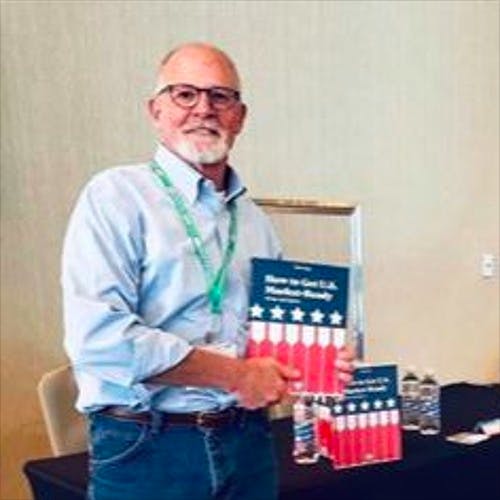
Ep. 394 Steve Raye U.S. Market-Ready | Find the Right Import Solution Part 2
Find the Right Import Solution Part 2
Episode Summary
Content Analysis Key Themes and Main Ideas 1. Strategies for finding and selecting the right importer for wine and spirits brands in the US market. 2. The critical importance of thorough preparation and detailed information for prospective importers. 3. The necessity for brand owners to actively support and promote their products in the US. 4. Understanding the nuances and specific requirements of the US wine and spirits market. 5. Leveraging networking, referrals, and specialized databases for effective outreach. Summary In this episode of the ""How To Get US Market Ready"" podcast, host Steve Ray, author and industry veteran, delves into the process of finding the right import solution for wine and spirits brands entering the US market. He outlines a two-step approach: first, defining clear selection criteria for potential importers, considering factors like location, distribution reach, company scale, and portfolio focus. Second, identifying prospective importers primarily through referrals, industry contacts, and specialized databases like bestwineimporters.com. Ray emphasizes that successful market entry hinges on meticulous preparation. Brands must provide comprehensive information, including a supplier summary, pricing structures, competitive positioning, and a solid marketing plan with committed resources (e.g., market visits, promotional budgets). He highlights that, especially for new brands, it's the brand owner's responsibility to build and support the brand, not solely the importer's. The discussion also covers practical aspects like having product samples ready, securing COLA waivers, preparing English-language marketing materials, and fully disclosing any past US market history to avoid complications. Takeaways - Brands seeking US market entry must define specific criteria for their ideal importer partner. - Referrals and industry networks are more effective for finding importers than cold calls or mass emails. - Thorough preparation is paramount, including a detailed supplier summary, pricing, competitive analysis, and a clear marketing plan. - Brand owners must commit to financially and logistically supporting their products in the US market. - Understanding US-specific regulations (e.g., COLA waivers) and industry terminology is crucial. - Full disclosure of past US market activities (even one-time sales) is essential to avoid future issues. - A compelling ""point of difference"" beyond just product quality is vital for market success. Notable Quotes - ""Experience is what you get when you don't get what you want."
About This Episode
The speaker, the author of How To Get US Market Ready, introduces the book and podcast on how to get US Market Ready, which aims to help brands enter and grow in the US market. The book and podcast will provide lessons learned from 30 years in the wine and spirits business, and referrals are crucial to understanding their model and market fit. The importance of updating information and working on network contacts is emphasized, along with marketing and support resources for new brands. The importance of differentiation in a product's potential for sales in the US market is emphasized, along with creative ways to showcase the product in trade events and exhibiting in creative ways at US relevant trade events.
Transcript
Thanks for tuning in. I'm Steve Ray, author of How To Get US Market Ready. And in this podcast, I'm going to share with you some of the lessons I've learned from thirty years in the wine and spirits business, helping brands enter and grow in the US market. I've heard it said that experience is what you get when you don't get what you want. My goal with the book and this podcast is to share my experience and the lessons learned from it with you so you can apply those lessons and be successful in America. So let's get into it. Hello, and welcome back. Thanks for sticking with us. This is how to get US market ready presented by the Italian wine podcast, and we continue with part two of finding the right import solution. Okay. So how do you identify potential importers? Well, step one is develop a set of selection criteria for prospective importers by defining what it is you're looking for. Create a short list of criteria to consider, to figure out whether they fit your model or not. And some of the things include location of the main office. If their headquarters are in Napa Valley and you're an imported brand and you plan on selling in New York, maybe that's not the best place. Which states do they have distribution in? All importers and distributors publish this information on their website, you can create a list of what states they're in, and generally what distributors they are with in those states. Simply by looking at their website, another place to find that out is seven fifty dot com. And I highly recommend you go and you get yourself a subscription to that. It's like twenty five dollars a month for a basic subscription, but it allows you to access information on who's distributing what products and what market. And remember, just because the import license of distributor has this national, that does not mean that the importer actually has distribution agreements in all fifty two markets. In fact, it's more common for them to not have the whole country. So as not to be distracted by small, non strategic markets. Sorry, South Dakota. So don't think that you're looking for a national distributor, and on the flip side of that is don't think that every distributor is national, because they're not. Another point is scale, scope, and size. And by that, we mean the dollar turnover, the number of cases shipped and completed annually, the size of the company in terms of number of employees, number of suppliers, number of brands, and skews. That'll give you a sense of whether or not and where you might fit into the market. And then the fourth one, portfolio focus or philosophy, do they specialize in a particular country or region, particular price point or area price points, varietals. Style of wine, such as Bydronomic, organic, and so on and so forth. So step two is to identify perspective or candidate importers. Yeah. I know this is not an easy task as there are not many resources available to have all the information in one place. The best place to start is through referrals and recommendations from other suppliers or industry folks who you know who are doing business in the US and ask them to give you an introduction to your importer. Couple of other places to go to for information. One, in particular, I would highly recommend is best wine importers dot com. W w best wine importers dot com. Importer Connect is a proprietary database of a thousand plus active wine and spirit importers developed and maintained by Bevology, but our experience maintaining the importer Connect database reinforces that even the best databases will be inaccurate with old information, especially when it comes to contact names, phone numbers, and emails. They're a really good place to start, but recognize you'll need to thoroughly update the information yourself. Design how and who will be doing the outreach. Cold calling is a common next step export brands take, and while it can be effective. Our experience has shown that warming up leads is a much better strategy. And by that, I mean, to get introduced to the person via someone they know or respect. And I recommend that everyone register on LinkedIn and actively engage in the community by joining groups, writing articles, posting a full overview of your company. And think long and hard before sending out a mass email. I'll give you a hint. It's generally a bad idea and probably will work against you rather than for you. Just think about how you react when you get an unsolicited email from someone you don't know trying to sell you something you don't want. So, again, I think the key point here is work your network of contacts and get recommendations and agreements to refer you, to other people. You'll have much better luck getting your phone calls answered that way. Another question to ask is, who will be managing the meeting and negotiating with the prospective importers? Will you be doing this yourself? Or do you have an export manager or representative that might be based in the US? It's absolutely critical that the person who will be calling the prospective importers speaks English well and has some level of familiarity with the US market. Having read this book is one critical factor that can distinguish between success or failure. Be prepared before you start contacting importers. You know, they will be asking some common questions. And you need to make sure that you have the information immediately on hand that an importer will typically ask for, including a top line supplier summary, and this should include the basic information on the brand and your company, including brands, history, structure of the company, what defines your product, whether you are vertically integrated or not, source of raw materials, current and expandable production capacity, countries that you're exporting to, and so on. They'll also want an OXWorks pricing and ideally a prototype state by state price structure and suggested retail pricing, what we call MSRP manufacturers suggested retail price. And I offer a tool that is on the book site, w w w get US market ready dot com, which includes a price structure tool as an Excel spreadsheet. And you can also access a more user friendly version of that at w w best wine importers dot com. Scroll to the bottom, and you'll see a separate wine price structure for the US and a separate spirits price structure for the US with information on both imported and domestic products. Also, you'll wanna be familiar with and be able to respond to and, describe your competitive positioning and competitive set. And most importantly, what you are offering to the importer as a prospective partner And by that, we mean in terms of support resources, money, people, other tools. And later in the book, we have a whole chapter devoted to this. But the bottom line here is if all you're coming to the market with is a product, That's necessary, but not sufficient. In fact, it's insufficient. You wanna make sure that you have product samples available for tasting, and make sure you have those samples already in the US. For shipping or a system to export them that complies with US laws and regulations that can get the product to a prospective importer relatively quickly. Once again, I have a little chapter on that on label registration. Which has a whole section on securing cola waivers, which you'll need. One very good solution is to work with service importers such as Park Street, MHW, Siemens Beverage, t l n tenney, All of those can help you reasonably affordably get cola waivers. It's also something that we do and in fact, store the samples here so that when we're working on behalf of a client that we can get them to them overnight. One other point I wanna make about client samples is I found a big difference in perceived value is when I put a sticker on the bottles that I'm sending out that includes who sent it? What date? What's the significance of the product of why it is being sent? And the contact information on the person who is sending it because frequently bottles and, descriptive information get separated. But if you put the sticker on the bottle and when that person ultimately does come to the point of pulling that bottle down from the shelf to taste it, they'll know exactly who it came from, when, why, and what they should be looking for. Background literature in English. That means cell sheets, tasting notes brochures, shelf talkers, bottle neckers, summaries of ratings and reviews by entities and competitions meaningful in the US. Again, chapter three is a whole detailed section on that. And recognize that there are some titians that simply won't review brands that are not currently imported into the US. Mine Spectator happens to be one. But there's a whole bunch like San Francisco, New York International, Ultimate Spirit Challenge, BTI beverage testing institute, all of which will review brands that are not currently imported into the US, and that's pretty important. You also wanna make sure that you have at your fingertips, brand performance history, including sales and marketing support. In the US, if you've been in the US before, and if not, then in key reference markets that somebody in the US might look at as informative such as the UK. And don't be surprised or lose your cool when data from outside the US is brushed aside as irrelevant. The reality is we're very myopic in our industry, and the industry is pretty much focused on what people say here, not what people say about your product in your home country. Another point is to have a marketing plan or overview. That doesn't need to be a very detailed one, but you do need to demonstrate that you've done your homework and you have your act together, you know what you're doing, and you have plans. In the US and especially for smaller new brands, it's the brand owner's responsibility to support and promote and build the brand. It is not the importer's job generally, certainly not at the point when you're first pitching them. So be prepared with a top line plan or be able to speak to what resources you have available to promote the brand and what budget or programming you have to support it. The musts here are minimum. Two market visits per year and support for in store tasting events because those are two tools that have proven their effectiveness. And if you use those in your introduction to these people, it's a nice way of saying you got your act together without having to use the words. Hey, I've got my act together. Another key piece of information is brand positioning. What is it that makes your product different, unique, and of potential interest to a prospective importer? By that, I mean, having a product that tastes good is not enough. That's just the ante to sit at the table. It has to have a compelling reason as to why it has potential for sales in the US. And I think one of the ways a lot of people look at this thing is what features advantages and benefits differentiate your product from others on the market. And that could be the size of of sales, the history of the product, the quality to price ratio, production techniques, starch source for spirits, terrior, vineyard location, soils, varietals, or blend awards, existing customers, etcetera. What promotion programs or assets that set you apart or define you? It could be social media engagement programs. If you have a significant following on Facebook or Twitter or Instagram or some of the others. Do you have plans for trade PR? If it's a spirit, do you have a cocktail recipe database? It's mandatory that you have where to buy functionality on your website or in social media, or at least acknowledge that you will include that if and when you do get distribution. Another great idea is exhibiting in creative ways at US relevant trade events. But I could write chapters about that alone. But the important thing is if you are in a place where the trade gathers to look at what's new, they're gonna be predisposed to be interested in you, a cold call from you, especially if you're not completely prepared, generally gonna be turned down. Identify the competitive set of brands or category that you're competing in. You should be able to clearly articulate where your products will fit in the marketplace and who your competitors will be. Do you have market research or other data documenting or validating the brand's potential in the United States market? Even if you haven't conducted your own market research, do you have access to syndicated data to which you can refer? And that could be IWSR. It could be Nielsen data, or it could be market research reports that you have access to. Another key point you need to have in the back of your head is what are the anticipated introductory and expansion markets you've selected? And a rationale for why they were chosen. Once again, I include an example of a tool that we use called a market selection worksheet at w w w get u s market ready dot com, which is free. It's a, prototype version is not as complete as the formal one that I use, but it gives you a look at to at some of the criteria that you need to look at on a state by state basis to have an insight into how a prospective importer distributor will be looking at your brand. If you know all that stuff in advance, it becomes a lot easier in a conversation with them to stress your benefits. Proposed MSRP and price structure to get you there in reference markets I mentioned that before, we have a price structure tool for both spirits and wines available on get US market ready dot com and also at best wine importers dot com. And it really isn't common on you to understand all the different levels in that. Not that you could write a price structure yourself, but that you understand the terms that are there. Once again, on that site, you'll find an updated glossary of all the terms. So if you've wondered what is an SPA or what is a DA, special purchase allowance or depletion allowance, they're all defined in that glossary. And it really, really makes a difference if you get familiar with those terms so that you don't get blindsided when somebody else uses it. And here's a point that's commonly overlooked but critically important. Full disclosure of past history of importers, distribution, and broker agreements. Even if it was a one time sale, the prospective importer needs complete accurate information on any past history of business in the US. They want a comfort level that they won't get blindsided by finding out you've taken on residual problems such as perhaps an aging inventory of white wines, delisted products, pre existing franchise state agreements, outstanding broker commissions or unpaid distributor bill backs. One example I like to use is I was working with a Portuguese producer, and they had engaged with somebody, and there was a problem in communication. When we finally untangled the mess, it turned out that that particular winery had had a distributor in the state of Connecticut, which is a franchise state. And the rule in Connecticut is you can't get the franchise state preemption removed unless you get the company that owns it to agree to it. Well, in this particular case, the company that had been the prior distributor went out of business so there was nobody to call. So it became a big problem. So make sure that you're aware of all the skeletons that are in your closet. I'm not saying that you should exhibit them necessarily, but you definitely should be aware of them so that nobody trips up on it. Well, that's it for today. I don't want to take up any more of your time. This concludes the two part series, finding the right import solution. Thanks for listening to how to get US market ready presented by the Italian wine podcast. Hi. This is Steve Ray. Have a POD that m a d, a point of difference? That makes a difference.