
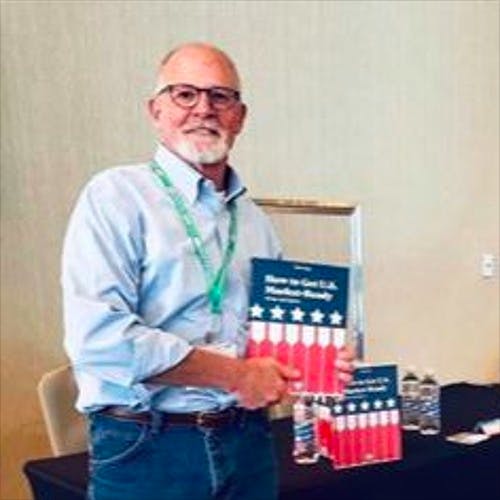
Ep. 359 Steve Raye U.S. Market-Ready | Market History
Market History
Episode Summary
Content Analysis Key Themes and Main Ideas 1. The historical evolution and complex regulatory structure of the US beverage alcohol market. 2. The challenges faced by foreign brands in entering and growing within the unique US market. 3. Strategic opportunities and ""inflection points"" for brands to achieve success in the US. 4. The importance of customized strategies over duplicating approaches from other markets. 5. Specific methods for market entry, distribution, e-commerce, marketing, and data utilization. Summary In this podcast episode, Steve Ray, author of ""How To Get US Market Ready,"" shares insights from his 30 years in the wine and spirits industry, focusing on helping brands navigate the US market. He begins by outlining the history of the modern US beverage alcohol industry post-Prohibition, highlighting the establishment of the 21st Amendment, the 3-tier system, and the diverse state-level regulatory structures (open vs. control states). Ray emphasizes the unique and complex nature of the US market, which comprises 52 different regulatory entities, making it challenging for exporters. He stresses that strategies successful in other markets often fail in the US. Ray then transitions to discussing opportunities for brands, identifying several key ""inflection points"": 1. Thinking outside the agency model: Advising brands to start with ""service importers"" (like MHW or Park Street) to gain initial entry and build a case history before seeking a ""forever importer."
About This Episode
The importance of learning how the US market functions and develop custom strategies for penetration and growth is emphasized, as well as the challenges of the industry. The success of successful new brands is driven by creating success stories with repeat orders at retail, followed by trade press. The e-premises industry represents a huge opportunity for wines and spirits in the US, and the success of new brands is driven by analytics and the value of analytics benefits the clients' brands. The success of e-premises is driven by social media and smart marketers, and the success of new brands is driven by analytics and the value of analytics benefits the clients' brands.
Transcript
Thanks for tuning in. I'm Steve Ray, author of How To Get US Market Ready. And in this podcast, I'm going to share with you some of the lessons I've learned from thirty years in the wine and spirits business, helping brands enter and grow in the US market. I've heard it said that experience is what you get when you don't get what you want. My goal with the book and this podcast is to share my experience and the lessons learned from it with you so you can apply those lessons and be successful in America. So let's get into it. So let's start off with US market, the history. The modern beverage alcohol industry in America began with the twenty first amendment, repealing prohibition in nineteen thirty three. New laws had to be established to control and regulate the sale of alcohol, and those new laws were focused on eliminating the that was created by Prohibition. Well, that was eighty five years ago when the world was a very different place with gangsters like Al Capone smuggling rum runners and bathtub gin as the problems of the day. The federal government had three priorities at that time. One was generating and collecting taxes, second protecting public safety, product quality and standards, and preventing fourth, false advertising, and consumer deception. At the same time, control was granted to the individual states on how to regulate monitor and manage sales of beverage alcohol. The structure of the industry that was established set up the three tier system to prevent any one entity or category from having any undue control or influence. There's also the introduction of what we call tied house regulations, which limited participation of suppliers and importers and distributors from owning an interest in retail on or off premise accounts. The states correspondingly set up systems that fell into two broad categories open and control. The control designation essentially set the state up as either the distributor case of Mississippi, or distributor plus retailer, Pennsylvania, New Hampshire examples of that. Essentially similar to the monopoly countries such as, the Skandex. In open markets, the state's role was less limiting, allowing free market participation by distributors retailers, and bars and restaurants. The net result is that there are fifty two different regulatory entities in the United States. There's the fifty states plus Washington, DC, and Montgomery County, Maryland, both function as independent regulatory entities. In the eighty five plus years since, only one state has changed its designation, that was Washington state, which voted to convert from control to open in two thousand and eleven. And keep in mind that within those two basic categories, there remain a kaleidoscope of state by state regulations. And that's what makes understanding the US market such a challenge for exporters. Just two examples of that complexity. Some states were set up open for wine and control for spirits, Michigan is an example. And some states allow sales of wine and or spirits in grocery stores, California, and some prohibit it in New York. So fast forward to today, what was once black and white has grayed over time, and in fact, there are many situations where the industry has evolved. Importers owning distribution companies, distributors importing brands are just two examples of that. And while breaking into the US market is challenging, it is something that brands are successfully accomplishing on a daily basis. Perhaps the most important thing to be stressed is the uniqueness of the US market. Duplicating strategies that may have made a brand successful in the home or other export markets often won't work here. So it's critically important for exporters to learn how the market functions and develop custom strategies for penetration and growth. Another way to look at that is to reinforce that there is no roadmap, so to speak, to be followed. Indeed, many successful new brands have found that charting a new course with customized strategies has led to far more effective results than following in someone else's footsteps. Opportunities. Here's the big conclusion to keep in mind, yes, you can be successful in exporting your brand to the US. However, I wanted to highlight here some of the key forces that are driving change in the US market. These inflection are tipping points represent opportunities to deal with known existing obstacles by navigating your way through over or around them. I've cited some examples of brands that have leveraged these and urge readers to apply their own creativity to do the same. Number one. Think outside the agency brand model. While some brands have had luck catching the eye of an existing US importer, the reality is that the odds do not favor the vast majority of smaller and specialty brands vying for entry. A better strategy is to look at this as a two step process, short term and long term. And by that, I mean, don't think that you have to find your forever importer first. It makes more sense To start with an importer who is guaranteed to say yes, they're known as service importers such as MHW or Park Street, to get started with while you learn the ropes and establish that all important case history of success in a limited number of markets and accounts. And that's just one of nine other import options to be considered, which you'll find outlined in detail in chapter two. Number two, distributor consolidation can be considered a constraint or an opportunity. The top ten importers now represent seventy five percent of total sales of wine and spirits in the United States. And that's up from forty eight percent in two thousand ten, and just about doubled with thirty eight percent that characterized the market in two thousand. So logic dictates and reality confirms the distributors spend the lion's share of their attention on the brands that represent volume revenue and profits. Sure. They're interested in new brands, but faced with the reality of thousands of producers clamoring for the attention of the guy. And yes, it's usually guys at the door, we've seen a lot of brands have success by following this strategy. Create a success story with metrics that document repeat orders at retail, and then trumpeting that success through the trade press. The result, interested distributors will call you because they are looking for the brands that stand out from the crowd and have demonstrated traction with both consumers and the trade. Check out the epic sangria story which started with Park Street and ultimately was acquired by Deutsche. It was a grassroots low budget strategy that flouted the common perceptions of the category as being cheap and sweet. Higher price meant higher margins and higher quality helped reignite consumer interest in a category that was given short drift in the market. Number three, e commerce. It's no secret that e commerce represents a huge opportunity for wines and spirits in the US. True, Current regulations have slowed the momentum of the channel in the two years prior to the writing of this book, but as we've seen with COVID nineteen and what looks like is coming down the road, the smart money is betting that consumer demand and economic realities will inexorably force the DTC direct to consumer e commerce market open. Some people have said that we've let the genie out of the bottle with a lot of states allowing a sale of wines and spirits with takeout food. Well, that means new to the US brands need to be exploring and testing ways that they can work within the online Bevac system, but are more tailored to their needs. And four, evolving demographics. We talked about this earlier. Millennials have grabbed the headlines in terms of redefining how the new generation discovers new to them, wine and spirits. Social media has been the engine that has transformed word-of-mouth from the face to face one to one conversations that used to take place around the Office Water fountain to the exponentially greater reach of one to many. Smart marketers are recognizing that being creative and using new communication tools to capitalize on an entire generation's interest in discovery, sharing, and experiencing. Case in point is the nineteen crimes brand we mentioned earlier. They were one of the first to use augmented reality and to tell a story in a spectacular way. If you haven't seen it, head on over to the Living Wine labels app and experience it yourself. Results, the brand was introduced in two thousand thirteen when it's all just seven thousand cases as it tested the US market. Remember, that was a period when premium wine from Australia was effectively considered an oxymoron, and nobody really wanted it. From there, the brand grew dramatically. And in two thousand seventeen, doubled its volume from five hundred thousand to over a million cases, two thousand nineteen data looks like it's two million, and there's no sign yet of that growth slowing down. And it was all based on them capitalizing on a unique app, which allowed the labels to become animated. Five. Better data. Okay. I'm a little biased. My friend Kathy Hoya came up with a brilliant idea to create a new company called Enolytics. The brilliance lay in the fact that the service was data source agnostic. That means analytics didn't rely just on Nielsen, IRI, diver, or beverage information group as individual data sources. Instead, they pioneered a way to integrate multiple big data sources to identify and graphically portray insights anomalies and trends that were previously buried or hidden from view. The value of that insight benefits the clients' brands, but they're finding that by using it as a tool to help the trade leverage these new found facts, their expanding distribution, improving sales efficiency, and providing added value to the stores and the on premise accounts they service. Check out analytics dot com for some case history examples. And I'm happy to report that Kathy just announced analytics has been brought into the Harvard Business School curriculum as a case history. Three by three insights is another service that's mining data on an individual store level and comparing it to a larger industry wide data set. They're finding new ways of teasing out insights at the account level to help retailers increase margins, improve shelf sets and promotions, and capitalize on the unique attributes of their store location, clientele, and inventory. Well, that's it for today. I don't want to take up any more of your time. We'll see you next week on how to get US Mark it ready presented by the Italian wine podcast. Hi. This is Steve Ray, and here's the, thought for today. Never confuse activity. For achievement. That's a great line by my friend, Ben Salisbury, and it really helps people stay focused on accomplishing results as opposed to just creating a lot of activity.


