
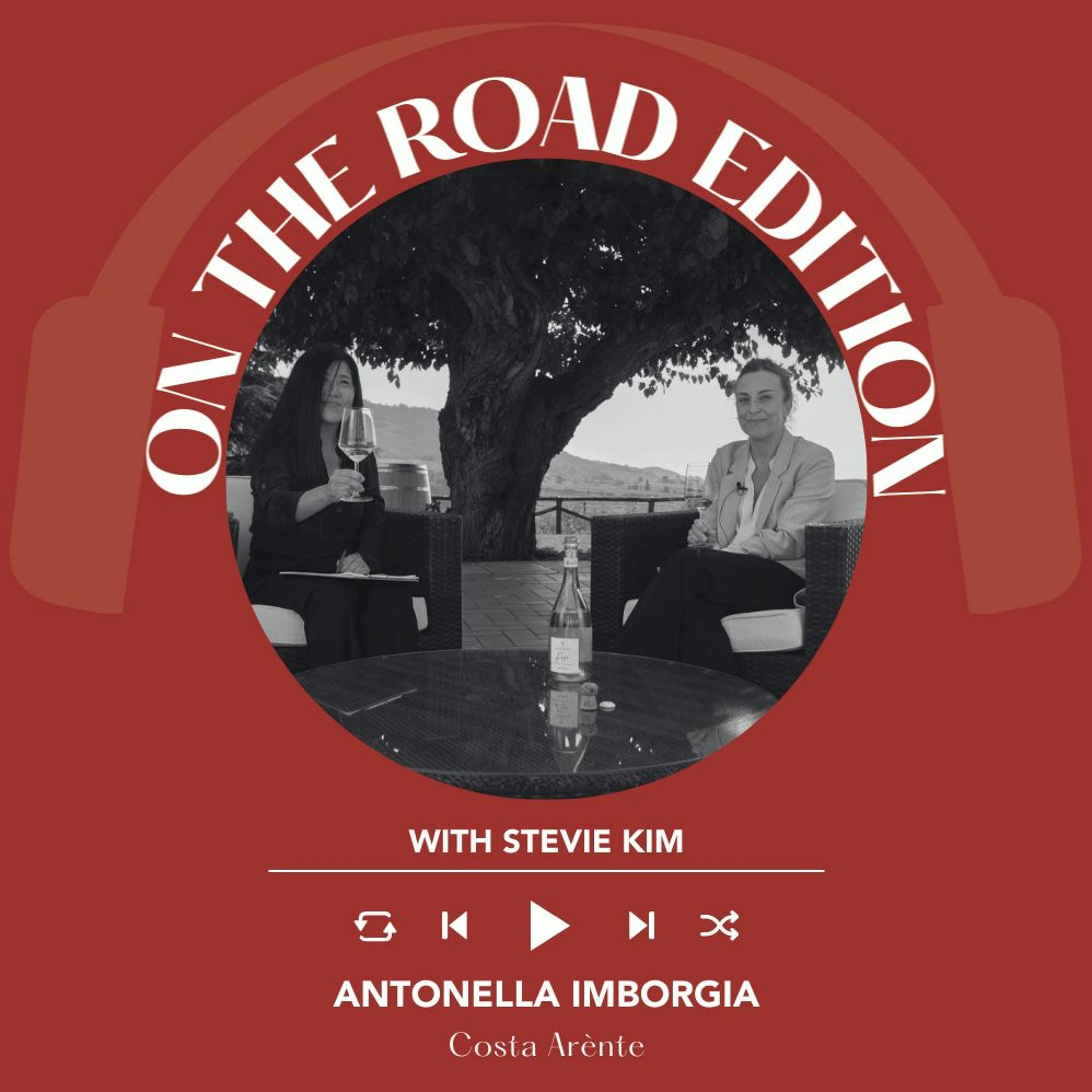
Ep. 1611 Antonella Imborgia Of Costa Arènte | On The Road With Stevie Kim
On The Road with Stevie Kim
Episode Summary
Content Analysis Key Themes and Main Ideas 1. The extensive career trajectory and insights of a marketing professional in the Italian wine industry (Antonella). 2. The strategic brand building and market positioning efforts of a large corporate wine group (Generali Insurance Group's wine unit). 3. The specific marketing and unique selling propositions of Costarente winery, particularly its ""handmade in Valpantena"" approach. 4. The diverse portfolio of Italian wine regions and grape varieties managed by a single corporate entity. 5. Challenges and adaptations in international wine distribution and communication strategies. 6. The integration of tradition, terroir, and innovation in modern Italian winemaking and branding. Summary In this ""On the Road Edition"" episode of the Italian Wine Podcast, host Stevie Kim interviews Antonella, the Marketing Manager for Generali Insurance Group's wine division, featuring a segment from the Costarente winery. Antonella shares her extensive career journey in the Italian wine industry, spanning various regions and renowned wineries before joining the Generali group's newly revitalized wine unit. She explains her role in marketing for the group's six owned estates, including Costarente, and five distributed brands, highlighting the strategic approach to brand building, especially focusing on Costarente's artisanal ""Handmade in Valpantena"" identity. The discussion also covers their international market strategies, particularly for the USA, and the group's innovative projects, such as traditional method sparkling wines from indigenous red grapes. Antonella concludes by emphasizing the symbolic importance of the ancient mulberry tree at Costarente, embodying the winery's commitment to preserving tradition while embracing evolution and protecting its territory. Takeaways - Antonella possesses a broad and deep understanding of Italian wine marketing from her diverse career experience. - Generali Insurance Group has significantly invested in and expanded its wine portfolio, creating a dedicated wine unit. - Costarente winery is positioned on its artisanal production methods and the unique characteristics of the Valpantena sub-region. - The Generali wine group manages a large and diverse collection of Italian wineries and distributed brands, spanning various regions like Friuli, Piedmont, Tuscany, and Valpolicella. - Marketing strategies are specifically adapted for different international markets, such as the US, where the group has its own distribution arm. - Innovation extends to traditional method sparkling wines, even utilizing unconventional red grape varieties like Schioppettino. - The connection to the land and tradition, symbolized by the mulberry tree, is a key element of Costarente's identity and communication. Notable Quotes - ""It was super interesting from a marketing point of view to rebuild these brands. And to acquire new ones."
About This Episode
The speakers discuss their experience with wine and the challenges of creating a female co-assigned brand. They also discuss their plans to increase communication efforts and expand international markets. They mention their involvement in various businesses, including their own brand of Prosseco and their own production methods. They remind their audience to visit the tour of Costa and Tejuan and rate their podcasts. They also discuss protecting the territory and protecting the territory for a long period of time.
Transcript
Since two thousand and seventeen, the Italian wine podcast has exploded. Recently hitting six million listens support us by buying a copy of Italian wine unplugged two point o or making a small donation. In return, we'll give you the chance to nominate a guest and even win lunch with Steve Kim and Professor Atilio Shenza. Find out more at Italian One podcast dot com. Welcome to another episode of On the road edition hosted by Stevie Kim. Each week, she travels to incredible wine destinations interviewing some of the Italian wine scene's most interesting personalities, talking about wines, the foods, as well as the incredible travel destinations. Hello. My name is Stevie Kim, and welcome back to Italian Line podcast on the road edition. This is part two of Costarente. And right now, I'm here with Antonella Okay. So first of all, we're going to be drinking sparkling wines now because it's already midday. And I think it's it's about that time. What are we drinking? We are drinking, Molinara. Sparkling wine, Ramulina Rosa. It's actually one of the example of how Costarente wants to innovate. Okay. But looking back to the tradition as well. Okay. So but this is Charmond. Right? Yes. Usually, we do the chinchin in the end. But this time, we're going to kick off with a chinchin with Molinara. We just need some food now and a hammock, and I'll be one happy camper. First of all, tell me a little bit about yourself because we met when you were working for another one Right? Yeah. So you've been working for a very long time. Right? You have a very long wine career. Give me a skinny curriculum of what you've been doing in the wines. First of all, I'm from Sicily, and but I moved, like, Atlanta, Cecilien. Yes. By city. Yeah. I'm from Palermo. I started to work actually in Tuscany in the wine industry for Castello Bambi. Then I moved back to Sicily for a long period of time for Canta Sertesoli. So a big cooperative. Yes. Some very interesting project. I stayed there for eight years. Then I'm That's a long time. Yeah. I learned a lot both from Vanfry and from Zettasoli. Mhmm. Then I did quick, Versage in, Franca. With Bella Vista. Oh, Bella Vista. Yeah. So sparkly wine as well, to go back then to Sicily again. Okay. And I work for Donna Fugata, and that's when I met you. Yes. Exactly. We met in Aetna. Right. They're yummy winery. Exactly. Then it's been now almost four years that I work for. So how did you end up a sicilian woman traveling all over it today? And then finally in this. I was intrigued by the project, which is very dynamic and interesting because is a new entity. Let's say like this. It was the previous Genagricola. Mhmm. I'm old enough to remember Genagricola. Yes. Yeah. Which is actually a very old project. It's not a new one, belonging to Generali Insurance Group. So they've already had, some wine estates. Around Italy. But, with the entrance of the new CEO, there was a renovated interest in the wine beat. So he decided to create this new wine unit with the new team hiring people from the wine industry Mhmm. Like the commercial director, myself, Giovanni. So there was a renovation going on. And it was super interesting from a marketing point of view to rebuild these brands. And to acquire new ones. What is your role exactly? What is the job title? Regardless of what you do. It's marketing manager. Okay. I look after the marketing department of the wine business everything about the labeling, the promotion, the events, the the social beat, everything regarding the storytelling about the wines, and also about the products itself. To how big is your marketing department? We are not a very big team. We are three people looking after all the brands. Yes. We said skinny team. Yeah. Very intense working. So it's, what is your I know I hope we'll we'll get a chance to talk about the other states later on in the future. But with regards to costa rin, it's fairly new winery, an area where there's so many wineries, right, especially in valpolicella at large. Yeah. Right? So how can you make co studying that be prominent and female actually introduce co studying to the rest of the world? It's a very big challenge. First of all, the ambitions are high. The main one is to produce one of the biggest amarone of the area. And, we are try with time, of course, to build the brand starting from, his strengths one of them is the artisanal bit. We do a lot of the steps of the process by hand. All the harvest is done by hand. All the selection of the bunches, the selection of the berries once they arrive in the cellar. So we built a lot of on this value. Then we have the Balpantenna part. It's a little bit different to communicate the Balpantenna and Balpantenna, especially abroad, but we believe that Balpantenna can give a point of differentiation compared to the rest of Balpolicella. That's why we proudly state Valentana on the label, and we are trying also to be the system of, wineries belonging to this territory, to this micro territory, as we like to call it. That's interesting. You're talking about the artisanal side of the the wine business for Coastatin. In fact, you're I think your tag line is handmade in Valentina. So that is your major claim. And so you want to really focus on that. Yeah. Absolutely. Yes. In fact, these two words sum up a little bit. Your marketing expert. How are you going to position this co studying day, their wines? Amongst so many different because to say it's in Valentina, there are other winers in Argentina. Yes. There is a bertani, there is Colina de Chilei. Cleaner is not fairly new, but exactly. Of course, it's the historical one. Yeah. But we are trying not to compete too much between each other, but to try to build the system and to communicate, firstly, the territory, the Valentana, to position our products in that sense, not to be like the another amarone, another red wine, like, you have thousands, but trying to build on this point of differentiation. That actually affects also the wine itself. Right. I mean, starting from the wine, actually. Because as Giovanni was explaining before, Balpantenna means a specific style of wines made of freshness and they are more easy to drink, which doesn't mean They are like simple wines. They can be very structured and complex, but at the same time more approachable. Wine to wine business forum. Everything you need to get ahead in the world of wine, Supercise your business network. Share business ideas with the biggest voices in the industry. Join us in Verona on November thirteen to fourteen twenty twenty three. Tickets available now at point wine dot net. And this is very interesting for us for younger generations, which are not very used to drink amarone. But in this sense, with this easiest approach, they can maybe be attracted. And we are also working a lot on the social side trying to communicate more with this kind of audience, try to find a more easy way to a language that can be more approachable as well. So tell me about your markets are you in Italy? I mean, Giovanni was saying that the wines are mostly sold abroad. So how do you manage the communication? Because what you communicate to the Americans are very open from how you would communicate to. I don't know the Germans or even Italians at all. Yeah. How do you manage, you know, the different layers and the different channels of communication? Talking about the international markets, we are starting to build a more structured way of communicating the brands. I mean, our main market is Italy for the time being, and, we are mainly focused on the on trade, and we are starting to be a little bit more aggressive also internationally. Our main markets are, of course, USA, where we have our own distribution. Yes. What is it called? Leonalato USA. Okay. But wasn't it called something else? Yes. It used to be called But with the new organization, yes, we changed as well Leon Alato USA. Okay. Yeah. So we're complete rebranding at every level. Correct. Also, to answer your questions, it depends also on the partner that you have on the different markets. For example, in the US, since it's a part of the company, we are very at ease to build with them, projects, plans. We have organized this year for the first time a workaround testing of all the pork for your wines. Of the retinue tech. Exactly. Yes. We try to build partnerships with our distributor abroad. But it's not always easy to do, but for example, USA is a good example for us. Right. Would you like to tell us briefly about the different estates? Because it used to be five, and now it's six Yes. With Guilani. Right? So would you like to give us a brief overview of the different estates? So let's look at the consists of six wineries owned by the group. One in, Frioli called the Torre rosazza, where we mainly produce white wines, like pinot grigio, Priolano, sovignon blanc, ribola, for sure. Costarente here in, in Piedmont, we have Brico de Guazzi where we produce Barvera, super orange, red wines mostly, but we are starting a very interesting project with pinot noir as well. We have just released a rosette from and we are going to have also a red wine, very premium wine. Then we have which is our brand of prosseco. E eight plus? Correct. Yes. Why why is it called back this? Why would be eight plus? It's more like, you know, I don't know water. Yes. It doesn't sound like wine. Yeah. We know that. And but we decided not to change the name of the brand because it was already a nice success in the market. We already sold more than one million bottles into the market. So yeah. We we decided that it was a little bit too risky to change it, but it's true. I mean, it's not very whiny, let's say like this. And it's also a characteristic of what to pew, which is very pop and fun and colorful and not very traditional. So we think that the name matches a little bit the soul of the brand. Except maybe for the American. Yeah. I know that there is also it's the name of a motor of of a car or something like that, which is a little bit confusing. Eight cylinder. Yeah. Okay. We have the motor. Experts. Yes. And then to finish the owner of the States, we have just acquired the Duimani in Tuscany. Very, yes, two hands. A very high end premium winery. We actually went to Silica. Do you remember? Yeah. We went to very interesting winemaker as well as the wines and the place. Very original wines quite unique. And these are the six wine wineries that we own. Aside, there is also a distribution project. We have four different wineries in Italy that we distribute, one in, Sardinia. Called the Ditori. Of course, Ditori. Very famous. Yeah. The historic one. Exactly. LIVeli in Pulia, in, Salento. Not bad. Also in Pulia Cantina, and, in the Bruno area, Pinnino. Does your job also entail promoting those binaries? Well Yes. No. We distribute them, and we also promote them. And because one of the value one of the mission, let's say, of let him tell you, it's also to build value for all the brands that we manage, not only the own advance, but also the distributed ones. And to finish the distribution project, we have just acquired the distribution of a champagne, maison Buchan. Of course, you always need champagne. Yeah. Yeah. So now we manage eleven different brands. Okay. Yeah. Because although Giovanni was saying in the previous interview that, you're also, currently making traditional method. Yes. We produce our traditional method in, Touroza in Freoli. A very unique project made by Scupetino grapes. It's called the Blancadineri, like a Blancanois because Cuupetino is a is a red grape. And, we think that we are the only one in Italy and probably in the world to produce a traditional method from Scropetino. Twenty four months, on the on the east. Then we are working for a traditional method also in Piedmont, always from pinot noir, as I was saying before pinot noir, it would be a focus in the future for the pinotese winery. And here in Costa and Tejuan is working also on, sparkly wine. I guess we're going to come to a close, but is there anything that you would like to say that we didn't mention? I would mention this magnificent tree behind us. Okay. We would forget we're sitting right in front of it. Tell us about this magnificent tree. Exactly. I mean, the mulberry is a mulberry tree and, In Italian, it's Gelsso. Gelsso. Yeah. Gelsso in Italian, Malberry in English. In English. And what a magnifier is. Is is beautiful. Yeah. Okay. It's it's beautiful and it's a sort of guardian of the of the estates. It was here before us and kind of remind us that, there was a path. There was a tradition in this place that we want to preserve and to evolve, in a sense, and that will be here long after us. So a wise, remind that, we have to protect the territory we are in to to let them hit leave for a long period of time. So I would say like that. Yeah. You know, a lot of wineries will have like a tree as a symbol. Yeah. I mean, you guys have grapes, but, like, I think this works nicely too if you want to rebrand. Yeah. Maybe in the future. Maybe in the future. Yeah. It's actually the logo is a double cross. There is stone also in the fountain at the entrance of the states. And we decided to take this nice symbol and to add also a bunch of of grave. I mean, some religious Exactly. Apparently, this was Messaging subliminal. I Yeah. We don't we don't I mean, there is no religion significance, but it's true that, Costa Rent apparently was a stop of a pilgrimage in the past where pilgrims stopped to store, to rest, and we like the distance of care and attention. And that's why we decided to make the symbol of the logo. Okay. Yeah. Santonella, you are the marketing manager, okay, of this entire group called I have to focus to say this thing. But for costa rente, I'm going to give you the last thirty seconds. You can convince your audience why they should come to visit costa rente. Go first of all, because it's a beautiful place. It's very close to verona, so it's also easy to to join and to reach. The wines are quite approachable and nice wine to drink very versatile. And, we have, a lot of future projects that we want to release on the market. So there will be always something new to tell about to costa rent. So I think that for all this reason, it's worth the visit. She had me at it's a beautiful place because I do agree. It's magnificent with the mulberry tree as well. And that is a wrap with Antonella in Borgia from Costarente. Channagat, so don't forget to subscribe below and and ping us whenever you get your pots. Okay? Ciao. Ciao. Ciao. Cin. Chin. Italian wine people. Listen to the Italian wine podcast wherever you get your podcasts or on Sound Cloud, I Apple podcasts, Spotify, email ifm, and more. Don't forget to subscribe and rate the show. If you enjoy listening, please consider donating through Italian wine podcast dot com. Any amount helps cover equipment, production, and publication until next time.
Episode Details
Keywords
Related Episodes

Ep. 2455 Orazio Rillo from the Fontanavecchia Winery in Benevento | Wine, Food & Travel with Marc Millon
Episode 2455

Ep 2322 Ambrogio Cremona Ratti of Tenuta Sette Cieli in Tuscany| Wine, Food & Travel
Episode 2322

Ep. 2297 Tessa Donnadieu of Vinchio Vaglio winery | Wine, Food & Travel with Marc Millon
Episode 2297
Ep. 2163 Marco Schiavo of Distilleria Schiavo | Wine, Food & Travel With Marc Millon
Episode 2163
Ep. 2140 Villa Sandi | On The Road With Stevie Kim
Episode 2140

Ep. 2013 Angelo Silvestro of Pietradolce | Wine, Food & Travel With Marc Millon
Episode 2013