
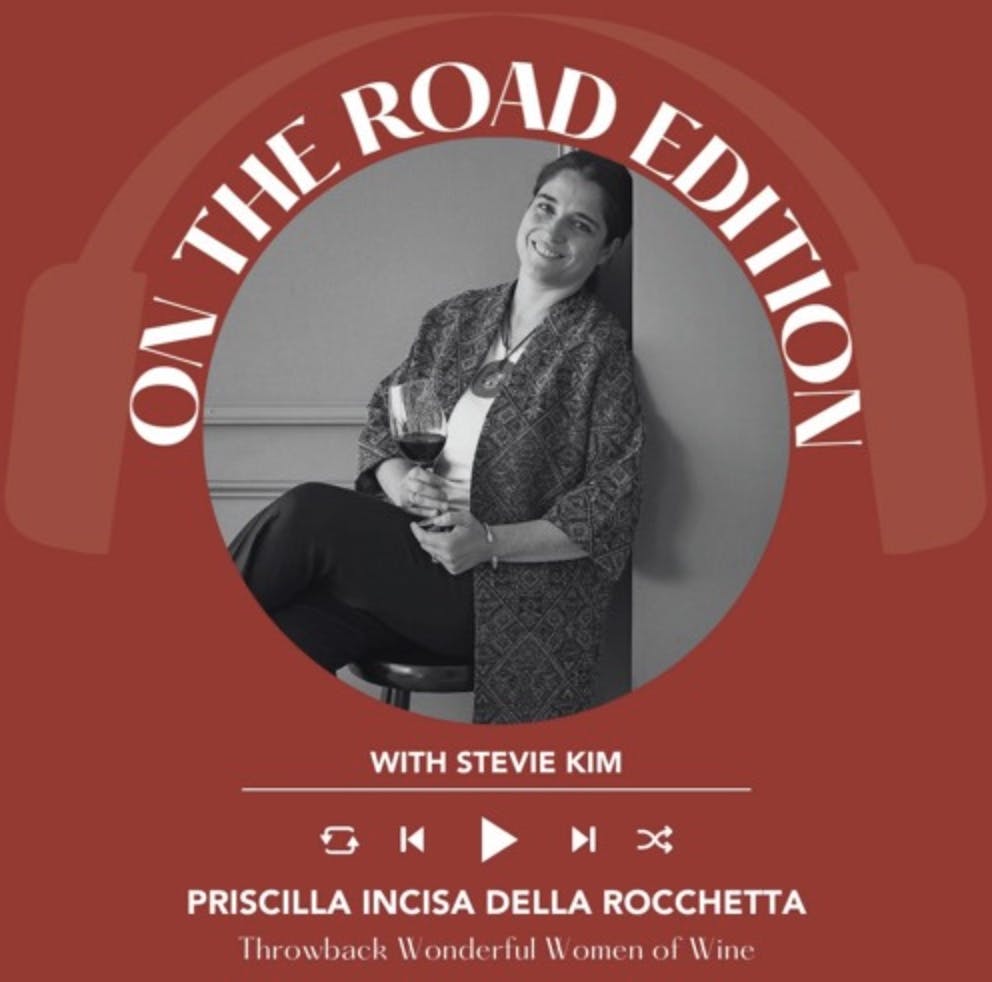
Ep. 1662 Priscilla Incisa Della Rocchetta | On The Road With Stevie Kim Throwback Instalive
On The Road with Stevie Kim
Episode Summary
Content Analysis Key Themes and Main Ideas 1. The rigorous demands and personal experience of pursuing the WSET Diploma. 2. The unique blend and terroir-driven characteristics of Sassicaia wine. 3. Strategies employed by Tenuta San Guido to combat climate change challenges and wine counterfeiting. 4. The significant and growing role of women in the wine industry, particularly at Tenuta San Guido and the Bolgheri DOC. 5. An overview of Tenuta San Guido's diverse wine portfolio beyond Sassicaia (Guidalberto, Le Difese). 6. The vast and biodiverse estate of Tenuta San Guido, extending beyond vineyards. 7. The historical context and unique regulatory status of Sassicaia and the Bolgheri Sassicaia DOC. Summary In this ""On The Road Edition"" of the Italian Wine Podcast, host Stevie Kim interviews Priscilla from Tenuta San Guido, the prestigious winery renowned for Sassicaia. Priscilla shares her personal journey and the intense preparation involved in achieving her WSET Diploma. The discussion then shifts to Sassicaia itself, exploring its iconic Cabernet Sauvignon and Cabernet Franc blend, chosen for its elegance, structure, and complexity. Priscilla details how Tenuta San Guido's specific microclimate, strategic vineyard placement on hillsides near the sea, and surrounding forests help mitigate the challenges posed by increasingly warmer vintages, ensuring the wines retain their characteristic freshness. The conversation also covers the winery's proactive measures against wine counterfeiting, including collaboration with law enforcement and advanced internal tracing systems. A significant theme is the increasing presence and influence of women in the wine industry; Priscilla highlights the strong female representation within Tenuta San Guido's team and the groundbreaking fact that the Bolgheri DOC consortium is now led by three women. She provides an overview of Tenuta San Guido's other labels – Guidalberto and Le Difese – explaining their distinct identities, production volumes, and target markets. The interview further describes the expansive Tenuta San Guido estate, revealing its diverse land use for traditional agriculture, olive groves, horse breeding, and a protected nature preserve, with vineyards occupying only a small, carefully selected portion. Finally, Priscilla discusses the historical origins of Sassicaia as a family wine and its unique status as the only single-estate wine in Italy with its own DOC (Bolgheri Sassicaia), emphasizing its historical significance and the strict rules governing its production. Takeaways * The WSET Diploma requires pre-course self-study and intense dedication. * Sassicaia's blend aims for optimal elegance, structure, and complexity, adapting to vintage variations. * Tenuta San Guido utilizes its specific terroir and strategic vineyard management to produce elegant wines even in warm vintages. * The winery is at the forefront of combating wine counterfeiting through technological investment and collaborative efforts. * Women are increasingly taking on significant roles across all levels of the wine industry, including leadership positions. * Beyond its flagship Sassicaia, Tenuta San Guido offers other quality wines (Guidalberto, Le Difese) with different price points and aging potentials. * The Tenuta San Guido estate is a vast, biodiverse ecosystem, with vineyards occupying only a small, carefully chosen fraction. * Sassicaia began as a private family wine, achieving commercial status and its own DOC significantly later. * The Bolgheri Sassicaia DOC is a unique appellation, highlighting the historical importance and specific production standards of Sassicaia. * The new female leadership of the Bolgheri DOC consortium reflects a positive shift towards diversity in the Italian wine industry. Notable Quotes * ""I was told when I enrolled that I had to know the book by heart even before I show up to the course."" (On WSET Diploma) * ""Cabernet Sauvignon brings more of the elegance and the aromas. Cabernet Franc is there to complement with some structure and some color as well."" (On Sassicaia blend) * ""What we try to look for in our wines is always a certain elegance and freshness, even in the more challenging, warmer vintages."
About This Episode
The speakers discuss the importance of wine in Italian wines, with personalities sharing their own experiences and challenges. They also discuss the importance of women in the industry and the production of two more labels. The success of S hesicaiah wines is discussed, with a new wine program and a video program being released soon. The speakers also mention the importance of nature protection and the history of the wines. They mention a new wine program and a new video program for more interesting content in the Italian wine scene.
Transcript
The Italian wine podcast is the community driven platform for Italian winegeeks around the world. Support the show by donating at italian wine podcast dot com. Donate five or more Euros, and we'll send you a copy of our latest book, my Italian Great Geek journal. Absolutely free. To get your free copy of my Italian GreatGeek journal, click support us at italian wine podcast dot com, or wherever you get your pots. Welcome to another episode of On The Road Edition, hosted by Stev Kim. Each week, she travels to incredible wine destinations interviewing some of the Italian wine scene's most interesting personalities, talking about wines, the foods, as well as the incredible travel destinations. Can you hear me? Can you hear Yes. Okay. Congratulations. You did it. Yeah. It only took us, like, five minutes. You see just in time. Ten ten seconds. Come on. Hey, Priscilla. Listen. The next step We're getting you on clubhouse. Yeah. Exact are you getting ready? Of course. No. Listen. Let me show you something. Is this your signature? Do you see it? Oh, yes. Yes. Oh, is that actually yours? Maybe I can sell it on eBay. Okay. Why not? Priscilla, how are you today? Very well. Thank you. How about really? Relax. I'm always under the weather. I have an exam tomorrow, actually. Listen, let me just introduce you to my team. Some of them, you know, already. Like, this crazy lady here, Christina. Hi. No. Krista, she used to refer Luca and Dean member. Of course. Of course. So she went from one crazy person to another. Rebecca she is our w Set educator. She's the smart one in in the group. Right. And then Yakapo. He's a Spanish, she's the boss from Fudia directly from Fudia. Hi, Nicole. Is our W Set Educator? Hi, Brian. LAN. They're both from China. Yeah. There are actually a massive. They're experts in line as well. So listen, you know, we are doing this mostly because I've started this diploma journey. Okay. W as a diploma. Do you remember? Like, I was working with you and you're like, no. So I know you do w set three. Tell me about Yeah. When did you do it? And what was your experience? Like, why did you do it? Well, I did it in November two thousand and nineteen, and I joined the Acadia Delvino in Milano. And I Didn't come to me. I I have to give you because you make decent wine, so I will forgive you. Okay. Thank you, sweetie. But I didn't I mean, for me, it was good because, you know, that I'm based half of the week in Milan. So I just, could follow the courses very easily. And I did the exam, at the end of two thousand nineteen, I think, in November, because I chose to do one week course with the exam on Saturday. Okay. So I started the book. So you're like Sakione. Secure and not really because I well, I became again a secure after so many years that I haven't been in school because I was told when I enrolled that I had to know the book by heart even before I show up to the course. So I did that I started the book, and then I took my one week course, which was more like a rehearsal of everything which was in the book. And also the tasting part was connected then. And, and the examination was then your the writing of the questions and then the essays and then the pasting part. And honestly, I wasn't that sure that, I was gonna pass it or yeah. Pass or even I mean, I was hoping to pass I do. I know, but you get you get distinction. I mean, that's so unfair. Yeah. I got I got you make good wine and you get good grades. I mean, the the world is not sad. You know what I mean? Yeah. I only got married. But I didn't study like you. You know, that's No. No. I really studied more, but I have, done the previous two levels in two thousand. So long you did. Yes. Yes. When I was when I was in London as a student, I enrolled for WAT City in the London headquarters, and I did the first and second level. What do you think about the way WS consider acidity? Oh my god. We have some real geeks on today. Crazy. So listen, what we're going to do is we're going to do a little bit of chit chat, and then we'll be tasting one wine. Okay? So let's start with one question. Let's start with Chowen. Hi. Yesterday, there is some homework I checked on your website about the blend. And, yeah, until, like, back to the nineteen sixty eight, like, your first one, and your blend has always been eighty five percent, covering so long, and fifteen percent company front. So what's so special about this brand? Well, first, I have to say that, both grape varieties, Cabernet, Sabernet, Sabernet, have demonstrated that they can adapt very well to this, environment and this microclimate here in the Bulgaria area. And, while maybe brings more of the elegance and the aromas. Cabena is there to complement with some structure and some color as well. So let's say that they are complementary and, at the same time, having two grape varieties gives the wine a little bit more complexity. Also, the fact that that they are as you said, eighty five percent, fifteen is not, a hundred percent the same every year. What is most important to remember is that, by law, according to the Volgari Saas, set of laws, We have to have minimum eighty percent of Cabernet sauvignon every year. Okay. Thank you so much. Thank you. So what did you get to, man? July? Hey. It's Janice Day. It's been wise since we actually last met at Vineettony, you did the, a coat vintage vertical tasting of Susigaya. So I have a question about the vintages. What are the hot vintages in the last decades and, what are the challenges and what are the characters? So in the last decade, probably two thousand and twelve and, two thousand and seventeen, I would say, where the warmer vintages I mean, the challenges are like everything that comes related to a a warm vintage. We have to harvest the grapes, which are in the end, but not so override because what we try to look for in our wines is always a certain elegance and freshness, even in the more challenging, warmer vintages. So I think the characteristics of the Bulge territory and our geographical position, as well as the peculiarity of the of the vineyards that we have in tenuta San Guido, which are placed in, strategic, points in the heights of the hills and surrounded by forest. And we are so close to the sea. Everything contributes to mitigate the effects of the warmer vintage. And then, of course, we have to do more selection at the time of the harvest. So it's a place that you live actually deep and working buggery. Yes. Yes. You see mountains. You have souvenas. Yeah. Yeah. It's not so bad. Yeah. Very beautiful. Yakaba has a question for you as well. Thank you. Detail. Yeah. So what's on your policy to prevent this? Well, we have, recently, a big case, in October. In October last year, But luckily, these bottles, which were found by the Grande Finance were never released on the market, because, of course, we collaborate, all along with police task forces that are involved in, checking all these things for falsified wines, etcetera. And luckily, they were able to identify these photos of as fixed because, of course, we give them the right information what they have to look for and every year, Timita Sabido, as a company invests, actually a lot of money in getting better and better with this counterfeit, tricks, how to prevent people from copying our bottles. But, of course, this of October was not the first and will not be the last, episode. I mean, there will always be people trying to fake some some wines and, we have to keep up with the technology and, also, we have, a good, tracing connection. I mean, we have a good connection with our importers, and we set up a system where we can trace our wine pretty well. Thanks to their collaboration. Of course, one advice is always to source the wines from, trusted the suppliers where you can have, yeah, certainty of the product. But I I would like to tell you more about, what kind of devices we have, but I can't reveal you some of them because they are classic. But for example, if you look at the bottle, I mean, from the simple embossing with the name of this state and the name of the wine, there are all little things that makes it more difficult for the counterfeiters to I can understand this. Yeah. Thank you very much. Thank you. So yesterday, obviously, it was international women's day. So I wanted to ask what you sought, tune in to San Grido and and brands like SASicaiah can do to kind of in advanced women in the industry, not just in positions of power, but maybe in positions of interest, you know, inologists, but to culturalist things that are maybe not expected to be jobs for women. Yeah. Of course. Well, first of all, I would like to say that, more and more in our industry, I noticed larger presence of women at all levels, like you said, not only of power, but also of interest. I can look at our own situation here in in the office. For example, we are seven women and eight men. So we are basically, same number. And, two of these women are agronomists. So they also are involved in the countryside works and so on and so forth. Regarding the works that we do in the vineyards, we have a team of about forty women that are, actively working and doing the most fine works exactly on the vineyard. So the quota of women is quite important here. And I suppose that, big brands or, larger states can give a good example. And in by other states to follow that example. Yeah. I agree. Thank you. Are you enjoying this podcast? Don't forget to visit our YouTube channel. Mama jumbo shrimp for fascinating videos covering Stevie Kim and her travels across Italy and beyond, meeting winemakers, eating local foods, and taking in the scenery. Now, back to the show. We're gonna ask you some few more questions, but we would like to start tasting the wine. Right. So we have here tada. Are you familiar with this wine? It's called Sassania. Kindly. Yeah. Listen. Before we go a little bit about the wine, we do have a small deep duff. Can you give us kind of an overview of your other labels? I don't know if it's sad to say your second or your third. It sounds so pretty gorgeous, but it's still drinkable. You know? I went through it already. Right. So apart from Sashi Kaya, you're right. We produce two more labels. One is called the with alberto, which we produce since the vintage two thousand, and it's a blend of, cabernet sauvignon and merlot. We don't actually refer to it as our second wine, but rather another wine produced in Tabuta Sanguelo, because we use, part of the grapes, which are selected from the younger vineyards of the Sasekaya DOC area, which we don't use for Sasekaya, but also it has some hectares, which we have planted on the burglary DOC part of our estate. And, on top of that, We also purchased some grapes from our relative of ours, who's a wine producer in the You're all relatives down there. Yeah. It's a big family. You're right. Which has a good aspect, but sometimes, it's a bit overwhelming, but it's very nice. To be here and, you're always surrounded by some family members, and we collaborate as well. So in this case, our cousin, sells us his grapes, and we use it to make with Alberto. With Alberto was started because at the end of the nineteen nineteen, my father realized that, he have planted enough Cabello Subigno binds in order to produce enough grapes to make more than enough Sashicaya. So in order to keep the production of Sashicaya, not too high. It realized that it could select a lot and have the some grapes of, cabernet, which were left over, and he could make another wine, which he decided to blend with Merlo to make a difference, and also because Merlo was becoming quite important in burglary. So the idea behind Willow is to reach a wider public and a wider Can you can you give us some numbers so we can contextualize, like, in terms of the production? Well, yeah. Of course. Sasekaya nowadays is about two hundred and fifty thousand bottles. And, with Alberto is a bit less than four hundred thousand, and letifaze around two hundred and thirty thousand. Okay. Very good. And letifaze, it's what we call entry level wine, I would say, which is, a blend of cabernet Solvino, and the thirty percent Sandroveza. And the Sandroveza, we purchased from in Lam Tuscany, again, from the same relative who also happens to have an estate in the county area and other friends. I mean, they are the same supplier since many years of Sandra Vasili because we don't ruin ourselves. When where is that coming from? Like, it's in Tuscany, but where No. No. No. In the county. Oh, it's in county. Yeah. Yeah. And let me face it. Basically, it's a wine that we advise to be drunk young. It's very fresh. Is it going? You know, it doesn't need to age for much whereas with Alberto has a longer aging potential. So They are really like, a little sequence of, entry level than Willow which has its own identity and, has, slightly longer aging potential and, but still the price point is very interesting compared to Sashikaya, which is then Well, yeah, absolutely. The bigger wine that you can put away for thirty years or longer. So we opened this bottle. It was too early. Right? I should have waited. Right. Yes. Okay. So tell us about this vintage two thousand seventeen. Okay. Two thousand seventeen was one of the two I mentioned earlier. I said it was one of the two warmest of the last decade. Mhmm. But, maybe not really comparable, not as warm as two thousand and twelve, less dry and less warm, maybe more comparable to a two thousand and five or two thousand and nine or two thousand and seven. And, yeah, it was, so still quite a challenging vintage, which shows exactly in this instance, the potential of the territory where we are close to the sea and also of the fact that our vineyards are strategically located in the high parts of Ventas and Rita. So even in in a vintage like this one, where one would expect maybe more structured and overripe wines, I hope you will find it still, quite elegant and with a surf freshness. What is the altitude? The altitude ranges from about, eighty meters to just below four hundred meters above sea level. It's very vast. Right? Yeah. Yeah. In fact, the whole estate covers about two thousand five hundred hectares. And, only around one hundred hectares are verified covered with Venus and of which Now can you repeat that? How much? Roughly one hundred hectares. So Okay. Let's say, ninety hectares. A bulgari is a sakaya doc, and the some hectares are in the bulgari doc because the bulgari is a sakaya. You'll see is a roughly four hundred hectares. It doesn't cover the whole of them. Doesn't read on. So Okay. That's separate. Right? You have your own DOC. Yes. The DOCs in Bulgaria are two. There's Bolgari DOC and Bulgaria is a sicaya DOC. Which were together to start with when they were instituted in nineteen ninety four. Volga Saqqaya was a sub zone of the Volga EOC. Then in two thousand and thirteen, they became completely separate, and we have two different set of rules. I don't know. Shipping at it. So to go back to your original question, our vineyards are very much scattered around this two thousand five hundred hectares in different spots. So there are different plots, which then also react differently to the different vintages and different climatic trends. So, basically, you can select from a much larger surface of vineyards, about sixty percent of our bulgaria C vineyards are actually used for SASI in the end because then we select and we use part of those grapes also for without that. So, you know, it's not wine related, but you have, like, so much land. What's going on in the rest of Illinois? You have birth sanctuary or something. Yes. Yes. So let's say of these two thousand five hundred hectares, about one thousand three hundred. So to say is farce on the hills menu, within this far you find some vineyards as well, which are surrounded by the classic Mediterranean and scrapland. And then on the lower part of the hills, we have traditional agriculture, olive yard, so we make olive oil, and then the training grounds for the horses. As you know, we have, English thoroughbred spots where we breathe and also train for flat racing English thoroughbred horses, which is the other big activity of the family. And then lower down towards the coast, basically, attached to the sea between the Orion Road and the sea are about four hundred and fifty hectares nature preserve where nature is protected and, where we have in the winter. These migrating birds that are stopping there because, the whole, a whole park gets flooded with water, and then you have, you know, you can come and look at the birds with binoculars and stuff. I'm waiting for my invitation through the bird watching. But, still, you have an open invitation. I don't need to invite. Listen, this dude, Mato Clausen, butchering his name, Panena. He said, aguri. Fifty eight birthdays. Listen, are is there anything special? Are you planning anything special for the fiftieth birthday? We we are we're actually not really doing anything special. You're right. Because we we this is the fiftieth birthday of Tasikaya on the market, but it's not the fiftieth birthday of the one, but still. Do you have any anticipation for the next Vintage, the eighteen. When is it going to come out in the market? The eighteen should shortly come out in the market. Usually, it corresponds with the the Italy moment. Yeah. But, you know, with there's no benefit. We yeah. But we can't wait until June. So the the Yes. Of course. Sasikai will be released, in the next month. And two thousand and eighteen is a nice fresh cool classic Sashikai vintage. So There's a dude from New York city. Love from New York City. Step fun. I know it's, like, it's very early. Just send him out to Step fun because he got out. Okay. That's yeah. You saw that? That was for you, Stephlyn. Okay. Alright. I'm going to let Christina ask you another question. Sure. The wanna tell you. No. No. No. It is true that, in the first years in the first, we pretty much started. We're gonna say in the first experimentations and also a bit longer than that. Our grandfather was using wooden bats for fermentation. And then with the arrival of Takis, the stainless steel bats were introduced. And, at that time, they seemed basically, like, big innovation, you know. Perfect. Okay. So we have one last question for you. Mhmm. Maybe not. You never know with me. I always have a surprise. For the students, the w set students, let's say even diploma level. What are, like, the three must know about Susicaiah? Well, I think I already mentioned some of them in my previous answers. One of them you're somebody. Yeah. I guess if I tell you that this is my son, now I'm gonna go go home and he's gonna feel a lot a lot of trouble. A lot of trouble. You know, your mom's gonna be finishing, like, three minutes. Okay? Just just relax. Just And then he will have to say. Fourteen. Oh, just just relax. Yeah. It's teasing me. It's teasing me because he sees that I'm concentrating on something. So, hopefully, I read it. Are you doing the cooking? No. Okay. Not today. You don't need to cook. Exactly. That's what you should do. Okay. I I'm not cooking, and he probably didn't get anything for a while. That's really funny. Okay. So anyway, I would like to say that maybe one of the special things about them because I'm good in general is this vast area of land where only four percent is actually occupied by vineyards and where we really selected the best spots where to plant our vineyards, the best soil, the best exposure, so on and so forth. And also this biodiversity that you mentioned with the nature reserve, the traditional culture, the olivias, the fact that the vineyards are surrounded by forest. It's a combination of a lot of things and it makes the ultrasound window a bit, a different winemaking estate compared to to other states that I know. Then I probably would say that Saticaya is the only one I know at least, but maybe one of the few examples of wines that were created out of fashion and desire to experiment and only became, like, so to say a commercial wine twenty years later, it was, it was a wine for family and friends for so many years. So this is also a bit strange. When it was first, created, it was not intended to be sold on the market, but to be consumed within the family circle. And eventually with some friends. And then also the the DOC, Bulgaria is also an important aspect because Yeah. I think that's very important. Historically speaking. Historically speaking. It was created for the whole Bulgaria area red wine in nineteen ninety four, and Sasekaya got its own, DOC appilation, which, of course, gives us some rules that we have to respect, and they are a little bit stricter than the ball get is variota, for example, in terms of, yield and in terms of grapes that we can use. But, I mean, it's a great honor to have our own VLC. So this makes, the wine very special. And, you know, I just sit on a personal note. I love the fact that, you know, the boy getty is run by three women. So let's see. Yeah. Exactly. Since, three years ago. I love that. It's great. Did you make any changes? Well, we are. We are. Yes. Before, Aldera was president, Aldera, it was federico Deleri, or other colleagues. Your cousin. Yes. And before that yeah. And before that, my father for Yes. You're born. For eighteen years. Yes. I know. Now it's really a big change and together with Chees and Alviera. Valenti Valentino. Yes. Valenti and I, of course. Super volunteer. But, yeah, yeah, we are, I mean, we're, Vierge is very hands on. And, I saw that you guys changed the logo. Well, they wanted to have a little fresher image, and, we changed also the web page. And then we started this Instagram communication with the pictures of the Yeah. I saw that. They're doing a good job. So about You know you know I have a bone to chew bag with you. You know what I mean? Right? You know that? You don't want this. I'm not going to tell everybody. So I'm just waiting. Okay. Listen, thank you so much. Okay. Thank you, Peter. You have to go eat. The other dude, Matos blah blah blah blah. Kiosas, if the Enoteko was open. I know. Unfortunately, not because we are, you know, done out and shown enough. Probably the most important question. Yeah. Exactly. Yeah. Thank you very much. Alright. Great. Fine. Goodbye. Ready. Bye, everybody. Thank you. Thank you for joining us on another installment of On The Road Edition. Hosted by Stevie Kim. Join her again next week for more interesting content in the Italian wine scene. You can also find us at Italian wine podcast dot com or wherever you get your pods. You can also check out our YouTube channel. Mama jumbo shrimp to watch these interviews and the footage captured of each location.
Episode Details
Keywords
Related Episodes

Ep. 2455 Orazio Rillo from the Fontanavecchia Winery in Benevento | Wine, Food & Travel with Marc Millon
Episode 2455

Ep 2322 Ambrogio Cremona Ratti of Tenuta Sette Cieli in Tuscany| Wine, Food & Travel
Episode 2322

Ep. 2297 Tessa Donnadieu of Vinchio Vaglio winery | Wine, Food & Travel with Marc Millon
Episode 2297
Ep. 2163 Marco Schiavo of Distilleria Schiavo | Wine, Food & Travel With Marc Millon
Episode 2163
Ep. 2140 Villa Sandi | On The Road With Stevie Kim
Episode 2140

Ep. 2013 Angelo Silvestro of Pietradolce | Wine, Food & Travel With Marc Millon
Episode 2013