
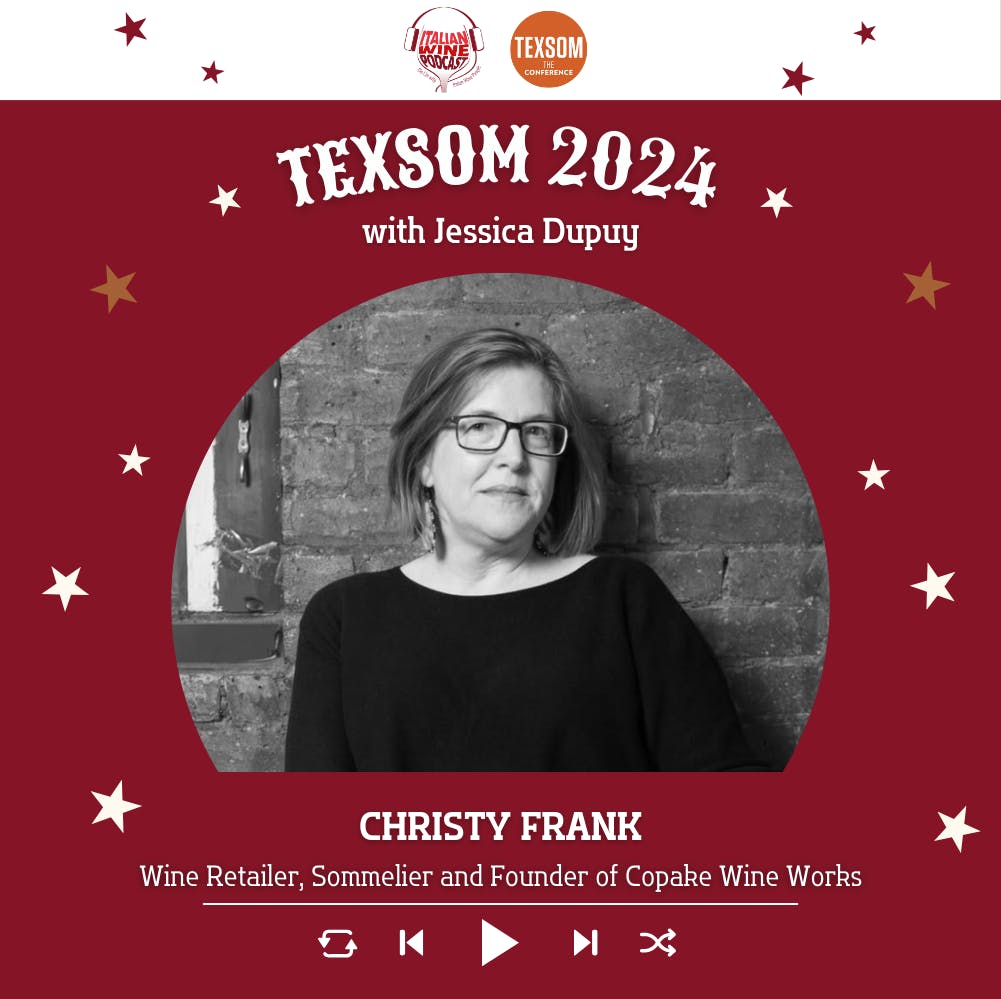
Ep. 2242 Jessica Dupuy interviews Christy Franck | TexSom 2024
TexSom 2024
Episode Summary
Content Analysis Key Themes and Main Ideas 1. Christie Frank's extensive career journey in the wine industry, from corporate roles to independent retail. 2. The operational differences and challenges faced by independent wine shops in urban versus rural settings. 3. An ""on-the-ground"" perspective challenging mainstream industry data and offering a more nuanced view of the wine market. 4. Evolving consumer behavior, particularly among younger generations, including mindful drinking, quality preference, and interest in sustainability. 5. Effective communication strategies in wine sales, emphasizing meeting customers where they are and avoiding ""info dumping."
About This Episode
The speakers discuss the importance of staying on top of selection and disciplined sales reps in the wine industry. They emphasize the need for disciplined sales reps and the importance of finding the right people to sell the wines. The shift in alcohol consumption is due to a desire to avoid distraction and stay at home, and the industry is changing due to the shift in mindset. The speakers also touch on the seasonality of consumption patterns and the impact of alcoholism on alcohol consumption. They encourage listeners to donate through Italian wine podcast dot com and encourage listeners to donate in the future.
Transcript
Christie Frank, you were a speaker this year, and there's one seminar I wanna really hang on, but tell me a little about what you were sharing this time around. So this time, I had two seminars. One was talking to consumers and not info dumping. Lovett, And so we joked that we were info dumping, hung out to info dump. Yeah. And the other one was discussing the state of the industry, but specifically the retail and restaurant industry on the ground. Tell y'all? I'm Jessica Duppuis, guest host for a special Texom series covering the twenty twenty four Texom wine conference from Dallas, Texas. Join me in the heart of the Lone Star State as we delve into the experiences and insights of key speakers and attendees. Exploring rear paths, challenges, and the latest trends in the wine industry. If you enjoy the show, please subscribe and rate our show wherever you get your podcasts. Alright. Well, Christie Frank, thank you so much for joining us on the Italian wide podcast for this special Texon series. I'm so glad you're here. I'm so glad to be here. I have to say this is kind of the place I've never been up to your shop in New York, which we'll talk about in a second. So, like, but I get to see you often almost once a year, sometimes twice. Usually in Texas. In Texas for a tax home related event. So I'm happy because it is kind of like a family reunion. You know, I know you and your background, but I wonder if you could kind of share with our listeners a little bit about Christy Frank and your journey to wine. Sure. So gosh, I've been in this industry for a while. I don't like to do the math anymore. It's been at least twenty five years, if not longer than that. I started out sort of the way a lot of people wind up in the wine industry. I wanted to learn more about it. I went to Cornell. I took the wine tasting classic Cornell and just loved it. And I was the first of my friends to turn twenty one. So if anybody wanted to drink, They went through me. And so I learned not only do I like it. I like to talk about it. So, you know, it was like, here, let me tell you about this delicious finger lakes riesling, and they're like, just no. Just just let me drink it. Yeah. So that that was that. So then was in Boston and wanted to learn more about wine to cheat to take classes, so got a job part time at a, little wine store in between work and the apartment. And just sort of fell in love with retail. That was my first real wine job. And, went to business school, worked from a hennessy for a while, sort of sort of, like, big global experience. What did you do for Moette, hennessy? When I started, it was Shefeline and Somerset. And Shefeline and Somerset at the time was a joint venture between Diageo and Moette, Tennessee. So it was really, really unique. I could write an entire book about that. That's another podcast. Okay. But I started with, doing sort of an internal consulting project. I worked on the classic Malta of Scotland for about three months and got to go to Scotland twice in that time. That's a whole other story as well. Not that. The, you know, this is a little bit of, like, big drinks history, Adiagio had just purchased part of Seagrams. And in the process of bringing that together, there was this whole, distributor realignment project that basically happened. And Diageo had about a hundred people on their side, and Sheflynn and Somerset had two on their side. It was my boss and I, and we had just done sort of an internal let's do a strategic planning process. So we're like, you're the perfect people to do this project, oh, it should have lots of PowerPoint, and Florence So we put that together. And, then I also worked on Tennessee, ten Kne rum launch, and the last thing that I did was run the US business for the Australia New Zealand wine portfolio. And I was like, oh, wait, wait, wine. That's why I got into this business because I love wine did that for about two years, which involves a lot of visiting different shops, doing work with, and just remembered, oh, right. Retail. If I ever have a wine shop, this is how I would do it. I would do this. I wouldn't do that. And eventually, it was just the time came to be like, enough of the corporate world. I'm going to open my own wine shop. Fantastic. So By that time, where were you? So that was New York in New York most of that whole time. Oh, to business school. That was when I moved to New York in sort of like nineteen ninety eight. Nice. It's been a while. Okay. And was it from two thousand to two thousand and seven and opened the wine shop at the very end of two thousand and seven. What was this fine shop? This was Frankly wines. Love it. And your last name is Frank. The last name is Frank. Okay. And it was down in tribeca. Now if you know your sort of financial markets history, opening at the end of two thousand and seven, neither first holiday season was really two thousand eight. Yeah. And we were right down by a for a company formerly known as Lehman Brothers. It was I mean, we were there the day that it all imploded. It was wild. Was that a big sales day for you or a horrible sales day? It was a big sales day, but it was a sad sales. The big fat tails. Literally wandering in and being like, it's all just gone. And we we, like, open something and we're like here. Just Amazing. Wow. So it was, I mean, for a lot of shops and for the industry, it was tough time. But when that's your first holiday season, you you don't have a down, like, I hadn't I didn't have boatloads of two thousand and five, ordeaux, coming to my shop at the top of the market. I had a six pack. I didn't have pre orders of high end champagne that I was going to be selling to people because I didn't have that customer base yet. So we didn't have a Downier for years until as the economy then started to go up, people started to leave the neighborhood during the summers, to go travel. And they're like, oh, so it was it was it was just an interesting time in sales history that looks a little different than people would expect knowing their financial history. Yeah. So I had that shop, and that was Open that again, two thousand and seven, two thousand and eight. Around two thousand and fifteen opened a shop up in Hudson Valley. Okay. Hudson Valley Berkshire in the town of Copake. Okay. There we go. There we go. So just, you know, for frame of reference, how far away is like Hudson Valley from or how far is Copake from New York City? Yeah. And it's a big, it's a big, big valley up there. And when we first opened the shop, that's like, well, I know where I am, but I don't know where anything else is. Yeah. Yeah. Yeah. But the main points of reference would be we're about two hours north of sort of the upper east side Okay. Of Manhattan. And about a half an hour to forty minutes away from Hudson on the river Okay. Which is a town that a lot of people know. And then we're also about thirty minutes away from Great Barrington in Massachusetts. Got it. So I call it the two hour band, and our sort of unofficial tagline is we're in the center of everything in the middle of nowhere. She's true. Okay. Love it. So that was opened that shop in two thousand and fifteen, not because I wanted a wine shop up in the Hudson Valley then, but the way that licensing works, it was such that, and there was a building available that we were able to purchase at a very, very good price. It was like if I wanna do this anytime in the next ten years, I gotta do it. Jump on it. Running two shops, two hours away from each other is there's no scale. So sold Frankly wines, which is still there. Really? And sold the shut that shop in two thousand and seventeen and have been increasingly focused up on Copic line works. And in two years, we'll be up there full time. Amee, so ten years from now, which is what we said. I wanna shop ten years from now up here, so I gotta do it now. Ten years is no duty. So I'm curious because you're talking about being in the center of something in the middle of nowhere. How do you do much online retail? We do a decent bit of online retail, and I had a customer base in the city, obviously, from, frankly. So I still kept, you know, what is the thing? People buy people. Mhmm. And they buy me. So I've maintained that sort of customer base through internet, through newsletters, through whatever it might be. So we do have a regular delivery schedule. Like, there's a lot of logistics involved in it, but that's where the, you know, I'm a firm believer. Anybody that's opening a wine shop, you think you're gonna do all this online business, but there's absolutely no reason for anybody to at any wine shop online. You needed to we wanted to make sure that we were supporting a local customer, which is very diverse. There are local families that have been there for ages. There are weekenders. There are summer people during COVID days. It was like half of Manhattan seemed to move up there. It looked like I had a great crystal ball. But it is very much a generalist store. Okay. In the way that, you know, if if you've got a little New York City, shop chances are it's a little shop. And population density is such that you can have a really specialized program. So if you wanna focus on a small book of spirits that nobody has ever heard of, you can do that. Somebody cannot walk into your shop, ask for something you try to convert them to what you have. But if you don't, and they're really set on what they want, you can send them to the shop a block, a couple bucks away. Yeah. And it's it's fine. It's good service. You're able to try to come get people into your, like, little orbit. But if not, that's fine. Yeah. Up in where we are, if somebody comes in and they want something, and I could sell it, but I don't wanna sell it because I have plenty of space. I'm basically saying, yes, screw you. Yeah. Go drive a half hour. Yeah. And that just doesn't feel good. Yeah. It's not good service. It doesn't feel like very hospitable. You know, this is ultimately the hospitality industry. So, we sell a larger selection of products than we ever did in New York City, but, you know, it works. Yeah. So generalists in terms of you've got the global sphere of wine that that is available. If people wanna come in for Italian, they can. If they wanna come in for New Zealand, you've got something, which exposes you as a I mean, you're the buyer. Yep. So you're having to keep up with what's going on all over the place. Right? I mean, you constantly have that hat on of, okay, here's what I'm looking for, here's what I'm not looking for, that sort of thing. Yeah. And and it's so, like, always trying to you know, by the time I sold, frankly, our sort of average price point per bottle was twenty to twenty five dollars. Okay. Up in the Hudson Valley, we initially, I thought it was going to be like six to seven dollars. It was more like ten, probably now ten to fifteen dollars. But there's a lot of work that needs to go into finding really good wines at that price point. And big bottles of things that at the price point they need, they might not be anything I ever sold frankly, but we do sell up there. And then just different regions, different styles. Like, people will come into the shop. They'll say, oh, you're a natural wine shop. Well, because they see all the same natural vibe. And then some people will come in and say, look at these fabulous Bordeaux and Barolo and the brunello that you have. And they don't notice the natural wine or the big bottles, and then some people will go straight to the big bottles, and they're like, oh, look. You've got I have this whole selection of, I want pinot noir, and there you have it. And so people see what they want. To see, which is something that I'm very good at putting together a selection, but everybody feels like the shop is just for them. It's theirs. Yeah. And very local. So I'm curious, how do you stay on top of that? Is it through is, you know, do you rely on relationships with distributors? Are are you constantly reading? Do you get to travel? A little bit of all of that? Because I'm still living down in New York City for the most part. And because I have all of this experience in history with the New York city buyers, I still go to tastings. I still, get invited to the tastings, make sure that they know I'm here to be able to go to them. So I'm in that loop. It's much harder if you're up where we are, and that's your main focus because sales reps I'm like, I don't want you to come out to the middle of nowhere, like, for something. Yeah. And I can only buy, I can only buy so much. Like, at Frankley wines, we were doing like one point two million dollars in sales before it all ended up in Copate, we're not doing that, but the cash flow is the same, ultimately. Fascinating. But you can buy a lot more wine when you're selling a million dollars worth of wine than when you're, you know, selling three hundred fifty to four hundred thousand. So I have to be really, really focused on really disciplined on these sort of fun higher end stuff. What you're going? Yeah. So yeah. So but you do get to travel sun too because you recently went to I would You're brutal. Okay. Yes. Has you been there before? Any of it? That was the first time that I've ever been to Italy. You're kidding me. No, which is sort of Oh. It's shameful. No. In a way? I mean, as a, you know, having been in this industry for as long as I've been into it to not have gone to Italy. I've been I mean, I've been to Australia five times. That's amazing. By South Africa once, but, you know, you just know the right people apparently. And I I worked for one Australia for a while. Oh, okay, right now. Tennessee business. So, like, you're an astronaut. But Italy was always like, Oh, some days there. And I got there. And it was amazing. Okay. So I think about what you were just saying in terms of price points that you're looking to achieve while based on where Copic is, Do you feel like you were able to find some things there? Or did you have that hat on, or was it more to experience? It was to experience it just to get a general sort of lay of the land, but always like look for what can we buy. Now the trip was through the consortium and we didn't visit a co op. That was there just wasn't time, which I would have loved to have seen a co op. But, I mean, I think that is part of what we were there to experience, was that we all know that the brusso is a fantastic source of great value wines for, like, nine ninety nine on the shelf or a big bottle for like a magnum size you can get for like seventeen. That's not a secret. Right. What I knew, but when you get there and you really see it first hand is at that sort of not the tippy tippy tippy tippy tippy top. I mean, you know, the sphere of the s one. Yeah. Bye. And, Valentini, like, of course, or, right, ops. Yeah. But so at the, you know, at the tippy tippy top, we know we know what that is. But that kind of twenty five to fifty dollar price point on the shelf where the Montepulceanos were just amazing. And I'm always thinking in terms of laterals, like, what is somebody going to come in and ask for that I can give them something that they're gonna understand it? But at a really good At a good price and also at a discovery. Yes. Yeah. And those wines were amazing in the sense of I could put some of those up against Napa Valley. Like, no, it's not Kabernet, but just in terms of the intensity and the concentration. And in some cases, like that really beautiful use of oak, but they're still fresh. They've got that dark color, which, let's be honest, when we're selling wines at that price point, I can explain over and over and over why a pale wine is delicious, but if it's deep and concentrated, then Somehow. I don't have to have that conversation. Yeah. Yeah. So that was just a really amazing discovery. And then, of course, meeting with winemakers, we've, like, went way down a rabbit hole of why that's the case. You know, what fine chemistry standpoint, which I won't go into now. The chair as follows were just delicious. Yes. Yes. And for a market that is crazy about chillable red wines to have something that has that historical provenance and that this is what this is. It's the original chillable, deeply colored, I don't know. Is it a rose? Yeah. Either way, is that a great structure and you want even more. Yeah. Yeah. Yeah. So that was amazing. And then the the Treviano's Deabruzzo, that was the real kind of eye opener for me. Okay. Why is that? Because we haven't oh, we just don't see them a lot in the market, and we had just styles that range from, like, rich and sort of opulent and slightly oxidative to these beautiful styles that had, like, just this razor edge of reduction that you could put next to certain white burgundy. For sure. And in a blind tasting, it would be tricky. So, like, that sort of red, what would it be? Red Rosay and white or red, white, blue white. But a full spectrum. It was just it was really like, oh, I can do some stuff with this. And then those were sort of the boom, boom, boom, the three big buckets that, really kind of came away with that story. But then, like, the quirky things, like, oh, let's try this Elianico down in the south. Like, that makes all the sense in the world, or some of the, like, the pecorino's and some of the white blends that we were seeing, like, just is a good eye opener for you? Yeah. Yeah. Now you've got your foot in the door. You're gonna wanna go back. It's gonna have to No. No. No. Just it takes time. You're fine. Well, so let's kinda transition. So we're at Texon. That's where we see each other all the time. You were speaker this year. Tell me a little bit about what you were able to you spoke a couple of times. Oh, yeah. And there's one seminar I wanna really hang on, but tell me a little bit about what you were sharing this time around. So this time, I had two seminars. One was now I have to think about the official title. That's okay. It was avoiding talking to consumers and not info dumping. Love it. And so we joked that we were info dumping, how not infodump. Yeah. And the other one was discussing the state of the industry, but specifically the retail and restaurant industry on the ground. So, like, from what we're seeing. Right. What we're seeing and not what the statistic are saying because if you look at the statistics and where are they sourcing those numbers from, this is my belief. The smaller independent channels, smaller retailers, smaller restaurants, were kind of invisible. Smaller distributors were kind of invisible. We're not reporting up to these big aggregates And it was a conversation. Everybody on the panel was sort of like, I thought I was gonna be the person who was moderately optimistic. And everybody was moderately optimistic. Alright. So I'm gonna pause you there. We're gonna break this down because I think this is really fascinating. First of all, Actually, let's do for the wine dumping, just or info dumping. Info dumping. Not wine. Nobody's dumping wine. Sorry. For the info dumping. That's basically just being able to talk to a customer without over, you know, talking to them about, you know, bricks levels at harvest and all of that stuff that maybe is a little too much in front. Yes. Yes. Okay. And that was three of us speaking, and then, Samantha was Sam was moderating. And it was just kind of to a tee meeting how do you meet customers where they are? How do you suss out how much information they want to give? And one of the reasons it was probably a panel in the first place was because this industry, I mean, in TexOM, is it's all about education, and you have a lot of people in this industry who are studying for this pin or studying for that certification, or this or that or the other thing, and you get excited, and you wanna just be share everything information. And that is perhaps where this industry's reputation is being a little, like, snooty and a little light wonky kind of comes from. Yep. So talking about how do you avoid that? How do you gauge what customers want? And then in my case, where do I find an outlet for my geekiness? Yes. Like, how do we do that? Cy find both sides. Yeah. Okay. So now back to the state of the industry, because as you were saying, and to be clear, you came in here to do this interview just off of that seminar. Yeah. Your energy level was so high. I was like, wow. We're gonna have a good conversation, or you must have just come from a great conversation because you're right. So let's break that down. We are hearing a lot of doom and gloom. Right? It's like, oh, wine sales are down. Oh, you know, nobody's drinking anymore. Oh, the young people aren't, you know, it is hard to hear because welcome to media. We like to really focus on drama. Yeah. But what you're seeing on a really on the ground level you're saying is a little bit different. So kind of tell me So so to caveat it to start with And this is sort of how I framed that conversation. A lot of the data that we see comes from so, like, let's talk about IRI and scan data. Okay. So IRI Nielsen, that comes from grocery store scans. New York, for example, is one hundred percent independent in terms of the retail channel. New York state, New York. All of New York state is independent. Yes. So there may be some wine is not sold in grocery stores. Wine cannot be sold in grocery stores. I'm breaking this down because we do have a lot of Italian. Yes. You know, listeners, I wanna be sure in New York wine cannot be sold in grocery stores. Mhmm. To break it down even further, each corporate entity in the state of New York is allowed one retail license. Okay. So Trader Joe's, a grocery store, a grocery store had one wine shop in the state of New York. Okay. I don't even know if Costco has a wine store in the state of New York. There are some grocery stores, which happen to be family owned. So Mama might own one of the stores. Hapa might own one of the stores, and each of those is technically a separate company. I mean, it's like they do. They cannot operate like a a big grocery store chain like Albert or something where you can buy these massive container deals and price it accordingly. That's even more detail. Gotcha. Okay. So a New York has there's been a lot of consolidation at the distributor the big distributors, the big national distributors are in New York. They are coming in like r and d c just entered into New York recently, but there are probably hundreds of small distributors. So there is so much wine, and they're not reporting their depletions. They don't have to report their depletions? Nobody has to. Nobody has to. Okay. So a lot of the numbers that we're seeing and the trends that we're seeing are based on the big part of the industry. Now, to be clear, that it's at least what we, up on that stage represented, these small independents across the country, if we're being generous, maybe that's actually twenty percent of the value and volume. So I don't wanna downplay some of these doomy gloom figures because there's a lot of wine out there. It is for a huge part of the industry, there's gonna be a correction. It's scary. Yeah. But at the level that we operate at, because remember, this panel was just about retail and restaurant on the ground. And where are we all from? Just like, what was the spread of the country? Two San Francisco. Okay. Two from San Francisco, two from New York, and then one from Las Vegas. Okay. So, you know, the one of the headlines is San Francisco's burning. Yeah. Well, we have two cautiously optimistic operators from San Francisco. So we were just sort of talking about what we are seeing in terms of what are young people drinking? How are they drinking? What are they not drinking at all? And one of the things we talked about is they are drinking more mindfully, but what does that mean? Well, it means maybe tonight, they might wanna have something from the non app belt selection. Maybe tonight, they wanna have something from the non elk selection, and then maybe they'll start with that and then have a bottle. Maybe tomorrow, they will just want the bottle. So there's a lot of sort of shifting and figuring out what do we want to drink. Today, the criteria that they're thinking about is they are legit more interested in the farming or the sustainability or what is that story. And the story varies, you know, based on what they're kinda looking for, the trends that they're looking for. They are I mean, I don't wanna say that everybody just wants skin contact wine and glugly wine, but what is happening at that level of the farming is, is important to people. Okay. Yeah. So in terms of the trends, it's not all doom and gloom. It just means kind of adjusting what the mindset is. If you want to make and sell a certain kind of wine, the customers increasingly if that's not what they want, you're gonna have pivot. And if you can't pivot or if you don't want to pivot, then you're kind of screwed. Yeah. In terms of what are the staffing and this idea that people don't wanna work. Well, not really, people do wanna work, but there are structural issues about how people can get paid and health care. And are you working at this gig because you need health care, but you might actually like to do this other day. Right. And it was overall, we're all quite hopeful that there are bright spots in the industry. We are, you know, some of the bright spots. Yeah. Does that help the eighty percent of the industry that has to, that has to find something to do with their wine? And maybe that is worrisome. So. Yeah. Yeah. That makes a lot of sense. And I think, you know, it is an interesting part. I was out with some ladies who were in their mid twenties. Mhmm. I asked about this. I'm like, what is this whole, you know, you're young and you don't drink anymore? Like, you tell me, what are you doing? It was fascinating because they were like, you know, it's not that we don't drink anymore. There are a couple of things. One, it's that if we're going to do it, we're going to drink really good stuff. Mhmm. And two, it's less about well, we're all gonna go to a bar and maybe I'm getting a glass of wine and he's getting a, you know, bourbon cocktail and she's getting a vodka soda. It's more like we want an experience. And so we're gonna go to a Moscow bar and only really kinda just talk about Moscow or one night it's gonna be we're not even going to about it's not about the bar. We're just going because this really cool hot pot place has got great food and we may not drink at all. Yeah. You know? And so it's just a different frame of reference or a different frame of mind that they're going for. And I don't know how you answer that, you know, if you're on the other side, but it was a really interesting conversation because they're like, yeah, we're just more selective. We're more intentional about what we're doing. T intentional, mindful. I think this the statistic that we didn't put PowerPoints up there. It was after lunch and I've been to I love PowerPoint, but I was just like, no, not today, especially because we're not incorporated in the PowerPoint. But I think the study that I have seen that shows that something like two thirds, one third of young people, however, that's defined, don't drink at all. But I believe if you look historically at consumption patterns in the US, going back years and years, Historically, one third of the US population does not drink at all. I remember that number vaguely from when I was at Moa, Tennessee. So that hasn't really changed. I think we see perhaps more seasonality in the sense of we're gonna do January, or we're gonna do sober October. So you might see certain hits at certain times of the year. If you know that's gonna happen, you plan for it. And we're just, I mean, up, up at my shop in the middle of nowhere. I have plenty of young people. I wish I was still a young person. Don't think the demographics consider me that anymore. But coming in and asking questions and drinking way better than I was, it that correct. Yes. Yeah. I mean, it's no longer Booms farm. And Yeah. Yeah. Yeah. But I think that's actually an interesting point. So let's talk about sober, October, and dry, January. Do you notice a significant dip in sales? I mean, in where my shop is, January sucks, but January sucks because it's January. It's cold. It's cold, and January has always been miserable because you've got your holiday. It's cold. Holiday. People anyway are drinking perhaps less because they've just been feasting. They have lighter pockets because they spent all All their money. Holidays. Yeah. And seasonally like October tends to be quiet for us anyway because we're not yet November and December is when it's gonna rain. It's a really interesting point because are we really seeing a tick because of almost convenience, well, we're not spending much money in October anyway. No one's gonna say, let's do dry December. Yeah. Or are they? Right? Because that would be the thing to know. Right? Like, January, again, you're right. People are not wanting to spend money. Yeah. Yeah. And and in all honesty, like, it's as a retailer, there's so much interesting nonalcoholic and low alcoholic stuff out there that as a retailer, I'm like, well, I'll go back on this a minute. I don't care. Like, I would love to be able to sell all of that stuff and build that into my program because we do know that most of the customers that are drinking think did I say this already? Most of the customers that are drinking nonalcoholic anything are also drinking alcohol. Correct. So they're switching back and forth. That's right. It's just the occasion. That's right. Now in New York because of the way the rules work, retail wine and spirits retailer really isn't allowed to sell nonalcoholic. Product. It's a whole other fascinating boondoggle. Okay. You know, we don't have enough time to go into how each individual state handles us, but it's annoying, and I'm sorry. It's annoying. And it's a huge loss. It's a lost opportunity, and it's something that I hope savvy retailers start till we start to think we're like, okay. This is missing. And the customer that is drinking, that stuff is drinking. Like, I want them. I want to be able to provide them. And not even if they're not even if they're going through like a sober month, but just to be able to pick up this and that and put it in the fridge and just, you know, depending on what the mood moves them. Yeah. So I love getting to hear this from, like you said, like, independent, you know, operators because it is a different kind of level or stratus, you know, stratum in the whole consumer world that you're seeing. And, yeah, I think it's really valuable that you were able to kind of have people from different parts of the country really weigh in on that. Yeah. Yeah. No. No. It's is are we going to save the industry? Are we gonna be able to absorb what's happening in certain regions that have little bits of wine lakes? No. But Am I able to make a living for my business? Yeah. Absolutely. Interesting. And the panel was retailing restaurants. Yeah. On the ground. On the ground. Not in the data. I think that's yeah. That makes the difference. Well, Christy, it's always exciting to talk to you. I wanna ask you one more question before we go because we didn't talk about how you're also a really great writer. And recently, you entered something into, like, was it a contest or a writing? So it's the, Jansett the chances Robinson? Wine. It's the readers, wine writers. It's the wine writers. Get with the exact title. The title. Yeah. But but it's the topic I wanna ask you about. What did you choose to write about? So the topic everybody was getting is what's your most memorable wine moment. And I wrote about a night at the shop. This was when we were down in New York City, and we we were doing a wine tasting, and these wine tastings. Like, that's a great thing. About doing a wine having a wine shop in a densely populated area, you do a tasting. People will show, they're just walking by. You don't have to worry about it. They're coming in. And so this had been a tasting. I don't remember what we were tasting during the tasting. But it had just snowed outside, and it was just like everybody was like, we were in a great mood, and it had been a lot of fun, and the shop is tiny. And so it must have been like this little party atmosphere. And as we were like breaking down the shop and putting everything back together, sometimes we'll open a bottle. And it was just this It was it wasn't Italian. It was a bottle. It was Spanish. It was pink. And we've been like, we wanna try this. We wanna try this. And so we're like, screw. Let's open it. But we'd already dumped out the ice on the ice bucket, and it wasn't cold enough. Oh, no. And it needed to be cold. And so We needed ice. So I walked outside, and there were some ice cubes. Or, like, why called it street ice? There was just it was cold. And there was ice, and we made sure that it wasn't yellow. Yeah. Yeah. It was fresh. And we just Uh-huh. Knocked off a piece and put it in our glasses, and we had street ice. Street ice wine. I love it. Street ice wine. Street ice wine. And it was just amazing. And I found the picture of the bottle, but like the bottle wasn't what was important. It was just that one of these moments where you just have just wine was just this festive, fabulous moment. Which is I mean, to me, what I love is that, you know, you send that to Janice Robinson. So it really, you know, with with the intent that, like, basically saying, like, wine is exactly that. Like, we're all together. We wanna do something fun, and we're gonna enjoy this as a convivial experience. You know what I mean? And so well done there because it's been selected. For the entire month, they published about thirtieth. Okay. And so mine was published, which means you know, at least people read it. Yeah. And hopefully, it will make the shortlist. And then when they do the shortlist, they do a reader's choice, and they do a the editors make their choice. So I'm like between one of those, I'm hoping I have. Well, congratulations. Well, thank you. Thank you so much for joining us for this. I learned a lot and I always learn a lot from you. And I hope that I see you again soon at the next tech song. Next year next year in Texas. Alright. Ciao. Bye bye. Listen to the Italian wine podcast wherever you get your podcasts. We're on SoundCloud, Apple Podcasts, Spotify, HimalIFM, and more. Don't forget to subscribe and break the show. If you enjoy listening, please consider donating through Italian wine podcast dot com. Any amount helps cover equipment, production, and publication costs. Until next time.
Episode Details
Keywords
Related Episodes

Ep. 2293 Ryan Lewis | Grandi Langhe 2025
Episode 2293
Ep. 2259 Jeff Porter | Grandi Langhe 2025
Episode 2259
Ep. 2251 Jessica Dupuy interviews Sergio Germano | Barolo Barbaresco World Opening
Episode 2251
Ep. 2233 Jessica Dupuy interviews Rebecca Hopkins | TexSom 2024
Episode 2233

Ep. 2226 Jessica Dupuy Interviews June Rodil | TexSom 2024
Episode 2226
Ep. 2219 Jessica Dupuy interviews David Way | TexSom 2024
Episode 2219