
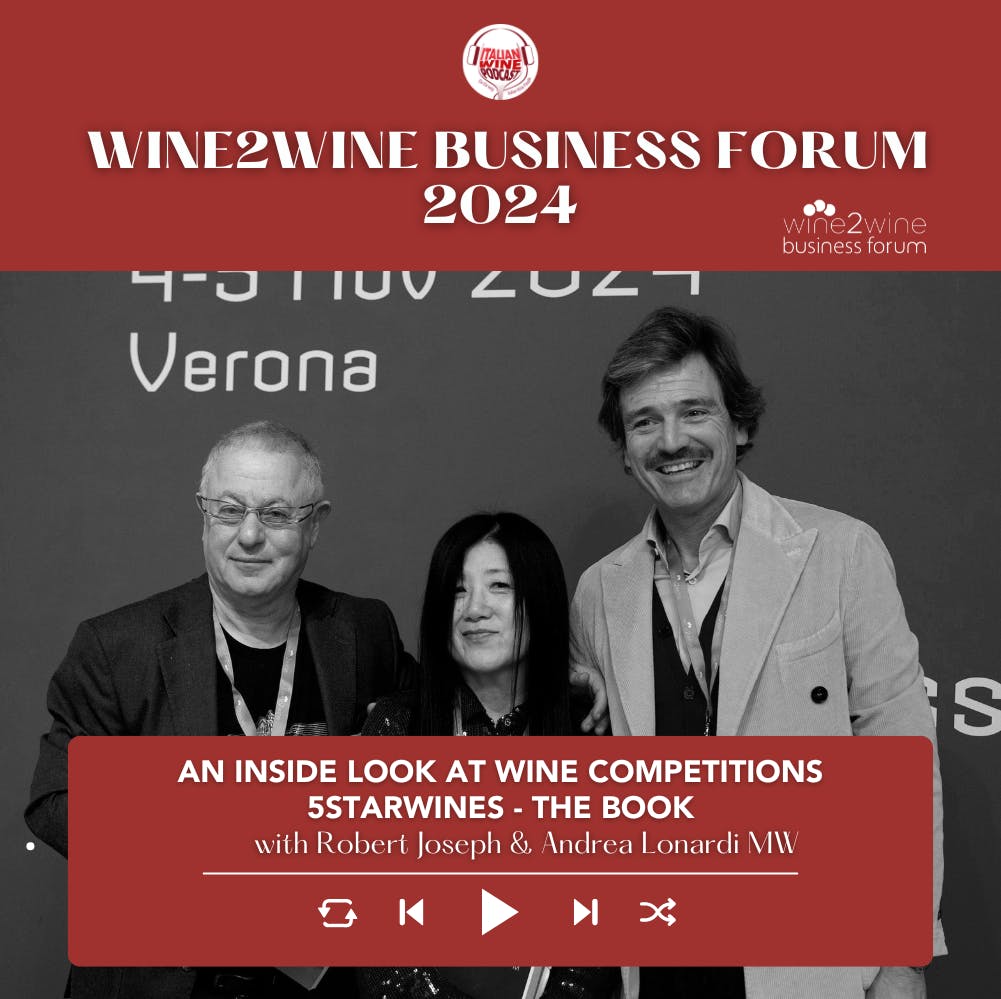
Ep. 2300 An Inside Look at Wine Competitions and 5StarWines - the Book with Robert Joseph and Andrea Lonardi MW | wine2wine Business Forum 2024
wine2wine Business Forum 2024
Episode Summary
Content Analysis Key Themes and Main Ideas 1. The Role and Philosophy of Wine Competitions (Specifically Five Star Wines): Discussion centers on how Five Star Wines operates, contrasting its collegial, discussion-based approach with the more rigid, non-discussion OIV system. It emphasizes judging ""identity"" and ""authenticity"" over mere technical perfection. 2. Beyond the Score: The Importance of Tasting Notes and Identity: A core theme is that numerical scores are less important than detailed tasting notes that convey a wine's character and origin. Producers are encouraged to focus on building a consistent, recognizable identity for their wines. 3. ""Italianity"" in Wine: The speakers frequently refer to ""Italianity"" as a unique quality of Italian wines, stemming from diverse regions, native grape varieties, and specific textural and flavor profiles (e.g., salinity, acidity, Mediterranean herbs). 4. Winemaking Practices and Faults: Practical discussions arise regarding the impact of corks (TCA, dryness) and microbial faults (Brettanomyces) on wine quality, highlighting the need for producers to thoroughly test materials and consider practices like filtering. 5. Contextual Wine Appreciation: The speakers argue that wine should be evaluated within its commercial context (price point, intended use like ""by the bottle"" vs. ""by the glass"") and for the joy and experience it brings rather than solely technical analysis. The concept of ""Pinozophy"" is introduced to describe this holistic appreciation. Summary This segment from the Italian Wine Podcast, recorded at the 2024 Wine to Wine Business Forum, features Andrea Lenardi (Master of Wine) and Stevie (host/moderator) discussing the ""Five Star Wines"" competition. They collectively advocate for a paradigm shift in wine evaluation, urging producers and consumers to look beyond numerical scores to detailed tasting notes that reveal a wine's true identity. Andrea Lenardi explains Five Star's ""pure agnostic approach"" to blind tasting, contrasting it with the OIV system by emphasizing discussion among judges and the importance of understanding a wine's origin and commercial positioning. They highlight the unique ""Italianity"" of wines, exemplified by tasting three diverse Italian selections (a Soave, a Nebbiolo, and a Lambrusco), discussing characteristics like salinity and balance. The speakers stress that objective evaluation by a large panel of tasters provides invaluable feedback for producers. They conclude by promoting the idea of wine appreciation as a joyful, experiential journey, encouraging people to ""fall in love with one wine and then another wine,"" emphasizing specific memories and moments over abstract categories or overly technical analysis. Takeaways * Scores vs. Notes: Numerical wine scores are deemphasized; detailed tasting notes that convey a wine's identity and character are considered more valuable to producers and consumers. * Five Star Philosophy: The ""Five Star Wines"" competition aims for purity and agnosticism in blind tasting, fostering discussion among judges to provide comprehensive feedback. * OIV Criticism: The OIV (International Organisation of Vine and Wine) competition system is criticized for its rigid, non-discussion format, which can overlook nuanced quality. * Wine Identity: Producers should focus on building a consistent, recognizable wine identity that is readable and enjoyable for consumers. * Fault Management: Rigorous testing of corks and careful consideration of filtering are crucial to avoid common wine faults that can negatively impact quality over time. * ""Italianity"": Italian wines are celebrated for their unique ""Italianity,"" a blend of regional diversity, native grapes, and cultural context. * Contextual Judging: Wine evaluation should consider commercial positioning (e.g., price point, ""by the bottle"" vs. ""by the glass"" wines) and the overall balance and finish. * Experiential Appreciation (""Pinozophy""): The focus should shift from technical analysis (e.g., nose) to the overall joyful experience of drinking wine, its suitability for occasions, and the memories it creates. * Targeted Promotion: Promoting wine effectively means focusing on specific wines, places, and experiences rather than broad, generic categories. Notable Quotes * ""The score is not the most important things, guys. There are much more important things inside the note."
About This Episode
Speaker 0 and Speaker 2 discuss the importance of tasting wine in a agnostic way and the need for transparency and agnosticism. They emphasize the importance of tasting wines for decision-making and sharing experiences. They also discuss the importance of tasting wine in a different way to create a different experience and emphasize the need for balance and depth in price points. They suggest funneling in information and collecting more information to make a decision. They emphasize the importance of promoting wine in a different way and being open in their attitudes.
Transcript
We need to stop and delete the score. The score is not the most important things, guys. There are much more important things inside the note. So what I'm promoting to you today is please send some wines to the five stars, but not to have a score to read the denote that a group of fifty people they will give to you, because that it will be an opinion of fifty people compensated in three, four lines. And I think that it's absolutely useful if you are a wine producer, if you are a winemaker, if you are a viticulturist, if you work in communication, if you work in marketing inside the company. Official media partner, the Italian wine podcast is delighted to present a series of interviews and highlights from the twenty twenty four wine to wine business forum. Bringing together some of the most influential voices in the sector, we discussed the hottest optics facing the industry today. Don't forget to tune in every Thursday at three pm or visit Italian one podcast dot com for more information. Hello, everybody. Welcome back. I I guess this is a little better timing than nine o'clock in the morning. I Laura. These two gentlemen, up on stage, they're part of How many members? We have five, five, five, general chairman for the five star wines. It's a three day, wine. Competition, but you can't say it. So it's a guide book. And they manned about two thousand three hundred wines. And before the ceremony, they did a simulation of similar to what we did the morning with System Balaga, explaining the rationale behind the point systems. How come one wine is given a score of ninety and the other one ninety five? Every wine guide and wine competition, they have their own criteria. This is ours. So I thought that it would be nice to simulate, what we did during Van Italy because the producer, especially, they really appreciate it. Okay. So we said, why don't we do this for a larger audience? And that's why we're here today. Okay. Take it away, boys. Thank you all for coming. Can I ask one quick question of the room? How many people were here for the system Belagot tasting this morning, probably around a third, I guess. The reason I'm asking that question is that what we're looking at is the differences in a way between the way that a monopoly like system Belagot chooses to list wines, and the way that we master at wine, Andrea Lenardi, and our fellow tasters choose to give wines scores for five star, which we'll talk about five star in a minute. But I think there is a difference between potentially the way that a retailer, a distributor, a monopoly might decide to buy or list a wine and the way that we are looking at wines in a blind tasting like five starts Andrea. Firstly, I don't think you got the right introduction really, but Andrea and Adi, one of the three Italian masters of wine, to get to be a master of wine, you've done a lot of tasting and judging and so on. Talk a little bit about that. And then go on to talk about five star a bit. Yes. We tried it for sure to bring inside five stars, a little bit, the master of wine approach. Thanks to the fact that before me was part of the tasting Gabriela Gorelli. And also in the last two years, we joined it also Peteros. And Pedro BellisERas, the Spanish Smart and also Carol Maurer was there a few years ago. But what I find that is very important about, five stars is a very pure agnostic approach that we have in the blind testing and with this wine through different categories that is quite interesting. So it is an opportunity to really understand what's going on in the market and try to judge and evaluate the wines more and more by the identity and obesity that these wines they have. And that I think that is a great opportunity and that is that the reason because I acted also to speak about five stars today because it is absolutely something that we have to announce and we have to promote for the near future. So if you look at the world of wine competitions, as Stevie said, they're all different. If you look at the OIV member or the OIV certified competitions of which there are a lot, the nature of those competitions is to me strange, but you are given a set of red wines or white wines, and you are not told anything about them, except for the alcohol level, you're told sugar level, and you're told the vintage. And that's all. So you don't know if you're tasting Italian, Spanish, French, Uruguay wine, wine, and you could go from a Tanat from Uruguay to a Teroldago from Italy, possibly in the same set of wines. It is the way that the international organization of vines and wines thinks that wine competitions should be run. Other competitions will tell you a country sometimes. Some competitions will tell you a grape variety. It varies. I'm involved with Monderswini in Germany where we tell you the grape variety, but we don't tell you the country. I think we should, but it's not entirely my decision. What Andrea's just said, I think is crucial is when we are tasting these wines, we are aware of where they came from and what they are. Secondly, and I think very importantly, we are two members of a five man and woman panel, but all of the wines before they get to us have been through a larger panel, tables with five or more people, and we have Italian professional people from Esonology. We have Sommeliers, and we have a lot of people who've been through via. Yeah. And that is very interesting to see the difference between how the winemakers are facing versus journalists, opinion leader of bias. They're testing. I give you an idea normally, especially in Italy for a mental culture, a winemaker days by faults. So he's looking to find what is wrong inside the wine. Normally, an opinion leader, a journalist is promoting what is nice inside a glass of wine, and seeing this different approach is very important to finally promote a serious wine that really represented the place and the wave variety where it's coming from. However, we had a question this morning about the joy in wine. Yes and no. Essentially, we will give wines high scores sometimes to wines we don't like. I've certainly done that because it's not my taste. It's not giving me joy, but I think this is a good example of what it is. And I think it will give joy to the people who want to drink that kind of wine. So the process, just so you know, in a room like this, you have a table with a group of people, and they're given the wines in sets, and they give a score to each wine, and they can discuss that score between them, and sometimes Andrea Pedro, go up, and we will go to a table, and they say we can't agree on a wine. And we then taste the wines with them, and we listen to what they're saying. So this is to me a crucial thing. If you're ever involved in a wine competition, and one of the reasons I hate the OIV system in case you hadn't realized that, is that you're not supposed to discuss anything. You're supposed to give a score and hand in your paper, and then the computer will give the medal. And even worse, they will take the top mark and the bottom mark off so that if you really liked the wine, or you really hated the wine, your score didn't count. So you thought there was Bretenomyces, you couldn't tell anybody else at the table, you just gave it a low mark, and they didn't notice the Britannomyces, and your mark is taken out. On the other hand, you thought the wine was really subtle, elegant, interesting, but maybe a little light bodied, but you liked it. The same thing can happen. So the Nate of five star is that each table is expected to discuss, and then when we get the wines, we are discussing. I'll explain in a second on Andrea, well, why we are doing what we're doing, why do we not just leave it to the tables? But the thing I will say to you is if ever you're tasting at a competition, you should be learning from that experience. I learn from every wine competition that I do. And when somebody says, I don't like this wine, you say, why don't you like it? And they say something and they say, the oak, do you think the oak is natural local chips? Actually, you know, I think you're right. I think that oak isn't really quite as nice, and I'm gonna come down a bit or whatever. There's always, to me, If you're not learning from a tasting event, then you're not tasting? I would like also to express why I'm inside. You know, I'm a winemaker. First, I'm an agronomist right now, I'm working in consulting. But as a producer, and before as a CEO of a company, I was Latani is the one. I was looking to define how the people they are tasting. I want to give you something that I was writing this morning early this morning. What is very important every day in our normal business. It doesn't matter if you're a TSC, it doesn't matter if you're reading, it doesn't matter. Whatever you are doing is to be very objective. And you cannot be objective. When you are sending a sample to a journalist, that he knows you very well, you know exactly your philosophy of way making, he knows what you are focusing, and he has a very, probably also relationship with you. In this type of tasting, you are sending your sample of wine to a very big amount of people, and they are the best, for me, it's one of the best panel that you can find right now in Italy because there's no situation like that where fifty top people from all around the world that is in your wine, I think that this is a great opportunity to convey a message about just what you are in function of where you are coming from and the creative variety that you are using and they are evaluating you about what exactly it is inside of the class. And these people, they are trained and they are format in order to judge exactly what is a great variety, which is the type of population that they are tasting, and exactly also the contemporary style, a certain type of wine they need to have today to be successful for the wine. So for me, it's a very beautiful Tatiana to really understand what's going on really in a very objective and agnostic way what is inside your bottle of wine. So the question that should be in your mind is if you have fifty good tasters out there, why do you need five people, the general chairman, sitting in another room, tasting the wines again? Well, the two reasons: one is disagreement on the tables, we look and see is there a range of marks? Because maybe that question, as I said, of Pretanomyces or subtlety or whatever. Secondly, you have two tables or three tables tasting the same style of wine. One table is more generous. So our job is to really just polish what has happened in the main room, and it's a wonderfully convivial experience, certainly for me as a taster, because I have a set of wines, I'm tasting them. I know what mark has already been given. And I think, yep, this is a ninety two point wine, and we're tasting specifically the wines that have had differences and the higher mark wines, or wines that have got a low mark that we want to know why. And when I find this has got ninety two points, yep, it makes sense. This has got ninety two points. I'm not sure to me, I think there's something, and then I will pass it to Andrea, and we are then very collegiate. Two or three of us will be looking at those questions. And we're not changing many things. But we're looking at the why of these scores, and I think that becomes a very useful experience. So any wine that you see in the book that has got ninety two points or ninety three points or whatever the points are, and they're all over ninety has been through those two levels of tasting. You can disagree with it or agree with it, but it certainly has had a lot of effort of looking at it. But I'm going to say one thing because if I don't, I'll forget it. Andrea and I have just tasted all of the bottles of the wine that has been served to you today. One of them was under Diam, so we didn't taste a lot of those. The other two were under natural core. One of them was under expensive natural cork. And between us, we pulled out three bottles out of twelve, I think, probably, that were not obviously corked. They did not obviously have a TCA mushroom smell, but they were flatter, just less fruit, drier, and she's no secret. It is actually the third of these wines, which has already got suntan in. And if that bottle of wine went to a tasting, like five star, the group may be through it out, and then it comes to us, and it's our job, which we don't always get right. But it's our job to go, do you know maybe this isn't as good, can we have another bottle? The problem is when you don't know what it could be, that doesn't always happen. So to you as producers, how many producers in the room How many of you test your corks when they come in? In other words, put them into neutral alcohol or white wine? How many are you making samples of different corks for the same wine? And you are tasting regularly every six, nine, twelve, two years? Okay. So if you're going to use natural core, you know, if you want to play the serious game, you need to have this knowledge today. Otherwise, you can be seriously attacked by a faulty bottles that is not a rocket bottle, but it is a forty bottles that go through an evaluation from top people that they are tasting. And if the tannins are dry, not because you may try tannins, but just because the cork tried the tannins, that is the final result that you will have inside, you know, And by the way, any of those of you who are making wine, and you say, I don't filter, which is a nice thing to say, just remember if there's any Britannomyces that is alive in the wine that you put into a bottle, that you didn't filter, by the time it arrives at our tasting, maybe there's more britannomyces, but if I taste britannomyces on a red wine in a competition, even a little, and somebody says, Oh, it's okay, it's adding complexity, it's just part of the character. To me, I always remember at a different competition, somebody giving me a disgusting Italian red wine, which epitomises to hear. And they said, what do you think of this? And I said, it's disgusting, and they said you in your competition gave this wine a trophy two years ago. Because when we had it two years earlier, the return of mysis was not a problem. But over that time, in that bottle, it became a problem. So if you're not filtering, Just remember that that wine could change in a bad way as well as a good way. Should we talk about these wines? Yeah, but let's talk about the three wines that we have in front of us. We decided to pick three different wines that really represented the beauty of this country. In the first class, you have something that is very old fashioned, very classic, but probably can be back in the future. In the last one on the right side, you have a wine that really represent what is very trendy. Contemporary today on the market about red Italian wines. And in the middle, you have something that is very cool. It's very pop. It might be interesting for the near future. All the three wines are absolutely expressing an identity about the grape variety and the place where they come from. And that is the reason because this is why they were scolded with very high scores. So please have a tasting over the first three. And after that, let's give one minutes. And after that, we will come back to you. What do you all think of the the three wines just in general? Can you see the quality in the wines? You've had a court art. The one that escaped the third bottle, it could be. We've tried to catch them, but it's it's it's not impossible. Can we ask for another bottle of the third wine, please? But can I also say this is also crucial to the five star experience? We are tasting the wine usually one hour after the bottles were opened. One of the things about TCA is it comes out with air, so the table gets the wines when they're freshly opened, and sometimes they don't get the TCA. It's quite possible that we stopped three and you may have bottle number four that just escaped us, and with the time that's been poured, it's got worse, or maybe we weren't very good at doing it. Let's go back to the the first wine. Let's try to describe this wine, and I want to refer to something many times where I was in the beginning of my stage in as in the master of wine program, I got the chance to discuss with people and see some less on what they were saying that Italian white wines are very flat. They are not a romantic and that are very difficult to recognize where they are. And when they are red wines from Italy, they are very tonic. So they have a very high level of tannins. They have a big color and they are quite oxidized with some VA on the nose. This is what a lot of general people in the wine business they're thinking about Italian wines. I totally disagree with this approach. I think that this country, it is absolutely full of an identity in the different region. And even if you are tasting a non aromatic river right inside the white wine. There is a lot of identity. What I love the first wines is absolutely the succulent and saline character that is in the palette that for me is screaming about the place and the grape variety where it's coming from. Do you agree or do you disagree on that? So this one, it is absolutely promoted as its identity. I totally agree that probably the winemaking approach with a lot of work on the nose is not typically of the pleasure. So it is an approach more related to the single producer that want to influence the expression of the great variety and the place with the use of oak, but absolutely the oak doesn't cover the beautiful mouth feeling character that is about this wine. I think what's interesting, I was in Georgia recently tasting a number of it happened to be some natural wines and there's somebody in the room who was also there. There were some wines where the acidity was to me, to my mind, completely out of balance with the wines. See, what I like about this, and you've just said salinity. By the way, salinity is the new word. We used to have mineral. I don't know what's going to come the next word, but I know what salinity means here but my point about this wine is I love the way the acidity is part of the wine, just as the oak can be part of the wine, and in some wines, whether it's the alcohol or whatever, it isn't on top of and there are some wines that I'm seeing getting quite good comments from critics sometimes at the moment where the acidity is just way up there and you have to fight through that to get to the wine. And here to me, it's a thread that runs through it. And I think that inside this one, we have also put in some score regarding the commercial positioning of this one. This one is probably sold for less than six euros per bottle, probably less than five So it is absolutely a wine that is more used by by the bottle than by the glass. And the commercial positioning is totally influencing the approach and the style of the wines that you are making. If it is by the bottle, guys, it's a gastronomic style of wine. If it is by the glass, it could be something completely different. And you can accept some more roundness, some more sweetness because you are tasting durianna periquivo. But by the way, we don't know the pro just so it's clear, we don't know the price when we're tasting, but we know the origin, we know the style. So we can kind of put two and two together to make four. But essentially, we're not tasting a three euro wine or a thirty euro wine with that in our mind. If it says Bruno or it says Barolo, that kind of gives us an indication. Thanks to the fact that you know the operation, you might also recognize quite. You can put a range of price that normally people, they don't know. And I think that it's very important to set the expectation that you have inside a glass of wine. You cannot judge in the same way in a wine that costs three euros than a wine that costs fifty, a hundred euros. They are completely different. And I disagree that you are testing that in the anyway, because my expectation, so I'm influencing myself in order to judge the wine if I know the price. And I think that is correctly to influence my expectation and function of the price positioning of the wine and the commercial positioning about the wine. However, just so we have a little bit of tension between this, if you like, to me, whether I'm tasting a wine that's three euros or thirty euros, there are a balance, I think, is crucial at any level. And secondly, and this is more ambitious, I want even a cheap wine to finish well. It doesn't matter whatever the price, I want it to make me want another taste of that wine. So any wine to me that is hard or too okay or whatever, that something that I don't like at the end or if it stops short, it doesn't make me want anymore. And so what I like about this is it's got some really nice, textural richness to it, that carries on it's not the longest, greatest white wine you've ever tasted, of course it isn't, but it is doing what I want a wine to do, and funnily enough, the thing that I'm personally and Andrea, you may disagree. A lot of wine tasters I've tasted with go, the nose, the nose is wonderful, the nose is wonderful. It's short, I don't mind because it smells so good. To me, the finish is probably the most important thing, but certainly it's as important or more important than the way the wine smells because everybody gets the finish. They all swallow andrea your thought. Absolutely. I totally agree. I think that the balance is required in each one that we are testing, the concentration of flavors and the depth and the density is absolutely something completely different that is related to the price point and the operation of where the one it is made. But I would like to say something. I'm sure that, there are better wines that we can find than these three wines. But I would like to pay the attention of the fact that these three wines, they are absolutely screaming Italianity. And I think that's something that we need very proud and we need to enhance in our vineyards, in our sellers, and in our communication that we're using every day. By the way, sorry. This man who has just invented a word, I think invented another word that involves Pino. What what is your Pino word, Andrea? Pinozophy. And the number three is absolutely expressing the Pinozophy style of wines that we are approaching today. And if you give Andrea Lenardi another hour, he'll probably come up with another word that we can add. No, but absolutely for Meet history, once they're absolutely expressing the Italianity of different style. And especially if you move to number three, that is exactly what today is common from classic Italian regions. And from my point of view, that there is a red spine across Italy that's starting in Pierre, go through Tuscany and arriving in Sicily. And the red spine of Italian wines, it is made by three grape varieties. Nebbiolo, sangiovese, and I'm sure that this wine is absolutely one of the three. Maybe I don't know which one of the three it is because they have some common character in in the middle, but for sure it is one of the three. And it is pale in terms of color, something that in the past was not really a value that was very appreciated today. It's a value of Italianity. It's a value that us absolutely expressing the Italian origin the second, it tastes a mix of Mediterranean character. There are some Mediterranean herbs, but on the same time, there is some campari amaro character that is absolutely typically of the Italian soul. And finally, in the palette is light, slender, agile, but on the same time, it has stepped and tallinnis with very high acidity. This is the beautiful blend of certain Italian populations, and when you find this balance this blend. I think that it's good and it is nice to give a good score to a wine that is made with that because it is a representation of an appolation and it is absolutely expressing the great variety where it's coming from. Can I say, by the way, we have a discussion session after this, but this man will talk to you for at least three hours, if you like, about the things he's been talking about just now in Valpolicella, and it's really fascinating and having tasted Amaroni with him few times and so on? It's wines don't always have to be the way we thought they were. Italianity is a moving thing. And I think, and I think that this wine, that is the reason because if you remember Joseph, for when we tasted this wine almost nine months ago, we say this is a great wine. This is a great expression of the place where it's coming from. This is a great expression of the grape variety and it's not probably the best, but it is a good expression about about the grape variety and the place where it's coming from. So for that reason, I think that we, inside five stars, we need to promote wines that are expressing this beautiful Italian identity in a very simple and very easy way. That doesn't mean that it is less qualitative wine. It is a wine that is showing what actually it is actually. So does everybody know what wine three is? How many for Nebula? How many for Central Visa? How many for Nebula? Well done, guys. Well done, guys. Nebula is correct. And the vintage twenty twenty. I wonder about the first one. Is not center or south? How many for south? How many for center? How many for north part of Italy? Right. How many for east part of Italy? So, Andrea, what you've done the master of wine exam? Let's say we all agree that it's from the north of Italy. What is your thinking when you taste this wine that's saying it's gonna be from here or here or here? What what what's going on in your head? Alright. It's always a matter of funneling. That is not just not only when you are tasting, but every time that you need to make a decision from my point of view, my strategy is always to funneling. So to be very open and very agnostic in the beginning, and try to collect in as much information you can. And that this is the first approach that you need to have inside a glass of wine. So you need to be very open and say, okay, is it automatic or non automatic rev varieties or it is a semi It's absolutely a non automatic rewrite. Second, which is the way making approach that they decided to have. It's more reductive, more sedative that you smoke, no hope, and you start to build this information. And finally, you need to have a look about the type of food expression that you have in order to start to understand the climate, the position where this wine is coming from. Look, this wine, this wine has an acidity that is typically of a cool region. It has a very moderate level of ABV, so it's confirming the fact that it's from a cool region, but the fruit is quite override a little bit. So there is some citrus character, but this citrus character is quite perfected. And that is starting to give you some opinion. And that is the reason because people in the room, they say, oh, this wine is from the south, and probably people that they were thinking from the south, that they were thinking about Aetna. Because many times, ethanol wines, they can have this confected fluid with a very fresh mouth filling. And that is related to the sun. And this actually this wine is coming from a place on the north part of Italy where you can replicate some climate condition typically than Monte Aetna because you have the sun and the sun is coming not from the latitude, but it's coming from the reflection of the soil because it's coming from a volcanic region. So you have the heat of the light and that really overripe a little bit at the expression, but it's coming from a cool region, and it is from soave. And what is confirming about soave is the salinity that with lovely crunchiness and very subtle incident that you have in the palette that is absolutely bringing you. It is typically of the palletian, especially both in volcanic or in white limestone and soave, you have this aspect. More saline in white limestone, mostly currency in the volcanic side. So that the only wild card, if you like, is the oak, which you may not have expected in swabic. Yeah. You are not expecting. And for for that reason, this one, it was a winner inside a organic category. So this was not necessarily our best suave in the five star pasting. We have a separate section where we look at organic and biodynamic and natural. And this was the top one of the top suave, I think in that organic category. What did you think of the barolo, by the way? I'm sorry, by the way, can I apologize to the people who didn't get the good bottle? And can I say, Mayor Cooper? If any of you are running a tasting for people, what we should do here what I try to do, it's hard to work. I try to go with one bottle, I go one three five seven nine, and the second bottle goes to four six, so that it means that everybody is sitting between two people who got a different bottle. So if there is a question, you can say to the person sitting next to you, can I taste and smell yours? We didn't do it today. I'm sorry. And that's one way I can recommend doing for tastings. I have a question for you. How many of you who chase at the bottle of wine? And after that, opened, very important, like, top wines, and after that, went to, like, some of the most important journalists and tried it to read the tasting notes. Have you never tried it to do that? If you never try to do it because it's very fascinating and you learn a lot of things. And you learn from a way that is different. So most of the time we read only the score, we need to stop to read the score. The score is not the most important things, guys. There are much more important things inside the note. So what I'm promoting to you today is please send some wines to the five stars, but not to have a score. To read the note that a group of fifty people they will give to you, because that it will be an opinion of fifty people compensated in three, four lines. And I think that it's absolutely useful if you are a wine producer, if you are a winemaker, if you are a viticulturist, if you work in communication, if you work in marketing inside the company. And then, by the way, if you've sent the same wine to the Spectator or the enthusiast, or compare. And then, and you sent it to Johnson Robinson or to Canada or whatever, and then into an Italian critic, you'll see cultural differences. You'll see what a critic in New York says is not necessarily the same as a critic in London says. And you need to be aware of that. And there are people in New York who read Francis Robinson because they prefer her way of looking at it to the spectator, but there are people in London who read the spectator because they actually like those courts as well. You need to be aware that there is no one way of looking at any wine. And I'm telling you what I've done in the last ten years. I was looking for consistency through the different journalists. My goal was to have the same tasty note from different journalists, from different opinion leaders, not easy. Not easy. It's the most difficult part, and it is more difficult than make a single score, make a single top score from one journalist. Because it means that you are building an identity and your identity. It is something that is recognizable. So how I'm influencing five stars is to work in that way. Is to work in a way where you are promoting wines that have an identity that people easily can recognize because when people can recognize, they will read the tasting note of the journalist. Otherwise, they won't read. Because it is just a mix of work that is very difficult some time to read and to understand. So please help us to develop this idea of helping producers to be consistent across the different competition or journalists or things like that. Because this is the key of the success from my point of view, from my legal point of view, this is the key of success. Andrea, we have eight minutes and we have the third wine. And we have the most lovely wine of today that for me is very I remember exactly when I tasted this wine. I stop it. Do you remember? And I stop it and say, please taste this wine because this is exactly what I would like to drink when I'm thinking about the Radelonbrusco seco. You know, and I think that it's beautiful. It's so pop. It's so perfect. It's a beautiful glass of wine as it's screaming joy inside of this glass. It is pure. The fruit is confected. It's juicy on the planet. The bubbles are very fine bubbles. There is no bitterness in the hand. The little residual sugar is perfectly balanced with the moderate level of I call, and it is exactly what I would like to drink in a summertime day. At five PM or ten AM in the morning as, to break my day. And by the way, this, I think, is Italianity Yeah. In a glass. Nowhere in the world makes anything like this. If you go to Germany, there's a a riesling from the mosel, a cabinet riesling from the mosel, there's nowhere I can do that. This is the Italian wine to me per excellence. And it's not for what you're doing. It's the motion of having this glass of wine with something, with food that is inside this glass of wine. And I think this is the new horizon where we need to have a look inside the wine business. We need to spend less time with the nose on the glass, and we need to spend more time about thinking how we can drink this wine, who is the right people that have the right to drink this wine. When was the last time that I got this glass of wine? How was with certain type of people which are my best friends that will probably love this glass of wine. How can I impress my friends in the future with an interesting glass of wine to discuss in a different way about wine? PCs are the new questions about wine, unless it tastes like banana or mango, pious type of things. I think that we need to move away from this approach and think about how to taste about wine in a completely different way. And we had a session earlier about how to be a wine warrior imagine a fashion show and people are there to look at the clothes and then imagine that there is some ham, there's some cheese, and there's some bottles of this. And you won't convert everybody. But if one thousand people at that fashion show, you can convert ten, twenty, a hundred, two hundred, and to Gina Colangelo's point earlier, make sure that you have ways of continuing to communicate with those people in the future. And that is to me one of the strongest ways we can work for Italian wine and for wine in general. How many people do we give less than ninety point to this wine? You can come again. Yeah. You can say if you think that, you can you can say that. How many people they will give between ninety to ninety two? Just a few. How many from ninety two to ninety five. Nice? How many above ninety five? That's good. I think that this is exactly what this one got. I think that it got ninety three point score, and it is exactly what it is. A beautiful glass of wine that costs nothing for the score that is between ninety two and ninety five. And it is absolutely expressing the beauty of this one. But we need to be open in our attitudes. We need to look at a Lambrusco and say we're giving a Lambrusco a higher score than we gave to some brunellos and some barollos, that's fine. And some of those brunellos and barollos are okay wines. The people are buying them will be happy with them, but the people are buying this will be happier with this than the people who are buying those eighty nine point wines will be happy with those. And what Stevie is doing side five starts is absolutely remarkable for the Italian wines. We have to say a special thank you to these women. About, how he's going to repeat it over and over again because she's not here at this point. I'm about putting a lot of energy in this, in this competition. And, there is only one problem about this husband, the name we don't have to call any more competition because we do not compete with anybody else. We are competing just with ourselves, and we are competing to a group of people that they try to evaluate how we are and how we express and how we are communicating. Because remember, most of the time, we produce something that we cannot communicate by using words, by using publicity or other stuff, but we can communicate only by what it is inside the glass of wine. So it must be something that is readable. And the wines that we are scoring with higher points, I always say to Joseph, we need to put points in wines that are expressing exactly what they are because think about the consumers, the people that we have in front of us, they need to understand wine, and they need to drink wines that are readable. So they can enjoy without thinking and overthinking for days because that is the the new board that of communication in order not to make people worried about wine, but to make people joy and happy about wine. And finally, just to pick up on that, we are all talking about promoting wine I don't think we can promote wine. I think wine is far too big and too complicated and too various to promote. I think we need to promote it wine by wine. We need people to fall in love with one wine and then another wine and another wine. You don't promote beer, if you like, you promote specific beers. You can promote Italy, but ultimately we promote verona. We promote Rome. We promote Treviso. We promote places because it's the place. People don't say I have a great memory of Italy. They have a memory of the place they were in Italy and the moment they had there. And in fact, we heard Karen McNeil in her video saying, people remember specific glasses of wine. Specific experiences. And that to me is what we should be trying to do at every price level. And, you know, during a day, while you are testing, I think that last year I did a day with one hundred and eighty wines with one hundred and forty, one hundred and four He's not competitive. Do you realize? You know, after one hundred wines, you have a glass of that and you drink. You don't speak because you absolutely need something to refresh your wallet. But in any case, please send your wines to five stars. And please don't have a look in this call, but have a look in the testing note and try to work on that for the following years and try to see if there is any difference about possible changes that you can make inside your winery while making approach and communication. Thank you so much. And also please look beyond your region. Look at all of the comments of the other wines because that will teach you where the market is going across wine and across Italy. Thank you very much. Listen to the Italian wine podcast wherever you get your podcast. We're on SoundCloud, Apple Podcasts, Spotify, HimalIFM, and more. Don't forget to subscribe and rate the show. If you enjoy listening, please consider donating through Italianline podcast dot com. Any amount helps cover equipment, and publication costs. Until next time.
Episode Details
Keywords
Related Episodes

Ep 2339 A Blind Tasting Journey exploring the nature of Natural Wine with Isabelle Legeron MW and Robert Joseph | wine2wine Business Forum 2024
Episode 2339
Ep 2332 Compiling a Vintage Report with Michaela Morris DipWSET, IWE | wine2wine Business Forum 2024
Episode 2332

Ep 2317 AI for Enthusiasts: tasting with Megan de Angelo and Danielle Callegari | wine2wine Business Forum 2024
Episode 2317

Ep. 2309 Understanding maturity by the glass: old whites from Italy with Cristina Mercuri DipWSET and Gill Gordon Smith IWE | wine2wine Business Forum 2024
Episode 2309

Ep. 2291 Systembolaget, how the tender process and tasting works - one of the tools for reducing the climate impact with Gad Pettersson | wine2wine Business Forum 2024
Episode 2291

Ep. 2282 Adopting AI at Treasury Wine Estates with Justin Noland | wine2wine Business Forum 2024
Episode 2282