
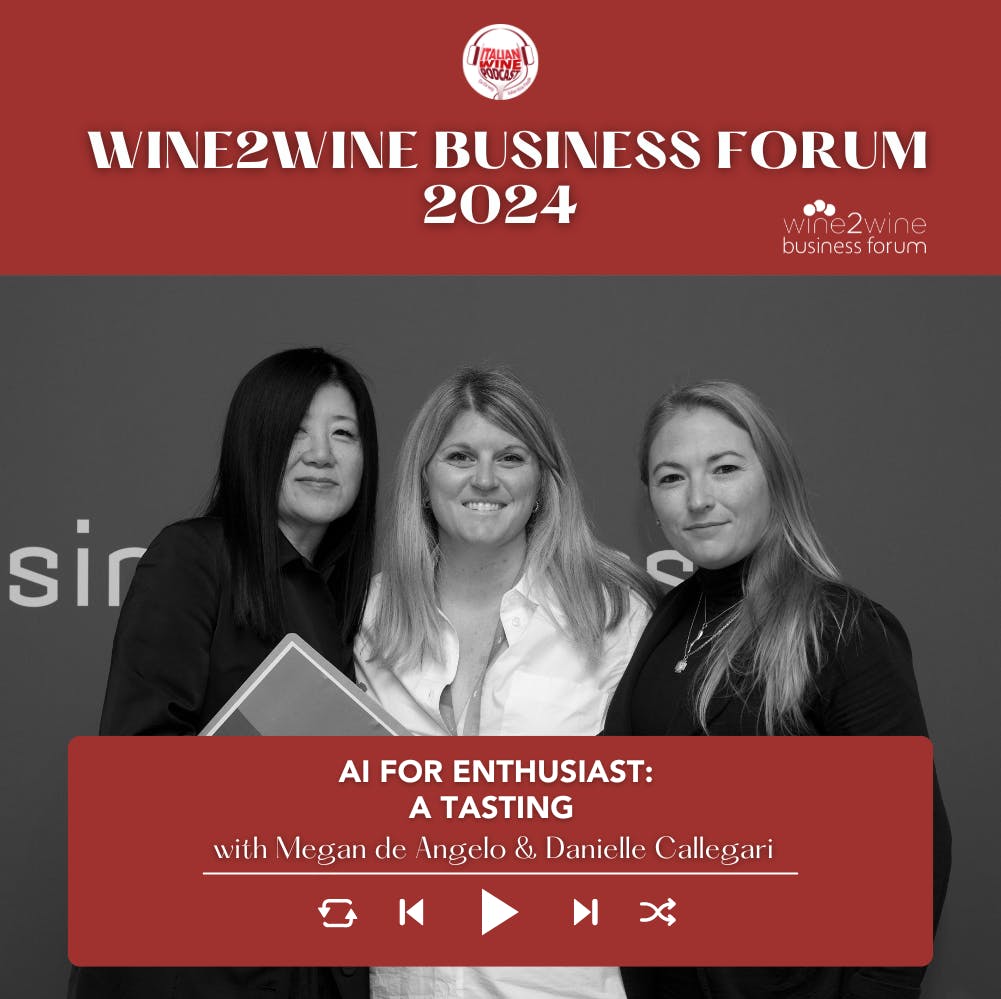
Ep 2317 AI for Enthusiasts: tasting with Megan de Angelo and Danielle Callegari | wine2wine Business Forum 2024
wine2wine Business Forum 2024
Episode Summary
Content Analysis Key Themes and Main Ideas 1. The critique of traditional wine tasting notes and numerical scoring systems for being exclusive and intimidating. 2. The necessity of shifting wine communication towards a more accessible, empathetic, and experience-based approach. 3. The unique opportunity presented by American and younger consumers who often approach wine without pre-existing knowledge or ""baggage."
About This Episode
The Italian wine industry is being discussed by various speakers, including Danielle Callegari, the Italian wine portfolio woman responsible for covering wines of Tuscany and the Italian south. The approach is through a combination of their own experience and their brand, and the challenges of creating a catalog of traditional notes can lead to loss of confidence for customers. The importance of language and engagement with the next generation is emphasized, and the process of tasting wine is discussed as being different from what Speaker 2 had previously discussed. The importance of tasting wine in a proper way and being well informed about the current state of the Italian wine market is emphasized.
Transcript
So many people come into wine from wine naturally. So they have this massive and mountain of knowledge, but they're struggling to build that into a lexicon that can be comfortable for their audience. I started to move the needle over. And Jeff and I talk about this a lot because Jeff also, when we talk together just as friends about wine, our notes are things like we were tasting a wine, both of us in two different places, but at the same time, and I said, this wine is so good. It makes me wanna karate you to death. And Jeff said, why is this why move you to violence? I said, because I'm so excited by, right, it makes me it's filling me with energy, and it makes me on a, it's like, pummel my giant bearer of a friend. Official media partner, the Italian wine podcast is delighted to present a series of interviews and highlights from the twenty twenty four wine to wine business forum. Bringing together some of the most influential voices in the sector, we discussed the hottest topics facing the industry today. Don't forget to tune in every Thursday at three pm or visit Italian One podcast dot com for more information. Tasting room. This is where we are. We are going to start in a few minutes. As you can see, Jeff Porter has become blonde and more beautiful, and younger maybe. Yeah. Jeff, unfortunately, is sick. So, I we've asked Megan, De Angela. She's the lead for the Italian wine. Do you do other stuff? No. She is the Italian wine portfolio woman for Colangelo and Plattness. So she has a lot of experience, and she's friends with Danielle. And so we thought that maybe she can just, you know, do a little bit of more support for Danielle this morning. Danielle, of course, you know who she is. She does wine as a hobby. I don't know how she does it. She, of course, is the she shares Italy for wine enthusiasts with Jeff Porter, but She's a bona fide full fledged professor at one of the greatest colleges in America. So we're grateful, and we're honored to have her. She's real small like me, so I have some affinity, but she's a lot stronger, both mentally and physically. I'm going to now shut up and give the floor over to Danielle Callegari and Megan De Angela, the new dynamic duo. Let's give it a warm welcome. Thank you. Thank you, Stevie. Hi, everybody. Good morning. I'm Megan Deangelo, as Stevie said. I am here this morning with Danielle Caligotti, who, many of you know. She is a the professor of medieval Italian literature at Dartmouth College in New Hampshire. The United States. And you probably know her more for her position as writer at large at wine enthusiasts. Danielle is responsible for covering wines of Tuscany and the Italian south. So I think this morning we're gonna start off with just if you could talk us about how you receive wines, you know, taste them and ultimately score them for the publication. Yeah. So thank you so much. All everyone for coming. I know it's early and extra gray this morning, but it's really nice to be here. And it's a pleasure to have such a lovely, large and diverse audience. As Megan said, my first job is as a professor, Dartmouth where I teach mostly and kind of cultural history of Italy. In addition to that, I review the wines from Tuscany and then Latio Nbrusso south in Italy. And, I write often for the magazine about all different kinds of things. And, related to Italian wine, but usually from a cultural historical point of view. When it comes to the way we do things at wine enthusiasts, it's as kind of straightforward as possible. At least to us, but I know it's not always that way to the producers. We are now introducing a newer more streamlined platform. So what happens is you simply log on to the website, put the information about your wine into a template and then send to us. That wine is received by my team. It gets cellared. There's no further transmission of information now, which is fantastic because you know about your wine and no one else has to know anything because that all comes directly to me. All of the wine gets tasted in situ at the office blind and scored there immediately, and then those scores go right into the system and are published online also more or less immediately, and then in the magazine in the following months issue. There's a lot of wine. Jeff and I are chasing around four thousand wines a year now together. Neither one of us does this full time. Jeff does all kinds of other things, as you know, No doubt because he's been around for longer than I have, not just because he's a very old man, but also because, he's, done this full time, whereas I was doing a PhD, a subject that guaranteed that I would make even less money than I would later as a freelance wine journalist. So that's just a a little bit of a layout of how we do things at the magazine. One of the reasons why I wanted to depart from that information is because what we're here to discuss is how Jeff and I are trying to move towards a different model of talking about wine for our readers. Also, what are the pros and cons to that model. Right? And why does that seem to tasting processes seem to always kind of be a struggle for these wineries. Yeah. You know, just pro problematic reasons. So let's start from the way that you would taste technically, which I'm sure everybody here is familiar with, but it's good process and we have the wine in front of us anyway. So why not? Right? I have the wine set up here as I would for any technical tasting session in my office. The main difference here is that I have, a usual setup is all wines of the same vintage varietal subregen. So they are closer together in their qualities. But I would usually begin in the way that anybody who did their wine certifications knows you take a look at the wine. You get some ideas about it by just what you see in the glass. I see that this is white wine. So a great start. Right? I, I start. Two points. Right. So far. Yeah. Exactly. Let's start building. I start with my distance sniffing where I see how aromatic it is. I come in for some more of that. I start in my mind building a little catalog of the traditional notes Right? And so what am I doing? I start usually by thinking about colors. So I'm, you know, in the world of fruits and flowers, and I start listing things that are familiar to me. And then I go in for my taste and I do exactly the same thing. Right? Now this isn't blind. I know what it is. I'm already influenced, but I know it's Pasadena. I know that I'm looking for some kinds of fruits and flowers. That would be on a list of things that you and I could go to the UC Davis where I once taught also wine wheel and have the stone fruits that are buzz words in the wine world, the flowers that we use all the time. I would start talking about texture. I would start thinking about the possible longevity of this wine? How structured it is? Do I feel a presence of wood and things like that? Right? All of these things are how we compile the review that usually ends up being around forty words that are just a list of things that occur in nature and that are the reflections of the phenolic compounds that are there in the wine making process. Right? What's the problem with that? The problem is that even when it comes to the really simple parts of the list of, let's say, peaches and apricots, and lilies and daffodils. We're already moving into a space of exclusionary language. Some people don't have the same sense memories as I do. And even actually one step behind that, right, before we even get there. I'm already, and I'm accusing myself here because I'm the person who gives scores and writes notes, but I am already by doing that imposing my experience onto my reader, which is the opposite of what we want from wine. Right? Wine is supposed to be your experience and how you enjoy it. So whatever you liked about it is fine. Whatever you disliked about it is equally valid. There is no part of what you decided that's more or less useful to your experience than mine is. My expertise here is really not helping your consumer to either feel more comfortable with the wine or to enjoy it more certainly. And it's possibly, and very often, I think, actually beginning to create the wall we know exists particularly for the American consumer doesn't have a longer standing cultural relationship with wine. Right? People ask and we had this conversation last night, people often ask me, does the average Italian know more about wine than the average American? And of course, the answer is no. What's the difference? Italians grow up with wine around them and feel more comfortable around it. So they respond to it with greater ease, and they're not afraid to take chance with it. A huge part of the obstacle to wine for Americans is starting out at the very beginning with the bottle where they don't know how to open it. And so one of the things that I first tell everyone when they say, how what am I supposed to do with wine? As I say, try to get it in your mouth. And then if we get it passed there, we're already really smooth sailing, right, which could be a great help for a lot of people who are worried about their market share right now because the idea that wine isn't selling or that things are going down, well, if we think about how many people in America who are just departing from the people who are active drinkers who enjoy alcohol beverages in their life are drinking wine. The great majority. The vast majority never reach for wine because of discomfort, first and foremost. So, yeah, lack of confidence. And so throughout this process, you know, these media is changing. Wine publications are changing all the time, What are you and Jeff and the rest of the team at Wayne? This is, what are you guys doing in order to fix that? Right? Because it's obvious your words. So how can you be biased when giving these reviews? Yeah. So it's hard, and it's a long process. So you can imagine how unlikely this whole situation is, but it's, if I, to give a little more context, when enthusiasts called me, I mean, I was going out for tenure university and in my preparation in medieval literature, I've always written about food and wine, but mostly in a pre modern context. And so I had wine certifications, and I have freelancer wine magazines for many years also. But I was an unlikely candidate for lots of reasons. And when they asked me to come on, they said, we want you not because of your wine knowledge. And I said, well, that's good because there are a lot of people who know more about wine than me. And, I mean, there are a lot of people in this world who know a lot about Italian wine. There aren't that many who know more about Dante than me, statistically. They said, no. What we want is someone who is a good writer. Right? And that's one of the big problems in this world. Like, so many people come into wine from wine naturally. So they have this massive and incredible mountain of knowledge behind them. But they're struggling to build that into a lexicon that can be comfortable for their audience. And so when I started writing, I thought that they brought me on for that reason, and so I started writing reviews in the way that I write normally immediately bounced back too too much poetry. Too many words confusing. I said, I really believe that this is gonna be better, guys. So I went, I swung all the way back in the opposite direction. I've started writing super traditional technical notes about the wine was made the way that the traditional notes that you would list all of those things. Right? Now I've been there for long enough and people feel a little more confident in my abilities, and I started to move the needle over. And Jeff and I talk about this a lot because Jeff also, when we talk together just as friends about wine, our notes are things like we were chasing a wine, both of us in two different places, but at the same time, and I said, wine is so good. It makes me wanna karate chop you to death. And Jeff said, why does this wine move you to violence? I said, because I'm so excited by, right? It makes me it's filling me with energy and it makes me on a nice, like, humble my giant bearer of a friend. Right? It's like, and So we started we're starting to try to bring just the first and foremost, the excitement and the optimism. That's the word that we try to use a lot. The optimism that we feel about wine into the way that we talk about it. So that Right. Yeah. And so I think the biggest question is, why is this important? Why should we care? Yeah. Why the process and ultimately these scores? Why do they matter? So let's talk a little bit about Sorry to US consumers. Yeah. Absolutely. So let's talk about even the scores in the notes, say, we're here. And in front of us, we have three wines that are objectively good. They are correct wines. I tasted them. If you haven't tasted them yet, you can. You can tell. These wines are not faulted. Jeff and I selected them when he was supposed to be here. They were his choices. So but I I agreed. Yeah. We think of them as a good representatives of their category. Good values her and how they're made and the thoughtfulness behind them. This is a an exciting panorama in terms of the regions that it represents, the style, and the varietals. But it's also a problem because of that. Right? So all of these wines are good. And as anybody here who's tried to go selling wine, no, you can't simply say, this wine, you should have this wine on your list or you should distribute this wine or you should have this wine in your supermarkets because it's good. All Italian wine is good. It's great news for me. I don't taste a lot of bad wine. It's very rare in fact that a bad wine comes in front of me. Might not be to my taste. But the wine is objectively good. So once we get there, then what do we do? Now you have wine and it's all good and different people like different things, right? All cookies are good too. Just Not everyone likes Oreos as much as they like chips ahoy or ringo. Right? Sorry. We'll we'll use Italian references. Yeah. Speaking movie would be uncle language. Yeah. Exactly. Great. Antonio Van did this commercially. So you have to give somebody something to hold on to that separates these things. Right? So what's exciting about this? I objectively think that these are all good. Sorry. I believe that these wines are objectively good. I also happen to like all of these wines. I would drink them all for pleasure anytime. What is it that I'm going to tell someone that allows them to select it against all of the other options in front of them? Because we know that the world of wine is vast, even if we just limit ourselves to Italy. And in an American scenario, you're not in a store that has only Italian wine or rarely you are. Right. Right. So why am I excited about these? Well, first of all, we have three wines here that are off map when it comes to wider world. We have a, so it's a, it's a region that people may have familiarity with because it has had traction in the last decade for sure, but it's a varietal that's different. So we can talk about the history that why is this less produced what makes this something that still has appeal despite not having as much of production in recent years? I mean, I'm talking long history, sorry to be clear. When we come to this Lambrusco, the fact that it's a is wild thinking about cultural, the distinctions here. This is a time of year where everyone in America is asking you what can I drink when I'm at Thanksgiving with my family? And I go, look at this. Right? I mean, this could take you from the first disgusting weird thing that your aunt made and is laying on a table all the way through to the eighteen different pies that are that no one's gonna eat that no one's gonna eat and nobody's gonna want three weeks later when they're still sitting there. Right? It's also just, I mean, what a fun and so herbaceous. It's the opposite of where I think about that contrast for somebody who's unfamiliar with, like, looking at this color and this texture in the glass. And then what you get on the nose is very unexpected, right, talking, you're getting that conversation going there. And then we have, again, right, something else that's less known, but clearly has so much easy appeal. This is the kind of wine that I talk to people about how it's a best of all worlds kind of wine. When they ask me, what do I drink and what do I select? I say I want a wine that could be for breakfast lunch and dinner. That could be from the antipasto to the. Right? If I'm talking to the average consumer. I'm very lucky. I have thousands of bottles of wine lying around all the time, so I get to have the sip of exactly what I want whenever I want it. But most people want to buy a bottle of wine and have one to two glass that evening. Right? So Yeah. They're not thinking about pairing each course with the proper. They're not thinking about pairing it all. I mean, again, like, you have to think about the average consumer, the things that we try to tell them. And they're just like, again, if I could just find out if it's okay for me to drink this and we just keep simplifying them. Right? More obstacle. Right? We wanna tear those boundaries down. So then how do we move into a kind of language that's really useful? Well, now I'm just talking experiences. I'll tell you I recently wrote a review that I described as going to my favorite bar in the morning where I felt like I could smell like the people just, you know, fresh out of the shower, a little bit of cologne wafting, the coffee being on the noise, the muscle, the warmth of it, the promise of the day coming. Right? I talk a lot. You know, people experience isn't necessarily any more shared than a note of apricot or a note of key lime, but people feel more comfortable when you're describing life and lived experience than the list of things that they maybe haven't had before. I have friends. I mean, one of my friends who has been working in Italian wine for thirty five, forty years. Recently told me that he only found out what a gooseberry was, which is like everyone's favorite. Like, in the anglophone world, you have you have a son. Of course, my whole life is Sandra. The, you have sauvignon blanc in the glass. And the first thing I say, right? The thing that you call just to show that you know what the grape is Right. Is, is gooseberry. How many people are were forty, forty five, fifty years old in America before they even saw a gooseberry? They don't travel well, and they're not particularly, like, widely grown. Right? These are not points of reference, even though they're technically they're available to everyone. They're not common points of reference, even for the people who are using them. Right? They just became so even the the parts of our lexicon that are ostensibly more accessible end up becoming wine speak. Right. And then, you know, you said how many thousands of wines do you taste a year? I mean, with traditional tasting notes, the, I mean, it gets frankly repetitive, and it's not distinctive from one wine to the next. Right? There's only so much you can do tasting all those wines with certain language. Absolutely. So when I'm thinking about how I'm going to express these things. But I'm also thinking then is how am I inserting my personality into these things? And that's where we get to the question of AI also, right? What's the difference between me writing about a wine or talking about a wine versus someone just compiling stuff that I wrote. Other people wrote in the past and just re spitting it out in a new and maybe even more efficient and am more immediately utilitarian mode. Well, the difference is that this is the same reason why my students at Dartmouth take class with me rather than another professor, because they wanna hang out with me. It's not Dante. I mean, they like Dante too luckily, right? But they but they want to hear it from someone specifically, someone they feel comfortable with, someone they have a shared set of values with. Right? Absolutely. And so going through the tasting, we ultimately get to scoring the wine. What is your impression of the US consumer when they're looking for these scores? And what does that mean to them? What do these scores mean to them? And and how does it affect their purchasing? You know? Yeah. What's a vicious cycle? Again, accusing myself here. I give the scores. But I think scores are really hurting everyone top to bottom. They confuse people for one thing because the same bottle of wine can have forty different scores as we know. Okay? Most of the time, we all kind of come together. I mean, Jeff and I taste heads up a lot, and we are usually maybe a point off, I can say. It's maybe a little bit unusual, but you'd be surprised. Like, people kind of have certain expectations that are drawn from, again, right, along experience and a lot of tasting. And now we taste so much. The we have a good inventory to draw from. But For most people, it ends up being the same way again. Right? This is why my experience in the university becomes very helpful because I know what happens when I'm at so Dartmouth is a very elite institution. And the students who come there come from really serious preparations, and they have very, very high expectations. Themselves, as well as the, people they work with. And if I give a student the equivalent of twenty seven out of thirty here, right, like, an, like, an, a, but not the highest kind of a, they come to my office right away, and they're crying. And, like, my, I guess can't I What did I do wrong? And I said, you didn't do anything wrong. That's the point. You gotta correct. You got the best bet to go to the right. You got a really good great. And they say, yeah, but I wanted the best. And I say, great, but you weren't. You know, there's a best out there. I'll let you know when I see it. And so we have it back and forth. And then I get back into the office to taste wine, and I'm thinking, I know I can't I just can't wait till the next producer tells me, you know. Why'd you give me a bad score? And I said, what do you mean? I gave you a great score. And they said, I said, yeah, but it could have been better. I'm like, so you're so good of your I guess. Right? But it's a relative scale. It's subjective for sure. It's also in a world where if I told my reader this wine is a ninety two and this wine is a ninety four, they don't know what to do with Right? It's not helping them because they say, okay, this is good. This is also good a little bit better. What else does it mean? And again, we're moving them away from the opportunity to just see wine as a police for playing for experimentation, for fun, for expression of the self for exchange, for conviviality, the things that wine was made for. Right? They're seeing it as this quantifiable thing, but wine isn't quantifiable at the level of personal experience. For the people who are selling the wine, I understand that we have to talk about that. But we're also at that point limiting the opportunities for all the people who might be interacting with your wine from the very beginning. So you're boxing people out before they've even gotten to a place of where they can make a decision. I mean, there's a lot of eighty six point wines that are selling very well in the United States. People are drinking those wines. Right? So I guess, do you see the point system ever changing, like, actually changing and and points as as the industry kind of tends to see these points be less relevant? Like, do you think that's actually something that will change? You know what? So I rather than saying that we have to discard something, I'd love to, like, speaking of that the mode being optimism, I'm interested in bringing in more ways of talking about wine, of interacting with wine, of spaces where people can engage and learn, and feel more confident with wine, points can be there too. There's no reason why they don't they can't also be useful to certain people certain segments of the market to the people, making sales to people producing wines themselves. Absolutely. But let's draw in other ways, other forms of communication so that you throw you're casting the widest possible net. Right? It's an opportunity rather than an obstacle then. Fantastic. I mean, this is I think leads us then to the question of engagement with the next generation if we want. Whereas another space that I think is mistakenly understood as a hard line between old people and young people. Right? I'm actually like right in the middle. I'm thirty nine. I just turned thirty nine. So I am twenty years older than my students, but twenty years younger than most of the people in the wine were all doing my job or especially your average consumer right now. Right? So as somebody who is old enough to have worked enough and luckily found myself in a position to have enough disposable income that I can just buy things that I like rather than that what I need. I now have a moment to start consuming in a different way. Right? But what are my choices based on? The twenty years before Danielle, who was approached when she was young and curious and experimenting still and not embarrassed in front of everyone and not afraid of things, right? As we tend to with age, we close-up more. We become less curious, less experimental, less open to things. And we have on the positive side, we have longer relationships that allow us to have richer experiences with the products we engage with. So twenty year old Danielle found out about wine when she moved to Florence and started drinking it and was with friends and enjoyed it in the context that it was meant to be, right, fun frivolous at the time, right, low cost, low risk, part of a culture that she wanted to become a part of herself, an opportunity to learn about the people she was with and the space that she was living in. And then twenty years later that Danielle after that time has the opportunity to have these wines in front of her and enjoy them in a very different way in a much more profound way, a much more personal way. And as a result, a way that suggests to her that her further investment in that is worthwhile. Right? And I think we're seeing, you know, specifically in the US. We've talked a lot about this in these days about wine consumption and people drinking less wine, and it it's a problem. You know, in addition to just people drinking less for certain health trends, but there's a lot of options in the United States for everything. Have you ever seen like a cereal aisle? It's ridiculous. Why, I mean, beverage is that way. Right? And so How do you think we should be communicating wine? Like, what are our ways in which we need to be communicating wine to a younger generation? Young wine drinkers that, again, to sometimes those scores aren't they don't even really know the system. So How are we should be shifting our focus in that way? Yeah. I think so this is, again, another thing that I has been frequently positioned as an obstacle that I instead see as an opportunity. American drinkers in general don't have a lot of information about out wine, and they don't have a lot of baggage about it. And the younger you go the less of that there is. Right? Certainly. So you're not fighting back. I talked to a lot of Italian producers who tell me things like, oh, we have to help people to understand that this isn't the case, right? We have to, we have to make sure that they don't think that Italian wine is like this or Italian wine is like that or this grape has this I said, you're talking to the marriage. I see, like, everybody who works on America is like, laughing is hardly because they're like, you're talking to people who they do not have any preconceptions about wine because they have no conceptions. It's a blank slate, okay? Taburasa. There is nothing. Now that's hard also, right? Building up from nothing means you there's work to be done from every angle. And that's a lot of weight on the producers. I very much appreciate and understand that. Once again, I walk into every single September. I walk into a classroom that has fifty students who come from all over the United States and the rest of the world. None of whom have any formation points of reference in common among themselves, let alone with me, and they all have come to read the divine comedy with me. Okay? I have to tell them my first lecture is always you're here to study medieval Italian literature with me. We're gonna start by defining medieval Italian and literature and that's gonna take us the entire first week. Okay. So that's before we've even started to talk about Dante. Like we're never we're not even anywhere close. Right? But it's a privilege to have that in front of you because they didn't come thinking that they know something already in any way. So I get to tell them everything. So there's a risk there. Because what I tell them is that what they go forward with from there. But if I do it right, now they're converts for life because if I start by telling them this is gonna be fun and you're gonna have a good time and you have the tools. I promise you to approach the difficult and rigorous and important subject, they say, okay, I believe you, and we'll do it. And those same students then come back and study other things with me, like, in the following term, or all kinds of other weird. I mean, I've done the things that I've done the Boiardo's pastorals one time. And, like, there's they because they don't they haven't been poisoned with the idea that they can't or they shouldn't yet. Right? So when we're talking to young people about wine, we have the same amazing opportunity, the great privilege of saying to these people who have no ideas about anything yet. Hey, this world is magnificent. It's so rich. It's so deep. It's so broad. You can do anything you want with it. And you don't have to ever be afraid of it. And you can have ten dollar wine or a hundred dollar wine or a thousand dollar wine whenever you want anytime all at the same time if you want. Nothing and no one's judging you. No one's judging you. No one's there to be afraid of. Right? It's just about bringing that into that space. And so back to your process and Jeff's process at the publication, it's changed a bit as we said. So as far as, like, timing goes. There's, let's say, open enrollment. Yeah. If you will. So how does that process look compared to what you were doing before? I don't because before you guys were based, like, on a calendar system. And so I think there was a lot of, maybe, anxiety about, like, miss a deadline and that kind of stuff. So how does that work now? So this is I mean, one of the things that we have tried to change and has been changed is that there's no limit anymore, and this was also one of my choices. I said that I am not limiting the types, qualities, Anyone who wants to send wine as long as it adheres to the our basic principles, which is it's, available in the US market because if we're writing or talking about wine, it has to be available to the people who we're talking to. It has to be legally just distributable, so it has to be bottled correctly and ready to go when it comes to us. And there are a couple of other technical elements like that. But as long as that's it, you can send me your wine. And I do not taste in any particular order or privilege anybody in any way. I tell the only thing that I tell my team is that there are so and things I'm going to be writing about this year. So I can tell you, for example, twenty, my twenty twenty five editorial calendar. I am writing about the Cecilian Islands and the West Coast and the coast of Tuscany from Salisbury excluded. So south. So any of those wines that come in, I ask them to put those up front so that I am tasting along with the things that I'm currently researching. But other than that, there's nothing that goes ahead of anything else. As it comes, I taste it as I as I can. I do that not only because I think that's fair and a better way for me to actually be well informed about the current state of the Italian wine market, but also because that's how your consumers receive the wine, blind and in a massive confusion. Right? And so, sometimes you're sometimes you're tasting wines, like, on-site, let's say, in Italy, and sometimes you're tasting them in New York office. I think Jeff does the same thing. Yeah. That's true. So a little bit about that process, like, you know, if I'm a a winery, I'm I know a lot of those communications come through the consortium. Can you just talk about that? The difference in how you do that? So we do so if we do a tasting in Italy, it has to be again in the search for fairness. It has to be something sponsored by either the doc or the consortium so that wines from a region are represented altogether. No single winery can be the sponsor of of a tasting and can be individually represented, everybody together. And again, this is because of the way the wine is then received as well. Right? Because the gives me actually a useful panorama. I see how wines of a certain subregen are performing. If they are representing themselves in a way, that's coherent. Yeah. Excellent. Yeah. So I guess maybe we open it up for some questions. Yeah. Absolutely. Yeah. Yeah. Yeah. Do you wanna do like a proper technical tasting? Well, let's talk about them together then. So let's how would you describe these wines? Frudy. Okay. Yeah. So by writing my traditional notes, sorry. I thought description at the beginning was I guess Steve didn't like that, but she never does. She wasn't paying attention. Okay. So if I so if I I were doing my old school model, I would start with the fact that I actually get more floral right now off the top of this. Plenty of a roomy. Right? There's, like, some nice. I'm thinking of these. They're these new laundry soap pods that are really expensive. It's, like, high end. But very good for the environment. Yeah. And they have a flavor, which I think I don't think you're supposed to think of laundry pods as flavored, but that are Italian citrus. And I think they cost, like, eighteen times as much as, like, regular laundry soap, but it's really reminding me of that right now in a great way. Think it's like clean linens. I'm imagining, like, a kind of, you know, outside spring day, warm, but not hot air. That salinity is bringing me, maybe seaside. New flowers blooming, lots of fresh herbs. One of the other things that I've been trying to do that's kind of striking down the middle between the two kinds of communication that we might do in this case is talk more about texture for an American audience. So we don't think that a lot of the people I talked to who have a little more experience with wine might feel comfortable talking about the fruits and flowers, vegetables, things like soil, and, you know, air, even salinity, but they're not as comfortable as describing what's happening on their palate, which I think is actually maybe a lot more useful. In terms of things that are more absolutes. So I would say I would talk about how I feel this wine coming like straight down the middle of my tongue, and then I would make a note about the acidity that's keeping my saliva moving and calling for another sip. I would talk to them then more than, again, now trying to swing away from the more traditional mode. I would say, how would you enjoy this? Right? I would say, what's the context that works for you here? And not just the, in American wine journals, there's been a lot of, you know, is this a porch pounder? Or, like, is this, like, is this, like, for the, you know, in the, in the pool? Or next to the fire side. But more like, is this something where that feels more casual and informal to you? Do you feel like you could pop and pour this with just a couple of friends? Is this something that you feel like? Right. Is it is this something that feels there something that marks this wine is more special to you for some reason? So I would then move to this, right? And say, okay. How do you feel about this wine? And we would talk about the world of sparkling, what that means? Why does feel festive, what makes it celebratory, what about sparkling changes your experience with it? And then I might note for them the fact that a great thing about sparkling wine that is often undervalued in day to day is that it pairs really well with almost everything because it's palate cleansing and because it has both the effervescence and the acid component that allows you to carry through a full meal. And then I would talk about what I mentioned before when thought I was teasing. The incredible contrast between the the savory components that I get on the nose that are balanced more thoroughly by that super almost passion fruit juicy raspberry note on the palate. And then I would lean in more to the Italian herbs that I get here because that's something that I think is really intriguing and unexpected for my audience and so I would say, do you smell that? You know what that is? That's sage. I bet you didn't think that you would smell that in this glass. Right? Do you know what that smells like? I would talk about going to grab stuff, rubbing it in your hands, smelling about essential oils of things, how you can actually make relationships with that. So if I'm gonna talk about these things, I try to explain how might experience them in another context so that they're not exclusive to wine also. I mean, I just backed to my original point. I think this is just like one of those wines or even this morning when I was not super pumped about starting to get my tasting going at eight thirty. I never I What is this one? I don't think everybody knows what this one is. This is a ligurian red grape varietal that, again, once we get to an outside of Italy context, I I think you it's very unlikely that mean, your average consumer would would know what this is. Right? So already there, it's fun. It's different. It's unexpected. It's just the kind of wine that I think is a great place where I would start with somebody who doesn't feel confident with Italian wine and who doesn't know where their pallet lies yet because it offers a lot without asking a lot. Speaking of opportunity, your average customer doesn't know what this one is. Right? So get them it using language that already inter they don't they're not comparing it to anything. There's no there's no point of comparison, so they don't have to feel like they were opposed to the biggest date back to that point of people feeling like they were supposed to know something. Right? Nobody's supposed to know anything about any wine. It's up to you to have your own experience. And, right, again, that brings us back to the question of what's the difference of tasting wine with me or me writing about or communicating wine for you. It's my experience. I'm putting it into context, and I have a lot of context, luckily. So that's helpful often. It gives people a lot of things that they can grab hold of. We were talking last night. About what's the point of knowing a lot about wine. It's because it's an arsenal, right? It's an opportunity to if somebody doesn't care about the way the wine was made, maybe they do care about where it was made, or maybe they do care about who made it. Maybe they do care about where the wine is going. How will it be in the future? It's longevity. Maybe they do care about, right? The more elements you have, that's more useful in as much as you can use it to speak to more people. It's not useful if you use it to create a fortress around the wine where people feel that it cannot penetrate into that space Yeah. Because they'll never know as much as you do. Okay. The time police is here. So, let's give it a round of applause for Daniella, Laquelegare, and, of course, Megan Diangelo. Listen to the Italian wine podcast, wherever you get your podcast. We're on SoundCloud, Apple Podcasts, Spotify, email ifm, and more. Don't forget to subscribe and rate the show. If you enjoy listening, please consider donating through Italianline podcast dot com. Any amount helps cover equipment, and publication costs. Until next time.
Episode Details
Keywords
Related Episodes

Ep 2339 A Blind Tasting Journey exploring the nature of Natural Wine with Isabelle Legeron MW and Robert Joseph | wine2wine Business Forum 2024
Episode 2339
Ep 2332 Compiling a Vintage Report with Michaela Morris DipWSET, IWE | wine2wine Business Forum 2024
Episode 2332

Ep. 2309 Understanding maturity by the glass: old whites from Italy with Cristina Mercuri DipWSET and Gill Gordon Smith IWE | wine2wine Business Forum 2024
Episode 2309
Ep. 2300 An Inside Look at Wine Competitions and 5StarWines - the Book with Robert Joseph and Andrea Lonardi MW | wine2wine Business Forum 2024
Episode 2300

Ep. 2291 Systembolaget, how the tender process and tasting works - one of the tools for reducing the climate impact with Gad Pettersson | wine2wine Business Forum 2024
Episode 2291

Ep. 2282 Adopting AI at Treasury Wine Estates with Justin Noland | wine2wine Business Forum 2024
Episode 2282