
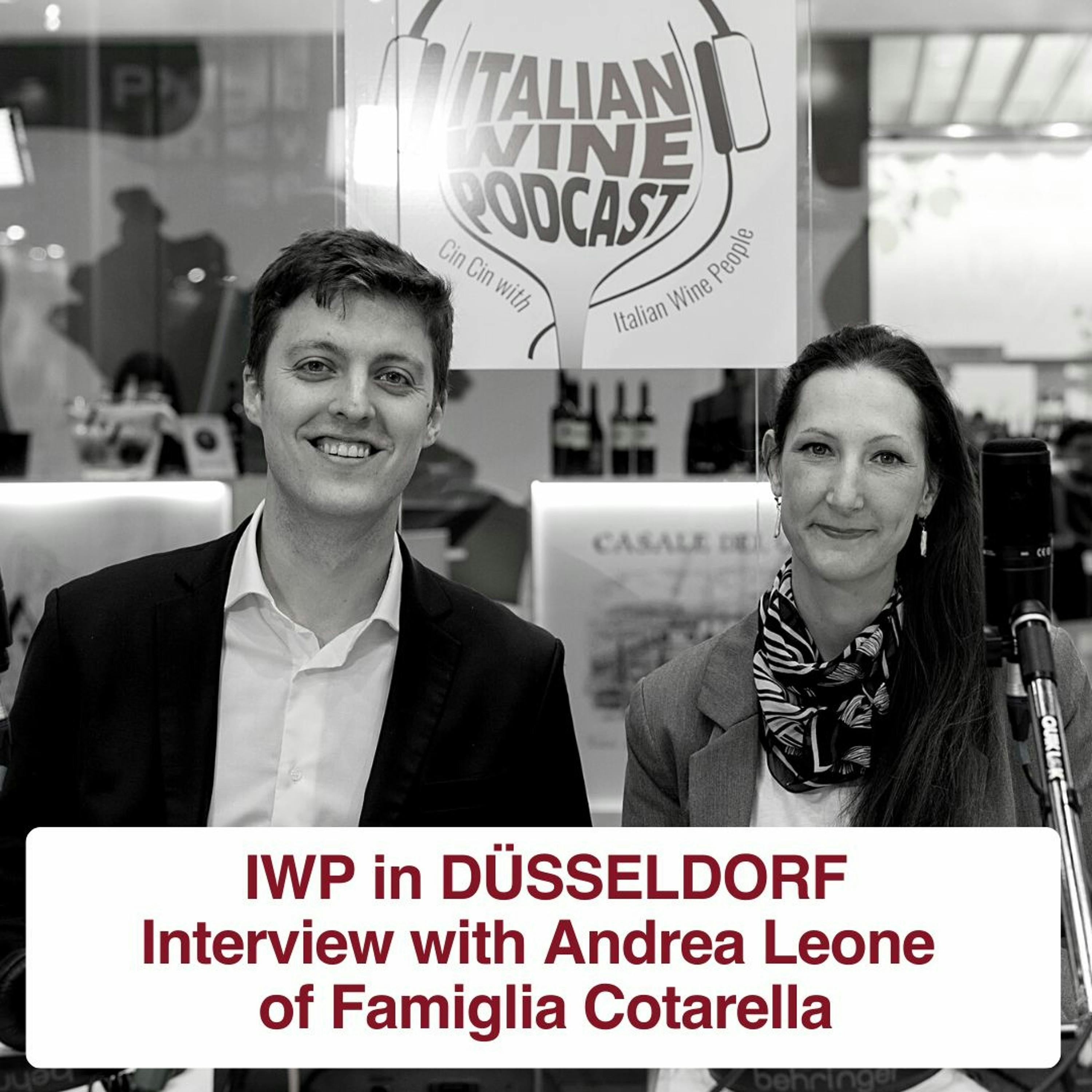
Ep. 1355 Andrea Leone | Italian Trade Agency Masterclass Wineries In Germany
Italian Trade Agency Masterclass Wineries In Germany
Episode Summary
Content Analysis Key Themes and Main Ideas 1. The promotion of ""Italian Wine Unplugged 2.0"" and the Italian Wine Podcast's mini-series from ProWein. 2. An in-depth interview with Andrea Leone, Sales Director for Famiglia Cotarella, covering the winery's history, family ownership, and operational structure. 3. Famiglia Cotarella's key wines, including sparkling Best Brut (from Montefiascone's volcanic soils) and their pioneering 100% Merlot, Montiano. 4. The impact of climate change on vineyard management and grape sourcing strategies for quality control. 5. Challenges and strategies for expanding Italian wine exports into new and regulated international markets. 6. The historical legend and cultural significance of the ""Est! Est!! Est!!! di Montefiascone"" appellation. Summary This episode, part of a special mini-series recorded at ProWein in Dusseldorf, features an interview with Andrea Leone, Sales Director for Famiglia Cotarella. Andrea discusses the winery's origins, founded in 1979 by Renzo and Riccardo Cotarella, and its current leadership by their daughters, each managing a specific company aspect. He highlights Famiglia Cotarella's participation in a volcanic wines masterclass, featuring their Best Brut sparkling wine from the Montefiascone region. Andrea also shares the story of their Montiano Merlot, a groundbreaking wine for its time and region, and how climate change influences their vineyard decisions, leading them to source grapes from both volcanic and higher-elevation sandy soils to maintain quality. The conversation expands to Famiglia Cotarella's global market presence, their success in established markets like the US and Germany, and their aspirations to enter challenging new markets such as Scandinavia, Africa, and Asia. Andrea elaborates on the significant bureaucratic hurdles and lengthy approval processes encountered when entering these emerging markets. The interview concludes with a captivating retelling of the ancient legend behind the ""Est! Est!! Est!!! di Montefiascone"" wine. Takeaways * ""Italian Wine Unplugged 2.0"" offers an updated resource for Italian wine knowledge. * Famiglia Cotarella is a prominent Italian winery with a strong family legacy, now driven by the next generation. * Wineries are actively confronting climate change by adapting vineyard management and grape sourcing to maintain wine quality. * Expanding Italian wine exports into new international markets, especially in Asia and Africa, is a complex process due to extensive regulatory requirements and market-specific demands. * The historical narratives and local legends, such as that of ""Est! Est!! Est!!!"", are integral to the identity and marketing of Italian wines. * Understanding and adapting to the specific preferences of individual markets (e.g., white wine preference in Germany) is crucial for export success. Notable Quotes * ""I'm the sales director of the company, both for, domestic and international markets. So pinpoint, a country, a place on a map. I need to be there and make sure that our lines are there."
About This Episode
The sales director of Miserys Vines introduces their second edition of Italian wine podcast, featuring a range of wine wines from Italian wineries. They discuss their involvement in the production of their own wine, Montello, which is made in volcanic rocks, and their plans to use more grapes from volcanic samples to make their own wine more flavorful. They also discuss their interest in Italian wines and their plans to expand into new markets in Scandinavia. They express their desire for more markets, but some markets are tough due to regulatory and economic factors. They also discuss the use of a label and test of multiphase connect, and express their love for the wine in the afterlife.
Transcript
By now, you've all heard of Italian wine unplugged two point o. The latest book published by Mamma jumbo shrimp. It's more than just another wine book. The fully updated second edition was inspired by students of Vin Italy International Academy and painstakingly reviewed and revised by an expert panel of certified Italian wine ambassadors from across the globe. The book also includes an addition by professor to Yoshinsa. It's leading vine geneticist. The benchmark producers feature is a particularly important aspect of this revised edition. The selection makes it easier for our readers to get their hands on a bottle of wine. That truly represents a particular grape or region to pick up a copy, just head to Amazon dot com, or visit us at mama jumbo shrimp dot com. Welcome to this new mini series on Italian wine podcast. Join Stevie and her just do the work team as they travel to Dusseldorf German to interview some great Italian wine producers. Each producer had submitted one of their wines towards the special Italian trade agency's master classes. Each were run by master Sommelier, Eroz Theboni, join us to get the inside scoop on these fantastic wineries. Okay. So here we are again. And this time, at this fantastic wine events, here in Dusseldorf. So I'm here with Andrea Deone from the Familla Cortrella. There you go. Perfect. That's awesome. What do you do for the company? And tell me a little bit about the family history of the company. Okay. So, I'm the sales director of the company, both for, domestic and international markets. So pinpoint, a country, a place on a map. I need to be there and make sure that our lines are there. And I've been with the company for three years. I started right before the pandemic around February of two thousand twenty. And what about, the family? The family is called, of course, famila, two very important names in I would say, for sure, Italian winemaking, but also worldwide making, Renso Ericardo Patera La Fan, the company in nineteen seventy nine. I don't think I need to go into detail and to explain who they are and what they do. But fast forward to two thousand seventeen, they passed, ownership to the daughters. So now, Domiga, Ricardo's daughter, only child, is a CEO and head of sales. Martha and Erika, that are Rancio's daughters, Martha is CFO, and Avika is, marketing director. So each, owner is in charge. They call each other's sisters, even though one is a cousin, but each sister is follows one specific aspect of the company. Okay. No. That's awesome. Yes. People like company. So Love it. No. I love it. So yeah. And we are here and it is bustling today. Do you, were, here also because Echek, has all these master classes going with, eros Cabone. Can you tell me which master class, your wine was featured in? And what was the wine? We were featured in the volcanic, wines. And we presented our sparkling wine for the Best Blruit. Best Brute is a sparkling wine made in Monteciscone, which is a small town about, an hour and a half north of Rome. Montefjeskone is better known for Sdestesto Montefjeskone, the appalachian, we may produce an s two S test, Esteskone, but we also produce a sparkling wine from there made with Treviano, Maraziya, and Roshitte to win varieties. Okay. And you are you said that, to me, it's not the signature. Correct. Yes. So we are still Monte fist corner because our signature wine is made in Monte fist corner. On volcanic soils. Our signature wine is called Montiano, which is a one hundred percent merlot. The first vintage of this wine was made in nine was released in nineteen ninety five with vintage nineteen ninety three. And it's been made every single vintage up to this point. We are quite proud of this, this wine, made in multiphis Corne. Just to give you a fact, when this wine was first released, it was outrageous to produce anything else, but an Estes test in Montecasio's point. So when the decado started the production of that one hundred percent below, the bishop of Montecotive's point, I went to talk to him and try to talk him out of producing this red wine, So that's how how, this wine started with, Catholic church trying to get involved with the production of our wines, but our jokes aside. We are quite proud with this wine today. The wine is still producing multiscusco on volcanic soils. Montifa Espona is on Lake Boltsana, which is the largest lake of volcanic origin of Europe. So, basically, one giant volcano of which its magma chain were collapsed and filled up with water thousands of years ago. So the area surrounding the lake is all volcanic soils. Today, part of our mid low vines are grown there, but because of climate change, volcanic soils and warm climate tend to deliver a wine can be overripe on the food side and be, not elegant. So what we have done, over the past couple of years, is buy an estate in Castiduna, which is not too far away from Lake. It's about half an hour drive, but it's a higher elevation on sandy soils. So depending on a vintage on Muntiano, whether it's warm or cool, or use more grapes from one estate or the others. To give you a practical example, twenty seventeen was a warm vintage, and it did not allow us to use the majority of the grapes from the volcanic soils. So we used more grapes from Castillo and Tivirina, from the sandy soils, opposite in two thousand nineteen, which in Italy was a perfect vintage. So we used more grapes from the original state in Motivirina, and less from, Castillo and Tivirina. Okay. Okay. Bosh, you are, a natural salesman. I can tell because, a, you know so much, about your products and just the family and everything. But, two, you just you you talk about it with you use these stories to support your points. And I think I think it's fantastic. Well, behind everyone, not just our own, but everyone that, exists, you know, everyone has a story. There's a reason why a line from I have in front of me, Greek, There's a reason why the one from Greece was made. There's a reason why Right. Armor low is made. Most people stuck with that, but I'm I'm I'm I'm telling you, you're you're natural. Well, thank you. That's amazing. Thank you. Seriously. Okay. So I guess I wanted to just, ask you two questions. One is completely not what I was gonna ask you today. I didn't know I was gonna ask you this. The other question is, so you guys are here in Germany. You guys export to Germany. Correct. Yes. You said that you are everywhere that you need to go to, sell wine. Yeah. Is there any markets that you would like to or you said you're everywhere, but like, is there any any markets where we're not or where you'd like to be. Or if you're everywhere, is there any market that you particularly want to? So when it comes to the markets where, Italian wines resonate the most. Are you enjoying this podcast? There's so much more high quality wine content available from mama jumbo shrimp. Check out our new wine study maps. Our books on Italian wine including Italian wine unplugged, the jumbo shrimp guy to Italian wine, sangiovese Lambrusco, and other stories, and much much more. On our website, mama jumbo shrimp dot com. Now back to the show. I think we are present such as Canada, United States, Germany, Switzerland, Austria, and we're quite happy with our partners there. As far as places where we are not, present, and where we would like a presence is a Scandinavian markets. So let's say, Norway, Finland, and Sweden. We just started last year partnership with, Finnish importer. But it's we find it quite difficult to work with these markets because of the liquor boards. And the liquor boards always look for something specific based on certain trends in the market, sustainability certifications, or organic products, or sometimes it's even a price point. They're just looking at price point, and we have not figured it out yet in those markets. I would say there. And in terms of future growth, I think, you know, growing markets is the future where to go. So, you know, Germany, China, Japan, United States, can only grow so much in consumption, unless there is some trend that allows you for your wine to be consumed more. So I would say is, you know, African countries. African countries would be something interesting to explore. We are, trying to find through some agents ways to go to business in these markets. On the other side, you know, it is quite complicated to work with these markets. Just because of the economic situation, but also because of the your your erratic aspect. Just to give you an idea, for example, not just in Africa, but in Indonesia. We're starting a new relationship with an importer in Indonesia. It took us it's still taking us around three to four months to prepare all the paperwork to give to the Indonesian importer that needs to bring it to the Indonesian government. The Indonesian government will take nine months to review all the paperwork. And if we have done one small mistake, which I hope we have it, We have to go back to drawing board, redo everything, and then we'll take another nine months. So slow and water retention. Exactly. And how much will you truly get out of these markets? We hope a ton. We hope a lot can it could do a lot for us. But some of these markets that, you know, are growing and expanding, are the ones that are also the toughest to go in because of economic and, regulatory aspects. I'm sure it's also just because, a lot of places you just don't have the experience, dealing with them in from the past. Correct. Exactly. Because they're brand new. It's brand new. So you have to learn. Sometimes it's needs of specific market. Specific markets consume more white wine. We are in Germany, This is a country that primarily drinks white wine. We are a company that promotes that works primarily with red wines. So we need to also understand those needs as we're looking at specific markets. What works best in market a? White wines? Okay. What kind of white wines can we offer to this? In a specific market, then you might have, you know, drinkers that like vionne. Okay. So do we produce a vionne? Can we produce a vionne? So you have to look at all these different aspects when trying to get to a into a market. Alright. Cool. Well, you have, like, you really know your stuff. So I I really appreciate it. I hope I do otherwise. How many people doing my job? Well, I'm gonna ask you one last question. I I don't know, if I, you know, this is way out of left field, but you were talking about s s s. And I know I've heard the story before, but I I don't do you why? Why is it called s s s? So s is Latin floor here. So the label and the s test test of multiphase connect will have s s test the multiphase corner. So it's here, here, here, of multiphase corner. And the legend behind the name of this one goes back to the eleven hundreds. When a German bishop was traveling down to Rome to meet with the pope. And on his travels, he would love to send a scout ahead of him to scout places that were serving good wine. So the scout would find taverns that were serving great wine and write s on the tavern as in a way for the bishop to see the sign as in stop here. And in, the scout falls in love with the lion to a point where he needs to write s, s, s, one exclamation point, two exclamation point, three exclamation points as you need to stop here. This is the greatest wine you'll ever have. And fast pull and the bishop fell in love with wine himself and decided to, move full time from Germany to Montek's corner. Eventually, he dies of old age, which is the sad part of the story. But the fun part of the story is that to this day in the main church of Montefield's corner, there's a tomb that was made by the, by the the scout. And it says, here lies my master for having drunk too much as this test. Oh, that's fantastic. The other side of the story is that, the bishop wanted to enjoy the wine in the afterlife as well. So what happened is in exchange of donating money, church money, to the city of Montevíosquone, the city of Montefield had to celebrate his life by pouring Estes on his tomb. So to this day, Montefield, there's a huge celebration for Estes, and Estes is poured on the tomb onto the shelf. What do you mean? So it's where we got. Wow. Easy Awesome. That's exactly what I wanted to get. I wanted to know because I know I've heard something in the bishops and whatever, but that's that's a good one. It's it's a really funny fun story. Again, going back to the stories. It's everyone, every application, there's a reason why they're called that way. Oh, I love it. No. You've been great. Thank you so much for taking the time to talk to me. Oh, thank you so much for having me. So once again, I'm here with Andrea Leoni. And I wish you all the best in this fantastic, show event fair. Exactly. I hope you meet lots of people. I hope I get a lot of business. Yes. Exactly. Thank you so much. Thank you. Thank you for your time. Listen to the Italian wine podcast wherever you get your podcasts. We're on SoundCloud, Apple Podcasts, Spotify, email ISM, and more. Don't forget to subscribe and rate the show. If you enjoy listening, please consider donating through Italian wine podcast dot com. Any amount helps cover equipment, production, and publication until next time.
Episode Details
Keywords
Related Episodes

Ep. 2474 Ben Aneff of US Wine Trade Alliance| On The Road Edition with Stevie Kim
Episode 2474
Ep. 1373 Cristina Bargagli | Italian Trade Agency Masterclass Wineries In Germany
Episode 1373
Ep. 1364 Elise Rialland | Italian Trade Agency Masterclass Wineries In Germany
Episode 1364
Ep. 1346 The Grignolino Consorzio | Italian Trade Agency Masterclass Wineries In Germany
Episode 1346
Ep. 1337 Enrico Coser | Italian Trade Agency Masterclass Wineries In Germany
Episode 1337
Ep. 757 Politics And Wine Trade | wine2wine Business Forum 2021
Episode 757