
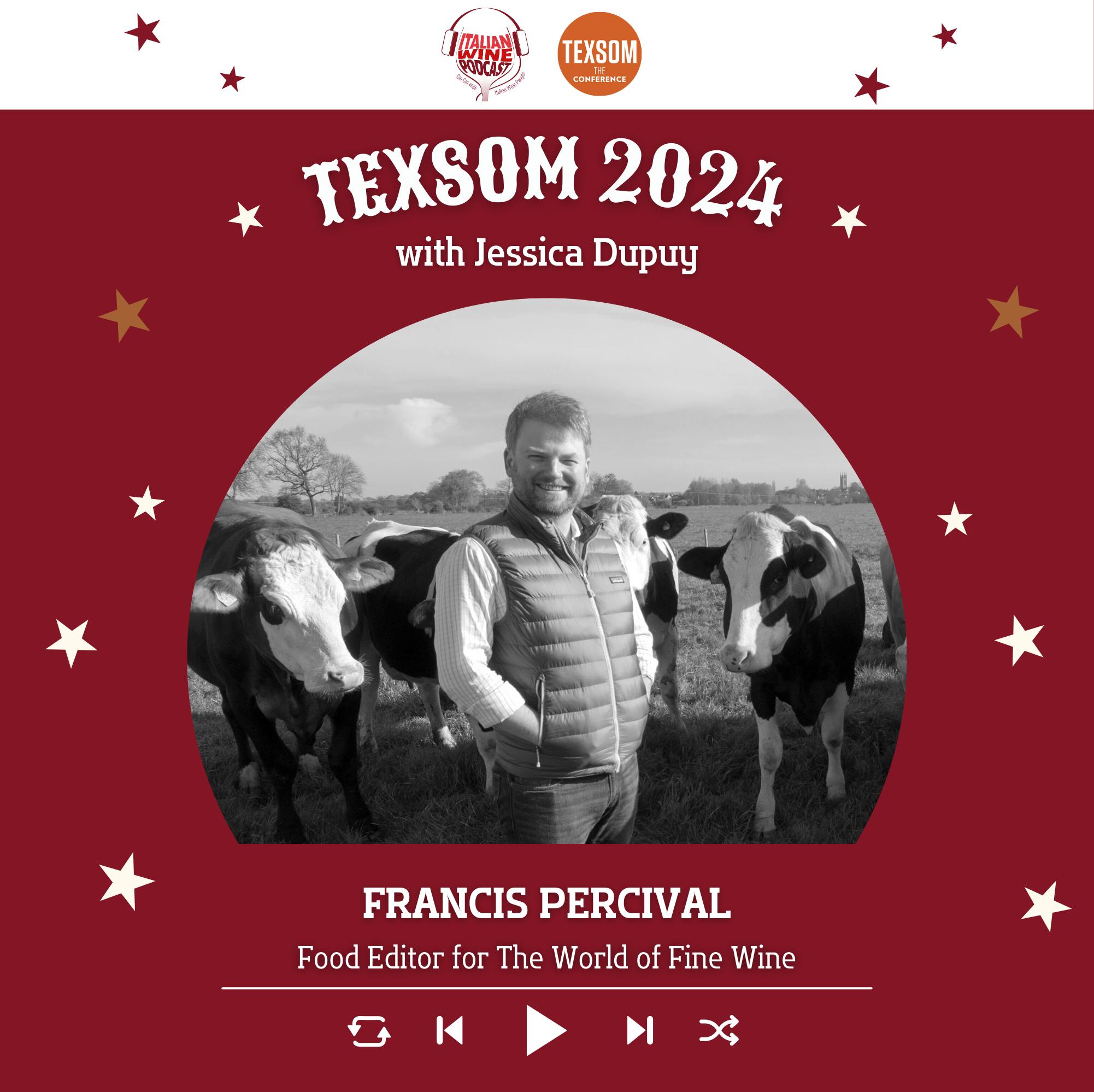
Ep. 2127 Jessica Dupuy interviews Francis Percival | TexSom 2024
TexSom 2024
Episode Summary
Content Analysis Key Themes and Main Ideas 1. The Texom Wine Conference: Its significance as a central gathering point for American wine culture, industry trends, and networking. 2. Francis Percival's Interdisciplinary Expertise: His role as food editor for ""The World of Fine Wine,"" his work on the ""World's Best Wine List Awards,"" and his journalistic approach to understanding the underlying processes (""how stuff gets made"") in food and wine. 3. Deep Dive into Traditional Food Production: Discussion of his book ""Reinventing the Wheel,"" which explores the science and history of artisan cheese-making, advocating for complex traditional methods over industrial simplification. 4. Curating World-Class Wine Lists: The criteria and philosophy behind ""The World's Best Wine List Awards,"" emphasizing ""creative intelligence"" and personality in list curation rather than just financial resources. 5. The Diverse World of Sparkling Wine: Preview of his Texom seminar, covering various sparkling wine styles (English sparkling, Californian Pet-Nat, Lambrusco) and contemporary challenges such as climate change. 6. Market Dynamics of Sparkling Wine: The unique commercial position of sparkling wine, particularly Champagne, as a symbol of celebration, and the cultural tension between its luxury status and its potential as a gastronomic wine. 7. Consumer Engagement and Recruitment: The importance of attracting new, younger consumers (e.g., millennials) to wine, especially through accessible and quality options like Lambrusco which can bypass historical perceptions. Summary In this special Texom series episode of the Italian Wine Podcast, host Jessica Duppuis interviews Francis Percival, the food editor of ""The World of Fine Wine."" Percival highlights the Texom Wine Conference as a vital hub for American wine culture, discussion, and networking. He details his diverse career, which spans both the food and wine industries, emphasizing his interest in the ""nuts and bolts"" of production, as exemplified by his book ""Reinventing the Wheel"" on artisan cheese. This book champions traditional, microbiologically complex cheese-making methods over industrialized simplification. Percival also discusses his involvement in ""The World's Best Wine List Awards,"" explaining how they seek ""creative intelligence"" and a distinct personality in wine list curation. A significant portion of the conversation focuses on his upcoming Texom seminar on sparkling wine. He explains their aim to showcase a range of styles, from English sparkling to Californian Pet-Nat and Lambrusco, addressing topics like climate change, the distinction between luxury and fine wine, and the unique cultural and commercial role of sparkling wine. He stresses the importance of making wine accessible and appealing to new generations of consumers by offering quality, unburdened by past perceptions. Takeaways * Texom Wine Conference serves as a premier event for understanding and engaging with American wine culture and industry trends. * Francis Percival advocates for a deep, technical understanding of production processes in both food and wine. * ""Reinventing the Wheel"" promotes traditional, scientifically understood methods in artisan cheese-making as superior to industrial approaches. * Excellence in wine list curation is defined by ""creative intelligence"" and a unique personality, not just extensive resources. * Sparkling wine, especially Champagne, holds a distinct commercial position due to its association with celebration. * The sparkling wine seminar at Texom will explore diverse global sparkling wines and their challenges, including climate change. * Recruiting new, younger consumers is crucial for the wine industry, with accessible and quality options like Lambrusco playing a key role. * The wine industry faces the challenge of balancing its luxury image with its potential as an everyday gastronomic product. Notable Quotes * ""The amazing thing about TexOM is if you want to see the summation of American wine culture, then it's probably the first place I would go to look."
About This Episode
The speakers discuss the excitement of the Texas wine conference and the potential for people to come to Texas. They talk about the history and cultural significance of the wine industry and the importance of finding the right people to meet with. They also discuss the importance of understanding the decision process for a brand and creating a creative and authentic wine list. They touch on the use of microbi biological techniques to study the communities of bugs within a cheese or on top of a cheese trail and the importance of being a wine orientated community. They also discuss the tension between luxury wine and fine wine, the excitement of the upcoming showcase of their new wine, and the cultural tension between luxury wine and fine wine. They express disappointment that they missed a trickling on and suggest pouring the entire US allocation at one t. They also discuss the potential of the Lambrisco and the selection of premium wines.
Transcript
It's great to talk about vibes. Right. I mean, the well, now now when we're recording it, vibes are absolutely the thing of the moment. Yeah. But it's also really, really interesting to talk about how stuff gets made. Yeah. Right. Chal y'all. I'm Jessica Duppuis, guest host for a special Texom series covering the twenty twenty four Texom wine Conference from Dallas, Texas. Join me in the heart of the Lone Star State, as we delve into the experiences and insights of key speakers and attendees, exploring career paths, challenges, and the latest trends in the wine industry. If you enjoy the show, please subscribe and rate our show wherever you get your podcasts. Okay. Well, Francis Percival. Welcome to the Italian wine podcast. I am so glad that you could join me. Welcome to Texas. Hello. I'm I'm delighted to be. I always always look forward to my my little trips for Texas for for a native Londoner, it's a it's a very interesting exotic and at the moment incredibly hot Incredibly hot. Place to be. Yeah. I have to say, you know, as as we're sitting here today, we are in in at Texom, and, as part of this Texom series, we're kind of talking to different people who are speaking or who have been involved in the conference for a long time. And I do think it's pretty fascinating that you agree to come to Texas in August every year. I I think that it's the amazing thing about TexOM is if you want to see the summation of American wine culture, then it's probably the first place I would go to look that it it the partly Texas is endlessly fascinating. I'm still busily digesting the the smoke brisket that I ate last night, but I think that the people who come to text, some of the people you can meet with, you can catch up with, sort of, industry scuttlebutt you can pick up is entirely unrivaled, entirely unlatched. There's there's there's there's nowhere, elsewhere you can see everything in in in in quite in in quite that way. I, you know, I I should say out loud that, you know, James did not James did well did not pay you to say that bait, but I very much appreciate that you said it because I feel like most people that I talk to who are who are not even from the United States, they they come back to Texon because of that exact reason. I mean, I met you here for the first time years ago. And I feel like most of the people that I've met, in the wine industry that aren't from Texas, it's because of Texon. So I I find that compelling, for so many reasons as as you And and I and I think that's it. It's one of the reasons that James James built built it. And I think in in the partly we're looking at the sort of the the the history of that and sort of the mid noughties, this idea that you wanted people to come to Texas, you had to give them an excuse. But I think now it's just developed its own momentum. Right. And for me, just the the efficiency of if I want to see what's going on in Washington, if I want to see what's going on in the upper Midwest, if I want to get, see, even see what's going on in New York state. Yeah. This is just easily the the the the the best place to come. Where you're gonna find it? Well, why don't we pause real quick on that? And, actually, let's give a a little, summation of who you are. Who is Frances personable and why are you sitting with me? Oh, Jimmy. A massive fraud, I think. But, I am the food editor of a magazine, a quarterly magazine out of London, called the World of Fine wine, which is long form in terms of the content that we produce, very we very much think of ourselves as the a cultural journal of wine. So it's it's not just about there are plenty of tasting notes. There are plenty of ratings of wines, but it's not really about that. It's about all of the other stuff, which I think is where the the interesting things happen, happen in the wine world. Yeah. And I think in terms of of my wider career, because I'm I am sort of stranded probably quite similar to you in this sort of awkward position between the worlds of food and the worlds of wines and a an an approach to the world that I've tried to take through when I've looked at things to do with the food world with food systems. And because I I'm I'm married into the cheese industry. My what my wife is, the technical director of Nils Yardere, a, a, an, a, an, a, and a cheese exporter as well as a cheese retailer in London. And So we have worked together on various cheese projects, a book reinventing the wheel, but but also some other endeavors, a conference, things where we we've just been looking at the the cheese industry. That have very much shared a sort of similar idea, this idea of, almost popping the hood and looking at what's the actual nitty gritty, what's how do how do these things work? I'm very in in inspired when it particularly actually, I think in US generalism, when I look at things like the original founders of vox dot com, people like Ezra Klein. At the New York Times who can exist in a space where they're talking about the nuts and bolts of policy. Yeah. And that there's there's there it's great to talk about vibes. Right. I mean, well, now now when we're recording it, vibes are absolutely the thing of the moment. Yeah. But It's also really, really interesting to talk about how stuff gets made. Yeah. Right. Right. Well, and from cheese to wine, they they all have a process. Oh, and entirely. And and we, we, I mean, when we talk about cheese, we talk about it. Being the, actually, the, actually, that sort of technical understanding is pretty much the third rail. It's the bit that our agent quite vociferously didn't want us to talk about. It's the bit that publishes or if you deal with sort of, food magazines or things like that. Really, a quite leery of covering. But it's absolutely it's, like, it's the third world. It's where the power is. Yeah. If you really want to understand the decisions that people are making, and to arrive at night, a a sort of a sensible idea about what might be good, you need that degree of understanding, which in many ways when you look at sort of a a highly engaged wine collector Mhmm. Is somewhere that perhaps, perhaps, perhaps, we with regard to some regions more so than others, but the wine collectors are already there. I, do burgundy collected dinners for a for a wine imported friend in London, and I am just constantly blown away by the level of detail, technical knowledge, and tasting experience that this collection of of, why enthusiasts have. And these, these, these are people. They highly accomplished people that their bankers, their lawyers, their but but they're they're career people in other industries. But they have because they're highly passionate about this wine region, and they've they've which they've visited many times, they have incredibly detailed understanding. To the extent, I'm I'm I'm quite scared if you are getting to I wouldn't want to get into an argument with them about sort of the soil type in a particularly a d or or how long a particular producer has been making a certain cuvette. But I think for me, it's it's really inspiring seeing that in a farm finished agricultural product. Yeah. And I would I would love to see more foods Right. Be able to command that sort of, respect and enthusiasm from their constituents. Yeah. Yeah. Yeah. It's a very interesting point that you make because as you say, so you and your wife, Bronwyn, wrote the book reinventing the wheel, which is not literally the wheel, but it's a wheel of cheese. It's a putt. It's it's it's all it's all all brought. And Bronwyn is the Yeah. Yeah. No. But it's good. But but tell me the the the the kind of gist of that book just so we can make sure that we have all of that because I I I love that book. It's it is, a merry romp through the world of cheese, farming, cheese and dairy microbiology, and and and cheese culture. And I think what would initially appeal to us was this is a way to tell the story of traditional foods where actually the the white coated scientists are not the villains because the the normal the normal story we tell and we spell this all time in my mind is industrialization comes along. Someone with the doctor, it comes along says, you dirty filthy peasants are doing it all wrong. Do it my way, and it's utterly catastrophic for the product that you it involves this grotesque simplification, then you throw away everything that's good about it. Right. What's interesting in the last twenty years has been that now you have microbi biological techniques like high throughput DNA sequencing, you can actually study the communities of bugs within a cheese or on top of on a cheese rind as a community. And that suddenly makes this the super artisan cheeses the most scientifically interesting in in including it just in in terms of finding out really sort of straightforward questions of basic science that we don't really know the answer to about how how different different microbes interact, whether they cooperate, whether they, kill each other, all of these these these sort of different different things, but also it gives us an understanding that we can now demonstrate scientifically point of a better word of how these pre modern techniques are really, really clever. Yeah. They're really, really smart in a way that the sort of the annihilationist approach of of the twentieth century, this idea that I can I'm gonna have a kill step early on in my product, and this might be a wine, this might be cheese, this might be whatever, and I'm gonna get rid of everything I don't want in it. And then I'm gonna reintroduce the single strain of microbes or the single high production cultivar or whatever. I mean, it's it's the same mentality view. It's gonna saturate everything that synthetic nitrogen fertilizer, then go from there. And that's just just this appalling, simplification if you if what you care about is the interest of eating these little organic, organoleptic quality of this thing. Right. But it's also just really boring if you if you study if you if you study it from a from a perspective of trying to understand what's what's going on inside it. Yeah. And so so we would we were trying to shine a light on that. Yeah. Exactly. We'll bring these these out into into more into a sort of a public conversation public discourse. I love that. And, I definitely think it's a great read, especially if you're not in that it kinda gives you a different perspective. Oh, we spent ages trying to rewrite it to put sort of dick jokes in and, to try to try and make it so that it was it was something that you didn't have to it's one one of the the the biggest questions I get, well, I ask myself whenever I'm doing something is, how can I make sure that someone doesn't have to be either taking an exam or being paid Right? To read this? It's got it's gotta be something you take to the pool. That you want to, yeah, read it. I love it. Read it at the pool. So so let's switch because there's another thing you're very, very deeply involved in, in the wine world, specifically with, world of fine wine. So in addition to working on, being the editor on food for them, you also help really do a big project, which is curating this best wine list of awards. The world's best wine list awards. So that it's, now we've been doing it for ten years, which is which is amazing in itself. And I think is just this endlessly fascinating glimpse into a as a snapshot of wine orientated restaurants around the world. It's something where for a restaurant to actively enter, it's a sign that they take wine seriously. Yeah. So someone has to enter it. So tell me what's the process and what's the best? Like, how do you determine? Oh, the best is is, I mean, is is a lot of long and bitter arguments and different score sheets. And it it is it is surprisingly time consuming, actually, to assess whiners, particularly, particularly at the at the at the high end. And I think one of one of the one of the biggest tensions within within the awards and one that we're constantly looking at trying to address is If you have the resources, if you are well capitalized, it is easy to put together a list of great wines. Mhmm. You can go you can buy them. Yeah. Your accountant will tell you how much to charge for them. And then Then you you you you have some operational challenges in terms of how you run that wine list, how you're gonna have a a a a team doing wine service who can who can, who can sell these wines. Yeah. But far far more interesting. And I think I and and I would say the thing that we that we look for most is putting together something where we can get a sense of a creative intelligence behind it. Okay. Instead of trying to have one of everything, you've got you're fulfilling that sort of editorial role. And you get it you really get a sense of the best lists. You get a this fascinating sense of the personality of the person who put it together. Sometimes, I think many of the best lists are from those restaurants have become institutions and then have the advantage of having been operating for twenty or thirty years. And there, you can even see it even becomes an exercise in archaeology. You can see different wine directors as they've as they've been and gone and their their different passions. They're different. The little Easter eggs that they might leave in there for for, sort of, curious or highly engaged, customers. And that for me is is tremendously tremendously fascinating. Yeah. Yeah. It has been fascinating to see that for a ten year period so that we see as the wine world becomes ever increasingly more multipolar. There isn't there isn't one wine conversation going on now. There are there are twenty different wine conversations. Yeah. Seeing how restaurants engage with that. And many do have to do it in a in a tremendously sophisticated way. So even, I know, they might be really strongly naturally, just super natty wines at the sort of the entry level of the price point. And then if you pay a little bit more, you've got an incredible sort of collection of very classical names that are inevitably a little bit more expensive. And it's it's clear you have you have two quite profoundly different conversations going on. Right. And selling those must be quite interesting because it becomes this good question of of sizing up what what actually does my customer want. Yeah. But the other thing I wonder, and and I'm sure you guys go through all of this. So this is why I'm curious about it. I mean, You're from London. I'm from the state. So big cities here, not particularly, you know, classic, wine growing regions. I mean, let's, you know, except for the Napas and the Sonomas and things like that. But in other countries, if you're talking about awards for the world of fine wine, like, restaurants around the world. How are you taking into account that, you know, big cities maybe in Italy or big cities maybe in France might have that big diverse menu, but then these smaller towns or smaller, or how does that I think that so so it's one of my very favorite awards that we give is for best wine list within a region. Okay. Oh, okay. Because I think that's where as a wine director, you can be astonishingly influential. Yes. On the one hand, you press in Centralena is is the perennial winner of that category because they do a really good job. But you you're at once offering a a a a window onto the region for visitors. But you also, if you're the wine orientated restaurant in a, you know, in a practically smaller market that you you might be, you are the canteen local winemakers. And then I think the the really the smartest restaurant list like that, are essentially running two programs that there's there's the collection of the the local great and the good Mhmm. For the for the tourists. So the sorts of places we're at, where we would would would drink if we were going in there. But there's also the collection of wines from places that aren't in the region Mhmm. But that might have something to say Yeah. About the world of wine, two winemakers who are who are operating there. Yeah. Who wanna know? Who wanna and that that, I think, becomes, become super, super, super interesting I always feel and and, James Tidwell, who's a a fellow judge at this competition, I think always feels that there is that element of unfairness about about, sort of, some wines don't go into other markets, you know, where we we we should we should be looking at the job that the individual wine director is doing with the wines available to them because of whatever political decisions, whatever agreements about distribution, or I think that the service of the awards is really for the consumer. And I think the interesting thing to say to people is This in the world is where the most interesting lists are. Mhmm. Yes. And so, yeah, you're not if you want an amazing selection of wines from Northern Italy, then, yeah, Verona might be a good place to hang out. Yeah. If you want to drink the wines of of champagne, it's in fact it's something that we'll I'll I'll be featuring with our sparkling wine seminar that that that Peter Lim and I have done at Texom this year, then Leclaire Yeah. Is sort of the restaurant that has all of the champagne. And so then so the the the super interesting thing about it is How do they organize it? Yeah. What what do they think is important about these champagnes, in an environment where you if they have essentially two wines, they have the whiteness of champagne, and then the whiteness of Not. Other wines. Of not champagne. I love it. Yeah. Yeah. Well, it is a really good question. It is, it is a fun list to always read through, and of course, you know, someone like myself who loves to dine out and and spends half of her time writing about food too, I think it's a really, it's a great way to kind of, you know, make a list of, okay, when I go here, I wanna eat here, you know, that sort of thing, but also to drink the wine. So I love that. When does that come out every year? Just so everybody can look at the big ceremony Mhmm. Is in the middle of September. Okay. So I think we we the the deadline submitting lists is, is normally sometime in March. Okay. And then that gives us, anyway, and it it does take that long. But to, to get get through and and judge and and arrive at a decision One of the things you mentioned when we sat down is kind of like, you're in the season of conferences. So so this is wine, what we're doing at Texon, but what else is going on? So I came to Texon from the conference that my wife, Bronwyn, organizes in Somerset in the Southwest of England on the science of artisan cheese. Okay. And the the the timing just worked that it was it was basically packing up there and then come come directly here. Alan, did you bring cheese with you? For once? I I I failed to mule any cheese. Okay. Okay. Okay. Sorry. Sorry. Keep going. And there, I was chairing a panel on historically informed technique where we'd gathered together a couple of two British cheese makers who who were working with early twentieth century, late nineteenth century, recipes who've been involved in a lot of of of of research into what were their cheeses like during that era, which I'd say, which is probably sort of the pomp of the of the British cheese making industry. And we we brought them together on a on a panel, with, so John Elliot Garnner, a British conductor who was one of the the the the founding figures, one of the driving forces behind historically informed performance in classical music. Biographer, a bar of Js Bark, and a a a very thoughtful presence. And I think that was tremendously interesting and reflected in a in a in a a lot of the things that I do, certainly with respect to wine projects and with respect to, to the book about teaser inventing the wheel of this sort of instrumentalist use of history, this idea of using the past as a repository of of of sort of roads not taken of ideas that we can use So we're not trying like an antiquarian to faithfully to recreate sort of this is what a historic cheese tasted like. Right. But we can say, actually, this is how they made cheese, and some of these techniques are actually very interesting for us now, and we can embrace them. We can can see what a what a a modern retelling of these these sorts of cheeses might look like. So I came directly from from Somerset worrying about that. Wearing up to you. Yeah. Yeah. Yeah. Yeah. Yeah. About about about wine. And particularly, this is the sparkling wine terminal. And then as soon as I land, so I I'm I'm very, very much hoping that the DFO at American Airlines do not have a major flight delay. Oh. I have to rush off for to Romania to Pennsylvania to Pennsylvania to go and look at high biodiversity, hay meadows in Transylvania, which is fascinating again. One of these things of sort of raiding the past for ideas. And I think there are there are there's a lot of Eastern European research around some of these sorts of ideas that mainly because, I mean, ceaușescu could never afford the chemicals. Right. And so they are places that are almost like a like a like a time capsule, where the twenty twentieth century changes in agriculture didn't happen. Okay. And where you have now these astonishing natural resources, and I think we've we've got this this slightly sort of mutually I hope supportive and overlapping set of curiosities in that I and my wife, very curious about what can we learn from the farming and the management of, of the of these meadows. Yeah. And they, I think, are very curious about how can we actually make this into economically functional biodiversity because it it's it's all very, very nice having it as a tourist thing. But the idea of what can we make, and I think they're particularly interested in, in in cheese that would allow you to capture this story, and have a sort of a the the tastable narrative, the thing that the thing that a consumer can actually consume, thing ultimately that can be exported out out of Romania and and engaged with by by a by a by a global marketplace. Yeah. Other parts of the world. That's really fascinating. So so let's zoom back to your middle your middle thing there. For Texom presenting with Peter Lee, you would assume, ah, champagne. We're just gonna hit smack dab right there, but you guys, you know, are presenting, If you'd seen Peter's initial selection of wines, that was very You know what I'm saying. The survey that was proposed So you had to broaden his mind about sparkling wine. Is that is that how Peter is is the most is wonderful and incredibly knowledgeable and is the most deeply embedded person I know within the the Champpin World wine industry. He's at a a house in E. But as one might might might guess, not a lot of global sparkling wine comes in to to to champagne. And so so so that I think becomes interesting. And I think for us, it was it was also this interesting tension because you can think of a survey as being oh, a basic introduction to places, or you can think of it and as this is a chance to talk about a snapshot of these other things that people are worrying about now. Sure. Mhmm. We're not pouring any carver, and I know that I can I already know that some of my fellow speakers here are going to be a little bit annoyed at that and all the questions from the from the floor? But what we what we are doing is discussing extensively in terms of the sort of the technical decisions you can make as a as a winemaker, the position of sparkling wines and climate change. We're talking about, I think, is is something that the, my friends and colleagues at at at Arini talk about a lot. There's this sort of tension between, luxury wine and fine wine, and both both of those terms that sort of make me feel a bit a little bit awkward even if I do work for a magazine that has fine wine in the title. But this idea with things like what how do you create a prestige couvet? Mhmm. This is hugely a question of the moment in the world of English sparkling wine as people are moving to multi blends. Yes. And then this this idea of where does that look? Where does that sit against a single vineyard wine? Right. Which is interesting because, okay, so the premise being different styles of sparkling wine, right, for this. There is a Prestige coubet being released, or being shown in this one. Fair enough. English sparkling wine. Is that correct? I happened to talk to Laura Reese the other day. So The the twenty Laura has been a a great supporter of the of the tasting. A the twenty sixteen Guborn, prestige few days. So they're fifty one degrees north. Yeah. And that is going to be fascinating. Yeah. One to show it in to this audience, Switzerland, some other pretty Yeah. Serious wines. We've, I mean, things like, the leroadra, the stock, the the the their, brute zero, they're they're undouced champagne. And I think it will be interesting in that in that context talking about all of those sort of sort of sets of decisions that go in to making a prestige Ku event. And it's it's very much not just, okay, we're gonna select some of the nicest bit lots and then give it a extended extended lease aging Right. Where that then fits within the culture of sparkling wine globally becomes a sort of a fascinating question. Sparkling wine has this amazing commercial position that sparkling wine and and in in particular champagne owns celebration. Yeah. And every marketing director of every other winery in the world would love to own celebration that the idea that that pop Right. Is is is in itself. I mean, there there there's an emoji for it, which people are celebrating. And the problem with that, so so so so so so champagne sparkling wine, they are the expensive wines that people who don't really know a lot about wine or who aren't really into wine will buy. Yeah. In the US, it's sometimes difficult because some some states sell sell wine in supermarket. Some states don't. But if you if you go into my local supermarket in, London Yeah. The difference in price between the most expensive champagne Mhmm. Which is also a nice sort of economic barometer there. Sort of how expensive is the most expensive champagne in your in your supermarket versus the most expensive still wine is almost certainly a factor of ten. Amazing. Yeah. Yeah. It's not just wine Geeks who are buying these things. Yeah. And I think that's amazing, and it's amazing for the shampoo and it's one of the very few regions in the world where you can make a healthy living just just selling grapes. But it's also this sort of cultural tension because I think there is this sort of profound impetus that the to these are serious wines. These are gastronomic wines. These are wines you should be pairing all the way through your meal. Yeah. How you get to have your cake and eat it Right. Right. As a producer, as a region, as a style becomes, I think this is sort of super interesting, interesting question. Well, it is interesting because okay. So you've said, there's not gonna be Kava. Sorry, Kava will do something later. But champagne and, English sparkling, talk about some of the other styles or or regions that were included. So for our pet net, we're going to California, with Michael Cruz, who I think is one of the most thoughtful American winemakers. He's all, certainly when it comes to sparkling wine, he's one who's who has been most deeply embedded within the world of Grower Champains. Mhmm. And is is very much making wines along that style. And so it became very this very interesting idea that Petnet, which so easily can be this sort of slightly sweet, somewhat throwaway. You sort if you think of, I mean, bougie or something like that in your software that you something you drink by the pool. And it's it's it's it's off dry and it's so it's it's fun, but it's not particularly interesting. With with with his wine, I think that the the question really becomes how, how serious is a pet net or is the, actually, the most interesting thing about it because you've got this fermentation continuing. What it it gives you is this amazing seasonal wine. Yes. It's wine that tastes different as time progresses in a very, very active way, not not in the sort of the passive aging, but that actively this biological process is evolving very quickly. And I think that's gonna be very interesting. Mhmm. Think a lot of our discussion is is gonna be around sort of how ancestral is the method ancestral. And I know Nopita definitely has some some of, opinions about that. Right. And and and and then we'll we'll we'll pour some Lambrisco. I I I'm I'm a little bit sad. The Lambrisco is going to be delicious and is one of the world's most gorgeous gastronomic wines. I'm slightly sad that we're not pouring aussie sparkling Cheras. Simply because we see it in London a fair bit because there's quite quite a healthy ex expat Australian population, and they need something to drink at Christmas. Yes. I'm not sure how much of that comes into Not much. Into the US. We don't see very much. And just as a style, I think it is, again, an endlessly fascinating thing to introduce to people. And somebody has a profound heritage, within Australia. Yeah. Yeah. So so they're they're they're I will hold my hand up and say we slightly missed a trickled on. I I it it is also the sort of thing where if we're gonna pour one of the big bigger names, I I fear that we would probably pour the entire US allocation at one t exactly, because there's not there's really enough But, you know, personally selfishly, the Lambrusco, I think it's a great selection because it, you know, that's such a spectrum of what you can find within that category, you know. And I I think it's a it's an exciting place, particularly for consumers as a food wine, you know, to kind of open their eyes to a whole different range, whether it's even white, Lambroosco. You know what I mean? Like, entirely, my my Californian brother-in-law, who I I use as the as this sort of person who very much is is is my sort of sort of sort of geriatric millennial, such as barometer of how far how far things have got It's and it's it's it's interesting that sort of that sort of progression. I think it's something we we talk about a lot in all of these industries. How do you recruit new consumers? And for him, it's that where he is in the Bay Area, he has a very nice local, pizza pizza restaurant pizza place. Yeah. It's just just just had their second kid. No time getting takeout, or or if they're taking their their their sort of their four year old and their six month old out off to pizza because that's relatively child friendly. And within that environment to be introduced to, as you say, the the the range of, Lambriscoe is is fascinating. Yeah. Yeah. Is he like does he He he adores it? I love it. He's he's he's super into it. He be he he pours it when we when we when we, go around to it. He sounds without without sort of thinking. And that's, I think, is the beauty of a lot of that con of of of of of sort of the millennial and younger consumers of Lambrusco. Because they're taking it entirely for what it is Yeah. Rather than dealing with thirty years of horrific wines and and the industrialization of the of the region. Exactly. That initially got to the states. In the first place. Right? And so now we're seeing so many other great things. So, I think that's really exciting. Well, Francis, I appreciate your time. This has been it's always an enthusiastic engaging conversation with you. Like, I learned so much, and I always feel like we need to kind of like spend another two hours. Oh, yes. No. No. I, I, I think the, yeah, there's so many things you can, you can talk about. But it's, and it's also funny. Selfishly, this is a great, series for me because TechSOM, inevitably, you say hi to a million people with the hopes and dreams that you might be able to catch up with them for a few minutes, and then at that time never presents itself. So I, get to actually have that with you. So I'm, I'm selfishly great full. Fantastic. Thank you very, very much for inviting me that so it's it's it's voice or always fun to take care Yes. To chat and catch up. Well, I look forward to next time. If not, if not at Texom, then at the Texom, awards. Indeed? Alright. Cheers. Thank you very much. Listen to the Italian wine podcast wherever you get your podcasts. We're on SoundCloud, Apple Podcasts, Spotify, email, IFM, and more. Don't forget to subscribe and rate the show. If you enjoy listening, please consider donating through Italian wine podcast dot com. Any amount helps cover equipment, production, and publication costs. Until next time, Teaching.
Episode Details
Keywords
Related Episodes

Ep. 2583 Women For WineSense and the Houston Rodeo Wine Competition with Amy Gross | On the Road with Stevie Kim
Episode 2583
Ep. 2242 Jessica Dupuy interviews Christy Franck | TexSom 2024
Episode 2242

Ep. 2233 Jessica Dupuy interviews Rebecca Hopkins | TexSom 2024
Episode 2233

Ep. 2226 Jessica Dupuy Interviews June Rodil | TexSom 2024
Episode 2226
Ep. 2219 Jessica Dupuy interviews David Way | TexSom 2024
Episode 2219
Ep. 2212 Jessica Dupuy interviews Matt Dulle | TexSom 2024
Episode 2212