
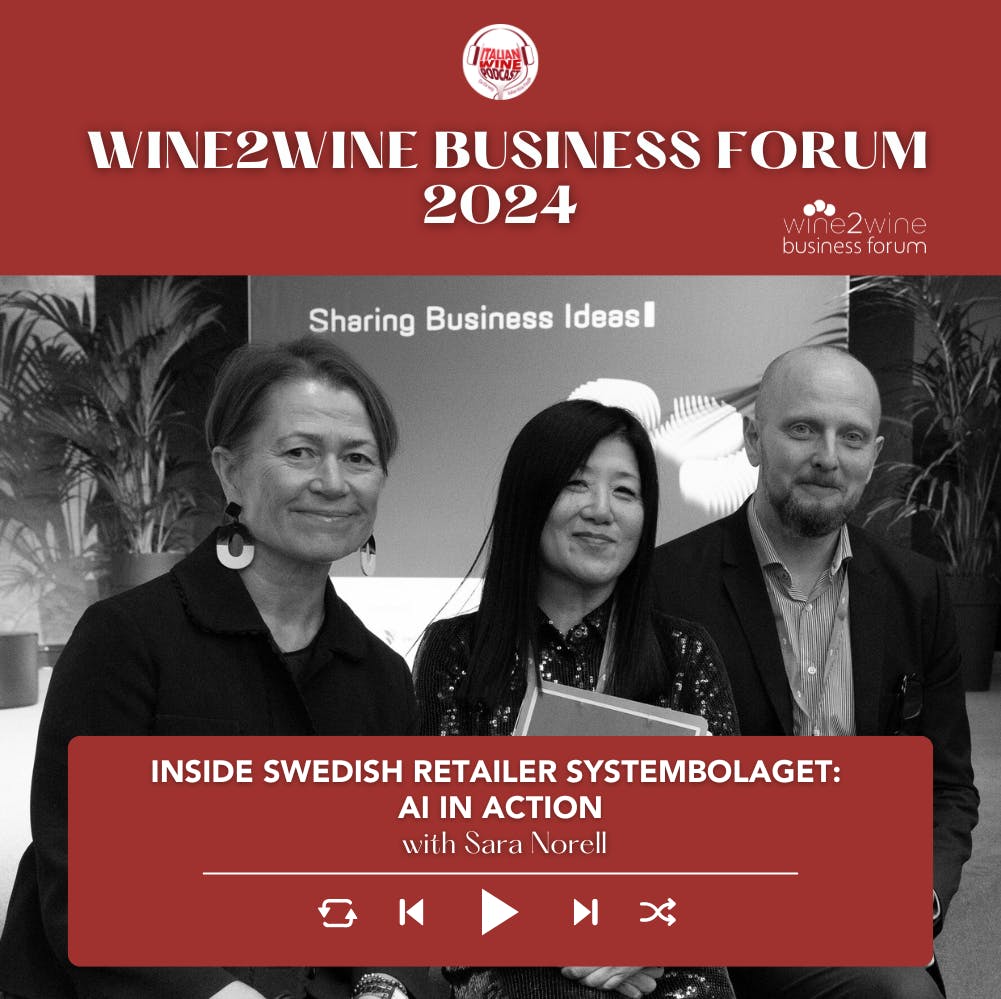
Ep. 2248 Inside Swedish Retailer Systembolaget: AI in Action with Sara Norell | wine2wine Business Forum 2024
wine2wine Business Forum 2024
Episode Summary
Content Analysis Key Themes and Main Ideas 1. The role of Systembolaget (Swedish alcohol monopoly) in promoting sustainability and public health in the wine industry. 2. The application of AI and digital tools to enhance customer experience and operational efficiency in retail. 3. The increasing consumer demand for sustainable products and responsible consumption. 4. Strategies for reducing climate impact in the wine supply chain, with a focus on packaging and product carbon footprint (PCF). 5. Collaboration among Nordic alcohol monopolies and international bodies to drive industry-wide sustainability efforts. Summary This segment features Sarah Norrell, Head of Assortment and Supply Chain at Systembolaget, the Swedish alcohol monopoly, discussing their commitment to sustainability and public health. She highlights how Systembolaget is leveraging AI and digital tools to meet evolving customer expectations, which include a desire for more knowledge, convenience, and sustainable choices, as well as a trend towards drinking less alcohol. Norrell details internal AI applications for forecasting and efficiency, and customer-facing tools like personalized taste profiles and intelligent search, all built on robust data. A major focus is Systembolaget's ambitious goal to significantly reduce its climate impact. She explains their successful push for organic wines and the impactful shift towards lighter packaging like bag-in-box. Crucially, Systembolaget is introducing a Product Carbon Footprint (PCF) reporting system, developed with other Nordic monopolies, to incentivize suppliers to lower their emissions. This data will influence product distribution, reporting, and customer communication, aiming to reward producers who are actively reducing their environmental impact. The presentation concludes by emphasizing collaboration across the industry as essential for achieving long-term sustainability goals. Takeaways * Systembolaget's core mandate includes limiting the harmful effects of alcohol and promoting public health. * AI is being used both internally (forecasting, staffing) and externally (customer recommendations, tailored profiles, intelligent search) to improve operations and customer experience. * Consumer behavior is shifting towards greater demand for sustainability, convenience, and responsible consumption (e.g., drinking less). * Packaging, particularly glass bottles, accounts for a significant portion of the wine industry's carbon emissions. * Systembolaget is implementing a Product Carbon Footprint (PCF) system to collect data from suppliers, which will influence product assortment and communication. * Collaboration among Nordic monopolies and international initiatives like the Sustainable Wine Roundtable is crucial for industry-wide sustainability efforts. * The goal is to create market opportunities for wine producers willing to change their approach to winemaking for a more sustainable future. Notable Quotes * ""The goal of the Scandinavian wine monopolist to contribute to the reversal of the climate curve suddenly doesn't sound so impossible."
About This Episode
The potential of the Swedish wine industry to contribute to the climate crisis and create opportunities for wine producers is discussed. The use of AI and data collection for improving customer experience, reducing climate impact, and personalized taste profiles is emphasized. The importance of collecting data for measuring the carbon footprint of their product, including the use of PCF data and the use of PCF data for their assortment management and marketing efforts is emphasized. The speakers emphasize the importance of sustainable wines and the potential for growth in the world.
Transcript
The goal of the Scandinavian wine monopolist to contribute to the ver reversal of the climate curve suddenly doesn't sound so impossible, and will create market opportunities for those wine producers who have both the skill and the willingness to change their approach to winemaking. Because, obviously, it's about enjoying wine in the future. It's about us living on the planet right now, but even more so that the generations coming next. Official media partner, the Italian wine podcast is delighted to present a series of interviews and highlights from the twenty twenty four wine to wine business forum. Bringing together some of the most influential voices in the sector, we discussed the hottest topics facing the industry today. Don't forget to tune in every Thursday at three pm or visit Italian one podcast dot com for more information. This is all about the Swedish retailer system below it and their strategy in which AI plays an important role. I'd like to welcome to the state Sarah Norrell. Let's give it a round of applause. So Sarah Norrell is also a very, very dear friend of ours, for her wine. T. Why? She's been with us. I think this is her third time. Fine. Yeah. Third time. Yeah. And She's one of the smartest woman I know incredibly rigorous, but sweet she's a sweet. This is why she runs system below it. And her official, yeah, her official title is responsible, but I guess, it means she's the lead. She's the big cheese for a system below it for the assortment and supply chain, including category management purchasing quality control stainability. Oh, we It's in light chain and logistics. I mean, the suites are so precise. You know, we'd like them this way. So I hope you can, share with us what you're doing, the state of the art of AI in the application of system belong in. Okay, Sarah. Thank you so much for inviting me. How many in here are working with the stone block today? Or Yes. That was one hand. Two hands. Wow. Great. You're gonna have not to sort of, review of what we do and how we do it, but more precisely about how we are using AI and also how we are with sort of the, the starting point in the customers. How we are developing, not the least, our strategy for cutting the climate impact. As we all know, the world is evolving, and so our customers' behavior and expectation. So at Stien Bologna, and most of us, we need to change the way we are doing things. And this is where our strategy starts. It starts with the customer, the consumer. And you know that there are a lot of things happening and how we are are sort of The expectations we have on retailers and where we are buying our things are incredibly different if it comes out ten years ago. We need more knowledge to help to choose because the number of articles are the SKUs are bigger than ever before. Where we need to know where to find my product, either in the shop or online. If I like something, how can I find something similar? We want it to be quick and convenient. We don't have time. And also we want to act sustainably. We know that the world is changing out there, and we have a planet that is not feeling very well. And last but not least, we like a healthy lifestyle. Even if it does not include sober October or anything else. But our customers, they want to drink less, and we know that it's a trend all over the world. So looking at our focus for the coming years, it's about strengthening our digital customer experience. AI is part of that. It is to significantly reduce our climate impact, but it also to work with better public health. And that is also in the core of what system we're looking to doing since since our mandate is to help limiting the harmful effects of alcohol. So I divide it into two different areas. The first one is how we are using AI behind the scene. It's about making better forecasts. It's about, staffing more efficiently. It's about, doing what we are doing administratively, more efficient, etcetera. I'm not gonna go more deeply into that. We also have a number of things we are doing to help the customer to choose more efficiently, even though and I think this is very, very important to say the personal customer meeting when you can meet with someone in our store. So it's highly trained in knowing wines and how to use wine. It's where we start from. So this is where we now build on the next step with AI as the support. But it all starts with really good and excellent data. If we don't have consistent data, it's very difficult to build a good AI on top of that. So this is where we start, and this is sort of just a piece from our website with a lot of data that we have been using to go further on with, for example, an AI somewhere called Amelia And she can help you to if you have a product that you you like to find something similar, or if the product, it's not on the shelf in your store. It also helps our staff to do better recommendations. It's a combination of the data we have and the expertise we have, who has sort of trained this AI to be a good facilitator for our customers. The other one is, personally tailored taste profile for having a more relevant online experience. So you get questions like what type of chocolate do you like most. And then it can after these different types of quest generator specific taste profile for you. And also, we have an intelligent search. We had, a session out there one where another a person from Sweden talked about this one. It's like when you search on Google, you can search, I mean, with different kinds of words in different kinds of languages, and they will will help you find what you will by looking for. But not everything is AI. We also have other digital formats on tools for our customer to use. And you can order with our app. You can scan the barcode on any fossil and you get the information out on your telephone, and you can find the store where, or where in the store your product is real time. And also what, what to pair with, what type of food. And also, I talked about sustainable log cabin in its core that the mandate includes help limiting the harmful effect. So, obviously, responsible drinking is part of what we communicate. And here is three different types of, tools we are using. It's the first one is just to know how much alcohol is in this glass or this bottle or the other one is when you're out in evening, you can have your own coach in your telephone to help you. Drink more responsibly. And the last one is how much to buy for dinner partner, for example. And also, we have an area where the customer can take part in, in developing our tools. So, we are not sort of totally finished when we release a tool. We ask the customers to give us feedback, and that's a good thing as well. So now I'm leaving AI for now, and I'm going into the customers. And I said before that customers want to make sustainable decisions, four out of five says that. I really did that. I was buying a lot of clothes before, and now I buy secondhand. So this is where the customer is. They are aware now of the situation for the planet. And you've probably seen this one before. It's about cutting our climate emissions. And it's quite a lot, actually, and the curve is quite steep. It's about seven percent each year. And of course, we at sustainable log of what to create business opportunities for the who deliver products to us. And what we've done in the past is, for example, we have been working quite heavily with organic products. And you can see that, we did a good jump there from o five till two thousand and ten. And then it's continued to grow. So today, about one of every four bottle is actually organic and Swedish market, and it's been stable. And I would say that the the Italian market has been really good at being part of that growth. So it has been for sure an advantage for the Italian producers to being able to serve the Swedish market with organic products. So when the customer moves, it makes a big difference. We also saw quite early that packaging were our lowest hanging fruit to cut emissions. And if you look at here, you have the heavy bottles. A lot of bottles are quite heavy. Eight ninety four CO2 equivalents, to a bottle. And on the other hand, on the other side, you can see the bag in box. It's about fifty percent of the Swedish market volumes. Quite good quality actually. It's not only the entry level. You can see there's a huge difference in packaging. I would say that most producers, possibly more than fifty percent of their total climate impact comes from the glass bottles there, you see. But what we also saw when using this is that it's not a hundred percent correct because there are, and so increasingly, last factories that are making glass bottles with non fossil fuel. So we need to be more accurate when we are measuring this going forward. The packaging is a fourth about and growing in raw material is about another fourth. And then we have productions. You can see there, almost eighty percent comes from the product we are selling. When we buy our own transportation, etcetera, we are already fossil fuel free there, but there are more to do when it comes to the almost eighty percent in our supply chain. It's clear. Lightweight bottles and organic won't do the job, and we want to reward all the good efforts being done in the supply chain. So what we will do, we'll start collecting something called the product carbon footprint. So now we're talking about data again. We need data to be accurate in how we are going forward. And it's scientifically relevant. It's in line with several standards We use third party expertise, and we want it to be easy to implement and use. For all those, we will require reporting on their carbon emission, their carbon footprint. And it's also jointly developed with our monopoly colleagues in in Finland and Norway. So it's about collecting data on several points. We get this method. We get this PCF, and then we can use it in different areas of going forward. So about the tools, how we're going to use the PCF data, obviously, to systematic improvements and also to share the benchmark. So that's due as the supplier or a producer can compare with other competitive, brands or producers. But we'll also use it for reporting. You know about CSRD, which is the European law coming up where we will start reporting next year. We will use it in our assortment management. If you have a lower PCF, you will probably be granted a bigger distribution than if you in comparison with the other suppliers or the other products you are competing with. And also, obviously, we will use it for communicating with our customers. So they can do informed choices when they come to the carbon footprint. And we will use it when we are sending out our requirements for the tender requests. It will be used also there. So we've done our first pilots. So it's about a sixty sixty products that we have collected data from, several suppliers. And when we ask them the participants, what they think about it, they think that it's moderately time consuming. It is not very difficult so far, but obviously, we learn a lot now. This is work in progress. So we need to do this, more. We need to supply training as port and we need to refine how we are doing things. Next year, it starts happening. It's next next year, we will start collecting data for everything in our fixed assortments, not everything at the same time, but gradually. And, that's about ninety four percent of the volumes we sell, but obviously it's not all it's not as many products since these are the volume products we are starting with. But anyone who wants to take part participate will be welcome. So if you want to go fast, go alone, if you want to go far, go together, I think this is very important. And I've talked about the monopolies in the Nordics, what, that we are doing things together. When it comes to finding the same tool, the same way of calculating PCF, the product carbon footprint. We believe that more buyers are aligned. It will be easier for suppliers and producers. We also had a Nordic Monopoly Conference in August where we met not only were with our nearest neighbors, but also with the American monopolies, which is Canada and also in, in the U. S. And this is actually when SAQ Quebec also signs the Nordic Environmental road map together with the rest of us in the Nordics. I would also like to talk a little bit about sustainable wine roundtable, anyone in here who heard about sustainable wine roundtable before. Yes. That sound good. We were one of the founding members And we think that this is really a good opportunity to get together, and you can see that it's really some really big players when it comes to buying wine volumes, but also some more niche producers, etcetera. For example, there's an agreement on the bottle weight accord, and everybody has signed not to have sort of a more than four twenty grams bottles on an average. It's a cooperative here outside in Veneto, and it's taken from an article in, wine business international. The goal of the Scandinavian wine monopoly to contribute to the ver reversal of the climate curve suddenly doesn't sound so impossible, and will create market opportunities for those wine producers who have both the skill and the willingness to change their approach to winemaking. Because, obviously, it's about enjoying wine in the future. It's about us living on the planet right now, but even more so that the generations coming next. It goes very well together with the vision of Sustien Boulevard, which is a society where alcohol can be enjoyed without harming people or the environment. And this is actually my husband and my son's little cousin. And they've had having a great fun at the beach at our summer house, which is in October's fantastic day. So I would like to say thank you. And I hope that you will remember. Thank you. I hope you will remember three things. It's about the customer. It's about a livable planet or a Growable planet perhaps. It's about doing things together, and AI will be an enabler for that. Thank you so much. Listen to the Italian wine podcast wherever you get your podcasts. We're on SoundCloud, Apple Podcasts, Spotify, HimalIFM, and more. Don't forget to subscribe and rate the show If you enjoy listening, please consider donating through Italian wine podcast dot com. Any amount helps cover equipment, production, and publication costs. Until next time, chi qin.
Episode Details
Keywords
Related Episodes

Ep 2339 A Blind Tasting Journey exploring the nature of Natural Wine with Isabelle Legeron MW and Robert Joseph | wine2wine Business Forum 2024
Episode 2339
Ep 2332 Compiling a Vintage Report with Michaela Morris DipWSET, IWE | wine2wine Business Forum 2024
Episode 2332
Ep 2317 AI for Enthusiasts: tasting with Megan de Angelo and Danielle Callegari | wine2wine Business Forum 2024
Episode 2317

Ep. 2309 Understanding maturity by the glass: old whites from Italy with Cristina Mercuri DipWSET and Gill Gordon Smith IWE | wine2wine Business Forum 2024
Episode 2309
Ep. 2300 An Inside Look at Wine Competitions and 5StarWines - the Book with Robert Joseph and Andrea Lonardi MW | wine2wine Business Forum 2024
Episode 2300

Ep. 2291 Systembolaget, how the tender process and tasting works - one of the tools for reducing the climate impact with Gad Pettersson | wine2wine Business Forum 2024
Episode 2291