
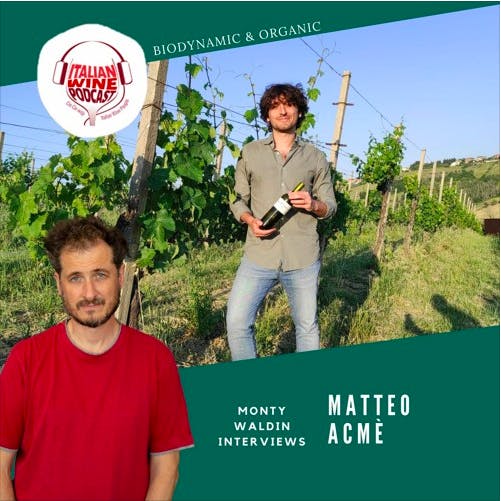
Ep. 630 Matteo Acmé | Biodynamic & Organic
Biodynamic & Organic
Episode Summary
Content Analysis Key Themes and Main Ideas 1. Filo di Vino's Commitment to Advanced Sustainable Practices: The winery's core philosophy revolves around organic and advanced biodynamic farming, aiming for ""zero inputs"" in the vineyard and cellar. 2. Expression of Marche's Native Grape Varieties: A deep dive into the versatility and different expressions of Verdicchio and Lacrima, showcasing their potential across various wine styles. 3. The Unique Terroir and Agricultural Heritage of Marche: Highlighting the region's significant percentage of organic vineyards, rich farming traditions, and distinct geographical advantages. 4. Holistic Approach to Winemaking and Community Building: Filo di Vino's mission to connect people with the beauty of their place, fostering a sense of community around conscious production and consumption. 5. Marketing and Consumer Perception of Biodynamic Wines: Discussing the challenges and growing opportunities in selling wines produced with a responsible and natural approach. Summary This episode of the Italian Wine Podcast features an insightful interview with Matteo Acme, the sales manager at Filo di Vino, a winery situated in the San Marcello area of the Marche region. Acme elaborates on Filo di Vino's profound dedication to organic and biodynamic viticulture, emphasizing their ambitious goal of achieving ""zero inputs"" in their farming practices. He explains how this approach allows them to truly express the unique terroir of Marche and the versatility of its native grape varieties, Verdicchio and Lacrima. The winery produces a diverse range of wines, from fresh, immediate Verdicchio to complex reserves, sparkling wines, and even an orange Verdicchio, along with various expressions of Lacrima. Acme highlights Marche as a region with a strong agricultural tradition and a high percentage of organic vineyards. He discusses the winery's philosophy which extends beyond just producing wine to building a community and sharing the beauty of their location. The conversation also touches on navigating consumer perceptions, noting a growing interest among younger generations in consciously produced wines, despite the initial challenges of explaining their unique farming methods. Filo di Vino aims to foster a deeper connection between wine, nature, and people, acting as a ""tool to gather together people and humans."
About This Episode
The speakers discuss issues of inclusion and allyship through intimate conversations with industry professionals, and the importance of organic farming and plant-based sprays. They also discuss their plans for cover crops and partnerships with indigenous wineries, as well as their approach to promoting their wine wines and growing food for profits. They emphasize the importance of responsibility and responsibility in producing their own wine and share their love for local wines and community-based approach to wine. They also mention their plans for building their own identity and working with local wineries.
Transcript
Welcome to the Italian wine podcast. I'm Rebecca Lawrence, and this is voices. In this set of interviews, I will be focusing on issues of inclusion diversity and allyship through intimate conversations with wine industry professionals from all over the globe. If you enjoy listening, please consider donating to Italian wine podcast dot com. Any amount helps us cover equipment, production and publication costs, and remember to subscribe and rate our show wherever you tune in. Before the show, here's the shout out to our new sponsor, Fairoline. Federal wine has been the largest warranty of Italy since nineteen twenty. They have generously supplied us with our new t shirt. Would you like one? Just two fifty euros and it's all yours. Plus, we'll throw in our new book jumbo shrimp to international grape varieties in Italy. For more info, go to Italian wine podcast dot com, and click donate or check out Italian wine podcast on Instagram. Hello. This is the Italian wine podcast with me Monty Walden, my guest today. Is Mateo Acme. Sales manager at which winery in the market region of Italy. What's it called? Filo de vino. Filo de vino, which is, how would you translate that? It's a great it's a very good title when you talk about a Filo dolio. Is that is that the same thing? Yeah. Like a Filodolio? Well, it's a, it, it plays with different meanings. Of course, it's Filo of wine, and, Alberto Gandolfi, and the owner of Filo Divino comes from the textile industry. So Philo is also the translation for Yarm, and that's another another meaning we play with. And of course, Divino as divine. So if you, ever come to Italy and you you managed to watch a TV cooking show, And they when the chef pours a little bit of olive oil and whatever he or she is cooking, they'll say, a little a little drizzle of, of olive oil. There we go. So welcome to the, Italian olive oil podcast. This afternoon now. Okay. Alrighty. So, you started working for the company quite recently. What is your you're you're pitching to me Vodicchio, in general, and your wine in particular? What's your sales pitch? Vardicchio is, the market region, with Filipino Divino, we are in the classical area, of, castelli is in Viricchio. And we want to express the place where where where we are located, which is San Marcello, very close to EZ. Vicky also offers us, many possibilities, a very versatile, grave with deep roots in the tradition of, lemarque in the region. And our idea is interpreting Verdicchio in, in our own way, finding our identity, and expressing the different potentials of Verdicchio through different whites. When you came to the winery for the first time for your interview, did you know the wines already, or did you taste them for the first time, that point? I got prepared before the interview. So I tested the wine before, going there. And, at the first glance, it was amazed by the, the freshness, the minerality, the vertical, style of the wines, especially the, the, the, the, the, the, the, and then, and I understood how, okay, my belt to decided to establish his wine over there. It's a very, amazing, place, you know, a steep hill, surrounded by other verdicchio and olive oil producers. But quite wide open. Almost it has almost three sixty view. And it happened to me something similar to what happened to a better when he he was looking for a wine for a place where to establish his winery. With his friend, with his friends, he was traveling around Italy in PMonte, in Tuscany, and then he arrived in that specific place and what he fell in love, with the place itself, and, he understood what he wanted to do was, try to, like, first of all, getting to know deeply, their area, their place, and then share that beauty with as much people as possible. I mean, some people would say, I mean, that is a great sales pitch, but I think what you say is absolutely true. I think it's a very underrated region. And the farming there, not just for wine, is, I think very carefully done, and it's there's no it's it's not a coincidence that the Marquay has, the highest percentage of organic vineyards, one of the highest in the in the world, actually. It's around about thirty percent of the vineyard area there is certified organic, but, organic or biodynamic. So, it's an it's an area that you can be creative with, I think, as a as a wine grower. And I guess that's why your boss and his, shareholders decided to invest there. And I'm sure you're gonna be able to explain this a little bit more mean, would you would you agree with that synopsis or not? Well, totally. Totally. It's really, a beautiful place with a long farming tradition. Still, market is populated, but by many independent farmers, not only wineries, And there is an old community of artisans, art artists, simple people living there, in a very healthy, way. It's it's a place that is where we are located twenty five kilometers from the seaside, twenty five kilometers from the mountains. And, and yes, of course, living in a, in a region where organic is such important, it helps. For us, for Filo de vino, organic wasn't even a choice. I mean, no alternative was considered when Albert established the, the winery. Since the beginning, they decided to go in that direction. They found in that place many actors of fifty years old vines. So the first work they had to do was try to rescue them to to get those old vines back to production. And, of course, low intervention organic way was the the the the only option. At some point, we we saw a lot or so that organic wasn't actually enough. In order to achieve the higher quality possible in that place to to to have a a deeper relationship with that area, we decided to move, towards, let's, let's call it homeodynamic approach to, to with the culture, taking the, the teaching of steiner, about, considering the, the holistic view, of of winemaking, considering the winery as part of a network that includes a global network that includes, not only ourselves and the community, but nature, microbes and all the natural, entities. And that are part of the part of the world. We take that vision, trying to actualize it and doing what we feel. It works at Philadelphia Vina in midsummercell where we are So, on your patek preparation is something that we are experimenting with obtaining, obtaining good, good results so far. With the idea with the goal, of reaching zero inputs farming. I mean, we would like with time, of course, to stop using even those products that are allowed by, the organic and biodynamic certification, copper, for example. So we are working in that direction. So what kind of alternatives are you looking for plant based sprays like, I don't know, seaweed or, other plants to use those as, sprays? Yeah. Yeah. Different space based on natural ingredients, natural preparation. For example, this is the time of the of the year where we are facing risks of, oedium, in the in the vineyard what we are losing now is, what we are spraying on the virus is extremely diluted, preparation, of sodium, diluted in, dynamized water. And then we spray it, in the vines, trying to push them having a positive reaction and get prepared, if an oedema attack can. It's a little bit like a vaccine, almost kind of Yeah. Yeah. It's kind of a kind of a vaccine. Yeah. Let's let's see here. Working on a balance, and preventing diseases instead of, healing the symptoms. What about your neighbors? When they hear you say, we're just gonna spray a little bit of a idiom on our vineyards. Do they come knocking on your door with a with a shotgun? Or do they think, oh, this could be quite interesting. No. Not shotgun, so far. It's something we are starting, experimenting. So and it's a normal partake preparation. So, yeah, we're in good relationship with everybody. So Okay. And, yeah, just tell us a bit more about some of the other plants that you use. You'd have to go through all of them, but you've got, like, Danny Lion and Borage and, what else have you got grapeseed? Oh, yes. And and and we also have some, some, some spontaneous, a indigenous plant like Sula, which is a nice, a red flower, able to fixate, ninth percent, in the, in, in, in the soil. So we also, in parts, we also push, indigenous plants, and use them as cover crops. So are you are you sowing cover crops, or are you letting, the inter row area between the vines, also be spontaneous as well. So it's a mix of bone and wild. Yes. Yes. Depending on what we need and, depending on the rain, and depending on the season, of course. And that would be the, the year ago. It was interesting to hear you say that. It's a little detail, but, it's important to hearing that. It's it's so you're basically, according to the season, according to the vineyard and the season, so the rainfall level or the heat level or whatever, you're adjusting your cover cropping program exactly to the what you feel is best for that particular situation. At that particular time, you're not just sowing the same stuff every single year. It's great stuff. Have you ever interested? Yeah. The idea is no having no protocols. And, and trying to interpret and go with the with what matters say to success to us and, trying to cooperate. When you before you came to the winery for your interview, did you know some of these activities were going on. Was that what interested you, or did you just turn up as a, you know, just looking for the job? And then when you got there, you discovered all these exciting things were happening. Well, in in the past few years, I've been worked with, biodynamic winaries, and that's and the the the kind of approach is exactly what I was looking for. And first of all, to to learn myself more and more about this. And also, I I really feel motivated if I have to talk about and introduce, this kind of, execute towards winemaking and win producing. Who did you work for beforehand? Just out of interest? Well, I will work with an Argentinian, winery, for that, which is, Chacana, ending Carrie, these two brands, and, I was in charge for, all the export markets. So that, why not? And anybody else? Oh, I I had some little collaboration with other wine and it's a little wine here in, close to the market in Numbria. But that's a very little cooperation I have with them. So the main, the main, occupation was with Argentina and now with Figo Dibid. So when you're going out selling, and and, obviously, explaining what you do to your clients and even members of the public sometimes. But how do they react to when they went to when when they hear you've explained exactly how the winery is is working in the vineyard. Are they interested by that or they not bother? They just say, just tell give us the wine, tell us the price, and we'll say yes or no. That's a good question. And then, of course, I face, both reactions. And and even worse. But, I strongly believe, that there are more and more, people, especially especially young people. Interest, interested in in, in this kind of, in, in alternatives and in, in a conscious, way of producing what we eat and what we drink. My job is to go out and, and find them. But they exist, and they are looking for, wineries in this case or producers, looking for their own, path and, and producing wine with responsibility and with them a new, I would say, or ancient, approach to nature and to way making. Do do you have critical, people saying, oh, it's easy for this guy. He's got a lot of money. He's got an underground winery. He's just playing around with these little toys and these little plants, or do people really take it seriously that this is kind of like where the future of farming in general and the future of wine growing in general is going? We believe, there is no alternative. More and more people is sharing the same point of view. And then, of course, we we need to to make it work, in a, in a financial point of view, and we need to serve to to to to keep going and to keep working. That's, of course, it's a very, very important part. But what moved, Alberto Gandolfi to to to create all this, and also, almost immediately as soon as he found a place also establish, a resort, in, together with the winery, was sharing and showing that the the beauty of that place. So with time step by step, one person and by one person, we would like to to to show what we are doing there, to to show what we have, where we work, and how we work. It may take time, but we we we believe that's the that's the right way. We feel. And this is what we feel. There is no recipe, of course. And, we do not own the truth. Yeah. It's a good line. I mean, it's very well put, actually. I mean, if you look at, sure you're aware of this, because you went to that conference in America a couple of years ago, a few years ago about Dynamics. You know, one of the first biodynamic estate I worked with was, in California, and it was called with Jimmy Fetser, actually. And the idea there was to was to make a a vine garden where you have obviously your vineyard, which is your economic crop, and you also have, food growing, in an allotment on the on the property where your binary workers can also eat and get something positive out of it as and and the idea there was not only is your estate sort of terroir driven, but your staff are as well, and you are by eating as much of your own food that you generate on the territory yourself. So, I'm sure those kind of ideas have have crossed your boss's mind as well. Yeah. Exactly. Exactly. And, promoting that place, understanding and promoting that specific place is the is the mission, I would say. And, of course, growing food, having an order and, it's part of the project. It's it's not just the place, but the people, it's the people as well. You know, there's no there's no way without humans. Exactly. Exactly. And and wine is a beautiful, tool, to gather together people and humans and, talking about this, talking about life and what we feel, and now we want to, to live and produce and, and and and go Yeah. Very well. But okay. So let's talk about, you can just give a give us the sales pitch on all of the wines that you do, even the the Vedicchio, the laclima, etcetera. Yes. We we focus since the beginning on low concretes. So Verdiq has a white and luckily multimodalba has a red. As we said at the beginning, Verdiq is a very versatile, great, amazing, the potential it is. And we try to investigate every single, characteristic of Purdue, every single shade. Starting with our Sarah forty six, which is the address of the Wall Henry, Sarah is here. So steep here in a, in a market channel, in a, in a local dialect. It's at a forty six. Sarah pointed to say is our entry level, verdicchio, focusing on freshness and, an immediate, but very pleasant, wine. Then we move, to Mato. Our, castelli is either, like, a superior, vibrant mineral, very vertical style. Both of them sees no oak, only only stainless steel tanks. Then we come to our Dino, our reserve, a security server, Dino is a wine named after Alberto's father, that, somehow made all of this possible. Denies our server, where we start adding, a small percentage of, okay, verdicchio, exploring the longevity, the complexity, the depth, verdic you can achieve. And then we are playing also with down for us with our cocho, which is a orange, a orange verdicchio, that spent twelve months in, you know, for that. Exploring, again, extra layers and extra aromas and extra flavors the verdic you can have. So presumably that's a no added. Is that a no added sulfites whine that one then? Correct. Correct. Fantastic. And no added sulfide amp filter. We step by step are going towards that direction consciously. And cautiously, low winning also the inputs in the during the winemaking process. So best idea, I really, let the Bikian Latlema express himself in the most make it way possible. Talking about Lachlima and and Vadicchio, we also produce two sparklings, one with Vadicchio, a Charmat method, and also as paroxie, sparkling with Lachlima. Luckily Madimorod alba, Latima means, tears, a tear because of the, the little tears of Jews that when they bury, there is a, ripe, they come through the skin. So our lucky, ma'am, it's well, there are only three hundred hectares planted of lucky mine in the market. Lack is planted only in the market. We have eight of those sectors. Lactimize a very, to me, which, I I was born in other regions. So I didn't grow up. I didn't grow up in the market. Lactimize is is a very, fascinating, very charming, great. So, fruity with those rows, aromas, and with a very attractive, I would say, vitality, acidity, and freshness, but with an interesting text. So we are playing also with a different expression of lacrima, with a sparkling, as I said, and we do, still still alive. One, Deanna is the Latlema at UFC we produce, and also we have a super with a more aging, in, in this case, in a mix of stainless steel tanks and oak fooders. And we also produce, a very interesting, still, Rosay with Laplima, again, with this fruity, charming notes. Okay. Can you give us, two or three examples of local food that you would have with, a couple of your wines. Just say maybe choose a couple of whites and, and a red. Well, we the one that we do offer some, some tasting menus to pair with the with the, with our wines, and I tasted them too too nice ago. So I my memory is fresh. And, one amazing pairing was, the with the Marquie Rosato, with the Rosie made with Latrima, paired with, kind of, soup of roasted tomato, with some, seafood juice that was very, very pairing, playing with the, with the smoothness and the minerality of both of both elements. And then we pair the, the coach or the orange wine, we produce with a roasted the rapid. And also that one was a very, very interesting. I I I'm suggesting unusual unusual, paris here, but because, of course, a dry verdicchio, superior, like, matter really goes well with the, with all the seafood and the fish and the grilled fish, you can, you can imagine. So these are all parents we can play with. Okay. I was quite good surprised to taste, our alley, the sparkling wine, based on on Lacrima, drinking it as an aperity with cold cuts. With salami and cheese and, and some salty prosciutto that was really an excellent, meat and, bedding as well. Yeah. It's on clay I think it's on clay clay soil as well. So you probably have a nice little bit of, backbone in there as well to cut through some of the Correct. Correct. It's all clean, cut caries clean, but, the backbone is there. Okay. Is there anything, we've missed out? Is there anything you anything else you wanna tell us about? Well, we, we welcome everybody to visit that at Filo Divino, our lodging activity in that beautiful place, and, we we really hope, that, we will have the chance to to host more and more, people and customer to build, with time, a community based on wine and, solid principle of agrochological practices. So this is what would how we are building our own, identity and our task in the wine world. Perfect. Okay. I just wanna say thanks to my guest today. Matte Ocmeid, who is the commercial manager or sales manager for Filo Divino in the market. It's a fascinating estate. It's the estate. The kind of estate, what it's doing is definitely ahead of its time and, more will follow without, any question, any shadow of a doubt. Keith, all the good work. Thank you very much. Much. It's gonna be a pleasure to be here, and thank you everybody from the same. Great to talk to you. Thank you. Listen to the Italian wine pot cast wherever you get your podcasts. We're on SoundCloud, Apple Podcasts, Spotify, email, IFM, and more. Don't forget to subscribe and rate the show. If you enjoy listening, please consider donating through Italian wine podcast dot com. Any amount helps cover equipment, production, and publication costs. Until next time, chi chi.
Episode Details
Keywords
Related Episodes
Ep. 655 Anna Alessandro | Biodynamic & Organic
Episode 655
Ep. 650 Valentina Cubi | Biodynamic & Organic
Episode 650

Ep. 645 Nicola Lenci | Biodynamic & Organic
Episode 645
Ep. 640 Luana Monterosso | Biodynamic & Organic
Episode 640
Ep. 635 Francesca Coppola | Biodynamic & Organic
Episode 635

Ep. 625 Andrea Di Fabio | Biodynamic & Organic
Episode 625